
“AI” is a good metaphor for the present moment.
The brainchild of half-educated conmen, Artificial Intelligence is not what it implies it is. Given a correctly formulated task it can accomplish it. But, confronted with a task more serious than a college admission essay – for example, whether to turn left or right on a blue moon night – its empty words slop around in its pre-determined logic loop until they break into (often harmful) nonsense.
For promotional reasons, AI promoters miscall “nonsense” “hallucinations”.
Thus far, at least, only people and other animals hallucinate – and they do because only they are capable of Imagination, which somehow or another anchors people in the whole perceivable world.
Quite “resilient” – meaning “able to pick themselves up after a good thumping” – but all the same sensitive to cuffs, blows, whips, snares, contumely and inappropriate handling suffered by its operator, Imagination requires only minimal glucose intake and no tools.
Accessing Imagination most often means being somewhere with; paying attention to the what’s around. It is often said – thanks the endless marketing hype around AI – that fighters in Ukraine benefit from mastery of IT technology such as AI. But, in fact, they benefit from a will to survive while observing how things work in order to shape their various tools, including software, toys and metal scraps into optimal responses to perceived needs: “Hey, Ilhor, we need to kill that tank. Well, Olya, what if we put dynamite on Little Tanya’s Чудо-drone™? Good idea. Do you have duct tape?”
The point of movement art is to access Imagination. In a time of reaction and change such as we are in, movement art just goes on getting more pertinent to going forward. The emerging artists who were first up in this year’s June Events program are witness for it.
For instance, there was what I recognized as “guerilla theater”. Most recently subsumed into what one might call in situdance and performance art, guerilla theater consist(ed)s of bringing performance to the audience to raise consciousness by inserting a physical idea into a group, rather than immersing the group into an environment.
I tried guerilla theater once, in the first years of 1968, maybe in Year 3.
I fell right down on a busy street, among a crowd. I was pretending to be massacred, as we supposed, much like a villager in Vietnam. My idea was, I think, to “bring the war home”.
But now, in Year 58 of 1968, I have seen real guerilla theater, perfected as simple performance by two-man dance performers, one older, one younger, and a young woman, the trio accompanied by a young man at a percussion set-up.
The trio begins in a line with a sort of soft-shoe tap. They are in easy, almost improvised synchronization: step, step 1.2. 123, 2.2, 1.2. 123, 2.2. tap-tap. The percussionist makes beats that plough a somber, but not sad, mood.
The performers punctuate their soft-shoe with bits of a bare-bones story … Christ.
When the lights faded on this piece – Paisiblement (“Peaceably”) by Mithkal Alzghair – I felt as if I’d just witnessed a fatal car crash happening just out reach of any aid I might bring.
Paisiblement gets across the sensibility that I wanted to get across in Year 3. in Year 58, it’s a sensibility that simply must get into circulation: the dire realization of how the slouch to political mass murder takes real shape in the fog of ordinary life: act out, subordinate, eliminate.
Take note, Minneapolis! Take note, Selma! Take note, Chicago! Take note Atlanta, Belfast, Paris, London… 1.2.3. Take note!
“Year 58 of 1968”?
“What have you got, 1968, that makes you so damn’ superior? …
This: As a little joke, in an essay about “Comic Visibility” in Molière’s Ecole des femmes, I wrote that we are living in “Year 58 of 1968” = The year 2026 as inheritor of 1968.
What that means is that I think there’s a (big) part of what’s happening today that completes – or as French puts it, “perfects” – what was begun in the mythic “moment” people like to call 1968.
For me, as above, Mithkal Alzghair’s piece completes the sensibility I was looking to get across back then – something more terrible and something more banal – something less dramatic but more true than we could imagine then.
There’s another (big) part of this “Year 58 of 1968” conceit that is about a general change-energy that began to be felt in the 1968 moment, the first tremors of the shift in position that the world seems to be going through – we are leaving “modernity”, I think.
Last Tuesday night, contemporary dance performer Alban Richard, with cellist Florentin Ginot gave choreographic and music-shape to Thoreau’s 1854 idea of “modern life” as “of quiet desperation”, showing the continuity of a certain notion of hollowness at the center of “modernity”. That hollowness can be more personal, too, in its continuity. “Quiet desperation” somehow also applies to my compagne Karine’s Dad, lucky to have lost his leg before General Paulus got bogged down in Stalingrad.
Thoreau’s Walden, on living authentically, Emerson’s “Self-Reliance”, on the individual, and Whitman’s “Song of Myself”, on individuation, are very much part of the 1968 moment.
“Year 58 of 1968” gives a word-shape to the continuity of 1968-2026 as a “present moment” where we are now happening.
So. In the emerging artist part of the program of June Events 2026, I felt that Paisiblement by Mithkal Alzghair was perfecting a thought I began toward the beginning of my own life in the Years of 1968.
Other pieces of the program struck me as carrying the same 1968 energy but somehow pointing toward new ways of Imagining my body in the world.
The word “porosity” keeps popping into my mind, but I’m not sure how it applies.
There’s the case of a young woman and a young man – Phénomènes (“Phenomena”) by Julie Gouju & Scratchy – who breathe or, rather, who have the art to make me listen to their breathing, then to their breath, then to how their breathing and that breath go through their bodies, through a body, then how breathing and breath can go from breath to voice, then from voice to song. Like that, in one elegant loop.
Rolling it around in my mind, I think of Phénomènes as like a slippery contemplation of something that sounds 1968-like, like “Hexagram 64, of Creating: Cosmic Snail Snugly Fits Creating Shell”.
In Agwuas, Marcela Santander Corvalán and a DJ build a Mass around water, water everywhere and plenty to drink – DJ uses a proverb that sums up the spirit of the piece: “Be like water”. But I find not a Mass Pour Le Temps Présent(1967), but rather an attention to the present moment and my present self as a real, sacred mass. Before I know it, Agwuas has me closing my eyes and visualizing: “The water that I am in the present moment where I am: hydrology is also psychology, is also sacred”.
Like “Hexagram 64, of Creating: Cosmic Snail Snugly Fits Creating Shell”, that visualization and understanding, hydrology is also psychology, seems vaguely ridiculous, incomprehensible. But, undeniably, there’s truth for all that.
“Saltation” means “abrupt evolutionary change” and Saltation – a really brilliant, well-thought-through piece of performed concept by Ludivine Large-Bessette and Mathieu Calmelet – is a patch of ground between cultivated plane trees at the back of Paris’ Parc Floral, three long-corded microphones, a complicated-looking sort of frequency modulator laptop that the creators say activated cell-phones might damage, two metal Rorschach-style gongs, some ideas about cymatics, and, of course, two guys and a gal to fool around with it all.
Saltation movement – to be found in marching bands the world around – is transformed by Large-Bessette and Calmelet into sound and evolved into the air around, which, I am not kidding, either because of the effect of the gloaming evening or because the performance had got hold of my senses, thickens and – shades of Hexagram 64 and Hydrology/Psychology! – I meet myself with a growing awareness of my “porosity of being”. Best of all, when I go back to read creator intentions, it appears Large-Bessette and Calmelet were looking for just this effect from swinging their microphones, swatting gongs and dancing in the gloom.
Our Bodies, Ourselves by the Boston Women’s Health Book Collective
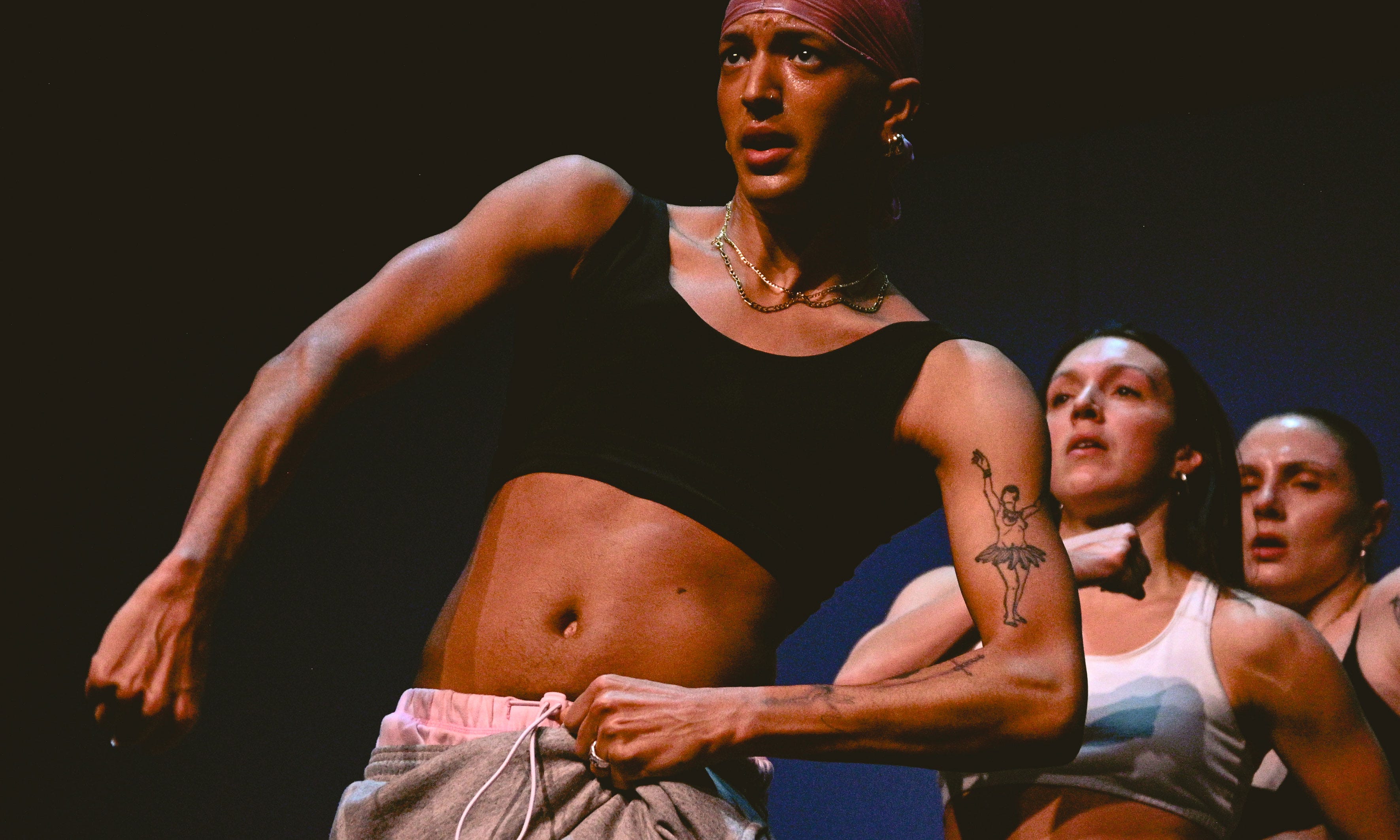
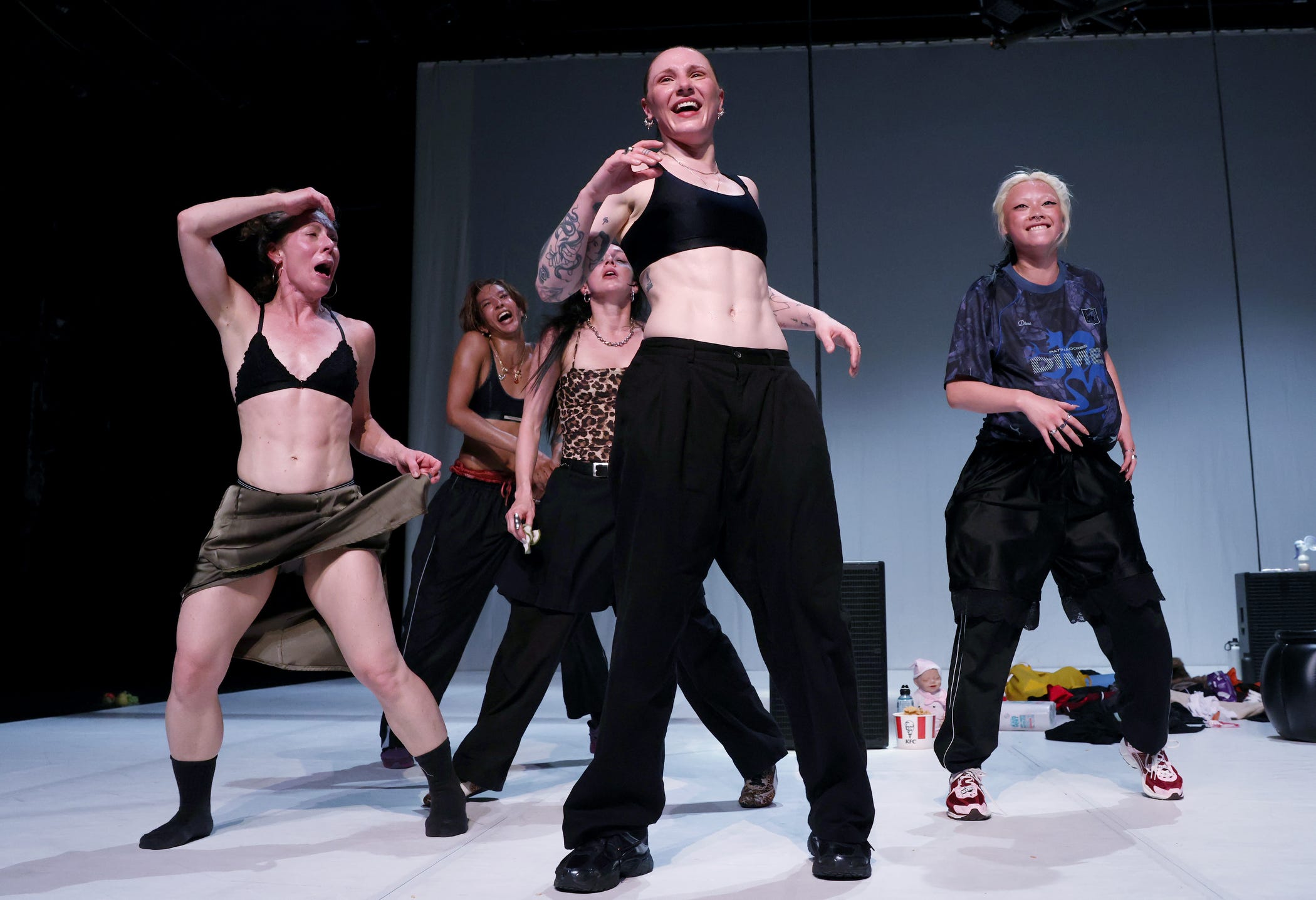
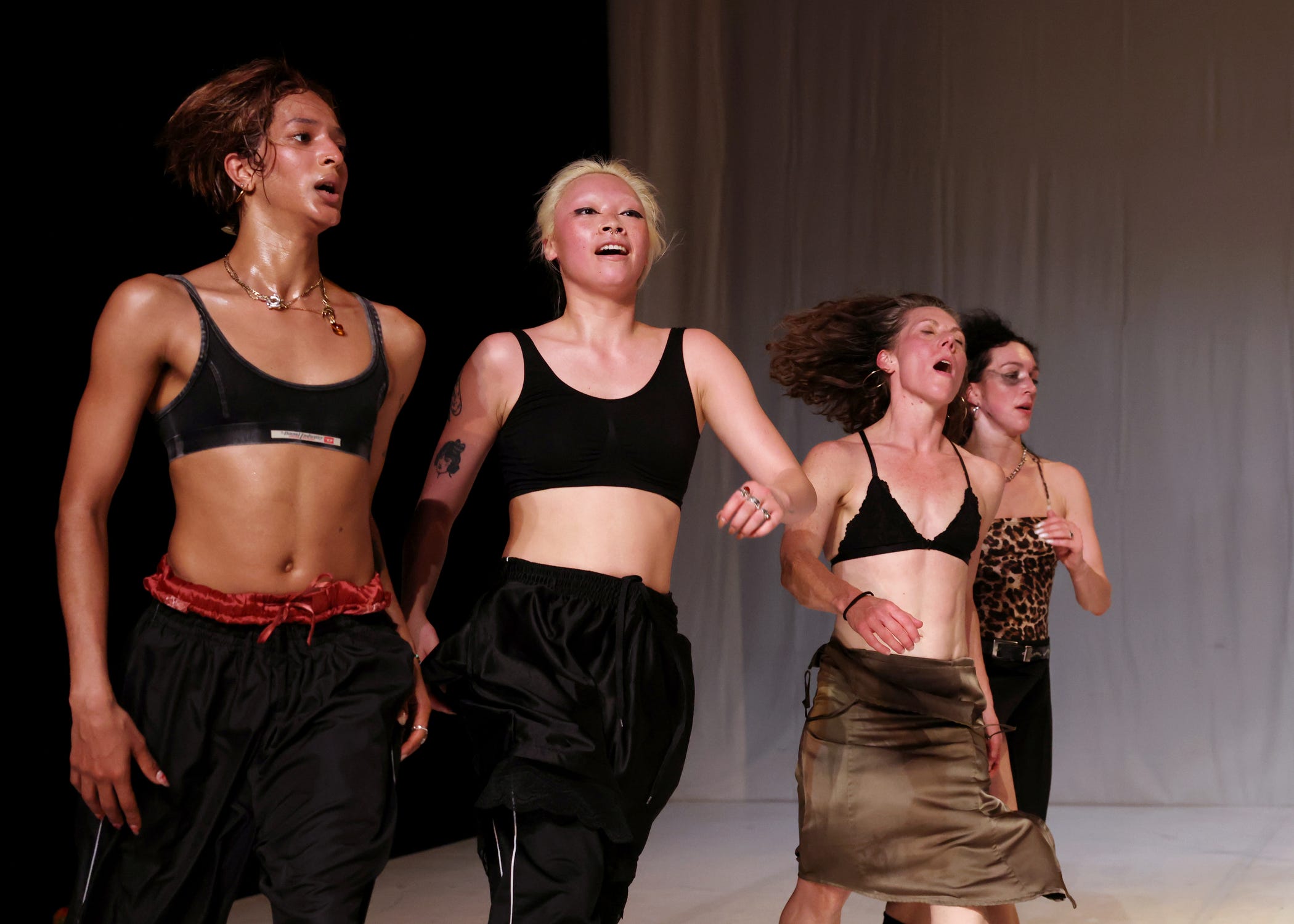
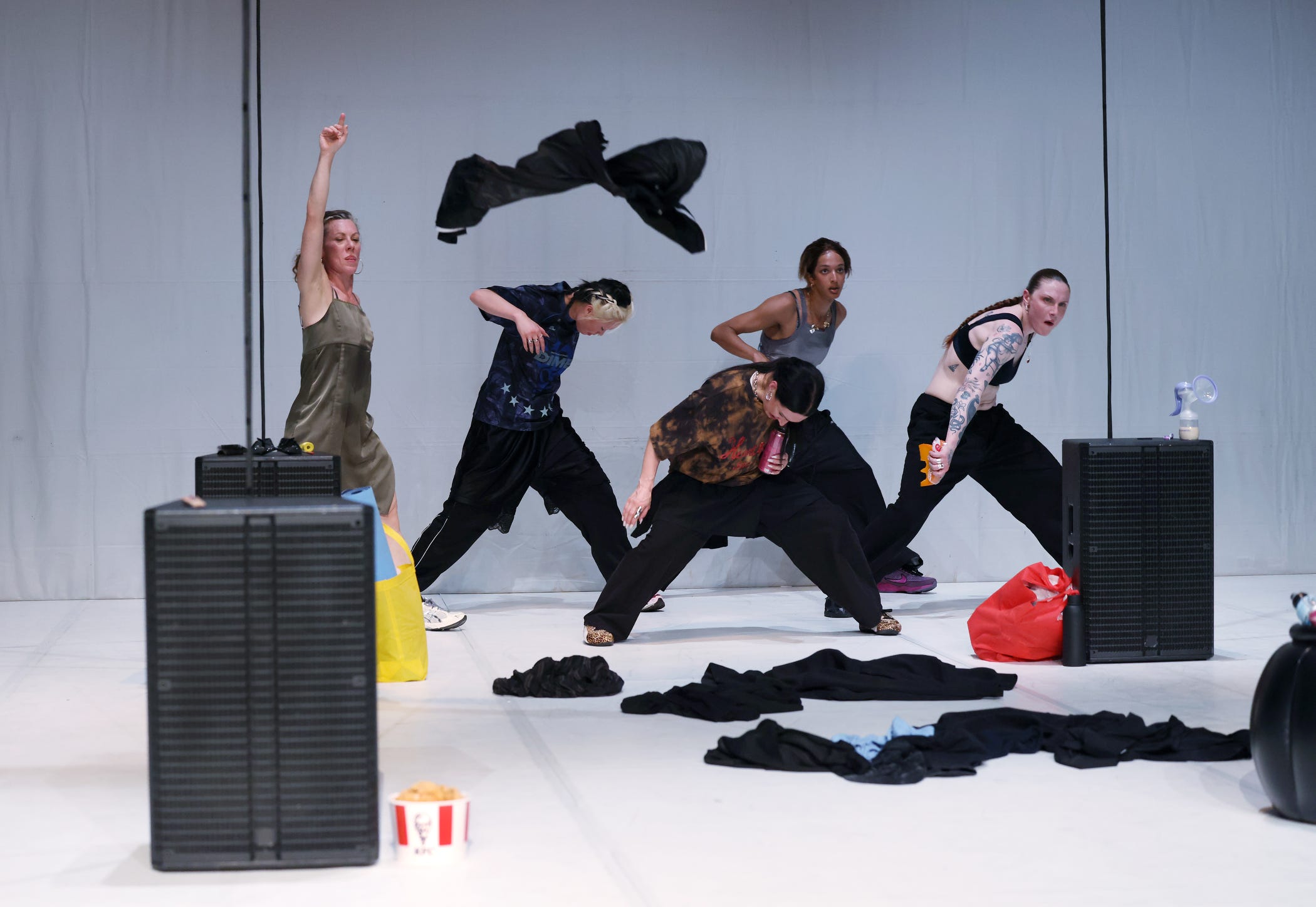
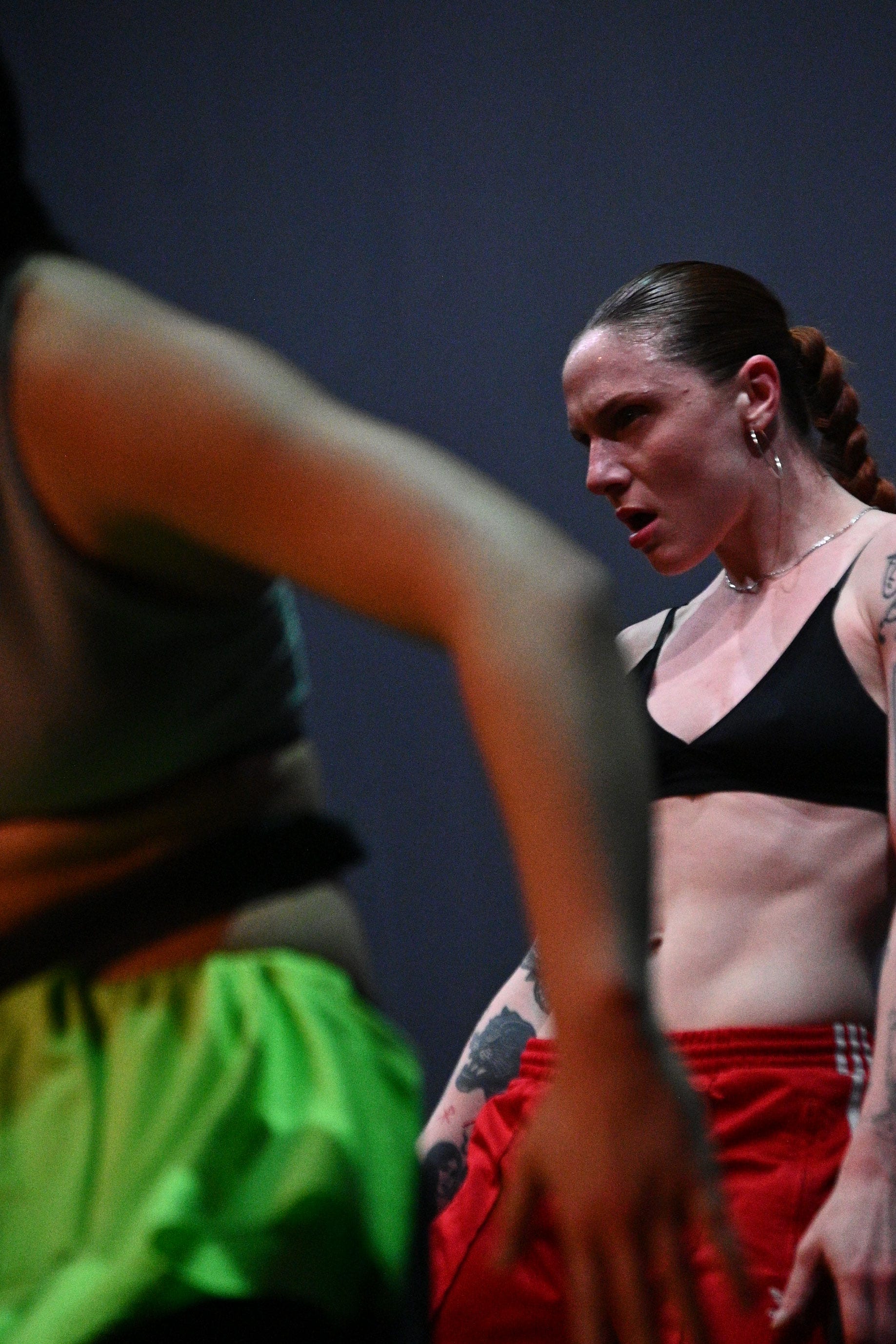
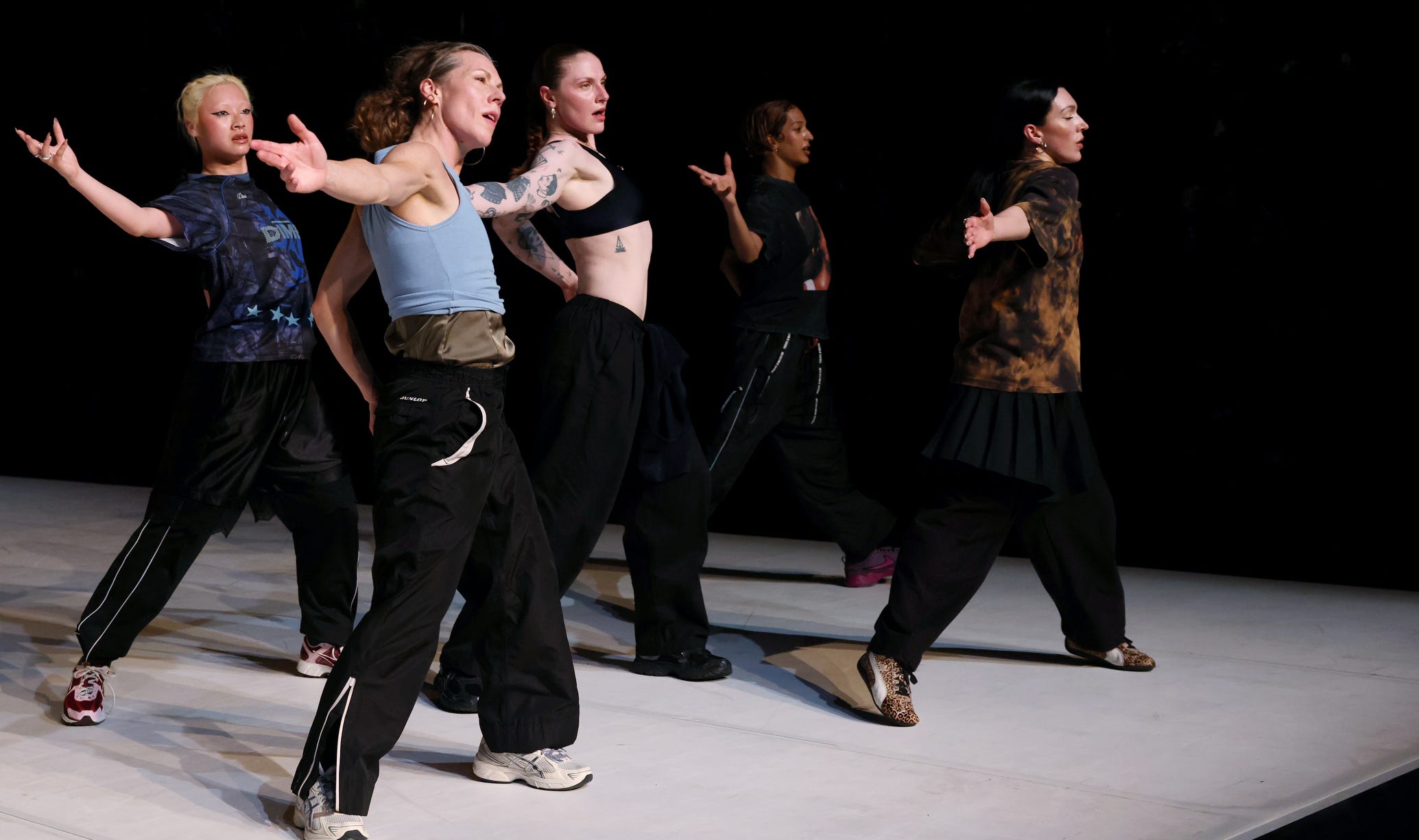
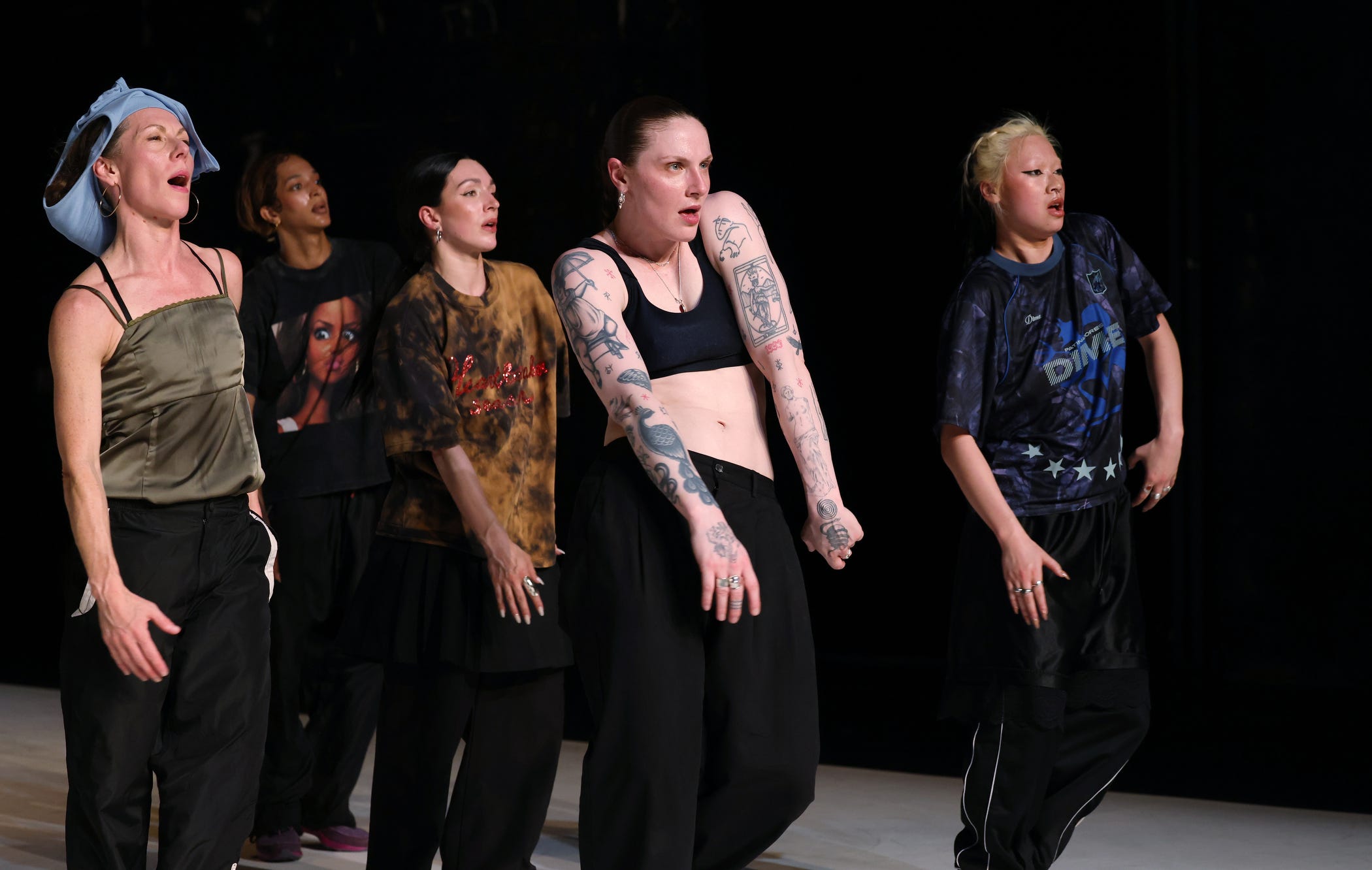
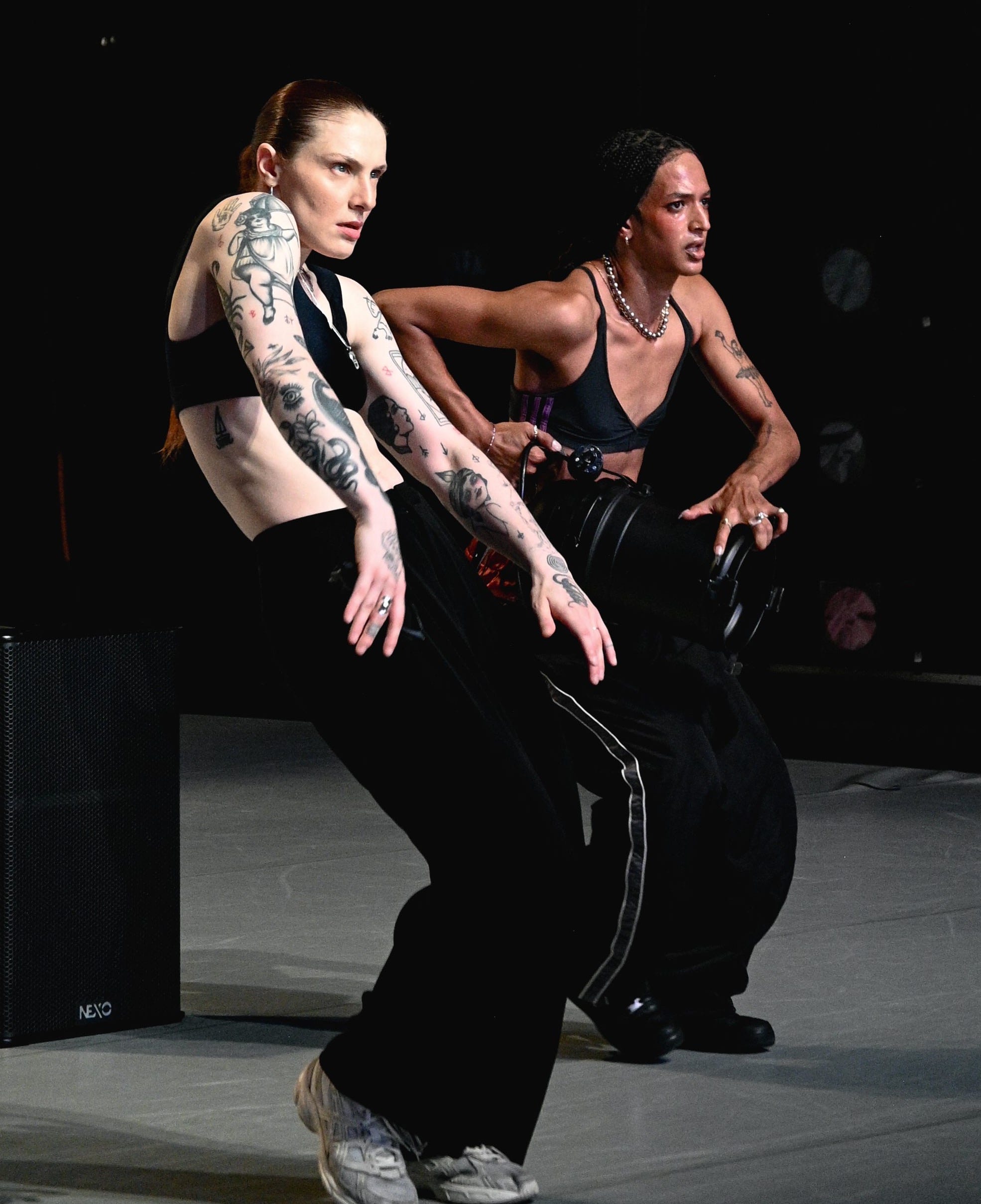
was self-published in Year 2 of 1968 (1970). Labour Parts+Labour by Emily Gualtieri and David Albert-Toth is choreographed around young women that strut like hip hop studs then don’t. They warm up all b-boy but surprise with an utterly contemporary, repetitive, choreography. The repetition develops a remarkable sustained energy that lasts nearly an hour – they dress and undress, eat, interact as they move hard; at a certain point they make it plain they are expending energy.
The energy puts me in mind of Hofesh Schecter, but unlike with Schecter, it isn’t goal-directed. Rather, the energy flows among the woman, puts out tendrils to spectators; I let myself get sucked up into it, go with it. These women are just energy, I think, whatever it is they want to play at or be: “Our bodies, Myselves”.
If Labour Parts+Labour works out in some ways like Mithkal Alzghair’s piece, perfecting a sensibility, it also gets toward a new one “loops through me”: Porosity/Hexagram 64/Hydropsychology/Our bodies, Myselves.
Thanks for reading! This post is public so feel free to share it.
__________
I saw Paisiblement on 26 May 2026 at Atelier de Paris as part of the June Events 2026 Program. Choreographed by Mithkal Alzghair; performed by Mithkal Alzghair, Samil Taskin, Mooni Van Tichel; with sound creation and live music performance by Modar Salama; and lighting by Abigail Fowler.
I saw Labour Parts + Labour on 26 May 2026 at Théâtre de l’Aquarium as part of the June Events 2026 Program. Concept, creation, scenography and direction by Emily Gualtieri & David Albert-Toth with performance by Brianna Lombardo, Maïka Giasson, Jossua Satinée, Lou-Anne Rousseau, Frédérique Rodier with Clodie Lambert, lighting by Paul Chambers, costumes and set by Jonathan Saucier, music by Frannie Holder, rehearsals with Jamie Wright and dramatization by Helen Simard.
I saw Phénomènes on 30 May 2026 at Atelier de Paris as part of the June Events 2026 Program. Concept and choreography by Julie Gouju, with performance and beatbox by Scratchy, with choreographic and drama accompaniment by Clarisse Chanel and
Julia Octobre, sound by Théophile Rey, lights by Manon Lauriol, set by Manon Lauriol and Julie Gouju, costuming by Florian Choulet and production by Chanie Roussel and Romane Roussel, Tadam Production.
I saw Agwuas on 30 May 2026 at Théâtre de l’Aquarium as part of the June Events 2026 Program. Choreography by Marcela Santander Corvalán, with performances by Marcela Santander Corvalán and Hot Bodies, in collaboration with Carolina Mendonça and Luara Raio, with music composition by Hot Bodies, lighting and set by Leticia Skrycky, water instruments by Vica Pacheco, costumes by Ann Weckx, sound by Jean-Louis Waflart, lighting by Antoine Crochemore and production, distribution and administration by Virginie Dupray / cie Mano Azul.
I saw Saltation on 30 May 2026 in the Parc Floral de Paris as part of the June Events 2026 Program. Concept and choreography by Ludivine Large-Bessette and Mathieu Calmelet, with performance by Pauline Brottes, Mathieu Calmemet, Sébastien Perault, set by Wilfriend Dsanbayonne and Ludivine Large-Bessette, sound by Yannick Donet, costumes by Elena Kouznetsova and voice coaching by Valérie Gabail.
I saw A Sentimental Landscape on 9 June 2026 in the Royal Chapel in the Château de Vincennes as part of the June Events 2026 Program. Music composition, scenography and performance by Florentin Ginot, choreography scenography and performance by Alban Richard, with sound design by Martin Antiphon, lighting and management by Jérôme Houlès, with assistance from Max Fossati, production by Mathieu Hilléreau – Les Indépendances, with music from Marin Marais, Prélude en Harpègement and includes material from Walt Whitman’s Leaves of Grass and William S. Burroughs’ Exterminator!
Mithkal Alzghair: https://www.mithkalalzghair.com/en/
Emily Gualtieri : https://nac-cna.ca/fr/bio/emily-gualtieri
David Albert-Toth: https://nac-cna.ca/fr/bio/david-albert-toth
Julie Gouju: https://www.tadamproduction.fr/compagnie/compagnie-linesthetique/
Scratchy: https://www.facebook.com/Scratchyinc/
Marcela Santander Corvalán: https://www.manoazul.com
Hot bodies: https://court-circuit.band/hot-bodies
Ludivine Large-Bessette & Mathieu Calmelet: https://www.lacproject.com/about
Alban Richard: https://oases.fr
Florentin Ginot: https://florentinginot.com
Marin Marais, Prélude en Harpègement: https://www.youtube.com/watch?v=vIoWuYV48yU
Hair: //www.youtube.com/watch?v=y2CoR1vggYc&list=PLmE-nbZ89BYZVdAmSxDyfh8yC8Eu2co4k
From Henry David Thoreau’s Walden (1854): “The mass of men lead lives of quiet desperation. What is called resignation is confirmed desperation. From the desperate city you go into the desperate country, and have to console yourself with the bravery of minks and muskrats. A stereotyped but unconscious despair is concealed even under what are called the games and amusements of mankind. There is no play in them, for this comes after work. But it is a characteristic of wisdom not to do desperate things.”
Cymatics: Science vs. music: //www.youtube.com/watch?v=Q3oItpVa9fs
No posts
Comments
Nothing yet. Say the first thing.
Sign in to join the conversation.