
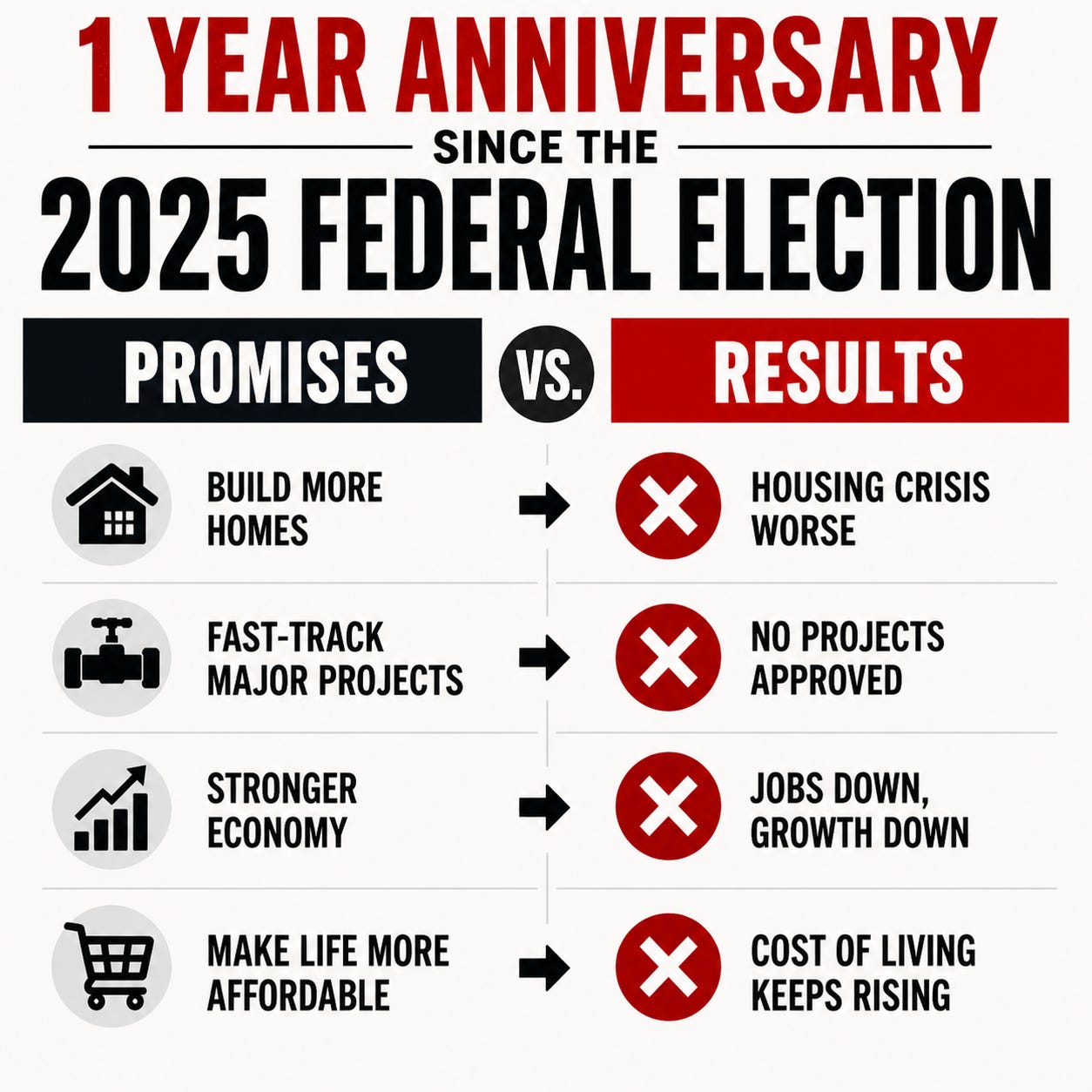
This week marks one year since the federal election held on April 28, 2025. An anniversary is a useful point at which to compare what was promised in the campaign with what has been delivered. The clearest way to do that is to take the Prime Minister’s central commitments one by one and look at the record beside them.
Housing. The promise was to double the pace of housing construction to nearly 500,000 new homes per year, and to cut municipal development charges in half on multi-unit residential housing. The Parliamentary Budget Officer estimates that Build Canada Homes, the new federal housing agency at the centre of that plan, will produce roughly 26,000 housing units over five years. That works out to about 5,200 units per year against a target of 500,000. CMHC reports housing starts in March 2026 fell to a seasonally adjusted annual rate of 235,852 units, and its Housing Market Outlook projects new construction will decline through 2028, falling to as low as 212,000 starts per year. The promised 50 per cent reduction in development charges has not happened. CMHC’s own data shows development charges still add eight to 16 per cent to the cost of a new home, and in Toronto can exceed $130,000 on a condominium.
The operating budget. The promise was to balance operating spending with revenues by 2028-29, while continuing to run deficits on the capital side. Whether that promise is on track depends on what counts as “capital.” The Parliamentary Budget Officer concluded that the government’s definition of capital investment is overly expansive and, under a definition consistent with international practice, the day-to-day operating balance remains in deficit through 2029-30. The PBO also estimates only a 7.5 per cent chance that the government’s other anchor, a declining deficit-to-GDP ratio, will hold each year through the planning horizon. The total deficit picture is also worse than the trajectory the previous government had projected. Budget 2025 was the most expensive in Canadian history, with the deficit roughly doubling to $78.3 billion and adding $90 billion in new spending. The Spring Economic Update projects a $65.3 billion deficit for fiscal 2026-27. Last year’s deficit number came in lower than initially expected, but mostly due to a one-time pension accounting adjustment driven by higher bond yields, bond markets are notoriously fickle, especially in turbulent times. The latest deficit figures also exclude the cost of major near-term defence purchases, including 12 new submarines. The trajectory is moving in the opposite direction of the commitment.
Major energy projects. The promise was to fast-track major projects through a new Major Projects Office, with the Prime Minister committing to new pipelines and energy corridors. Eight months after that office was launched in August 2025, no project has been formally designated as a “national interest” project under the Building Canada Act, the legislative tool that would actually trigger the streamlined approvals the office was created to deliver. Several projects have been referred to the office across two tranches for review, but referral and designation are not the same thing, and only designation produces the regulatory acceleration that was promised. As a benchmark, Germany built and commissioned its first LNG import terminal in roughly seven months in 2022 when the political will existed. Mexico, meanwhile, has several LNG export terminals operating or under construction on its east coast, including the New Fortress Energy Altamira facility off Tamaulipas, supplied by natural gas piped in from Texas, a position Canada could have occupied with its own resources had the regulatory environment supported it. The Prime Minister’s own commitment was to build “at speeds not seen in generations.” Eight months in, the record on actual designations stands at zero.
Trade with the United States. The Prime Minister’s central campaign argument was that he was the right person to negotiate a new economic relationship with the United States. The deadlines came and went. After meeting President Trump at the G7 on June 16, 2025, he committed to a deal within 30 days. On June 29, the government rescinded the Digital Services Tax, a piece of real leverage on large American technology companies, with no concession in return. The July 21 prime minister’s self imposed deadline passed. Then the next self-imposed August 1 deadline passed. Counter-tariffs were quietly walked back in mid-August. A narrow sectoral arrangement we were told was to be reached in mid-October. It also passed with success. That was the last substantive contact: the American ambassador to Canada has publicly stated there have been “no serious negotiations since October of last year.” Tariffs on Canadian steel have doubled, tariffs on softwood lumber have tripled, and not one Canadian product has had its tariff reduced. The mandatory six-year joint review of USMCA begins July 1, 2026. I wrote about this record at length in last week’s edition of Resuming Debate.
The last federal election was framed around a change in direction from the previous government. On the economy and the deficit, the record so far points the other way. The deficit under the previous prime minister’s final budget was projected at $42.2 billion. The deficit in this Prime Minister’s first budget was projected at $78.3 billion, almost double. That figure was subsequently revised downward to roughly $66.9 billion in the Spring Economic Update, driven primarily by stronger-than-expected tax revenues, still well above the previous government’s projections, and notably, the improvement reflects a stronger short-term economic backdrop rather than any spending restraint by the new government. Annual deficits over the next five years are now projected to average $64.3 billion, more than twice what the previous government had forecast in its 2024 Fall Economic Statement. The Mark Carney-led federal government is deficit spending twice as much as the former Trudeau-led federal government. Federal debt is on track to reach $1.5 trillion by 2030, and Canada now ranks fourth in total indebtedness among 34 OECD countries, with combined household, corporate, and government debt at 377 per cent of GDP. The Parliamentary Budget Officer has concluded that the government’s own declining-deficit-to-GDP fiscal anchor is unlikely to be respected. The Build Canada Homes program proceeds while the existing housing crisis worsens. Public service employment, which the Prime Minister committed to capping rather than cutting, has continued to rise alongside day-to-day operating spending up roughly 9.1 per cent in under a year. By the measure of the dollar, this is not a course correction. It is acceleration in the same direction.
After a year of these promises and these spending decisions, the state of the country is what residents are living through directly. That trajectory is showing up in the day-to-day economy residents are living in. Statistics Canada reports the economy contracted 0.2 per cent in the fourth quarter of 2025, making Canada the only G7 country to record a contraction that quarter. In February 2026, more than 108,000 full-time jobs were lost, the steepest monthly drop in full-time employment in years outside the pandemic, pushing the unemployment rate to 6.7 per cent, the second highest in the G7. There are now over 1.5 million Canadians without work, and the rate has held at 6.7 per cent through March 2026. The picture for younger Canadians is worse still. The youth unemployment rate stood at 13.8 per cent in March 2026, after peaking at 14.6 per cent in September 2025, the highest level since 2010 outside the pandemic. In 2025, 437,000 young Canadians aged 15 to 24 looked for work and could not find it, a 57 per cent increase from 2022. The gap between the youth unemployment rate and the adult rate has reached its widest level since the 1982 recession.
The cost of feeding a household has moved in the same direction. Food inflation peaked at 7.3 per cent year-over-year in January 2026, the highest in the G7 and roughly double the rate in the United States. It has since moderated, but grocery prices were still rising 4.4 per cent year-over-year in March 2026, well above headline inflation of 2.4 per cent. The Dalhousie food price report projects a family of four will pay nearly $1,000 more for groceries in 2026. According to the PROOF research program at the University of Toronto, 24 per cent of people in Canada, about 9.8 million people, including 2.4 million children, lived in food-insecure households in 2025. Canadian household debt has reached 103 per cent of GDP, the highest in the G7, with $1.77 owed for every dollar of disposable income.
These are the numbers, and they come from Statistics Canada, the Parliamentary Budget Officer, the Auditor General, CMHC, and the OECD. One year on, that is the accounting residents of Calgary Shepard are entitled to. You were promised construction of major infrastructure faster than we had ever seen before. You were promised a resolution to the trade war between the United States and Canada with a successful free trade deal concluded. You were promised that the federal government would get a handle on the cost of living crisis. None of the headline promises from the last federal election have been achieved based on a review of the numbers and the record of results.
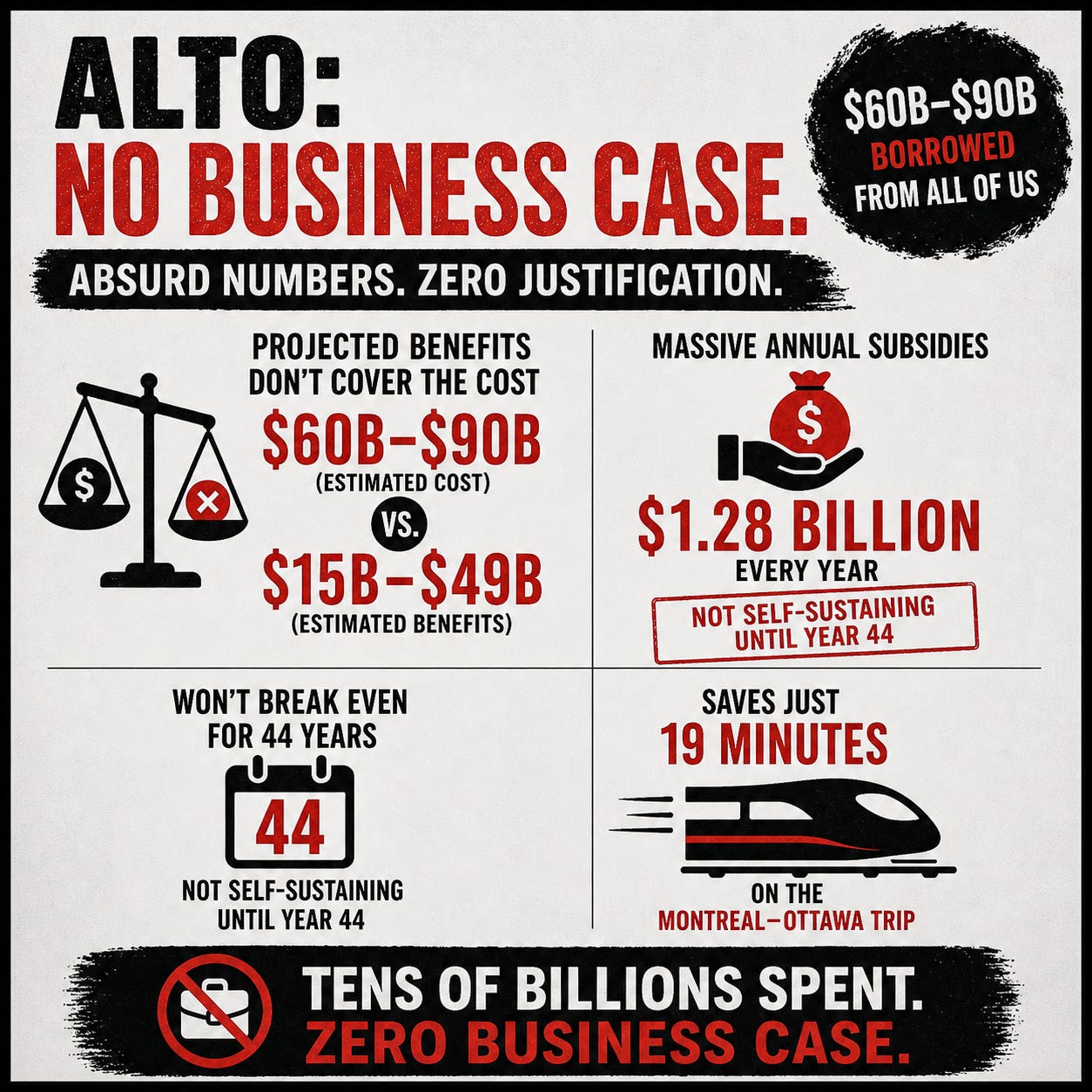
When the federal government commits tens of billions of dollars in borrowed money, every household in Calgary Shepard pays for it, even when no track will ever be laid in Alberta. That makes Alto, the proposed high-speed rail line between Toronto and Quebec City, a file residents here have a direct interest in.
Earlier this month, my colleague MP Dan Albas, the conservative transport shadow minister, published an opinion piece in the National Post raising concerns about Alto. His argument was straightforward: this is a megaproject of at least $90 billion, advanced without a public cost-benefit analysis or credible business case, in which taxpayers carry the risk in the early stages despite the project being described publicly as a public-private partnership.
That argument was reinforced last weekend by an editorial in The Globe and Mail, which concluded the project is too expensive for the problem it is meant to solve. The estimated cost is $60 billion to $90 billion, at the high end, over $5,000 per Canadian household, borrowed federally and added to a debt load already on track to reach $1.5 trillion by 2030. An EU audit cited in the editorial found cost overruns and delays are the norm in high-speed rail projects internationally. California’s high-speed line, originally meant to connect San Francisco and Los Angeles by 2020, has tripled in cost and is now expected to connect only two smaller cities by 2033.
The projected benefits are also in question. Alto estimates total benefits to travellers and communities at roughly $49 billion over 60 years, already lower than the construction cost. A C.D. Howe Institute study cited in the editorial places the figure between $15 billion and $27 billion. Alto projects 24 million annual passengers by 2055 and claims the project will eventually require no subsidy. A McGill University study estimates ridership at less than half that level and finds the project would require ongoing subsidies of roughly $1.28 billion per year, with the system not becoming self-sustaining until its 44th year. The previous government had been studying a high-frequency rail option that, according to analysis cited in the editorial, could be delivered at roughly half the cost and in as little as five years, while saving only about an hour less between Montreal and Toronto. The federal government has already committed $3.9 billion to early-stage development of Alto.
Residents in southeast Calgary have been told for years that there is limited fiscal room for the projects that matter to this region like pipelines, highway twinning in the rockies, and the port and rail capacity needed to move Alberta goods to market especially through the Port of Vancouver. The government’s own Major Projects Office has yet to designate a single project as being in the national interest. It is a fair question to ask why $90 billion of borrowed money can be found for a passenger line that has not cleared a basic public business case, while the projects that would actually grow the national economy and create jobs in this province continue to wait.

This week, I joined a meeting with members of Alberta Building Trades, the umbrella organization representing the province’s unionized construction workers. It was a chance to hear directly from the people who actually build major projects like pipelines, power infrastructure, refineries, commercial and industrial construction, about what they are seeing on the ground and what they are hearing from their members.
The conversation focused on the challenges facing the construction sector in Alberta and the priorities of skilled trades workers, including the need for predictable timelines on major projects, the impact of federal regulation on project investment decisions, and what tradespeople need to see from the federal government to keep working in this province.
Procedural context: With their new majority, the Liberals forced Parliament to change the composition and size of most parliamentary committees. This is fair insofar as the government has a majority and should have a majority of the MPs on these committees. For most committees, membership increased from 10 MPs to 12 MPs, and a new split of 7 government MPs, 4 Conservative MPs, and 1 Bloc Québécois MP. The fear of opposition MPs was that the government would use this new status to shutdown accountability actions which have now come to pass including an emerging practice I am dubbing, secret by default, with FIVE parliamentary committees this week being forced to go in-camera and outside of public scrutiny to deal with motions, witness invites and other matters.
Ethics Committee: MPs met on to take up government business, but the meeting was moved in camera shortly after it began on a motion from the Liberal majority, ending public debate. It was one of four committees moved behind closed doors this week following the recent change in committee composition, a shift Conservatives have raised concerns about in terms of public accountability and transparency.
Health Committee: the meeting was also moved in camera within minutes on a motion from the Liberal majority. The shift cut off planned Conservative efforts to have the committee call on the Auditor General to investigate PrescribeIT, a $300 million federal e-prescribing program launched in 2017 and set to wind down on May 29 amid reports of limited uptake. A procedural attempt to question the in-camera motion was ruled out of order by the chair.
Science and Research Committee: the meeting was moved in camera on a motion from the Liberal majority to proceed to drafting instructions, which are conducted behind closed doors. The move ended debate on a Conservative motion proposing a study of a $200 million federal agreement tied to Spaceport Nova Scotia near Canso, including its value for money and implications for Canada’s space sector.
Transport Committee: this meeting was also moved in camera on a motion from the Liberal majority after the committee voted to adjourn debate on a motion seeking the production of documents related to the Port of Montreal expansion.
Human Resources Committee: MPs had been debating a Bloc motion to order the production of documents on the federal Cúram IT modernization project, a benefits-delivery system launched in 2017 with a $1.7 billion budget that is now reported at $6.6 billion. When the committee met on April 30, the government side moved directly into clause-by-clause consideration of Bill C-20 (Build Canada Homes) without notice, which ended the document-motion debate.
Immigration Committee: MPs continued the study of Canada’s immigration system. Witnesses raised concerns about recent reforms, including Bill C-12, and spoke to procedural fairness, backlogs, integration barriers, and how new tools and discretionary authorities may affect system integrity and public confidence.
Finance Committee: MPs opened a study on the federal spending power, hearing from academics and the Montreal Economic Institute. Discussion focused on when federal spending is justified, how results should be measured, and the fiscal and jurisdictional trade-offs of sustained spending growth.
Public Safety Committee: the committee focused on drafting reports tied to its ongoing work on removals and border enforcement, including Canada’s ability to remove foreign nationals with a criminal record, Canada Border Services Agency practices (including the H2O Highway Corridor and port-clearance), and Canada–United States border management. In that context, MPs have continued pressing for clearer public accounting on removals and enforcement outcomes, including removals linked to listed entities such as the IRGC, an issue MP Frank Caputo has highlighted publicly in his questioning.
Industry and Technology Committee: MPs heard evidence on the economic and supply-chain impacts of U.S. tariffs on Canada’s metallurgical and advanced manufacturing sectors. Later in the week, the committee also heard testimony related to AI and strategic industries, including productivity impacts, Canadian compute and data-centre capacity, workforce implications, and questions about governance and security as deployment accelerates.
Public Accounts Committee: MPs examined the Public Accounts and heard from the Canada Infrastructure Bank on its investment model and project pipeline. Discussion focused on how commitments translate into disbursements, delivery timelines, transparency, and value for money.
Justice Committee: MPs conducted clause-by-clause consideration of Bill C-16 with departmental officials present for technical guidance. Debate focused on amendments related to victim protections, coercive control, deepfake sexual content, and sentencing provisions, including clarification on legal and constitutional constraints.
Government Operations Committee: MPs continued work tied to the Main Estimates and the comprehensive expenditure review, and heard from the Parliamentary Budget Officer’s office on the economic update and Main Estimates. Discussion centred on what is being reviewed, how reallocations and savings are tracked, and how Parliament can evaluate impacts on services.
No posts
Comments
Nothing yet. Say the first thing.
Sign in to join the conversation.