
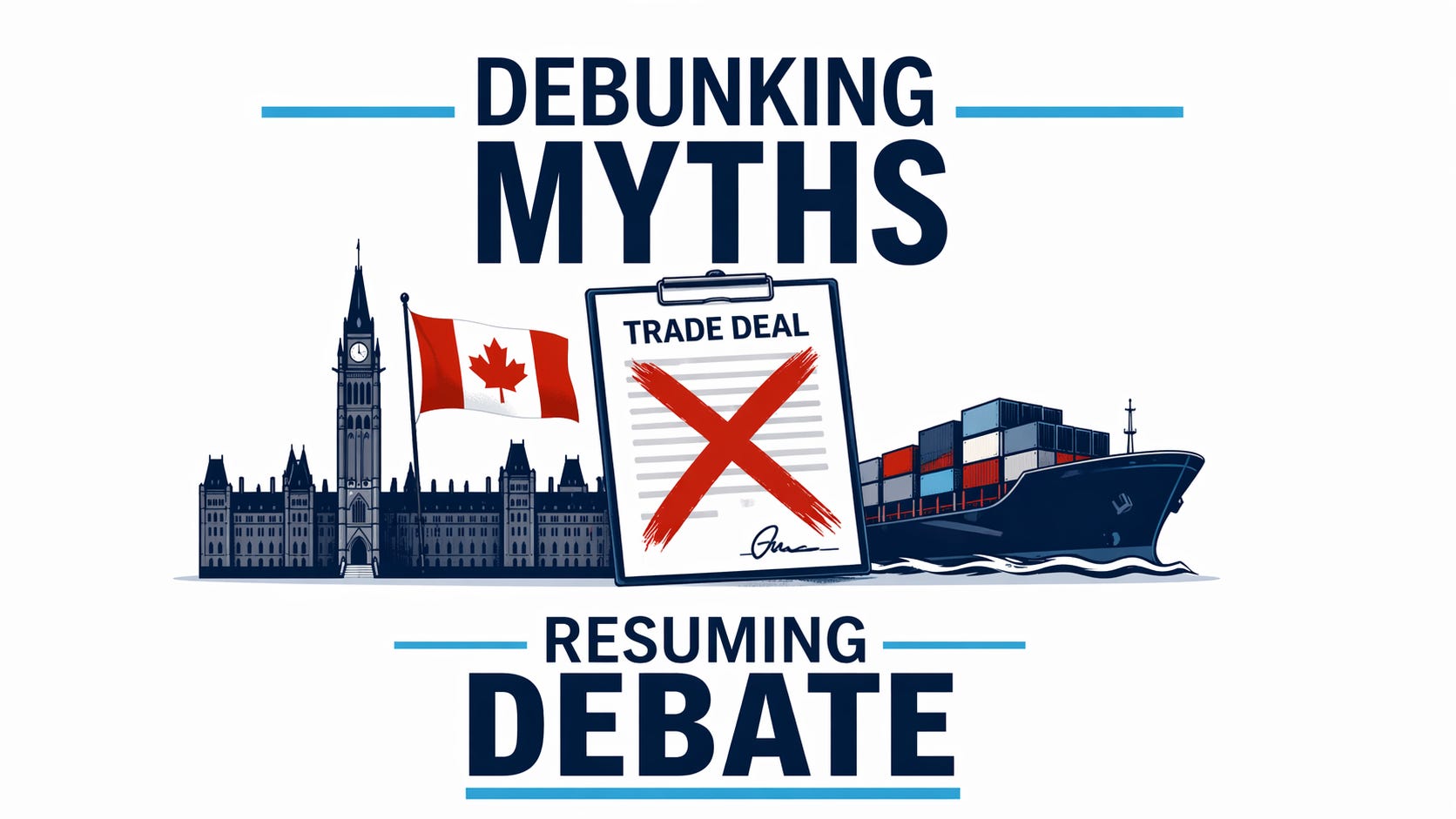
Nearly a year into this Parliament, the federal government has yet to complete negotiations on a single new trade agreement and have it approved by Parliament. That bears saying plainly. The travel schedule is busy. The photo ops are frequent. The results are missing. Canada has become the only shrinking economy in the G7, and tariffs are the explanation the federal government offers for that record. There are other factors that take precedents to that deflection.
In the last federal election, the Prime Minister asked Canadians for a mandate on one central argument: that he was the right person to handle President Trump and secure a new economic relationship with our largest trading partner. He set his own deadlines. At a press conference on June 19, 2025, following his meeting with the President at the G7 in Kananaskis, he said plainly: “President Trump and I agreed to pursue negotiations towards a deal within the coming 30 days.” That commitment was confirmed in the official PMO readout of the meeting. Ten days later, on June 29, the government rescinded the Digital Services Tax in anticipation of a comprehensive agreement, and the deadline was restated as July 21, 2025. When that passed, the target moved to August 1, 2025. None of those dates produced a signed deal.
Video: Press Conference on June 19, 2025.
The Digital Services Tax point deserves its own sentence. Canada gave up a tax on large American technology companies, a piece of real leverage, as a gesture of good faith before negotiations. Nothing came back in return. In October, the Prime Minister told Parliament: “If we do not have a good agreement, this government will negotiate one.” In December, his explanation shifted. Asked what happened to the talks, he told reporters Canada had been “close to an agreement“ before an anti-tariff advertisement run by the Ontario Premier quoting Ronald Reagan caused negotiations to stall. Whatever one makes of that explanation, it is the government’s own account of why the file is where it is. The American ambassador to Canada, Pete Hoekstra, has said publicly there have been “no serious negotiations since October of last year.” Mexico, by contrast, is ahead of Canada, its negotiators have already secured bilateral talks with Washington in advance of the trilateral review.
It is also worth being honest about what a “Trump trade deal” actually is. Since taking office, the President has announced agreements with the United Kingdom, Japan, Indonesia, Cambodia, and South Korea. Most are framework agreements, outlines for future negotiation paired with a temporary tariff truce. They do not go to Congress. They are executive arrangements the President signs and modifies by proclamation as well as abrogated by truth social statement. That is the standard Canada has been measured against, and Canada has not cleared it. Tariffs on Canadian steel have doubled. Tariffs on softwood lumber have tripled. Tariffs on manufactured goods have broadened. Not one Canadian product has had its tariff reduced. The federal government isn’t succeeding at delivering on successful trade negotiations.
A press release is not a trade deal. A joint statement is not a trade deal. A readout from a phone call is not a trade deal. Canadian businesses cannot ship subject to the terms in a press release. They ship under signed as well as ratified text with enforceable tariff schedules. That distinction has been blurred in much of the public commentary this year, and it needs to be restated.
The one free trade agreement moving through Parliament this year is the Canada-Indonesia Comprehensive Economic Partnership Agreement. I voted for it. It opens a market of 280 million people. According to the government’s own economic impact assessment, total bilateral trade is projected to expand by roughly $1.5 billion in the first year, growing to about $1.8 billion by year five, though the breakdown is worth noting. Canadian exports to Indonesia are projected to rise by $216 million, while Canadian imports from Indonesia are projected to rise by $1.6 billion, mostly in apparel and leather. Canada’s GDP gain is estimated at $226 million. As a comparator, LNG and oil exports at today’s prices would easily outpace this GDP gain with several tankers in a couple of months rather than the annual trade needed to reach that same goal. Energy remains our greatest economic asset for export GDP gains. It was the Trudeau government that concluded negotiations substantively on November 15, 2024, under the previous prime minister and his trade minister. The signing ceremony was last year.
This matters in Calgary Shepard because the next deadline is closer than most residents realize. The mandatory six-year joint review of the United States-Mexico-Canada Agreement begins July 1, 2026. USMCA governs the rules for almost everything we ship south such as energy, agricultural products, manufactured goods, services. Businesses across southeast Calgary have reached out to my office with the same concern. They want to know whether Canada will arrive at that review prepared, with a clear negotiating position and a record of results behind it. On the evidence of the past year, that confidence has not yet been earned.
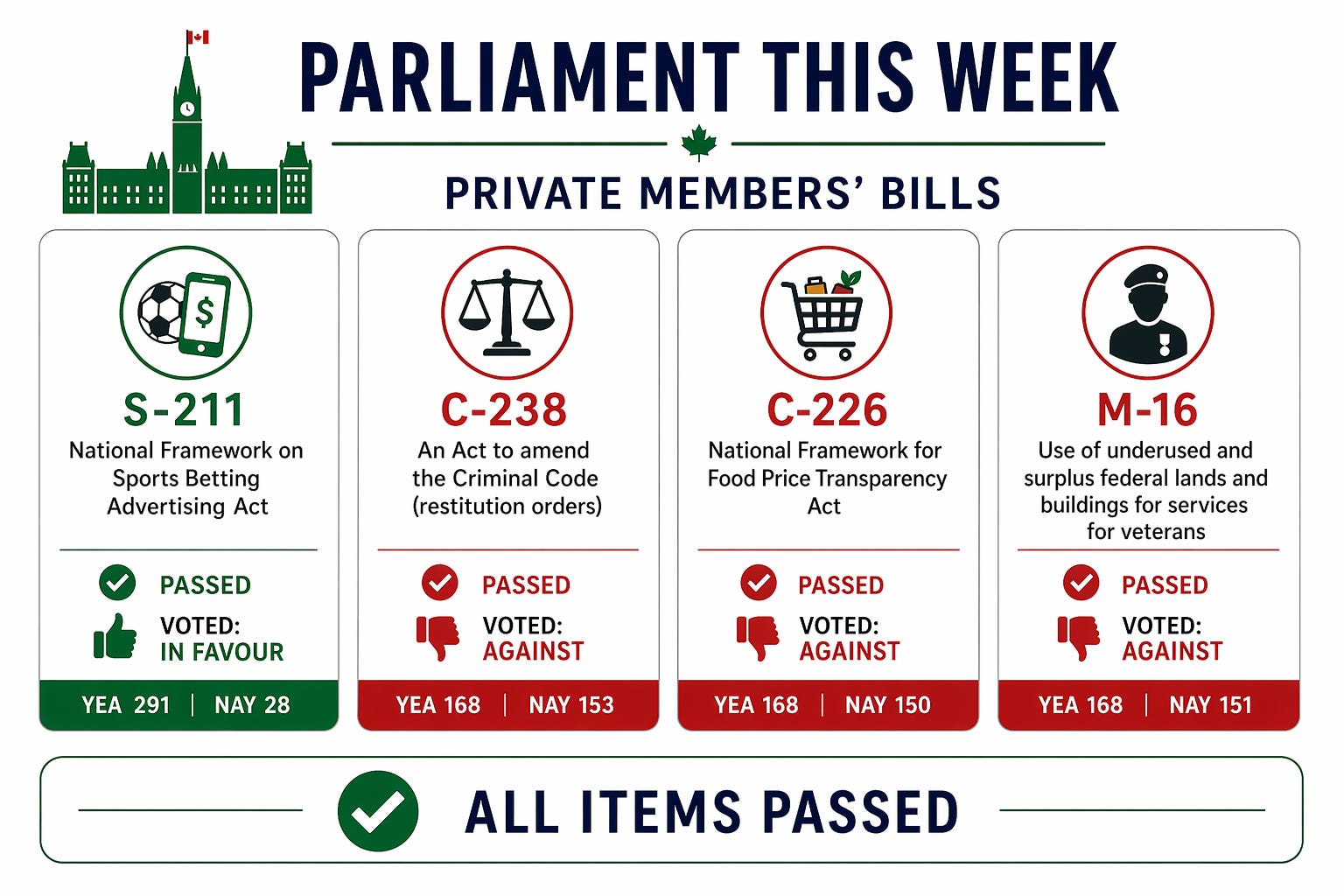
This week, Parliament voted on four private members’ bills, and I want to walk residents through each one, how it turned out, and how I voted. Private members’ bills are brought forward by individual MPs rather than the federal government. They give every member of Parliament, regardless of party, the chance to put an idea to the House. All four items this week passed second reading and now move on to committee study and further consideration.
S-211 — National Framework on Sports Betting Advertising Act. Sponsored by a Liberal MP after originating in the Senate, this bill directs the Minister of Canadian Heritage to develop a national framework to regulate the advertising of sports betting. The goal is to reduce the volume and reach of gambling promotions. This is especially true of live sports broadcasts. There is a need to address concerns about exposure to minors and problem gambling that have grown since single-event sports betting was legalized in 2021. The bill passed second reading by a wide margin and has been referred to the Standing Committee on Canadian Heritage for detailed study. I have some worries about the prescriptive wording of the proposed law that might interfere with provincial jurisdictions, although I think the parliamentary committee could fix these defects. Many residents have over several years complained by email and phone calls about the excessive gambling advertising appearing on sports programming. It’s also flooded mobile devices and sometimes there is a strong suspicion it’s been targeted towards young men and youth in general. Much of this advertising is originating from Ontario or promoting Ontario based gambling platforms. With all these ideas in mind, I voted in favour.
C-238 — An Act to amend the Criminal Code (restitution orders). Sponsored by a Liberal MP, this bill would amend the Criminal Code provisions that govern restitution orders, the court orders that already exist requiring offenders to repay victims for financial losses tied to a crime. Victim compensation is a goal I support, but the amendments proposed in C-238 raise questions about how the changes would work alongside the provincial courts and collection agencies that actually enforce restitution order. There are important questions about whether they would meaningfully improve the rate at which victims are paid. Restitution is already ordered in many cases. The problem continues to be enforcement. This bill does not address that. I voted against the bill at this stage of debate. It passed and has been referred to the Standing Committee on Justice and Human Rights for detailed study.
C-226 — National Framework for Food Price Transparency Act. Sponsored by a Liberal MP. this bill calls on the federal government to establish a national framework aimed at improving transparency around food prices in Canada. Grocery costs are one of the top concerns I hear about from residents of Calgary Shepard. My concern with this bill is that a new federal reporting framework would duplicate work already done by the Competition Bureau, which completed its retail grocery market study in 2023. The bill would also duplicate the work of provincial consumer protection authorities. Nevertheless, it passed and has been referred to the Standing Committee on Agriculture and Agri-Food for detailed study.
M-16 — Use of underused and surplus federal lands and buildings for services for veterans. Sponsored by a Liberal MP, this parliamentary motion instructs the Standing Committee on Government Operations and Estimates to study how underused and surplus federal lands and buildings could be used to provide services for veterans. The motion sets the study at between four and six meetings and requires the committee to report back to Parliament within six months. Supporting veterans is a responsibility every MP takes seriously, but this motion asks for a study rather than action. The federal government’s record on disposing of surplus real estate, including properties that could have supported housing or services for veterans years ago, speaks for itself, and another committee report is unlikely to change that pattern. I voted against the motion. It passed and has been referred to the Standing Committee on Government Operations and Estimates.
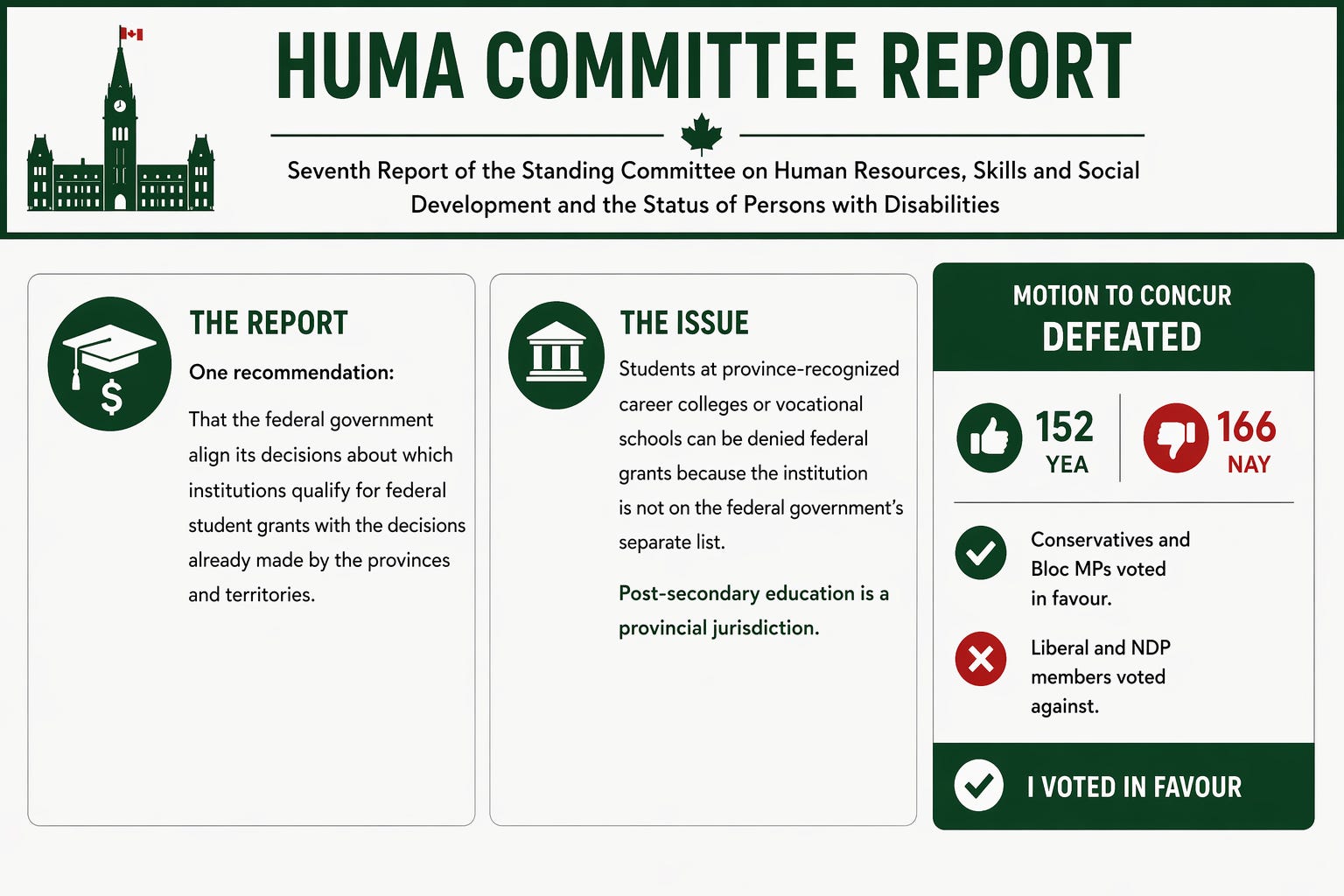
This week, Parliament voted on whether to formally back a recent committee report on how federal student grants are handed out. The report has one simple recommendation: when the federal government decides which schools qualify for student grants, it should follow the lead of the provinces and territories, since they are the ones who already license and approve those schools. This federal policy is especially damaging to students pursuing a skilled trade and apprenticeships.
The practical issue is that a student attending a regulated career college or vocational school that is fully recognized by their province can still be denied federal grants because the institution is not on the federal government’s separate list. Post-secondary education is a provincial jurisdiction, and where the provinces have already approved an institution, a federal grant program should not be leaving their students without support. Apprenticeships and the skilled trades are just as worthy of pursuing as a bachelor degree.
The motion to back the report was defeated. Total: 152 Yea, 166 Nay. Conservatives and Bloc MPs voted in favour; Liberal and NDP members voted against. I voted in favour.

This week, one of my meetings included Garth Anderson, a resident of Calgary Shepard, and his colleagues from the Mechanical Contractors Association of Canada (MCAC). MCAC is the country’s largest trade contractor association, and its members are directly involved in delivering the housing and critical infrastructure Canada needs.
If you are coming to Ottawa and Parliament with an association or for work, please do consider reaching out to have a sit down and talk about the issues that matter to you, your profession or your occupation.
Ottawa needs a new approach to fiscal policy: A C.D. Howe Institute report finds Canada’s fiscal framework lacks a clear anchor and does not impose meaningful discipline on long-term debt. It calls for transparent targets and a credible plan to stabilize federal finances.
Parliamentary review examines blind trust and ethics rules: CBC reports on a parliamentary ethics review examining the Prime Minister’s blind trust arrangement and whether it complies with the public’s expectations on conflict-of-interest rules.
Youth unemployment is rising amid weaker labour conditions: CTV News reports that youth unemployment is increasing as labour market conditions weaken and entry-level opportunities decline.
Most Canadians say cost of living is outpacing income: A Toronto Sun poll finds nearly 80% of Canadians say their cost of living is rising faster than their income, pointing to continued pressure from housing and everyday expenses.
Fewer violent crimes being solved in major cities: The Hub reports that fewer violent crimes are being solved in cities like Toronto and Winnipeg, while Calgary is performing better. The gap points to differences in policing outcomes across the country.
Canadian households carry the highest debt in the G7: The Hub reports household debt has reached 103% of GDP, the highest among G7 countries, underscoring how exposed Canadians are to high borrowing costs.
Banks drop specific emissions targets for oil and gas lending: Bloomberg reports that RBC and Scotiabank have dropped specific financed-emissions energy targets. This is good news for energy workers and the projects they work on as that financing is what pays the salaries and benefits as projects get built and upgraded.
Support for new pipelines remains strongest in Western Canada: Global News reports polling continues to show strong backing for pipeline development in Alberta and Saskatchewan, reflecting regional differences on energy policy.
Energy industry calls for regulatory certainty: At the CAPP conference, industry leaders told CBC that unclear and shifting regulations are holding back investment and long-term planning in Canada’s energy sector.
Federal debt projected to reach $1.5 trillion by 2030: The Hub reports Canada’s federal debt could reach $1.5 trillion by 2030, with concerns that current projections may understate the total.
Industrial carbon pricing could affect economic output: A Fraser Institute study estimates a $170 industrial carbon price would have measurable negative effects on economic output, investment, and costs, particularly in energy-producing regions.
No posts
Comments
Nothing yet. Say the first thing.
Sign in to join the conversation.