
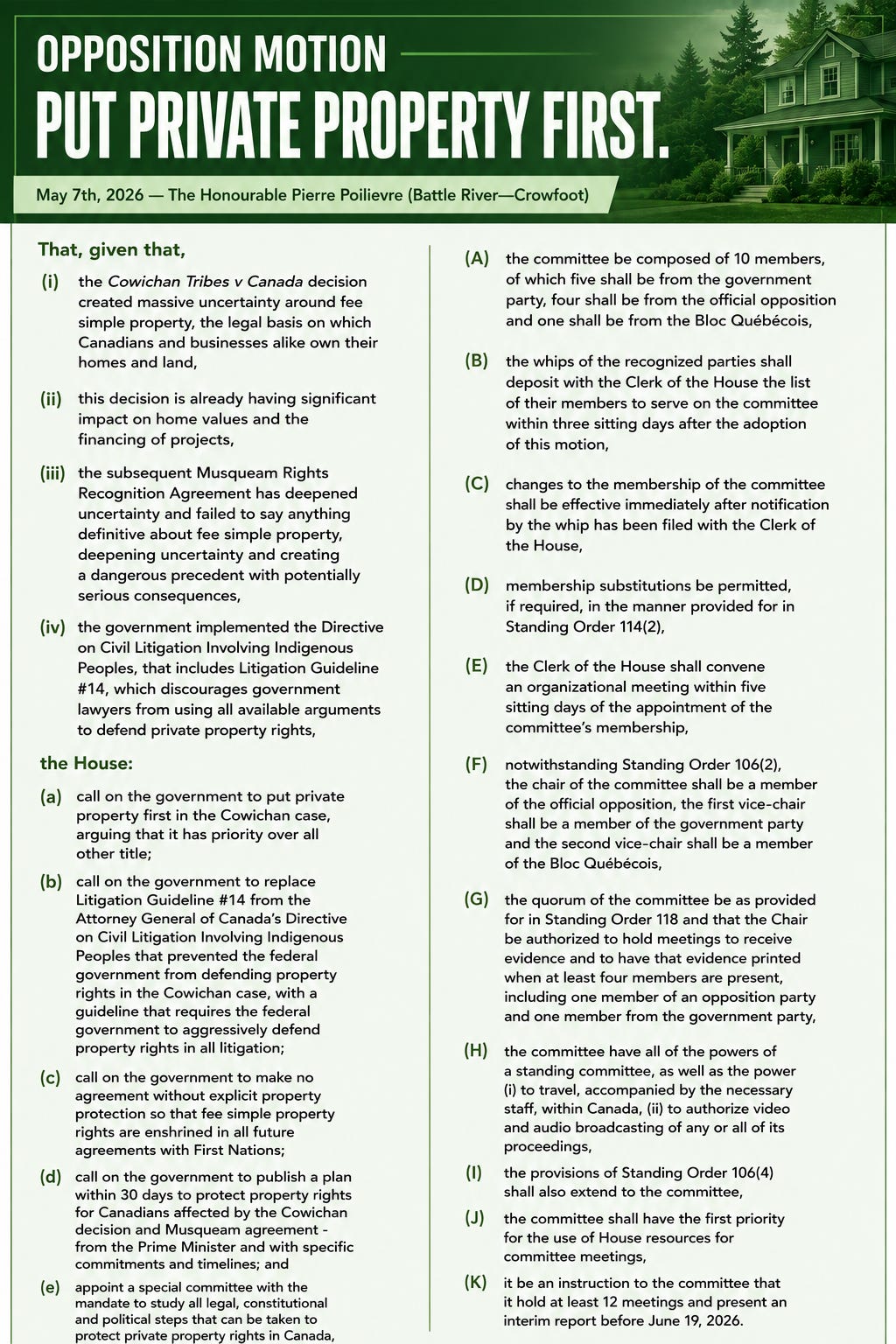
This week, conservatives kicked off an important all-day debate on Thursday to clarify the status of property rights in Canada as well as compel the Liberal government to vote to confirm the importance of property rights. The vote will happen May 25th and will confirm that private property rights come first over all other title rights, it will enshrine explicit private property protection in all future agreements with First Nations, force the publication of a public plan within 30 days to protect Canadians’ property rights affected by the Cowichan decision and the Musqueam agreement, and finally set up a parliamentary special committee to study all legal, constitutional, and political steps that can be taken to protect private property rights in Canada.
Why are we here, and how did we get here?
Last August, the BC Supreme Court decision in Cowichan Tribes v Canada undermined the certainty of property owners, creating confusion on legal agreements involving mortgages, property titles, investment agreements. Then came the Musqueam Rights Recognition Agreement made public February 20, 2026 that avoided clarity on property rights while recognizing broad Aboriginal rights including title within their traditional territory. The latter also further confused the matter when overlapping claims from other First Nations were not clearly settled. While the federal government gave notice in September 2025 it was appealing the Cowichan decision it continues to maintain Guideline #14 of the Attorney General of Canada’s Directive on Civil Litigation Involving Indigenous Peoples that discourages government lawyers from using the private property argument to defend a case. Neither parliamentary committees nor continuous questioning in Parliament during Question Period has yielded certainty or clear answers from cabinet ministers on the position of the Government of Canada. This vote is meant to establish a baseline and a path forward.
Why property rights?
Property rights are human rights and fundamental to our daily lives. Ownership of things and ideas is what allows us to create capital allowing us to grow our individual and shared prosperity. Here I’m going lean on Hernando de Soto’s terrific work in the Mystery of Capital and especially at the front end where he says: “Capital is born by representing in writing – in a title, a security, a contract, and in other such records – the most economically and socially useful qualities about the asset as opposed to the visually more striking aspects of the asset. This is where potential value is first described and registered.” It is a terrific book overall but that part especially found near the beginning under the header fixing the economic potential of assets is incredibly clarifying to what property is in the West. Anything that confuses who owns what and how do they own it undermines the potential for the creation of wealth.
Much of the debate over the meaning of the Cowichan decision and the Musqueam agreement is not about definitive legal conclusions but uncertainty on true ownership. When ownership is unclear, value suffers. You see this already with the City of Richmond sending letters to property owners informing them that they can no longer rely on their title confirming fee simple interest (property right) as evidence of absolute ownership of their land. And that’s from the Mayor of the City of Richmond.
Where do we go next?
The vote on the content of the motion will happen on May 25th. The Government of Canada gives direction to its crown lawyers defending and appealing the Cowichan case, and therefore, Parliament can and should influence how the government conducts that work with this motion. This isn’t about influencing the appeal judges who will hear the case but the conduct of government lawyers. Additionally, the best go forward option is to have a parliamentary committee conduct hearings, compel testimony from government officials as well as release of documents, and then hear from experts across Canada. An authoritative report from a parliamentary committee has in the past helped settle such contentious issues and conservatives are again leading the way shoring up Parliament at the centre of this property right debate.
Link to the Text of the Motion
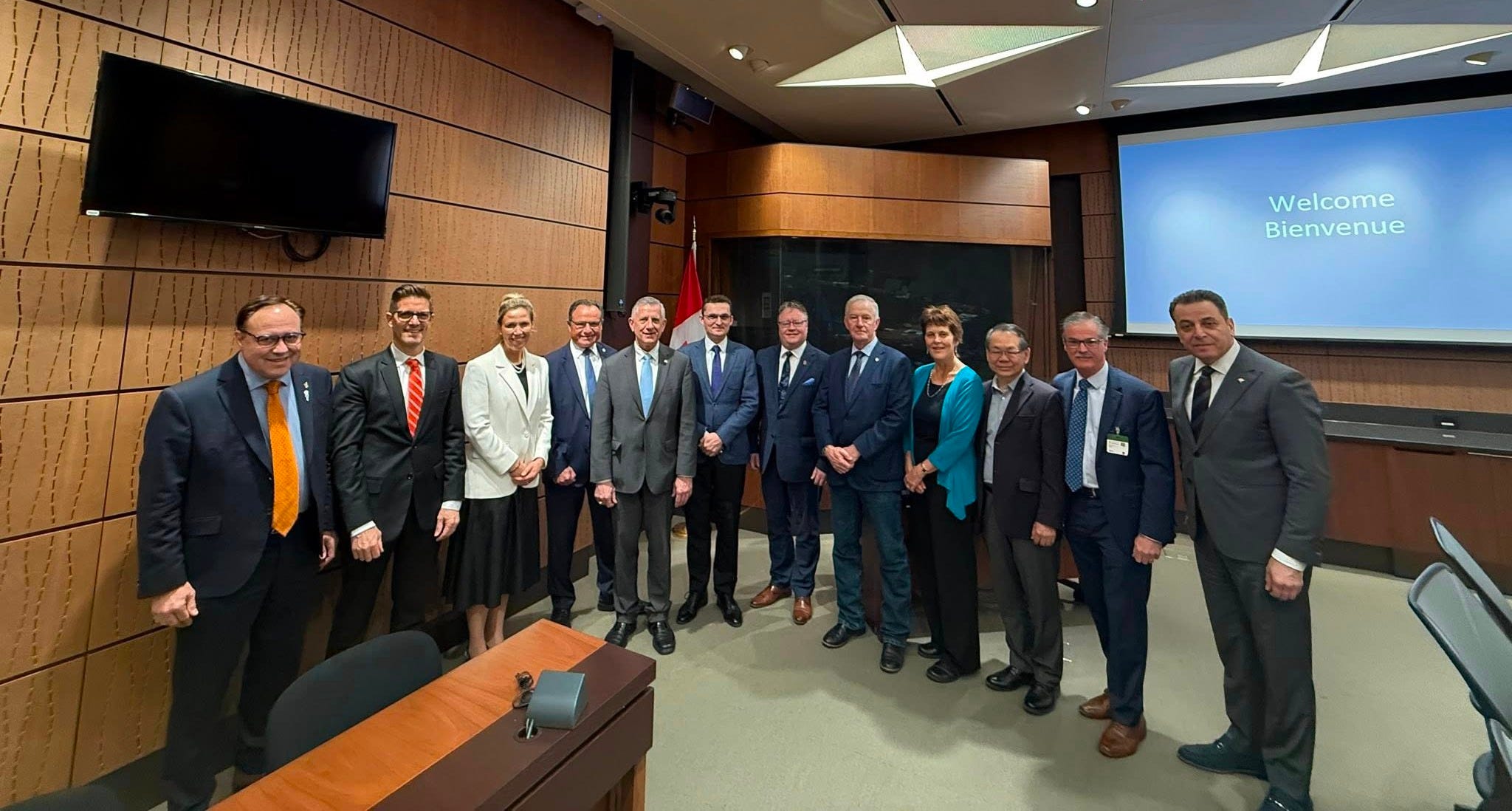
This week I had the pleasure of co-hosting a parliamentarians’ breakfast roundtable with the Christian Embassy of Canada, featuring economist Peter Hall. The topic, Chaos and Canada’s Future: Is There Hope for Growth?, is one MPs are wrestling with on a near-daily basis right now.
Peter is the former Chief Economist at Export Development Canada and now runs Econosphere Inc., where he advises Canadian industry associations, manufacturers, and trade-focused organizations. He’s also a Fellow-in-Residence at the C.D. Howe Institute and writes a regular column in the Financial Post. In other words, he’s spent two decades looking at Canada’s economy specifically through the lens of how we sell what we make to the rest of the world, which, with U.S. tariffs reshaping our largest trading relationship, is exactly the lens Parliament needs more of.
A few of Peter’s points stuck with me. First, the share of Canadian goods exports going to the United States has fallen to roughly 71%, the lowest level since the early 1980s, while exports to non-U.S. markets hit an all-time high last year. Whether you read that as forced adjustment or overdue diversification, the structural shift is real. Second, Peter has been making the case since 2006 that Canada’s chronic under-investment in machinery, equipment, and trade-enabling infrastructure is the root problem behind our productivity gap with the United States, not a recent Trump-era problem. And third, on the question in the title of his talk: yes, there is hope for growth, but only if we stop treating diversification, capital investment, and fiscal discipline as competing priorities.
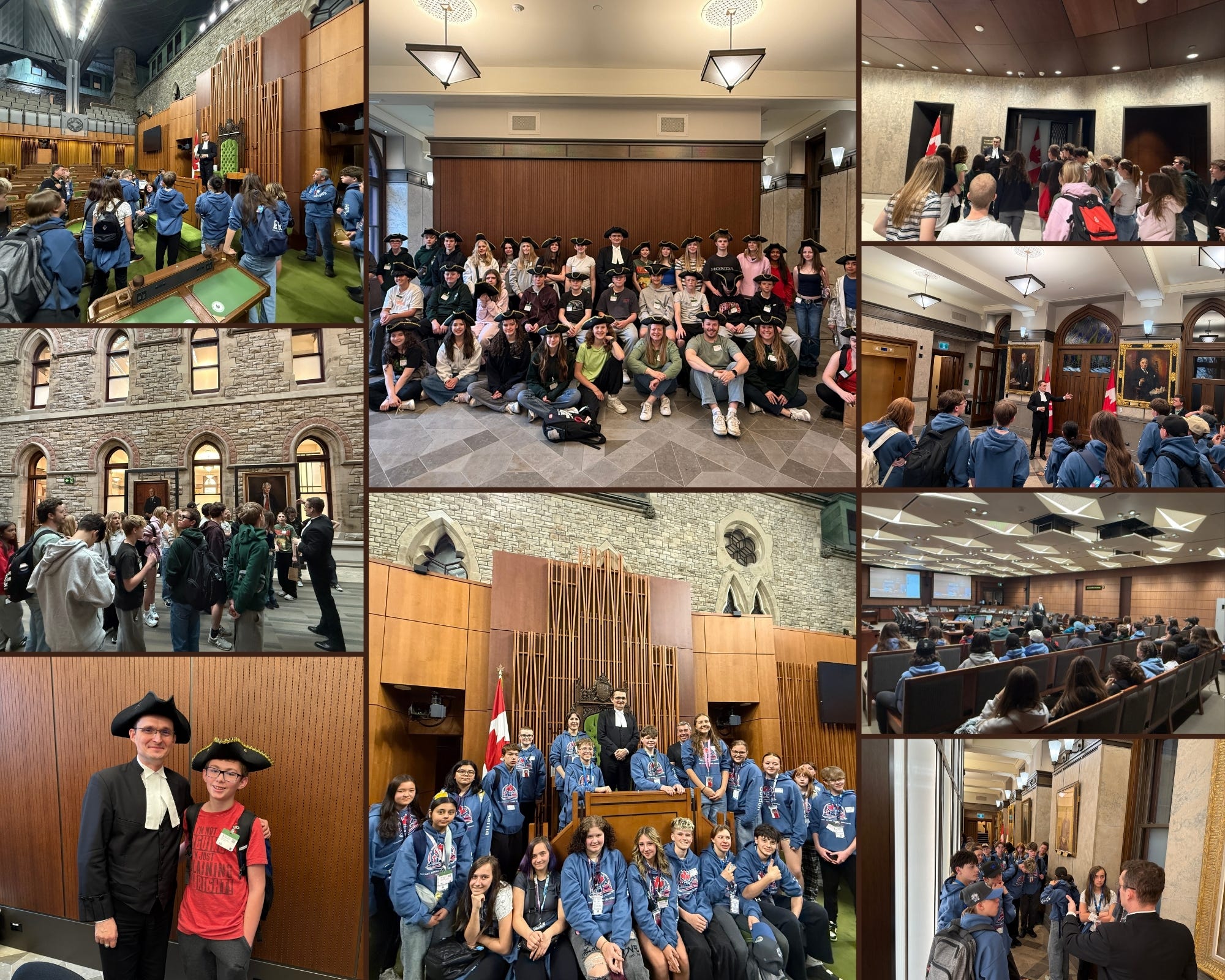
Over the last two weeks, I had the chance to host three groups of students from Calgary Shepard on Parliament Hill: Mountain Park School, Dr. George Stanley School, and École David Thompson School. Each class made the long trip from Calgary to Ottawa, and I was glad to walk them through the building and explain how Parliament actually works day to day.
These visits matter. Reading about Parliament in a textbook is one thing, standing in the Chamber, seeing where debates and votes happen, and asking questions of your own MP is another. The students came prepared, asked sharp questions, and were a credit to their schools and their families.
Trips like these don’t happen without a lot of work behind the scenes. My thanks to Holly LeBlanc at Mountain Park School, Janice Ramsay at Dr. George Stanley School, and Natasha Andrews at École David Thompson School for organizing. If your school is planning an Ottawa trip, my office is always happy to help arrange a tour.
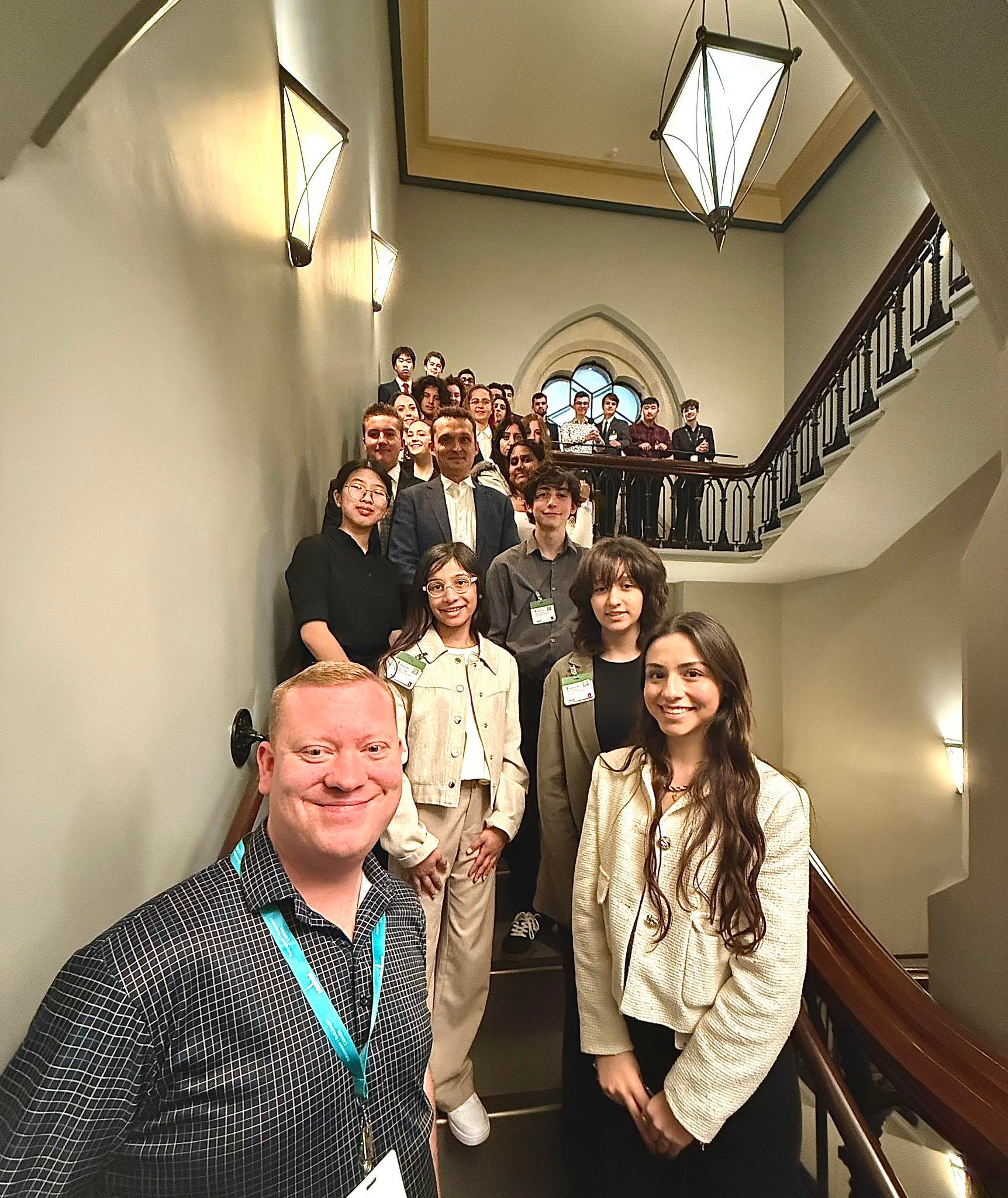
This week I met with the Youth Advisory Council organized by Sandra Cobena, MP for Newmarket-Aurora, who brought the group to Parliament. We sat down to talk about the role of the Deputy Speaker, the rules of parliamentary procedure, and the people and processes that keep Parliament running day to day.
The Speaker and his deputy as well as assistants chair the debates and rule on points of order, but the building also depends on clerks, procedural staff, security, interpreters, and committee teams. Walking young people through that picture is one of the more rewarding parts of the job, and the council came with thoughtful questions about how decisions actually get made.
PBO assessment of the Spring Economic Update: The Parliamentary Budget Officer says the government is on track to meet its two fiscal anchors, but warns the update gives no added precision on how capital and operating spending are defined. That limits Parliament’s ability to evaluate the fiscal plan properly.
The Spring Economic Update: Canada Strong, deficits long: Robert Kavcic writes that stronger revenues were largely absorbed by new spending, leaving the deficit path mostly unchanged. He also notes the Canada Strong Fund looks less like a traditional sovereign wealth fund and more like a borrowing vehicle for priority projects.
Four years, $90 billion in new spending: C.D. Howe notes that federal spending projected for 2026-27 has climbed from $504 billion in Budget 2022 to $595 billion in the Spring 2026 Update. That is a $91-billion increase in planned spending over four years.
Not enough deficit discipline in the update: C.D. Howe argues the government spent the improved fiscal outlook instead of using it to reduce deficits. The memo says stronger 2026-27 numbers were absorbed by new spending, leaving future deficits close to Budget 2025 projections.
Growth focused, deficit fuelled: RBC Economics says the Spring Economic Update keeps the same strategy as Budget 2025: growth-focused spending funded by continued deficits. It notes deficits are mostly unchanged, while the government is betting public balance sheet spending can attract private capital.
IEA warns Canada not to miss its energy opportunity: The Globe and Mail reports that IEA head Fatih Birol sees a major opportunity for Canada during global energy disruption. The practical question is whether Canada can build the infrastructure needed to move energy to customers who want reliable supply.
Canada’s economy stuck in low gear: The Hub reports the Bank of Canada expects GDP growth to remain below 2% through 2026 and 2027. It points to a period of prolonged slow growth rather than a short downturn.
Government policy and youth unemployment: In the Financial Post, Philip Cross argues policy decisions have contributed to rising youth unemployment. Separate reporting from CTV notes youth joblessness is significantly higher than the national average.
Shell’s major Canadian energy purchase: Shell has agreed to acquire ARC Resources in a $16.4-billion deal, expanding its position in Canada’s natural gas sector and LNG markets.
Federal fiscal problems getting worse: The Fraser Institute argues that deficits and debt have continued to grow since the last election, with no clear path back to balance.
Media coverage and the Prime Minister’s early months: A Hub podcast examines whether early coverage of the Prime Minister has been less critical than in previous governments, particularly on economic and fiscal issues.
No posts
Comments
Nothing yet. Say the first thing.
Sign in to join the conversation.