
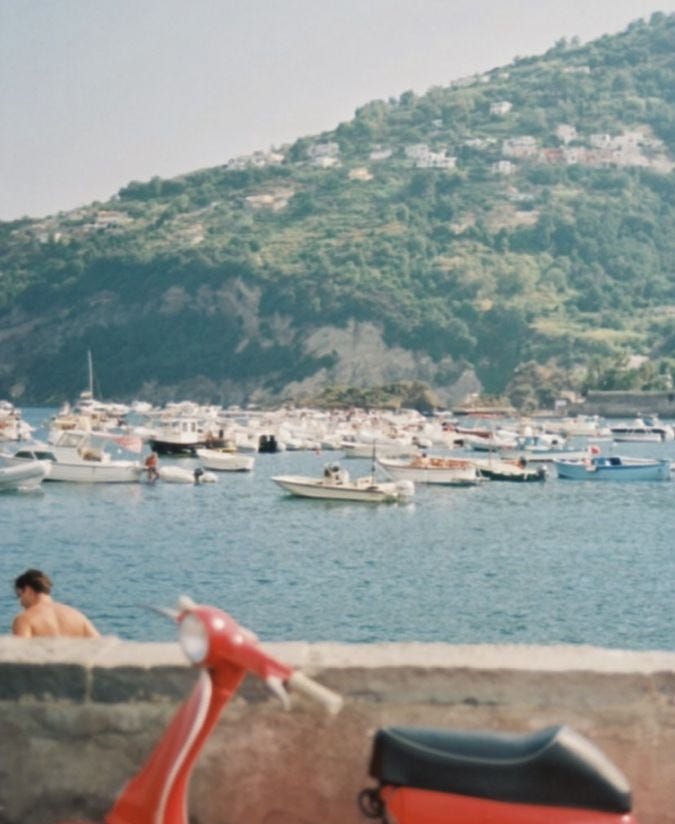
From up here, at this altitude, with the valley spread far below, the lake glimmering within it in its varying shades of blue, one can see the proper dimensions of the world, and one becomes keenly aware of one’s place within it. From this vantage, I am convinced that most arguments are utterly unnecessary.
Including, I admit, the one I am about to make.
Still, I make it, nonetheless. Because it seemed relevant when it came to me — and it is relevant now, and not for very much longer. It is July, but it will soon be November; sooner than you think. So allow me to proceed.
We have grown suspicious of the body. We trust the thought more readily than the perception, the concept more readily than the sensation. This is a recent prejudice, and a strange one. The body walks, climbs, sweats, shivers, tans and experiences things in ways the mind alone cannot. Life, whatever it is, exists first and foremost in the physical world.
Summer, more than any other season, reminds us of this. I do not mean action for its own sake, nor the indiscriminate accumulation of experiences that can later be reported. My argument is simpler, though considerably more demanding, I am afraid. It is an argument for being in the world rather than merely thinking about it from the comfortable armchair of one’s own mind, or experiencing it second-hand, through the lenses of others, who have themselves, bothered to go after it.
The trouble with a rich interior life, and I say this not against it, but as someone who has heavily invested on his, is how fertile it becomes. It is remarkably easy, and terribly common, to live removed from one’s actual life. To spend the days in the anteroom of experience, planning, anticipating, imagining, and, nowadays, even seeing, albeit vicariously. The mind sustains elaborate visions of the swim one might take, the mountain one might climb, the evening one might enjoy. It imagines them so convincingly that they begin to feel almost redundant. One develops the strange sense that one has already been there, done that, so why go again?
The heat cannot be imagined. The ache in one’s legs after reaching the summit cannot be rehearsed. The shock of stepping into a mountain river cannot be approximated; that utter disagreement between body and mind as every instinct protests the cold cannot be imagined. The scent of pine after rain, the kind of silence found at altitude, the warmth of a sun that has no interest whatsoever in your productivity; these things resist abstraction. The world presses itself upon us with a physical force the imagination, however richly furnished, cannot imitate.
This pull, I think, is all the more insistent in the summer. It is the season least tolerant of the life lived at one remove.
There is a certain urgency here, though I hesitate to use the word, for urgency is too often mistaken for anxiety. Anxiety looks toward what may or may not happen; a guessing game. It lives in the distance between reality and desire. What I am describing is something altogether calmer. It is the simple recognition that what is already here will not remain for long. The urgency lies in refusing to let time pass unnoticed. The feel is something closer to the alertness of someone who just found out, to their surprise, that the world is extraordinary as it is.
One can waste a life without ever doing anything obviously wrong. But waste it in the continuous habit of deferring the enjoyment, the experience, to a nearby future, which will begin shortly, under better conditions, when one is more prepared. The season turns, the years accumulate, and the life that was being prepared for remains, always, just ahead.
The summer makes the evasion very clear. The sun is up early in the morning, bright without apology. It wakes you before you intended to wake, as though reminding you of all the things you promised yourself you would do one day; and strangely never did. It is quite insistent and unapologetic at that. The clarity of light brings a sort of clarity of thought, something that the winter fog is incapable of providing.
Summer is far less a metter of whether one is living correctly, but rather whether one is living at all. The purpose of man, after all, is to live, not to exist1. Such questions of meaning can be left for more contemplative weather.
Now, go, then. Climb the mountain or walk the long way home. Go for a run. Swim in the sea, the pool or the river — do it on a Thursday morning when it is sure to be empty. Sit in the garden until the shadows change. Eat outside. Drink that bottle of wine that was meant for a more special occasion, and find out that Tuesday will do perfectly well. Watch the sun go down with the seriousness the event deserves. Lay on a patch of grass and read. Walk barefoot. Take the bicycle out for no reason.
None of this requires extraordinary planning or expensive equipment. The special occasion, should you require one, is summer itself.
This is not a plea for wildness, nor for the relentless pursuit of memorable experiences. It is a plea that one actually show up to one’s own life. To create proofs, if proof is needed, that one has indeed been.
“I would rather be ashes than dust! I would rather that my spark should burn out in a brilliant blaze than it should be stifled by dry-rot. I would rather be a superb meteor, every atom of me in magnificent glow, than a sleepy and permanent planet. The proper function of man is to live, not exist. I shall not waste my days in trying to prolong them, I shall use my time.” — Jack London
No posts
Comments
Nothing yet. Say the first thing.
Sign in to join the conversation.