

There’s a few things I’ve learned in university, some are defensible and others not so much. Belonging to the latter category, there’s this habit of always order drinks in threes. The first is curiosity, the second is confirmation, and the third is commitment. After that, it’s merely compulsion and a matter of public health.
I was somewhere in the middle of my commitment Negroni, wondering whether the conclusions of the confirmation one had been valid or whether I should change drinks, when I realized an Italian friend was trying to convince the rest of the group, Northern Europeans, that it wasn't necessary to split the bill so strictly, that it was a foolish thing to do.
He claimed, with the sincerity of good actors and the confidence of practiced liars, that the concept was what he asuredly described as an Anglo-Saxon aberration. One that got in the way of friendship, trust and generosity.
He made his point whilst reclining in a linen shirt that had never seen an iron, the cuffs artfully frayed, the buttons dangerously undone. Beside him, a sweating bottle of wine swimming in a bucket of melting ice, next to a dish of salted nuts that no one had touched. Back then, I unfortunately didn’t drink wine, it was either beer — in large — quantities or something heavier.
To this day I am not sure if he was sincere in the case he was trying to make or if he just had no intention of ever paying for a drink in his life.
He had arrived an hour late, hugged everyone, and with a smile on his face quickly began a monologue about how l`aperitivo was probably the best of Italian inventions. More than that, it was a defence against modern despair — not in those words, of course, but in spirit, I am sure.
My friend, the defender of Italian customs, was arguing with a German that the idea of simply sitting with a drink in hand around wasn't a waste of time and resources. It was a pastime of profound philosophy. It was part of the roman otium. Something the Germanic tribes completely destroyed when they invaded the Roman empire.
I suspect he only believed half of what he said, but then again, perhaps belief wasn't the point.
That was a few years ago. Since then I have realized that my Italian friend was not completely wrong, and that l'aperitivo is, in fact, a matter of great philosophical value. After all, there is no better time to dicuss the deepest — and the shallowest — of topics than with a drink in hand and in the presence of good company.
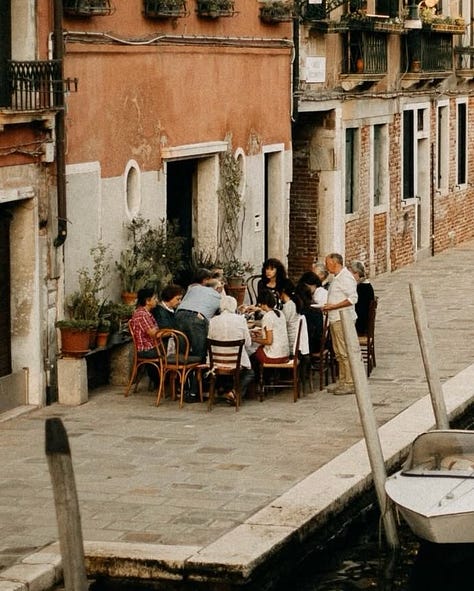
You see, the aperitif is a ritual of drinking, but it’s not about drinking per se. It is an Italian invention and, I admit, it is best done in a good setting, ideally, a fashionable cafe in Turin, or a terrace overlooking the sea in Genoa. However, I believe is should be done anywhere one can find small round tables placed on streets or public squares. Dutch canals in the summer, for example, provide exactly the type of atmosphere the aperitif culture requires — a good view, fresh air, and a cold drink.
But more important than the setting, the drink, the food, or the clothing is the attitude and the intention. L’aperitivo is best shared with people who interrupt each other, tell stories they’ve told before, exaggerate them, and become less coherent with every refill. There comes a point in every good evening where no one tries to impress anyone and the conversation ceases to be a mere exchange of information and it becomes a ritual of conviviality, a sort of shared act of presence.
The aperitif is among the last graceful acts of resistance available to the respectable citizen. It is one of the last surviving forms of elegant idleness. A relic of a world that knew how to waste time. If you're fortunate enough to have such evenings, in those fleeting moments, you might uncover some forgotten truths. That time is not money, for instance, as everybody is so fond of saying. Time, in fact, is just time. Money is what you use in an attempt to buy back the hours you wasted trying to earn it.
I've decided to see l’aperitivo as a philosophy disguised as habit. One that wages war against the tyranny of constant achievement — a rebellion against modern despair. Reserved only for those who take their leisure seriously, the so-called aristocrats of the soul.
Perhaps that sounds overly grand for something as simple as a drink before dinner. But certain things should be taken with the seriousness they deserve, and others with the lightness they require.
Of that particular afternoon, however, I remember very little. By the end, the table around us, I am sure, had become a slight mess of half empty glasses, folded sunglasses, linen shirts, sunburnt noses, and conversations that were certainly no longer concerned with reaching anything resembling conclusions.
Whilst the rest of the world was burning, we were there sitting, sipping, talking about everything and nothing at all, watching the light shift and fade along the canals and then over the row of slanted old houses behind us.
Which was, of course, the greatest sign that the afternoon had been put to excellent use.
Until next time,


No posts
Comments
Nothing yet. Say the first thing.
Sign in to join the conversation.