
I.
In Perugia, I realised that one learns a great deal about the world simply by observing it from a distance, as someone far removed from the fray of existence. It was there, over the course of a rather leisurely meal, that I found myself entertaining two rather curious thoughts. But I am getting ahead of myself...
It was late in the afternoon, that agreeable hour when the heat begins to slowly fade and the city becomes pleasant again. As the shadows began to climb up the facades of the old stone buildings we decided it was safe to come out for an exploratory stroll through the city.
We walked through the bewildering arrangement of alleys, stariways, and medieval passages, less preocupied with getting lost and more in finding interesting details, the things that one notices, no one takes pictures of and no one writes about, doors, chapels, walls and forgoten corners. Of these, I am glad to inform we found many, enough to fill our conversations and deviate our attentions quite quickly from one to the next. We lost ourselves both phhysically in the streets and also on our thoughts.
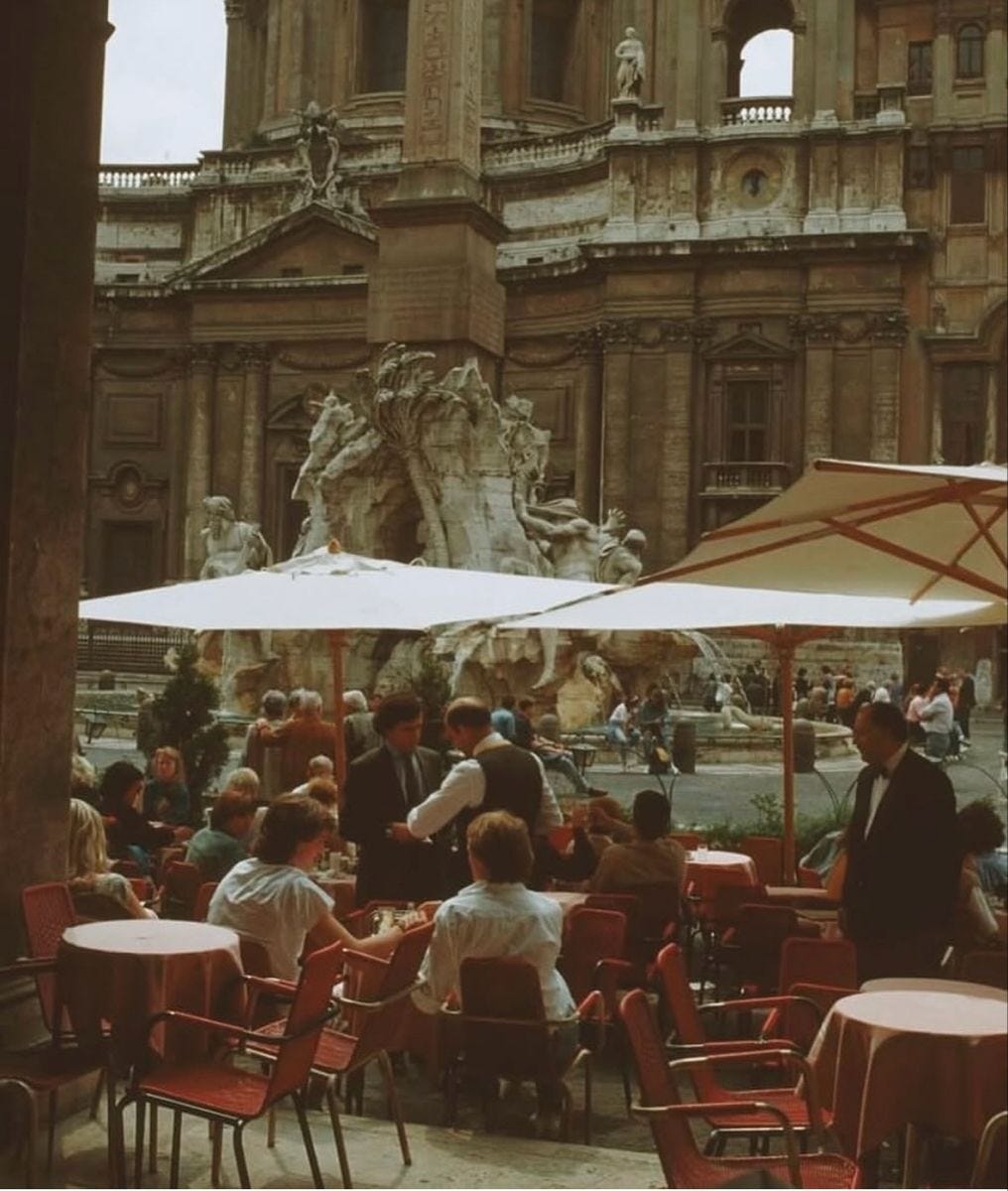
Inevitably, we found ourselves in the city’s main square, whose name I never learned, but it did have all of the features of an old Italian city: a fountain in the middle, a church, cafes surrounding it, and, of course, enough people making use of its space to justify its existence. The steps to the church were taken by loose groups of people, who gathered there in conversation and laughter. I later learned that many of them were probably students who attended the University of Perugia. The easy familiarity with which they treated the square suggested that they regarded it less as public space than as an extension of their common room.
Some were drinking beer, others wine, though all appeared to be drinking time itself in generous quantities. A few older figures, professors, I imagined, stood nearby with glasses in hand, engaged in that curious form of semi-academic conversation in which disagreement is expressed with clear politeness, but not without the italian enthusiasm of the voice and hand gestures.
The buildings around us, of pale limestone, seemed to absorb the light of the descending sun. Long, slanting shadows stretched across their walls, made interesting patterns that would move every time you’d move your attention to something else and come back to it. It was a scene of unstudied leisure, and within it there was a quiet sophistication. For to be properly at leisure is among the most difficult achievements of modern life. Anyone can be idle, but to carry it with the ease one encounters in the south is a rarity, a true art.
Having spent some time admiring this spectacle of collective unproductivity, we discovered a small pizzeria situated just beyond the square. It offered precisely what one hopes for in such establishments: a few wooden tables placed outside, two chairs still touched by the remaining sunlight, a view of the church, and the promise of simplicity competently executed.
We took our seats and ordered accordingly. A margherita seemed the most reliable measure of the kitchen’s abilities, while a second pizza, topped with a local Umbrian sausage recommended to us earlier that day, satisfied our curiosity. To accompany them I ordered beer, she an Aperol Spritz. Contrary to common knowledge, as I had been told, beer tends to be the beverage of choice of the Italian person to accompany a pizza, and not wine, as the northern person imagines.
The pizza was delicious, nothing less of what one would expect in Italy. The beer… Well, it was cold and not much more than that. This was perhaps inevitable. One does not travel to Italy in pursuit of great beer any more than one visits Belgium in search of exceptional olive oil. The world distributes its gifts unevenly, and wisdom consists partly in recognising where each may be found.
Still, the beer accomplished what was required of it. It cooled the throat and refrained from distracting attention from the food. There are occasions in life when excellence is desirable; most of the time, adequacy is best.
II.
We must have been halfway thorough our meal when the calm of the piazza encountered an adversary. From one of the narrow streets emerged a car; sleek, polished, and evidently proud of itself—probably expensive, I wouldn’t know. Cars have always struck me as rather like wristwatches: beyond a certain point one is no longer paying for utility or even beauty. The young man behind the wheel appeared to have invested heavily in that story.
Comments
Nothing yet. Say the first thing.
Sign in to join the conversation.