
My first substantial introduction to eroticism and sensuality was through the book Erotique Noire/Black Erotica, edited by Miriam DeCosta-Willis. The book was published in 1992 and is an anthology of text on sensuality by some of our best Black writers, including Alice Walker and Audre Lorde. I discovered it amongst a box of books when cleaning at home. I was 15 years old.
To this day, my favorite haiku is one that I read in the book. It’s by Kalamu Ya Salaam (who would go on later to revise this haiku but I still prefer this first version):
Haiku #107
I think of you as
rain and I as dry earth cracked
beneath cloudless sky
I read this for the first time, and then read it again. And then again. And again. How could someone express such longing, such deep yearning, in only 17 syllables? My favorite word in this poem is “cracked”. Its function is to emphasize the dryness of the earth. The ground has gone so long without moisture that it has cracked—in such need. And then there is “cloudless”—no relief in sight.
I’ve always thought of sex as a form of worship. As humans have prayed for millennia to the skies for rain—to end droughts, to water their crops, to hydrate their bodies, as essential for living—so too do we pray to loved ones to end our loneliness. To consider someone so essential to your existence. I think of this, and feel this same deep desire, as I bend my knees in front of the lap of a lover to worship. To need someone’s touch as badly as I need water.
I learned from this book, and this poem in particular, the astounding ways that art can express and explore human emotion and desire. As a young person fully emerged in the study of her own sexuality and romantic longing, I devoured this book as a guide to Black sensuality.
And then came D’Angelo.
Around the same time that I discovered the Black Erotica book, Voodoo was released.
I admit that D’Angelo’s first album Brown Sugar was an album that I appreciated a little later in my life. I was too young to fully appreciate its innovation and its flyness when it first came out. Today, of course, I understand. “Lady” is a perfect song, with a perfect bass line, to create the perfect moment for a head nod with a joint in hand.
Voodoo, however, was love at first listen. A very clear understanding of what was happening and how it would change my life. I could feel this music in my body. Maybe it’s some Black shit, but it felt palpable in the way of a praise break during Sunday service, mixed with whatever it was I felt the first time I heard Prince’s “I Wonder U”.
You know how in childhood, through pop culture or your parent’s introduction, you find an artist or musical movement that was a generation or two before you, but completely resonated with you? For me, those artists were Aretha Franklin and Prince. D’Angelo felt like an intimate space that blended the soul and gospel of Aretha, with the instrumentation and funk of Prince. He felt current, and young, and old, and like his music was made just for me. I realized that “me” was all of us. Black folks. Black folks who cried, and sang, and kissed, and made love, and laughed, and danced, and held our hands in the sky.
A friend of mine said before that gospel music aint nothing but love songs. Musicians who grew up in the church know how to craft an experience of love. D’Angelo would be crafting a different form of worship. D’Angelo crafted a religious experience – not a particularly Christian one, the faith that he grew up in – rather, a Black religious experience that incorporated hand claps, snares, bass lines, hollering, horns, humming. All poured into a pot to conjure up love. All placed into a basket and passed around the Black collective as an offering.
Love.
A different form of worship. What is “Untitled (How Does It Feel”) if not reverence for a lover, a laying down of pride to exalt the wonder of another human being, to offer them the best your body for the gift of their ecstasy? And like Haiku #107, D’Angelo also invokes the use of natural elements in “The Root” to express a longing for a lover, a lover who has worked a root on him, the conjuring of a spell.
“She done worked a root
In the name of love and war
Took my shield and sword
From the pit of the bottom
That knows no floor
Like the rain to the dirt
From the vine to the wine
From the Alpha creation
To the end of time”
In the way one haiku connected with me out of a larger body of work, the song that connected with me the most from the Voodoo album was “Send It On”. I listened to it the first time, and listened again. And then again. And again.
”Send It On” has led my list of my all-time favorite songs for over twenty years. Soundtracking important moments in my life. Romanticizing my homes. Filling my life, my body, my experiences like incense smoke filling a room. When I think of romance, when I think of love, when I think of Black intimacy, I think of “Send It On”.
Since D’Angelo’s passing, I’ve been mourning his loss. Crying in public, crying at home. I feel a part of a collective mourning with the people who never met him, but were deeply affected by his music and his existence in this world. I’ve fallen into a little obsession, consuming as much D’Angelo as possible. Listening to his music, watching interviews, observing pictures. After much consumption, my mourning reaches a point as an artist of needing to produce, to create, and to release.
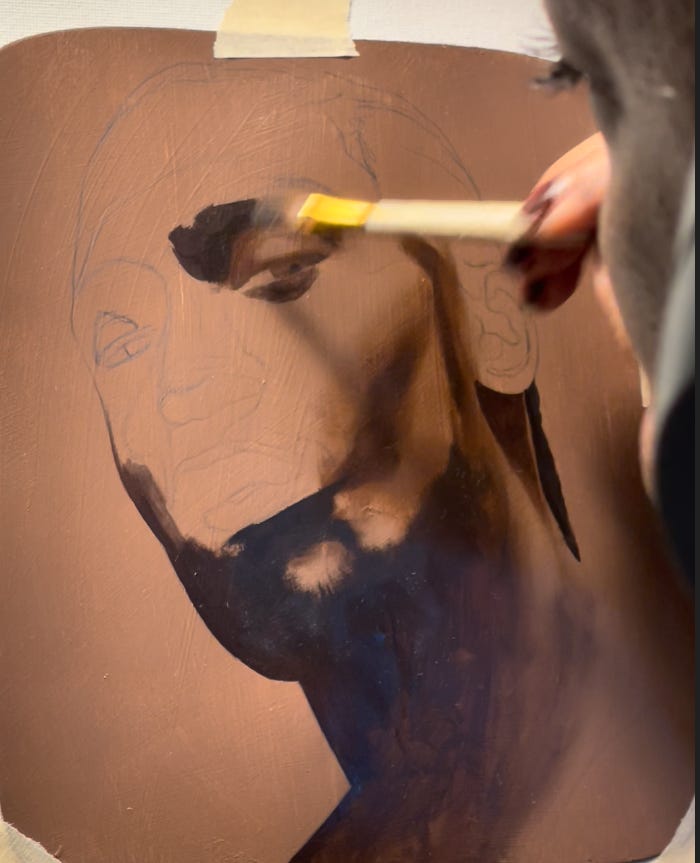
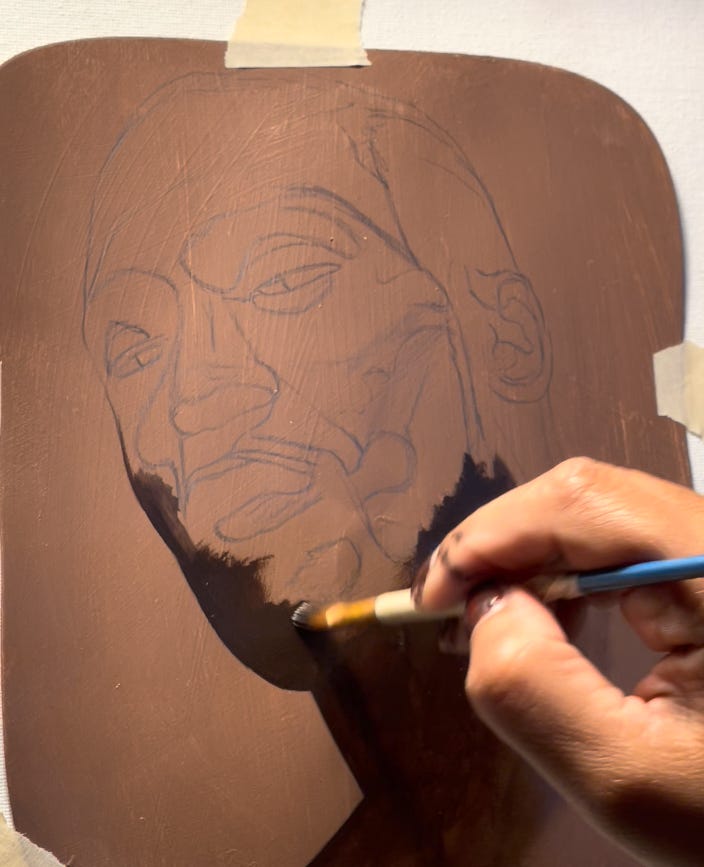
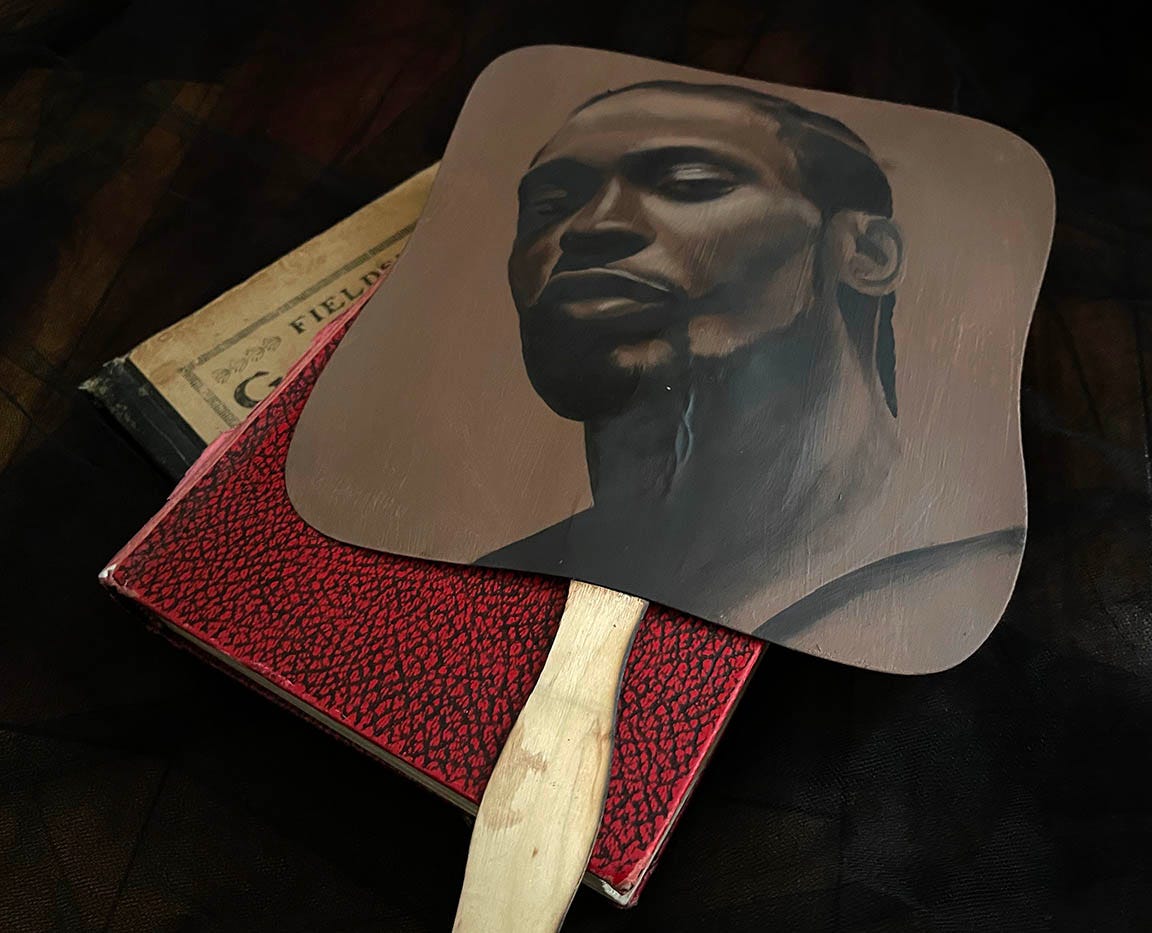
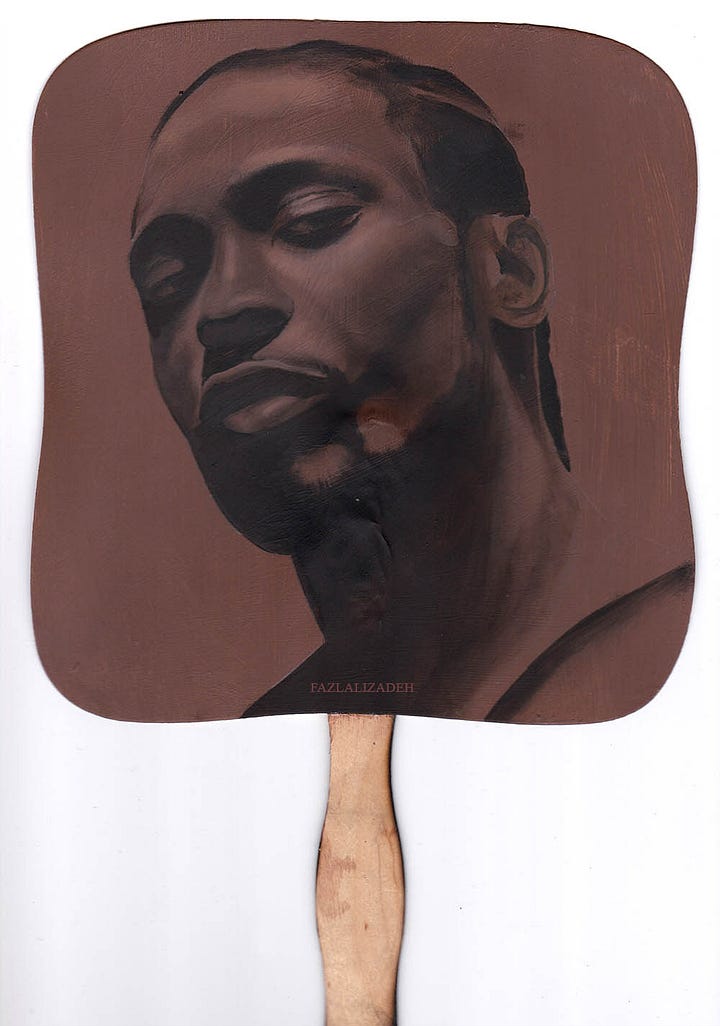
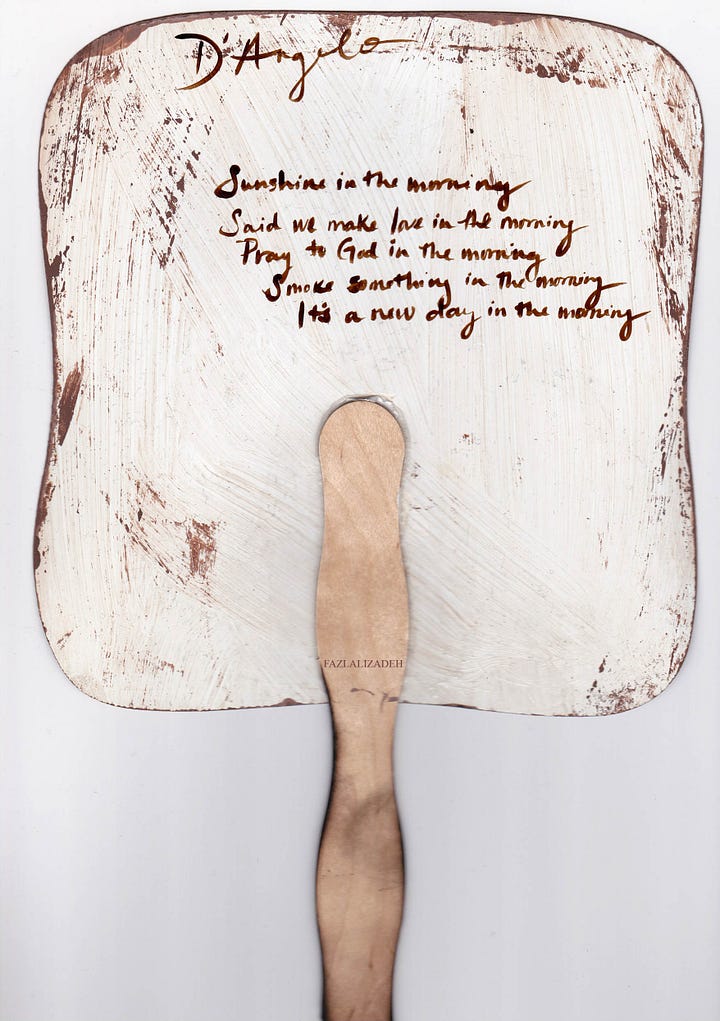
To do that, I made a portrait of D’Angelo. It is painted in oil and acrylic on a church fan. I have many church fans stored in my studio from an installation I did a few years ago in the sanctuary of the Historic Vernon AME Church. I’m always interested in reappropriating religious objects to show the overlap in cultural sound, aesthetic, and intent within Blackness. D’Angelo’s music is a perfect example of this, and I thought to paint his portrait not just on a canvas, but on a functional Black religious object was appropriate.
Thank you, D’Angelo, for being a reminder to never leave the core of being an artist. For making me feel. Over and over again. For giving me a place outside of church walls, and inside your music, to lay my burdens down.
Towards the end of “Send It On”, D’Angelo invites us to hum. In the same way that emotion, whether deep love or deep grief, often both, can’t always be expressed with words, he invites us into the feeling with a hum. Because sometimes it makes you wanna stop and say Hmmm. Sometimes we don’t know what else to say but Hmmm. And it’s alright. It’s alright.
No posts
Comments
Nothing yet. Say the first thing.
Sign in to join the conversation.