

The first community I ran was free to join. For the first 5,000 members, I welcomed every single one personally. A DM that said hi, asked what they were working on, and waited for a reply. Most of them replied. Thousands of short conversations about side projects, product ideas, struggles with launches, day jobs people were trying to leave.
I could have automated it from day one. A welcome bot would have been trivial to set up, and nobody would have blamed me. Running a free community of that size on personal DMs was, by any reasonable measure of my time, insane.
Looking back, it was also the single best thing I did for the business in that period.
Those 5,000 conversations told me what members actually wanted to read, what they’d pay for later, which problems kept coming up, and whose names to remember when I needed to test something. Every paid product I’ve launched since traces back to something I learned in those DMs. Analytics wouldn’t have told me any of that. A survey would have given me sentiment scores and topic clusters, which isn’t the same thing as knowing what people actually want.
Sponsored by Pipedrive
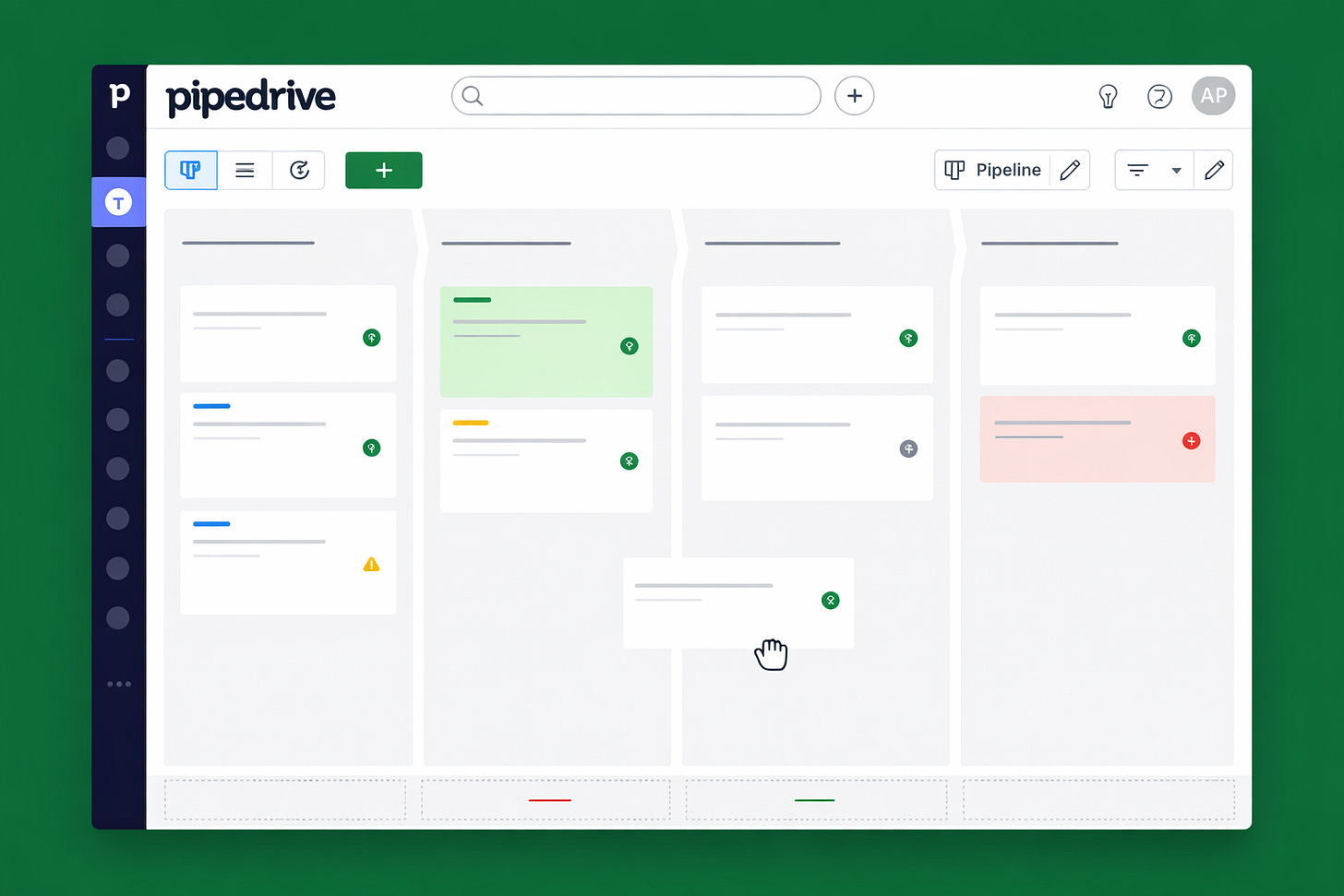
If you're selling anything, you need a CRM. But most CRMs are built for large sales teams, not founders doing everything themselves. Pipedrive takes the opposite approach: a visual, drag-and-drop pipeline where every deal has a next action, so nothing gets forgotten. It connects with 400+ tools, and the AI features are practical, handling things like email drafting and deal prioritisation. Plans start at $14/month per seat. Worth a look if spreadsheets are still your CRM. Tiny Empires readers get an extended trial and 20% off their first year.
Solo founders automate by default. It’s the obvious move. You’re one person, your time is the bottleneck, and every manual task looks like a leak you should patch.
The reflex is mostly right. I advise it quite a lot on this Substack actually. There are many tasks which are low value and worth automating. With AI, even high-value tasks are becoming worth automating.
But there’s a second category of task that looks the same from the outside and behaves differently. Tasks where the act of doing the work manually is where the value gets created. If you automate those, you save time and break something you can’t see.
I love Rory Sutherland's “doorman fallacy” which sums this up perfectly. The doorman fallacy is the mistake of looking at a job, seeing only the most visible task, and concluding the role can be replaced or automated once that task is handled. A hotel doorman appears to exist to open the door, so a revolving door or automatic sensor seems like a straight swap. What the door-opening measurement misses is everything else the doorman does: hailing cabs, remembering guests by name, keeping non-guests out, signalling that this is the kind of hotel where someone greets you. The visible task was never the actual job. Sutherland uses it as a warning against efficiency logic applied to roles whose value lives in the things spreadsheets don't count.
A task is safe to automate if the output is what matters and the process is just overhead. Invoices, reports, room bookings. Nobody cares how it happened, only that it happened.
A task is dangerous to automate if doing it yourself produces a second output you weren’t tracking. Support tickets teach you about the product when you answer them personally. A handwritten thank-you from the founder gets screenshotted and posted leading to word-of-mouth marketing. Onboarding calls surface patterns in confusion that no survey will catch.
The question to ask: if you automated this task tomorrow, what would you stop learning?
If the answer is nothing, you can probably automate it. If there’s a specific thing you’d lose, the task should stay manual.
Most solo founders I’ve talked to end up protecting roughly the same four categories.
New customer onboarding. Whether that’s a call, a personal email, or a handwritten note. The first hour a customer spends with you sets the retention curve for the next year. Automating it saves time and flattens retention.
Support for your best customers. Not all tickets. The ones from people who pay you the most or have been around the longest. You handle those personally because the information you get back is worth more than the 20 minutes it takes.
Refund conversations. Easy to automate because they’re awkward, which is the reason to leave them alone. A refund request is a customer telling you, in detail, why your product failed them. If a bot processes it, you never see the reason.
Your first conversation with a potential partner or sponsor. You’ll be tempted to use templates. Every templated outreach message reads like a templated outreach message, and the response rate reflects that.
The case for automation is always presented as maths. If this saves 15 hours a month and my time is worth £100 an hour, that’s £1,500 a month. Hard to argue with.
The case against is harder to quantify because you’re measuring things that didn’t happen. A customer who didn’t churn because you caught their confusion on the call. A product decision you didn’t make wrong because you saw the support ticket yourself. A partner who replied because the outreach email was clearly written by a human rather than generated.
None of that shows up in the time-saved column. It shows up in retention numbers six months later, and you don’t always know why.
You can’t A/B test this because the effect is slow and the data is noisy. You have to decide in advance that some tasks produce information worth more than the time they cost, and keep doing them even when they feel inefficient.
Bigger competitors can’t do this. A 50-person company can’t have the founder doing onboarding calls. The CEO doesn’t answer refund emails at a Series B. These companies scale by automating, and the automation is both a strength and a ceiling.
As a solo founder, the manual tasks are available to you because the business is small. Keeping them manual is how you build a product that feels different from everything else in the category. It’s also a strong anti-AI moat. With everything becoming more robotic, human contact becomes a novelty. Customers don’t always say it out loud, but this is what they stay for.
The automation playbook is well-documented and widely copied. The manual playbook isn’t, because it doesn’t scale. That’s the point.
Hope you found this guide useful. Consider forwarding it to somebody who might also benefit. If you’re not already subscribed, I share guides like this every week.
Depending on your goals, there are 2 ways we can work together:
JOIN PRO MEMBERSHIP Learn more
Get full access to all our resources with Pro Membership for a one-time payment of $149.
💰$50k in Perks: Access Exclusive offers from the top no-code tools who have partnered with us. Including $15k waived Stripe fees, $500 Bubble credit + $1000 Coda credit View all
💻 No-Code Operating System: Advanced Notion template that replaces all your productivity tools. Everything you need to launch and manage your business from one page. Learn more
🎓 Course: Tiny Empires Method: Learn how to build a 6-figure business that works around your life and not the other way around. Learn proven frameworks to stop wasting time and start making money. Learn more
🎓 Course: Sales for Introverts (and people who don’t like selling): Learn how to sell in a way that fits your personality and delivers consistent, reliable revenue for your busines. Learn more
🛠️ 75+ Curated No-Code Courses and Resources: We’ve curated 2000 no-code videos into 75+ easy to navigate courses. Save yourself hours of watching Youtube videos that don’t move your knowledge forward. View all
SPONSOR THIS NEWSLETTER Learn more
Want to get in front of 34k+ other founders and makers building business faster using no-code and AI tools.
Comments
Nothing yet. Say the first thing.
Sign in to join the conversation.