
In my last post, I wrote about the excellent medical care I received from a great provider with one notable flaw: before receiving a medical device, I had to sign a contract promising to pay for it without ever being told the price!
A few weeks later, I have an update. I’ve received bills for an affordable share of the office visit and the x-rays. But the item I explicitly promised to pay for? Still waiting to find out what it costs.
Sound familiar? Prices are hard to pin down in health care, particularly in the hospital setting. Hospital prices are hard to find for two reasons. First, they are hard to predict; they fluctuate with unpredictable complications and are intimately connected to patients’ other underlying health conditions. Second, prices are constantly negotiated between two heavily consolidated industry behemoths: health systems and insurers. Making prices easily available hurts hospitals’ bargaining power; if the insurer knows the hospital made a better deal with a competitor, they can lay on the pressure to do the same for them. Keeping prices hidden may even be legally written in to the contract. But all this is contributing to the dysfunctionality of our health care system: transparent prices are the lifeblood of a well-functioning market.
I have some small progress to report on this is mind-numbingly aggravating but common problem, at least for hospital settings. New federal legislation not only forces prices to be available on request, but to be easily “shoppable” by consumers. How will a test drive look through my local hospital’s shopping assistant?
Several initiatives since 2019 have focused on releasing hidden prices, focusing on the relationships between hospitals and insurance providers. The first Trump presidency began the process with an Executive Order which was strengthened in February 2025. Every U.S. hospital is now required to provide clear, accessible pricing information online about the items and services they provide.1 The act requires hospitals to provide information in two ways:
1. As a comprehensive machine-readable file with all items and services.
2. In a display of shoppable services in a consumer-friendly format
The rule focuses on “shoppable” services. These are defined as procedures or tests that are non-urgent or that a patient can schedule in advance. The required hospital display (usually a website) must include prices on at least 300 services, including 70 CMS-specified “shoppable” services. The CMS shoppable services include things like “Basic metabolic panel,” “Removal of one knee cartilage using an endoscope,” “Removal of 1 or more breast growth, open procedure,” or “Colorectal cancer screening for average-risk individuals.” See the full list here.2 This requirement can be satisfied by releasing a list or even by offering a price estimator which generates an out-of-pocket estimate personalized to include the individual’s insurance information.
The good news is that, as a consumer, you may not need to know all possible prices. You are just interested in the one that is most likely to apply to you. How do these hospital transparency policies help make that happen?
Although insurers or academics like the first requirement- the full machine-readable file- you may be willing to settle for just one simple price for one procedure, for goodness sake! Consumer-friendly prices are supposed to be listed on every major health system or hospital website. I took the challenge and simply googled my local hospital. Since Wake Forest University School of Medicine is the jewel of the Atrium Health System, I searched out the Cost Estimator for Atrium Health and focused on Charlotte, NC, the biggest city in the region. You can follow along with me in the Atrium Health’s Cost Estimator or check out your own local hospital.
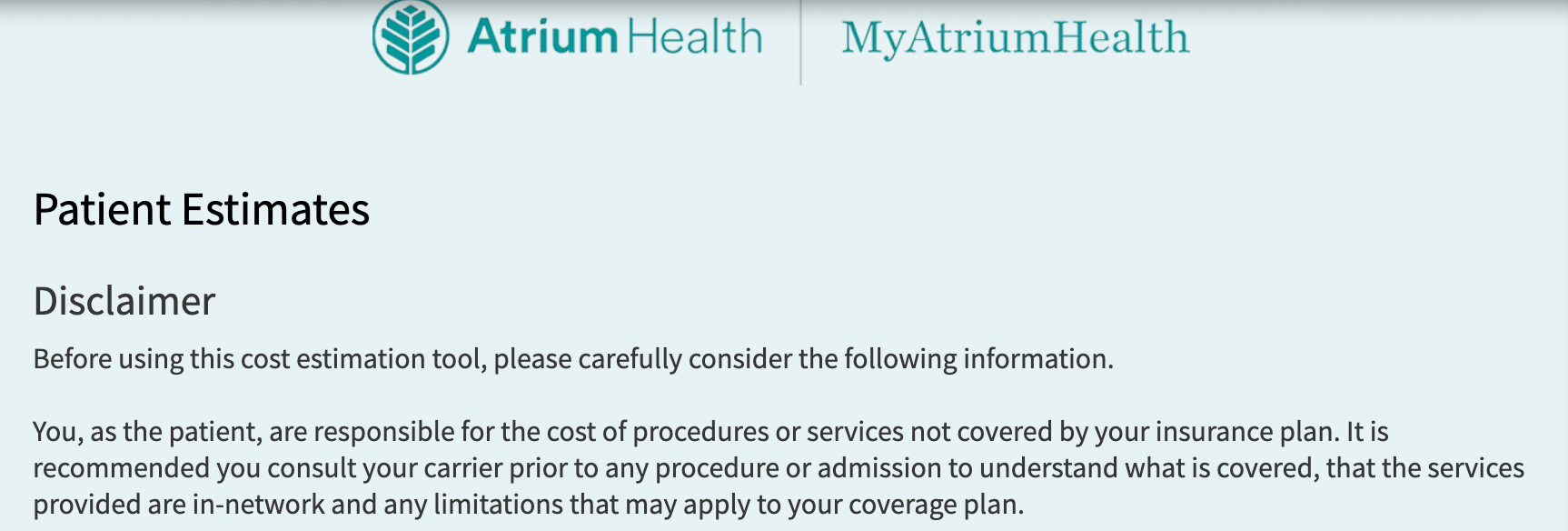
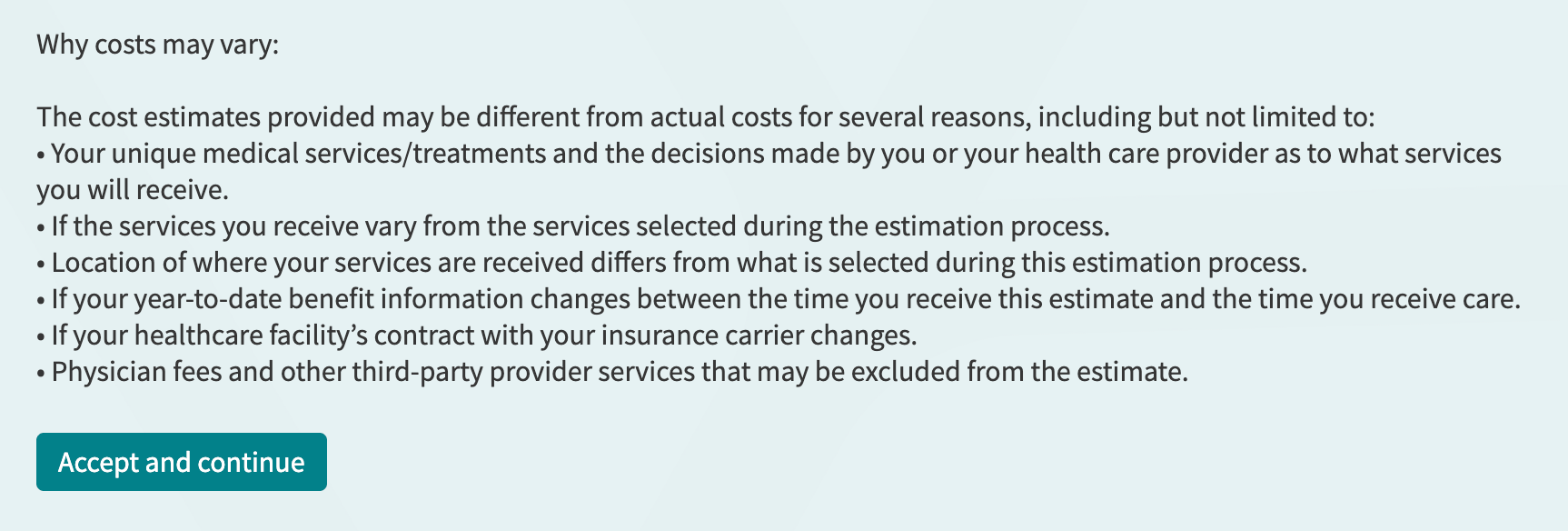
Note prices are not the first thing you see when you click on the Cost Estimator. Instead, it is a consent waiver that you understand all these prices might be false. This 461 word introduction with words of warning culminates in “The cost estimates provided may be different from actual costs for several reasons, including but not limited to:” followed by a 6 point bullet list and a cheerful “Accept and continue” button. Not an encouraging start.
After this rather ominous beginning, however, the website is surprisingly friendly to a non-medical visitor. There’s a nice page with 21 different categories of services put in general terminology, such as Ortho/Joint, Skin Care, Surgery and a search bar if you still don’t know where to go next. Each box attempts to give an overview of the category to help you decide if that’s what you’re searching for.
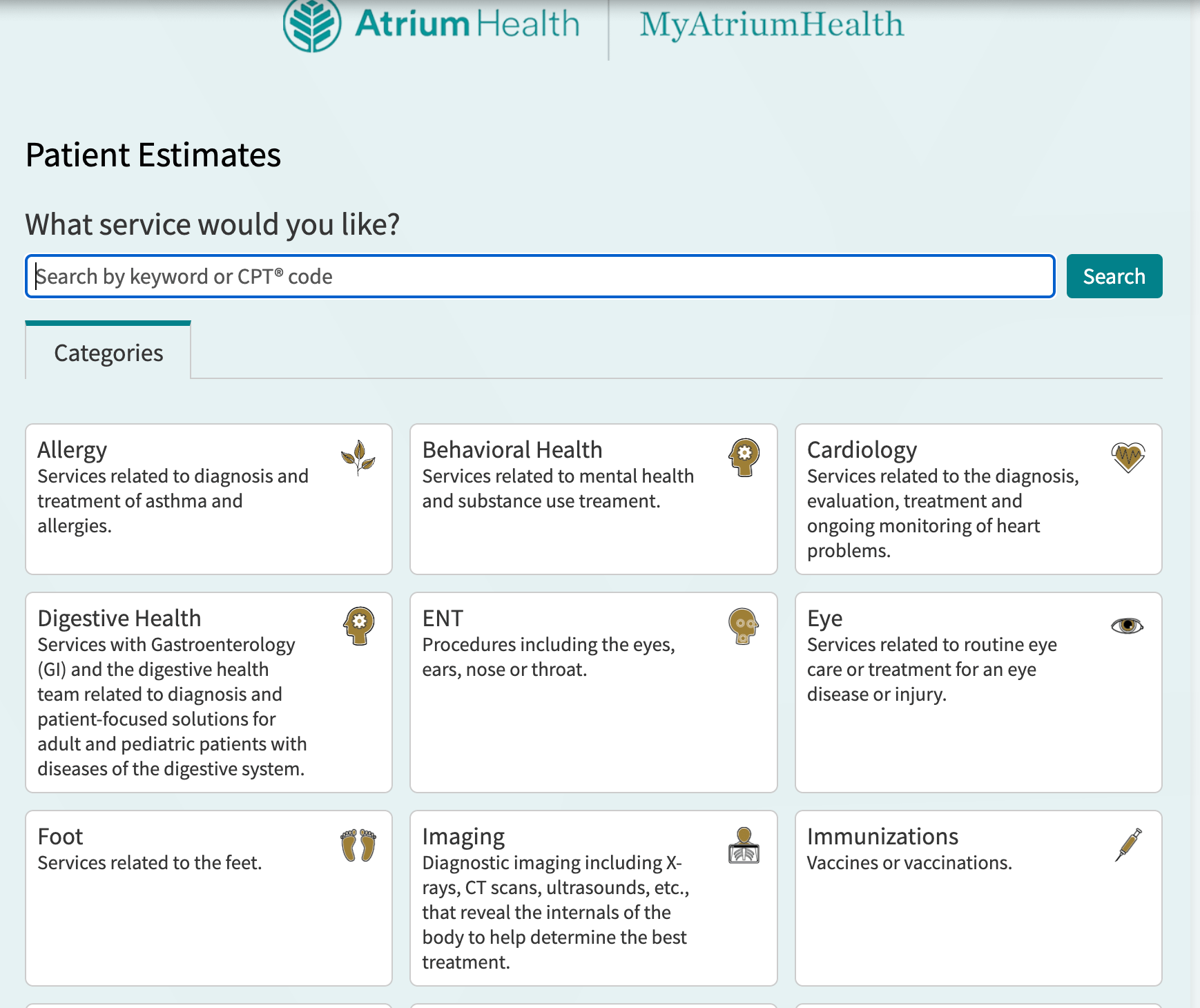
I decided if we’re discussing unpleasant but inevitable experiences, a colonoscopy might be an apt procedure to search. Clicking on the “Digestive Health” box, I see immediately no less than 4 options that have the word “colonoscopy” attached to them. Here’s the first information hurdle for the patient. Do you know which of the four was the one your doctor prescribed? Do you know which of the four you will finally end up needing? This illustrates the uncertainty component of pricing. For example, one of the choices uses the term “biopsy.” I hope I won’t need this option! But this price represents a bundled treatment if the colonoscopy ended up detecting something suspicious that would then need to be biopsied to check for cancer. This is a choice you have no idea if you’ll need before entering the facility, or even before anesthesia.
Moving on, I pick one that sounds like words my doctor used and move to the next page. (Actually, I picked an incorrect code in my first draft, focusing on the word “snare” I’d heard about the technology. Later, ChatGPT told me that would be a fraudulent billing code if the snare wasn’t used. Physicians on this newsletter- leave a note in the comments if I am still getting it wrong. It will further prove my point that most consumers are not well equipped for this exercise!)
Based on my luck so far and the fact that Atrium Health is the third largest health system in the U.S., I assume this is a fairly well-run hospital page. As such, the next page includes the helpful feature of identifying yourself by your insurance carrier. This is helpful since the last post explained that every person walking into a hospital has a different negotiated price depending on which insurer they are using. On Atrium’s page, you can identify yourself as an enrollee of 4 major commercial insurers (i.e. Aetna or Blue Cross Blue Shield) or Medicare. You need to enter your specific insurance information, since when we say each plan is different- we mean as detailed as your plan vs. your neighbor working for a different employer or your plan vs. your cubicle neighbor that enrolled in your employer’s other option. Or you can skip entering any insurance (I did) and settle for the “continue without insurance” self-pay information.
Clicking “next” then tells me what the estimate includes (hospital fees, physician fees, anesthesia, evaluation of findings) and no less than 18 locations within about 2 hours of the hospital where I could get this procedure done.
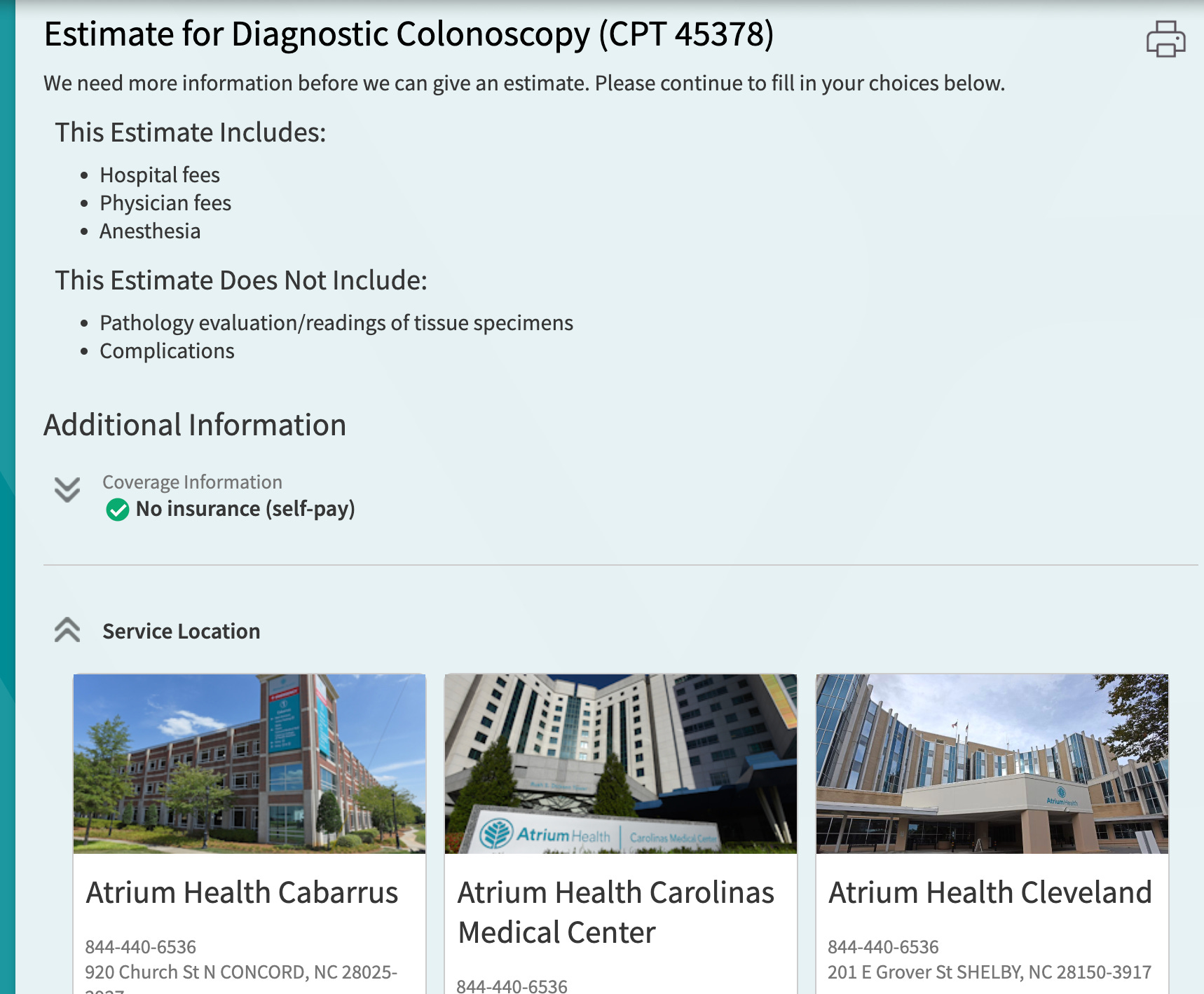
If I choose self-pay, the main Charlotte hospital gives me a 50% “discount” off the $11,657 price (remember all prices are fake, people) for a total of $5,829. Then I thought I’d get clever and move out of downtown, to Concord, NC, about 40 minutes north, thinking I might save a few bucks. However, there the price increases slightly, $6,271. This location page gives me a range of possible prices, ranging from 11,586 to 12,855.3
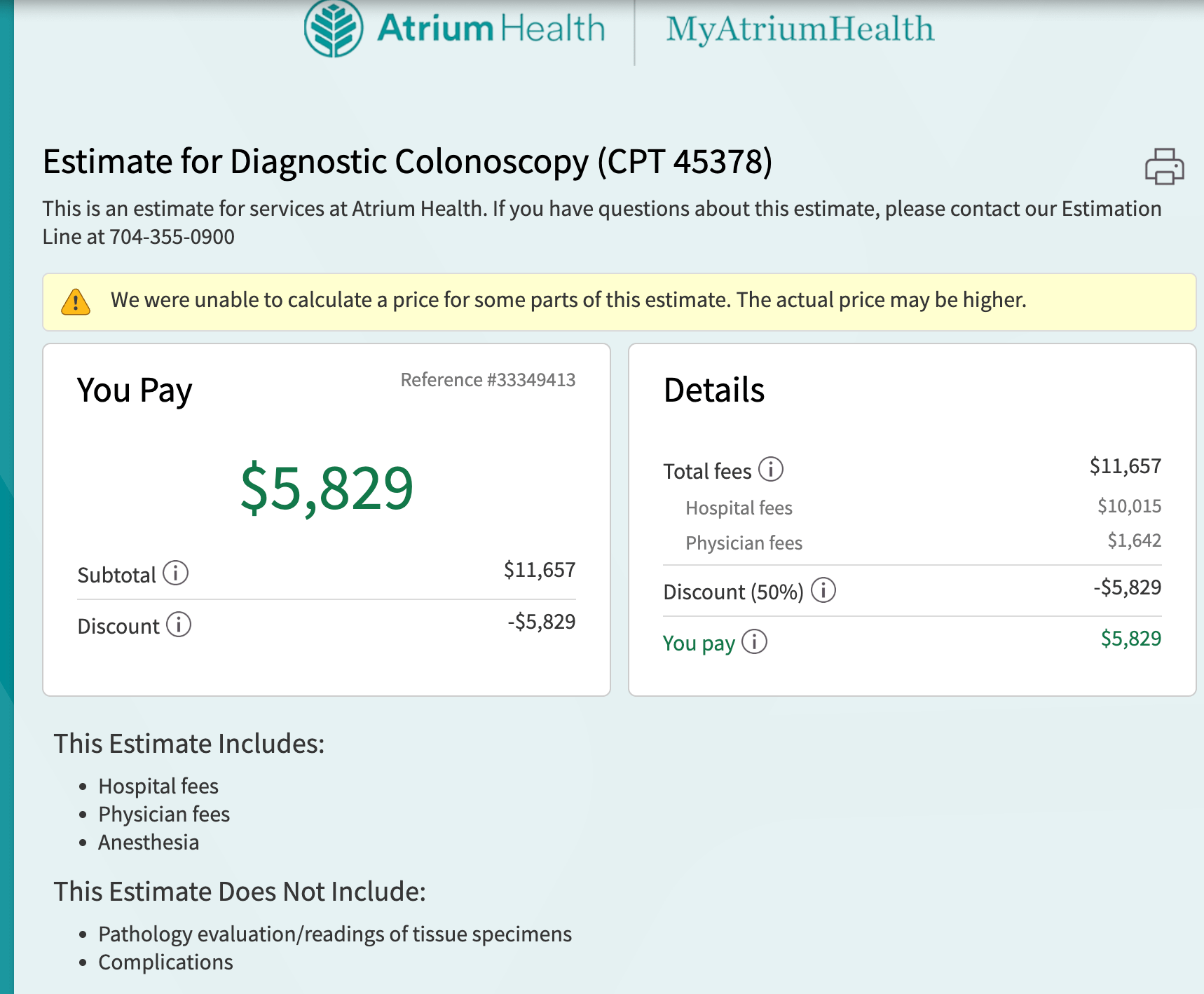
Well, that was fun and fascinating for me as an economist, but it has already been a lot of work and I’ve only looked up two locations. Plus, this assumes I picked the correct procedure code on my own from what my doctor would have prescribed and that I won’t end up needing a more intense version of care because of an adverse reaction to anesthesia or discovery of a suspicious polyp in my colon. In the name of science, I also tried this exercise for the other main health system competitor in town. This system shall remain nameless, because it was an undeniably worse experience and I ended up after multiple tries with no price information and simply an 800 number to call the main billing office with questions.
The main takeaway is that this price transparency rule has made a large volume of new information on hospital prices available to the public; this doesn’t mean the information is usable or useful to the everyday consumer. The average consumer just doesn’t have enough medical knowledge or predictive ability to harness the benefit of prices. Self-pay patients stand to benefit the most as individuals—those unfortunate few who were constantly trying to tease out a firmly stated price from the hospital.
However, self-pay patients are few compared with the many negotiating relationships within a hospital. This doesn’t mean the push for price transparency has been without benefit, however. More likely this information is advantageous to the insurers who sit across the bargaining table and have a much larger stake in prices. In the next post, we’ll explore these relationships and envision how this improved price information can be used improve health care markets as whole. Some new industry disruptors have already made a start!
via Becker’s Hospital Review
Note I drafted this article and then let it sit a few weeks. When I came back and did the same exercise, I had to update all my numbers. They were still approximately 5,800, but it moved around.
Comments
Nothing yet. Say the first thing.
Sign in to join the conversation.