
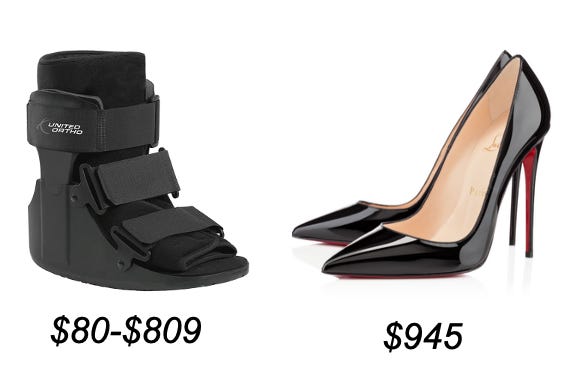
Hospital prices in the U.S. have long been a mysterious, shadowy entity. You see them on your insurance statement and ask, “that can’t really be the price, can it? Why does a hospital ankle boot cost as much as a designer shoe?” My first post in this series explained why prices are slippery things that hospitals might prefer to remain hidden, but, since February 2025, every U.S. hospital is federally required to provide clear, accessible pricing information online for the items and services they provide. We price searched for a colonoscopy together (vicariously, luckily) to test drive searching hospital price websites. The result? Lots of prices, but still plenty of confusion for an average shopper. However, as we’ll explore below, even a mess may be a good start.
Hospital spending makes up about 30 percent of total national health expenditures in the U.S., at 1.6 trillion dollars. Spending also grew 8.9 percent in 2024.1 If we want to cut health care costs, this is a major market to attack. Well-functioning markets are defined by easily accessible prices. However, you may not run a hospital or an insurance firm. As an individual you might think, I know this is a mess, but isn’t it all covered by my insurance? Why does it matter to me?
Here’s a few reasons to care about prices as an average citizen, even without a hospital contract of your own. Prices really matter for about 9 percent of Americans who are navigating the system of self-pay medical care while uninsured and crossing their fingers. Prices matter for the next 9 percent of Americans without “nice” insurance through their employer or Medicare/Medicaid. They aren’t “sharing” premium costs with their employer, and about half of last year’s Health Insurance Exchange enrollees have lost their federal premium subsidy.
Even for you lucky folks with employer-sponsored insurance, prices matter in your deductible region- the part of the insurance contract where you pay full price for care without any subsidy, waiting for insurance to kick in.2 Deductibles are always rising. The average 2025 deductible for workers in employer-sponsored insurance was $1,866 across all firm sizes, rising to $2,631 for small firms.3
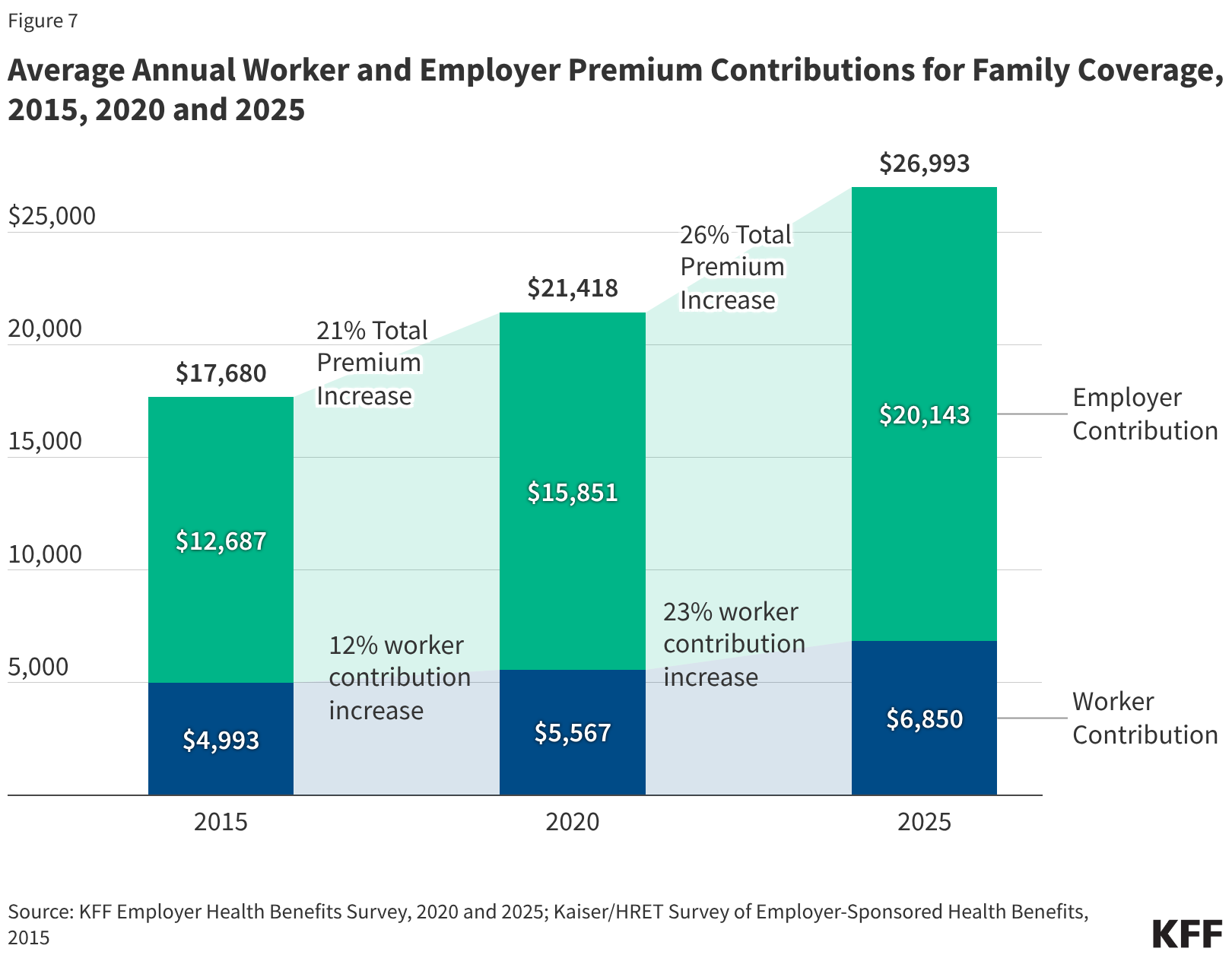
More dramatically, these higher prices matter because higher hospital prices feed into insurance premiums, employer costs, taxes and public spending. And the portion of your premium that your employer is “paying for you”? Remember this is instead of offering you higher wages. It also makes individual workers more expensive to hire. A study by the prominent economists Katherine Baicker and Amitabh Chandra in 2006 found that a 10% increase in health insurance premiums reduced wages by 2.3%, reduced the chance of being employed by 1.2 percentage points, lowered hours worked by 2.4%, and raised the part-time employment rate by 1.9 percentage points.4 (Psst, the median proposed premium increase for small businesses in 2026 was 11%.5) High prices are a problem for everyone.
While the American Hospital Association touts that over 90 percent of hospitals have posted their costs, studies show that only a third of them are complete.6 This chasm is caused by both the vagueness of the assignment to hospitals and the nature of prices themselves.
Presently, there are two major problems with price transparency. First, the raw data is not comparable. Reporting requirements don’t specify a specific format. For example, one charge lists the per-diem charge- what it costs per day in the hospital- whereas another hospital may list the total charge for a full episode of service. Most academic studies focused on assessing the accuracy and usefulness of posted data find substantial problems. Prices are misleading, doubtfully high or low, listed twice with different values, or are reported even though the hospital does not even perform the service.7 The current data works poorly as a consumer shopping tool but could be molded into a valuable infrastructure for regulators, employers, and insurers who learn to work with it.
The second problem with erratic price reporting is more endemic. Before maligning the administrators trying to comply with the law, it is important to understand that all prices really represent relationships. A price is an agreement between two parties to complete a transaction. Consider your preferred chain grocery store. Its prices represent a simple relationship. Pre-listed prices apply to any shopper that walks through the automatic doors. We all understand that our individuality isn’t factored into the price.
Now suppose instead grocery store prices depended on whether you were an individual or buying for a restaurant business. Or whether you’re a frequent shopper (this already exists in loyalty cards). Or suppose the grocery store must cater to different kinds of shoppers in the same general categories: “mushrooms” includes white mushrooms on cheap pizza for college kids as well as truffles for the Michelin star chef. What if the grocer priced all these relationships individually?
Hospitals maintain layers upon layers of relationships between suppliers, providers, insurers, and the government. You, the patient, walk through the automatic doors; however, in reality, the relationship is between the hospital and your insurer. Each insurer negotiates a separate contract for payment of services. Not only that, but each insurer relationship may also have a radically different structure to their contract.
The simplest relationship may be Traditional Medicare, which pays hospitals according to federally set rates, with some local adjustments. Hospitals generally have little choice but to accept them, much like the chain grocery scenario. Medicare Advantage and private insurance work differently: hospitals negotiate separate contracts with each insurer and often each type of plan, producing many different prices and payment rules for the same care.

There’s one set of prices for the Medicare Advantage contract with, say, UnitedHealthcare, but then multiply this by every other Medicare Advantage insurer in the service region (i.e. a few from Humana, Blue Cross Blue Shield, and Aetna). Then add in every contract for every local employer-sponsored insurance plan. Oh, plus the individual market plans, maybe with the same set of insurers, or maybe with Centene, which dominates the exchanges but doesn’t operate in other parts of the U.S. insurance ecosystem.8 You see the dimensionality problem here? Imagine if a grocery store charged a different price for shoppers depending on the kind of meal they were making. It would be a mess. If you ask a hospital to report “a price,” its response is something like, “which one of the 20 prices do you qualify for?”
On top of the sheer number of bargaining partners for prices, the structure of contracts may vary. Abnormally high prices for one service may be part of a larger contract structure compensating for a low price elsewhere. Certain contracts might pay a capitated rate- a fixed price per person- whereas other may list each service component explicitly. Sometimes prices are negotiated as a percentage of the Medicare list; thus “price” becomes a percentage rather than a specific value.
These challenges do not result necessarily from lack of compliance with the rule; rather, these differences highlight the complexity of the contracting environment and the sheer number of relationships hospitals juggle. Is this complexity really stemming from hospital operations, or is it coming from anti-competitive practices? We don’t all have personal prices from the local grocery store because there are many shoppers, many restauranteurs, and many choices of grocery store if you don’t like the price you’re given.
The federal act has made prices public, but it’s more like turning the light on in the junk closet. We suspected it would be a mess of jumbled shoes- orthotic and designer alike- and shudder at our first look. To offer a glimmer of hope, this act isn’t primarily for the patient anyway. The public data is about finally facing the closet and sorting through it. For patients, we need intermediaries to interpret all this data in a user-friendly way. But more importantly, we need all parties involved in these negotiations to have the same transparent information. This is what turns the mess into an easy grocery shopping trip.
This is already beginning, where third-party companies are “prettifying” this mass of information and leveraging economies of scale to standardize information from scattered and diverse hospital reporting. These third-party companies then sell their more digestible information to the major relationship partners in the hospital sector. Castlight Health and Optum Healthcare, both founded within the past five years, use proprietary software to estimate the costs of common medical procedures. The reports include performance data on various providers, enabling clients to account for both cost and quality. They sell these health care “shopping” tools to health plans or companies running their own insurance plans.
This act is the first step in making negotiations transparent between the biggest players in hospital markets, which, sadly, doesn’t include the patient. It doesn’t help the patient complain about designer prices for an ankle boot, but it may level the playing field for the big players involved in negotiations. What starts as a mess could open a world of possibility for transparent contracts and better-informed government negotiations.
Particular thanks to Mike Riggs and Jannik Reigl for great comments and editing help. Thanks to Rhishi Pethe for constant inspiration for the series.
Claxton, Gary et al., “Challenges with Effective Price Transparency Analyses” Peterson-KFF Health System Tracker, Health Spending. Feb 25, 2025.
Comments
Nothing yet. Say the first thing.
Sign in to join the conversation.