
Hey, I’m Timothe, cofounder of Stellar & based in Paris.
I’ve spent the past years helping 500+ startups in Europe build better product orgs and strategies. Now I’m sharing what I’ve learned (and keep learning) in this newsletter.
For more: My Youtube Channel (🇫🇷) | My Podcast (🇫🇷) | Follow me on Linkedin.
If you’re not a subscriber, here’s what you’ve been missing:
How Front is turning product teams into AI-powered growth engines
Inside Amplitude’s journey to enterprise-scale Product analytics
Privy was founded in 2021 by Henri Stern and his co-founders to solve a simple problem: crypto products were too difficult for mainstream users. The team believed that powerful cryptographic infrastructure could only reach mass adoption if developers could integrate it directly into existing product experiences rather than forcing users to learn entirely new behaviors.
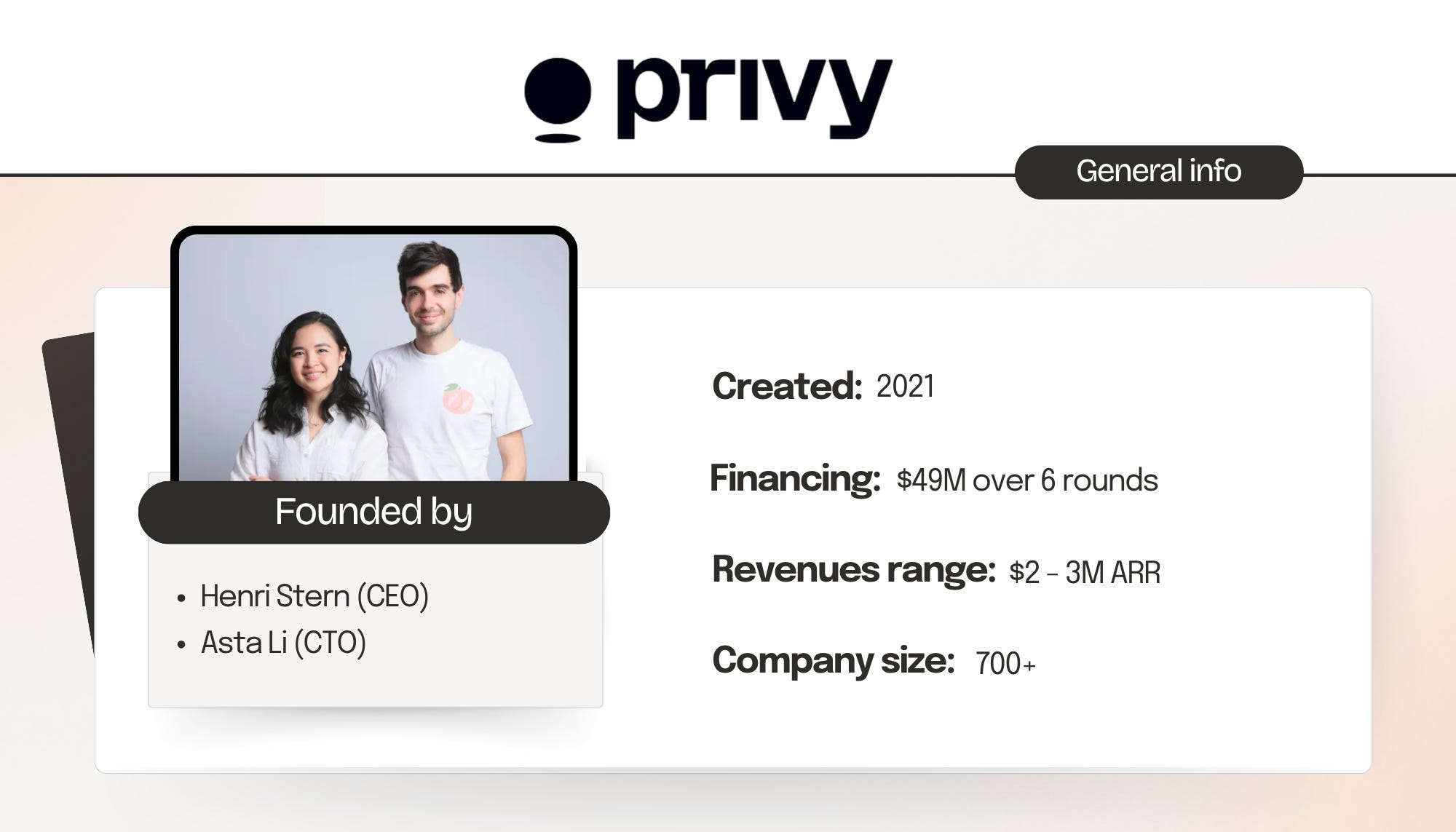
~2,000 customers worldwide
~130 million wallets deployed
Team of roughly 30 people before joining Stripe
Acquired by Stripe in 2025
Customers include Bitso, Hyperliquid, Uniswap, Ramp, Deel, Gusto, Clara, Rem, and Stripe itself
Privy sits at the intersection of fintech and crypto infrastructure. Instead of asking users to install wallets, manage seed phrases, and learn blockchain mechanics, the company allows developers to embed wallets directly into their products. The core belief is simple: users should benefit from crypto infrastructure without becoming crypto experts.
As stablecoins became increasingly useful for global payments, payroll, and financial services, Privy positioned itself as the wallet layer that makes those experiences accessible to mainstream users.
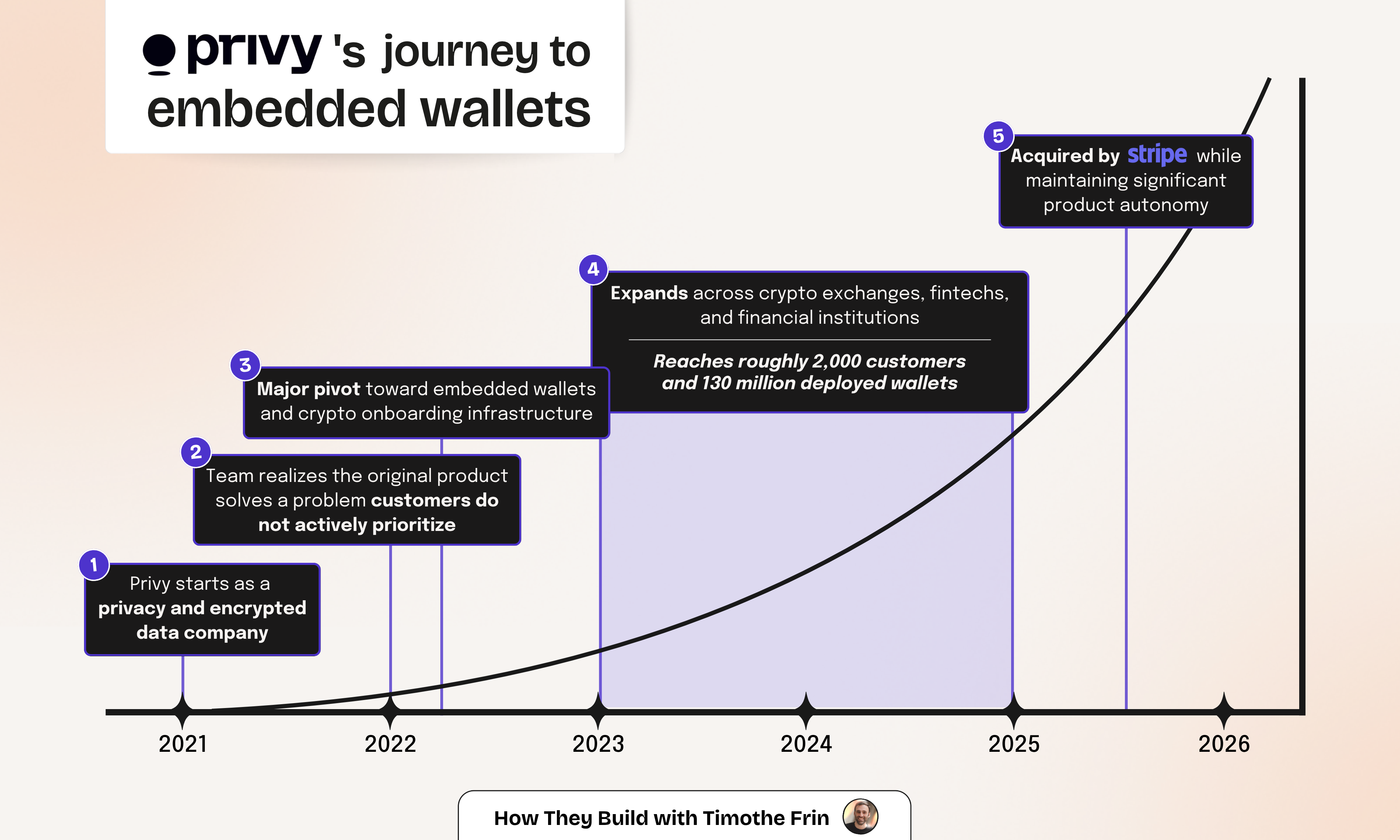
2021: Privy starts as a privacy and encrypted data company.
2022: Team realizes the original product solves a problem customers do not actively prioritize.
2022: Major pivot toward embedded wallets and crypto onboarding infrastructure.
2023-2025: Expands across crypto exchanges, fintechs, and financial institutions.
Reaches roughly 2,000 customers and 130 million deployed wallets.
2025: Acquired by Stripe while maintaining significant product autonomy.
David sat down with Henri Stern, Co-founder and CEO of Privy, to discuss how crypto infrastructure becomes useful when builders focus relentlessly on user experience instead of technology.
Disclaimer: The organizational choices and technical solutions shared in this newsletter aren’t meant to be copied and pasted as-is. Always keep your company’s context in mind before adopting something that works elsewhere! 😊Most crypto founders start with crypto. Henri Stern started with privacy.
Before building Privy, he spent years working in cryptographic research and became convinced that powerful infrastructure was being developed faster than real users could adopt it. The technology kept improving. The user experience barely moved.
The first version of Privy focused on protecting user data and helping companies encrypt sensitive information. From a technical perspective, the problem was real. From a customer perspective, it was not urgent enough. Buyers acknowledged the issue but rarely prioritized solving it.
That disconnect became the company’s first major lesson.
Instead of asking whether the technology was valuable, the team started asking whether customers were actively trying to solve the problem.
Henri describes this shift as moving away from fighting the market.
“It’s always a bad idea to try to convince the market of its needs” - Henri Stern
The breakthrough came when the team noticed a different pain point emerging. Developers wanted to create crypto products for mainstream users. Existing wallets required users to install extensions, download separate applications, manage recovery phrases, and understand blockchain mechanics. Every additional step reduced adoption.
Privy realized the opportunity was making wallets disappear.
That insight became the foundation of embedded wallets. Developers could integrate crypto accounts directly inside their products while users interacted with familiar onboarding flows. The underlying infrastructure remained powerful, but the complexity became invisible.
The team also made an important strategic decision early.
Rather than chasing every possible use case, they focused on crypto-native companies that desperately needed better onboarding. Those customers felt the pain immediately. They provided a smaller initial market, but one with urgency.
As stablecoins became more practical for payments and financial services, the market expanded naturally around them.
One of the strongest lessons from Henri’s journey is that technological sophistication alone rarely drives product adoption.
For years, the crypto industry focused on improving infrastructure, decentralization, protocols, and technical capabilities. Yet mainstream adoption remained limited, largely because many products were designed for people who already understood how crypto worked.
Privy was built on the belief that users should be able to benefit from the technology without having to understand its underlying complexity. Henri often compares crypto infrastructure to email. Billions of people send emails every day without knowing anything about SMTP or the protocols that make it possible. Adoption happens when technology fades into the background and useful experiences take center stage.
That philosophy shaped every product decision at Privy. Wallets were embedded directly into applications, and much of the underlying complexity was handled behind the scenes by developers. Features such as account recovery could be streamlined, allowing users to focus on the experience itself. In this way, crypto infrastructure became an invisible layer that enabled better products rather than a destination in its own right.
The same philosophy influenced how Privy brought its product to market. The company deliberately avoided selling an ambitious vision of the future and focused instead on demonstrating immediate value. As Henri explains, conversations centered on what customers could do today rather than on what the market might look like years from now.
That discipline is particularly important in emerging industries, where founders can easily become captivated by future potential. Customers, however, buy solutions to current problems. Privy’s customers were looking for practical outcomes: expanding internationally, moving money more efficiently, simplifying user onboarding, and launching products faster. Stablecoins simply happened to be an effective tool for achieving those goals.
The lesson extends far beyond crypto. Every technical founder eventually faces the same challenge: users do not experience architecture, they experience outcomes. Products win when the value they deliver is clear, while the technology that enables it remains largely invisible.
A recurring theme in Henri’s thinking was the importance of becoming a meaningful part of a customer’s workflow. At Privy, this idea was reflected in a simple internal principle: “If we went down, customers should notice.” The extent to which customers relied on the product became an important signal of its value and relevance.
That perspective shaped how the company approached product-market fit. Beyond acquiring customers, the goal was to become deeply integrated into the way they operated on a daily basis.
One moment brought that reality into focus. When an AWS outage affected part of Privy’s infrastructure, customers began reaching out within minutes to understand what was happening. While the incident created immediate pressure for the team, it also highlighted how closely customers had come to rely on the platform in their own operations.
This level of integration became an important benchmark. Products may attract frequent usage, but long-term value is often reflected in the role they play within critical workflows. The more essential the workflow, the greater the impact when the product is unavailable.
Privy’s early focus was on becoming a foundational layer within crypto applications, a market where customer needs were immediate and clearly defined. Operating in that environment provided rapid feedback, demanding product requirements, and frequent opportunities to improve the platform. Over time, those learnings helped strengthen the infrastructure and prepare it for a broader range of use cases.
As stablecoins gained traction in areas such as payroll, remittances, and financial services, the same infrastructure was able to support a much larger set of customers and applications. The company’s growth was built on a foundation of deep adoption within a focused market, which later enabled expansion into adjacent opportunities.
This progression illustrates a common pattern among enduring infrastructure businesses: value is established through consistent integration into customer workflows, and scale follows as that foundation expands across new markets and use cases.
Stripe’s acquisition of Privy provides an interesting example of what successful integrations look like.
Many acquisitions fail because the acquiring company absorbs the startup completely. Product velocity slows. Teams lose autonomy. Customers experience uncertainty.
Privy approached the process differently.
According to Henri, one of the key discussions with Stripe centered on preserving independence over roadmap decisions and operating speed. The crypto market evolves rapidly, and maintaining responsiveness was essential.
The cultural alignment already existed.
Privy had long viewed Stripe as a benchmark for building elegant APIs and financial infrastructure. Henri even recalls pitching investors using a framework built around what Stripe might look like if it entered this category.
The acquisition therefore created leverage rather than replacement.
Privy gained:
Access to Stripe’s infrastructure.
Distribution across a larger customer base.
Deeper integration opportunities.
Increased ambition and scale.
Meanwhile Stripe gained:
Wallet infrastructure expertise.
Embedded crypto capabilities.
A proven platform already adopted across the ecosystem.
“The goal was essentially do no harm. We had to protect Privy’s growth” - Henri Stern
A notable detail is that the teams spent more time aligning around culture, product direction, and Stripe’s role within crypto than detailed organizational planning. Henri believed that once strategic alignment existed, operational details could follow.
That mindset likely explains why the integration appears to have progressed smoothly.
Privy’s growth was closely tied to the evolution of the market it served.
When the company was founded, most crypto products were built for crypto-native users. Over time, however, stablecoins began finding applications in a much broader range of financial workflows, including payroll, remittances, international transfers, agent payments, and embedded fintech experiences. In many cases, end users interact with these services without even realizing that crypto infrastructure powers them behind the scenes.
Throughout this evolution, Privy’s core thesis remained consistent: crypto infrastructure would create the most value when it became invisible to users. As adoption expanded across new categories, an increasing number of use cases reinforced that view.
Reflecting on the company’s journey, Henri often emphasizes the importance of clarity in what a startup is betting on.
“Your startup should succeed or fail on one bet” - Henri Stern
For Privy, that bet was straightforward: the market for stablecoins and crypto infrastructure would continue to grow. With that assumption in place, the company could focus its energy on execution : building reliable wallet infrastructure, improving developer tools, and serving customers effectively.
This mindset also informed how Henri thinks about market selection. Founders can enter a large existing market or position themselves within a smaller market that is expected to expand significantly over time. In either case, the objective is to keep the number of fundamental assumptions as limited as possible, allowing the company to concentrate on solving customer problems and delivering value.
Privy’s experience illustrates the benefits of that approach. By focusing on its core infrastructure product while the stablecoin ecosystem matured, the company was well positioned to support a growing range of financial applications as demand expanded.
More broadly, the lesson is one of focus. A clear market thesis provides direction, but long-term outcomes are often determined by the quality and consistency of execution that follows.
Some of Privy’s most valuable lessons emerged through experience.
In its early years, the company spent nearly a year pursuing a direction that ultimately generated limited customer demand. The technology worked as intended, but adoption remained slower than expected. Over time, customer feedback made it clear that the team needed to adjust its focus, leading to an important pivot.
Looking back, Henri sees that period as a reminder of how closely product development and market demand need to align. Building a successful product is not only about solving a problem technically; it also requires addressing a problem that customers actively prioritize. The strongest signals often come from observing where customers naturally invest their time, attention, and resources.
A different challenge emerged as stablecoin adoption accelerated. New use cases created demand for additional infrastructure capabilities, prompting Privy to launch Server Wallets alongside its existing Embedded Wallets product. While this approach allowed the company to move quickly, customers increasingly viewed both products as part of a single workflow. Feature requests frequently spanned both offerings, making it harder to maintain clear product boundaries and creating additional complexity for the team.
As customer needs evolved, Privy concluded that a more unified platform would better serve developers. The company eventually rebuilt parts of its infrastructure and brought capabilities together within a more integrated experience, simplifying both the product architecture and the customer journey.
For Henri, these experiences reinforced an important principle: platform evolution is often driven by changing customer requirements. As markets mature and new use cases emerge, infrastructure must evolve accordingly while preserving simplicity for the people building and using products on top of it.
Viewed through that lens, pivots and product adjustments are not interruptions to the journey. They are part of the process of discovering where value is created and how customer needs are changing over time. Each iteration helped Privy better understand the role it could play within a rapidly evolving ecosystem.

The strongest product opportunities often emerge when founders stop selling technology and start solving problems customers already prioritize.
Embedded experiences consistently outperform standalone experiences when adoption depends on reducing user education and onboarding friction.
Becoming mission-critical for a narrow customer segment creates stronger foundations than being mildly useful to a broad market.
Product-market fit becomes clearer when customers immediately notice outages, workflow interruptions, or service degradation.
Founders should avoid making multiple strategic bets simultaneously and concentrate uncertainty into a single market assumption.
Market expansion can create extraordinary outcomes when companies establish category leadership before demand reaches mainstream adoption.
Successful acquisitions require alignment around culture, product philosophy, and strategic direction before operational integration.
Infrastructure products create disproportionate value when they make underlying complexity invisible to end users.
Platform evolution often requires architectural reinvention rather than creating additional overlapping products.
Customer behavior provides better strategic guidance than founder conviction when deciding whether to persist or pivot.
The most durable crypto products may ultimately be the ones users never recognize as crypto products.
Great developer platforms become essential layers inside customer workflows rather than optional enhancements.
Dive deeper into this topic with Henri Stern, Co-founder and CEO of Privy, in this episode:

Enjoyed this newsletter? Share it with your network using the button below—your support means a lot!
No posts
Comments
Nothing yet. Say the first thing.
Sign in to join the conversation.