
Hey, I’m Timothe, cofounder of Stellar & based in Paris.
I’ve spent the past years helping 500+ startups in Europe build better product orgs and strategies. Now I’m sharing what I’ve learned (and keep learning) in How They Build. For more: My Youtube Channel (🇫🇷) | My Podcast (🇫🇷) | Follow me on Linkedin.
If you’re not a subscriber, here’s what you’ve been missing:
How Front is turning product teams into AI-powered growth engines
Inside Amplitude’s journey to enterprise-scale Product analytics
Most product teams spend their days optimizing what happens inside their product.
Timeleft spends its days optimizing what happens after users close it.
Every week, thousands of people open the app, answer a few questiticket for an experience (dinner, coffee, drink or run), and then put their phones away. For two hours, the product disappears. The experience unfolds around a table or during a run, where six strangers meet for the first time.
That simple constraint changes almost every rule of product management.
Instead of optimizing engagement loops or recommendation algorithms, the team focuses on something much harder: increasing the chances that a meaningful conversation happens once the app is out of the picture.
That raises a completely different set of product questions. How do you build a product when the value is created by people rather than software? How do you measure success when your users spend almost no time inside the application? And how do you know where the product ends and the community begins?
To answer those questions, I sat down with Luba Vyaznikova, VP of Product at Timeleft after my episode in French with Maxime (Timeleft’s CEO). After building consumer products at API.ai and spending several years leading product teams at Badoo, she now helps scale one of Europe’s fastest-growing social products.
Disclaimer: The organizational choices and technical solutions shared in this newsletter aren’t meant to be copied and pasted as-is. Always keep your company’s context in mind before adopting something that works elsewhere! 😊Most social apps are designed to keep people online.
Timeleft was designed to get them offline.
The company’s premise is almost deceptively simple. Every week, strangers are matched into small groups, assigned to a location, and invited to share a moment together. The experience is intentionally simple. Users answer a few questions, let the matching system build their group, and show up.
Behind that simplicity lies a much harder product challenge.
Unlike a SaaS product, where software creates most of the value, Timeleft only creates the conditions for value to emerge. The app can recommend a restaurant, build compatible groups, and make the logistics effortless. But it can’t make six strangers enjoy each other’s company. That part happens entirely outside the product.
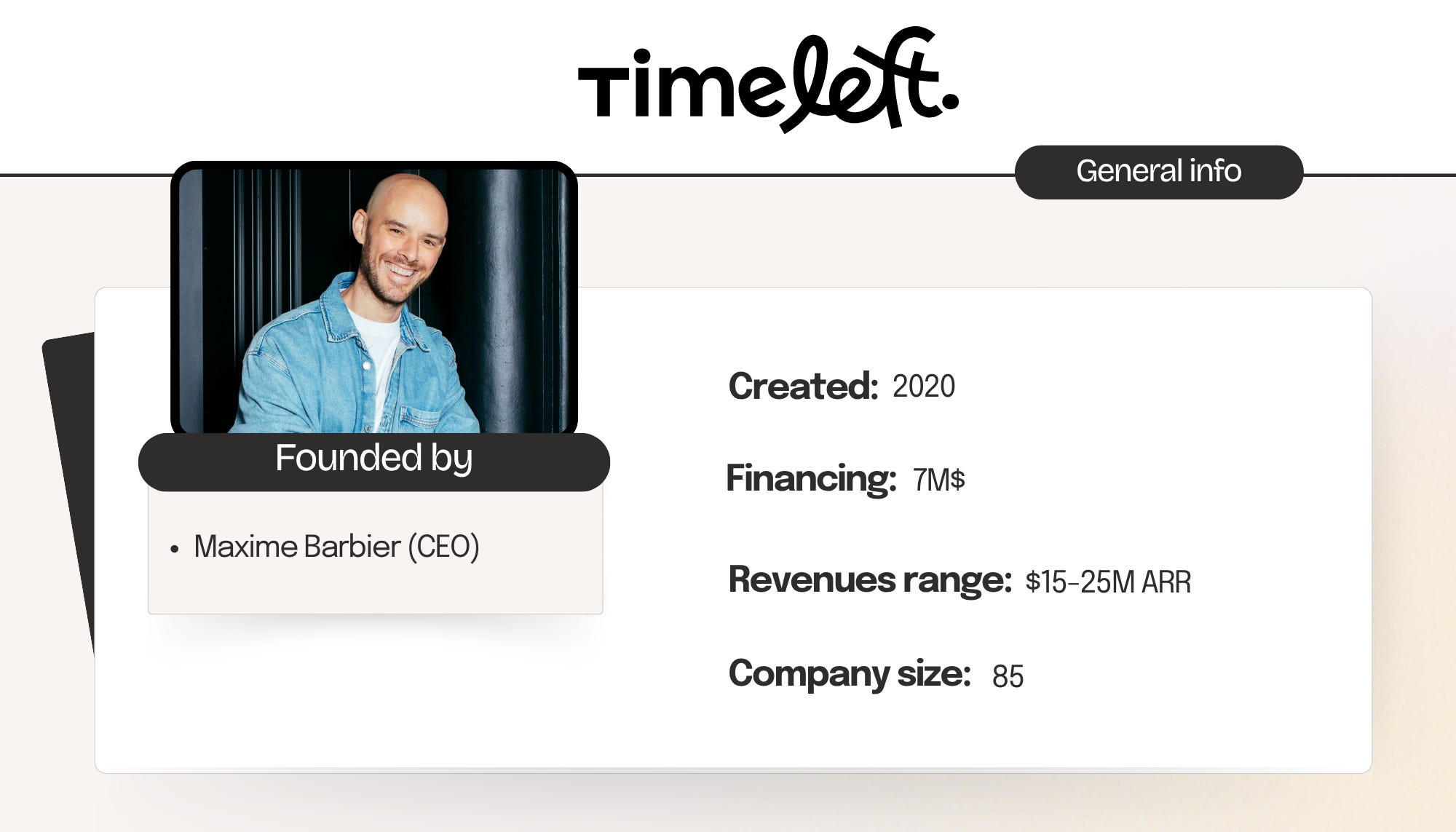
Over the past few years, the company has expanded far beyond its original dinner format. Alongside weekly dinners, Timeleft now organizes coffee meetups, running groups, and drinks across more than 160 cities. According to Luba, the platform welcomes around 150,000 participants every month and generates approximately $18 million in annual recurring revenue.
Listening to Luba, I realized that Timeleft doesn’t really think of itself as building software.
It thinks of itself as designing an ecosystem.
And once you adopt that mindset, almost every product principle changes.
People create the value in network-effect products, while software creates the conditions for those interactions to happen.
That idea shapes the way Timeleft approaches product development. The team approaches every product decision through its impact on the community as a whole. Pricing, matching, onboarding, and cancellation policies all shape who joins the platform, how people behave, and ultimately the quality of the experience around the dinner table.
Most product teams evaluate decisions through the lens of the individual user. They improve onboarding to increase activation, simplify pricing to boost conversion, or redesign a feature to improve engagement. Each decision is measured by its impact on a specific step of the user journey.
Timeleft designs for the ecosystem.
Luba shared a simple example that illustrates this perfectly. Like many subscription products, Timeleft’s biggest drop-off happens at the paywall. The team tested a free version in one market, expecting more sign-ups to create a better product.
Sign-ups increased. So did cancellations.
With less commitment, more participants failed to show up, leaving incomplete tables and affecting the experience of everyone else. The interface remained exactly the same, but the dynamics of the community changed entirely.
The experiment revealed that pricing was doing much more than generating revenue. It also encouraged commitment. Every payment represented a small investment that increased the likelihood of people showing up, and every participant who attended contributed to a better experience for the rest of the group.
Luba drew a parallel with Bumble’s decision to let women send the first message. While often described as a product feature, it also shaped the community by influencing who chose to join the platform and how people interacted once they arrived.
The same principle applies to every network-effect product. Product decisions rarely affect a single user in isolation. They influence the incentives, behaviours, and composition of the community, which ultimately determine the value the product creates.
Most product teams optimize what happens inside their product.
Timeleft has to optimize what happens after users leave it.
That creates an unusual challenge: how do you measure an experience you don’t control?
“The reality is that we can’t create chemistry between people. What we can do is maximize the chances that it happens” Luba explained.
Instead of searching for a perfect metric, the team relies on a collection of signals. After each event, participants rate their experience through an Experience Score. They also track whether guests continue chatting after the event, book another experience, or recommend Timeleft to friends. None of these metrics proves that meaningful connections were made, but together they provide a reliable picture of whether the product is creating value.
This reflects a broader principle of product management. Teams often search for a single KPI capable of capturing success. In reality, the most valuable outcomes are sometimes impossible to observe directly. Trust between teammates, confidence in a product, or genuine human connection cannot be measured with a single metric.
What can be measured are the behaviours that consistently follow those outcomes.
For Timeleft, the goal is to create the right conditions for meaningful connections to happen, then use the signals those interactions leave behind to understand whether the experience delivered value.
Retention has become one of product management’s favorite metrics. Open almost any growth playbook and you’ll find the same objective: increase engagement, create habits, make users come back more often. Products with daily usage are often treated as the gold standard, leading many teams to believe that stronger retention is always a sign of stronger product-market fit.
Like many consumer startups, Timeleft tried to encourage users to attend more experiences. The assumption seemed obvious: if people enjoyed the experience, they should naturally want to come back more often. But over time, the team realized they weren’t fighting a product problem. They were fighting human behavior.
To explain this, Luba uses a simple analogy. Imagine taking the best flight of your life from London to Barcelona. The seats are comfortable, the service is exceptional, and everything exceeds your expectations. That experience doesn’t suddenly make you want to fly to Barcelona every week. The product isn’t the limiting factor, the need is.
Timeleft follows the same logic. Meeting five strangers is a high-commitment activity. It requires time, energy, and a willingness to step outside your comfort zone. Even the happiest customers won’t necessarily want to repeat that experience every Wednesday, and that’s perfectly normal.
That realization fundamentally changed how the team thinks about growth. Timeleft focuses on being the first product people think of whenever they want to meet new people. Growth comes from being present when that need arises naturally, rather than changing how often it occurs.
It’s a useful reminder that every product has its own rhythm. Some products solve problems that occur every day, while others address needs that appear only occasionally. Chasing Instagram-like retention for every business can easily become an optimization exercise detached from the reality of users’ lives.
“Users are great at describing their problems, but not necessarily the solution.”
It’s an idea that’s often repeated in product circles, yet few examples illustrate it as clearly as the ones Luba shared.
Working on consumer products means dealing with constant feedback. App Store reviews, support tickets, surveys, social media comments, everyone has an opinion about what should be built next. The temptation is to treat that feedback as a roadmap. Luba believes that’s one of the fastest ways to build the wrong product.
She recalls a feature from her time at Badoo that allowed users to pay to message someone before matching. On paper, it looked like a terrible experience. Women disliked receiving unsolicited messages, while many men complained about paying for messages that never received a reply. Both sides were unhappy, and every new Product Manager joining the team suggested removing the feature.
The data told a different story.
Every time the team tested removing it, one of their most important metrics dropped: the number of meaningful conversations taking place on the platform. Despite generating complaints, the feature was helping more people connect. Eliminating it solved a visible frustration but reduced the overall value created by the product.
Users’ frustration was genuine. The challenge for the product team was to understand how that feedback fit within the broader ecosystem before making a decision.
The same pattern appears at Timeleft. One of the most common complaints the team receives is about the paywall. Users naturally ask why they should pay to meet with strangers. Taken at face value, the solution seems obvious: remove the subscription and let people experience the product for free.
But, as the earlier experiment showed, removing the paywall didn’t improve the product, it weakened it. Participation became less reliable, no-shows increased, and the quality of the experience declined for everyone around the table. Listening to users without understanding the system would have produced the wrong decision.
This is where product judgment becomes essential.
User feedback is most valuable when it helps teams understand the problem users are experiencing. From there, it’s up to the product team to investigate, run experiments, and determine which solution creates the best outcome.
As Luba put it, the role of a product manager is to combine qualitative feedback with experiments, behavioral data, and a deep understanding of how the product works as a system.
In other words, feedback is evidence, not strategy.
Negative feedback is uncomfortable.
Every product manager has experienced it: a one-star review, an angry email, or a frustrated customer explaining why the product failed them. The instinct is often to treat those users as churn risks and move on.
Luba sees them differently.
Because Timeleft sits at the intersection of loneliness, friendship, and dating, emotions run high. A disappointing dinner can feel deeply personal. Many participants arrive hoping to meet someone interesting, make new friends, or simply enjoy a memorable evening. When those expectations aren’t met, they’re often eager to share their experience.
Counterintuitively, that’s rarely the feedback the team worries about most.
Emotional users still care. They had expectations because the product solves a real need in their lives. If Timeleft can understand what went wrong (too many no-shows, the wrong venue, poor logistics) there’s a good chance they’ll come back. Those problems are tangible, and in many cases, they’re fixable.
The more worrying response is indifference.
When someone says “It was fine” or “It just wasn’t for me,” there’s often very little to work with. The experience wasn’t memorable enough to create excitement, but it wasn’t disappointing enough to trigger frustration either. More importantly, it may signal that the product simply isn’t solving a meaningful problem for that person.
That distinction also shapes how the team responds to negative experiences.
Whenever possible, Timeleft reaches out to disappointed participants and tailors the recovery to the reason behind their feedback. A poor venue can be changed. A dinner affected by no-shows deserves another chance. Those conversations aren’t just about customer support, they’re about rebuilding confidence in the product.
Some problems, however, remain outside the team’s control.
If someone leaves saying, “I just didn’t click with anyone,” there is no feature that guarantees a better outcome next time. Human chemistry isn’t something software can engineer. The product can only improve the odds.
Building a social product means understanding which parts of the experience can be designed and which ultimately depend on the people using it. Great product teams improve the conditions for meaningful interactions while leaving room for human connection to unfold naturally.
Few topics are reshaping product management as quickly as AI.
Like most product teams, Timeleft has embraced it. Engineers write code faster, support teams automate repetitive tasks, and product managers can query data in seconds instead of waiting days for an analyst. For Luba, this is where AI delivers its greatest value: accelerating execution.
Before joining Timeleft, answering a simple product question often meant going back and forth with a data team. Today, product managers can ask AI to analyze a user segment, compare experiments, or generate a report almost instantly. That speed changes how teams work. It removes bottlenecks and gives product managers much greater autonomy.
But that’s where Luba draws the line.
For Luba, AI is transforming many parts of product management, from data analysis to documentation. Product decisions, however, still rely on context, trade-offs, and judgment, the elements that shape the answer to the hardest question every team faces: what should we build next?
To explain why, she uses an analogy that perfectly captures the limitation of today’s models. Ask ChatGPT or Claude how to become a good father and you’ll probably receive sensible advice. Spend time with your children. Listen carefully. Be patient. They’re all good recommendations.
Following them, however, doesn’t automatically make someone a good father.
Product management works the same way.
The hardest product decisions require teams to interpret context, balance competing priorities, and make choices with incomplete information. Those responsibilities continue to rely heavily on judgment.
Ironically, AI makes this distinction even more important. As execution becomes cheaper, the quality of decisions becomes the real competitive advantage. Shipping features faster has little value if teams are simply building the wrong things more efficiently.
Luba also pointed to an idea from Andreessen Horowitz’s article Institutional vs. Individual AI. AI has dramatically increased individual productivity, but that hasn’t necessarily translated into more valuable companies. Most organizations have adopted new tools without fundamentally changing how they make decisions.
Timeleft has experienced this first-hand. Ask the same question to three employees using the same AI assistant and you’ll often get three different answers, each shaped by their own history, context, and conversations with the model. AI is highly personal. Organizations, however, still need shared judgment.
That’s why Luba believes the role of product managers is evolving rather than disappearing.
The repetitive parts of the job (writing reports, exploring data, documenting decisions) are becoming increasingly automated. But the hardest part of the role remains exactly the same: deciding where to place the next bet.

Design products as ecosystems. In network-effect businesses, every product decision shapes the community as much as the user experience.
Measure the behaviors that create value. When success happens outside the product, proxy metrics can provide a more accurate picture than a single North Star metric.
Build around real user needs. Product success isn’t about maximizing usage—it’s about being the best solution when the need arises.
Use user feedback to understand problems. Feedback is a valuable input, but product decisions should be validated through experiments and behavioral data.
Accept what your product can’t control. Great products remove friction and create the right conditions, but some outcomes—like human chemistry—will always remain outside the product team’s control.
Use AI to execute faster. AI is becoming an excellent tool for analysis and execution, while product judgment remains essential for deciding what to build next.
Dive deeper into this topic with Luba Vyaznikova, VP of Product of Timeleft, in my latest episode:

Enjoyed this newsletter? Share it with your network using the button below—your support means a lot!
No posts
Comments
Nothing yet. Say the first thing.
Sign in to join the conversation.