
Hey, I’m Timothe, cofounder of Stellar & based in Paris.
I’ve spent the past years helping 500+ startups in Europe build better product orgs and strategies. Now I’m sharing what I’ve learned (and keep learning) in this newsletter. For more: My Youtube Channel (🇫🇷) | My Podcast (🇫🇷) | Follow me on Linkedin.
If you’re not a subscriber, here’s what you’ve been missing:
How Front is turning product teams into AI-powered growth engines
Inside Amplitude’s journey to enterprise-scale Product analytics
Every AI conversation seems to end the same way.
Someone predicts that Product Managers will disappear. Another argues that engineering teams will shrink by half. A third insists that companies adopting AI today will inevitably outperform everyone else tomorrow.
Inside product organizations, however, the conversations are often far more pragmatic. Leaders are trying to understand where AI actually creates value, which workflows genuinely improve, how roles evolve, and which parts of product development remain fundamentally unchanged.
That gap between the public narrative and the reality on the ground is what made this discussion so interesting.
I sat down with Geoffrey Janvier, Nathalie Edlinger and Arthur Rougier to explore how AI is reshaping Product and Engineering organizations from the inside. Between them, they have led teams across startups, scale-ups and some of Europe’s largest software companies, experimenting with AI across product development, engineering, leadership and organizational design. Their experience offers a practical view of what is changing today, beyond the hype.

As the discussion unfolded, one idea kept resurfacing.
AI certainly accelerates coding, documentation and many individual tasks. But its most significant impact comes from the way it reshapes collaboration across teams.
Product Managers spend less time writing detailed specifications and more time creating shared context. Engineers move from producing every line of code to reviewing, orchestrating and guiding increasingly autonomous systems. Leaders stop thinking about individual productivity gains and start redesigning how entire organizations operate.
The companies creating the most value from AI are combining powerful models with new ways of working. As teams redesign how they collaborate, the transformation becomes organizational as much as technological.
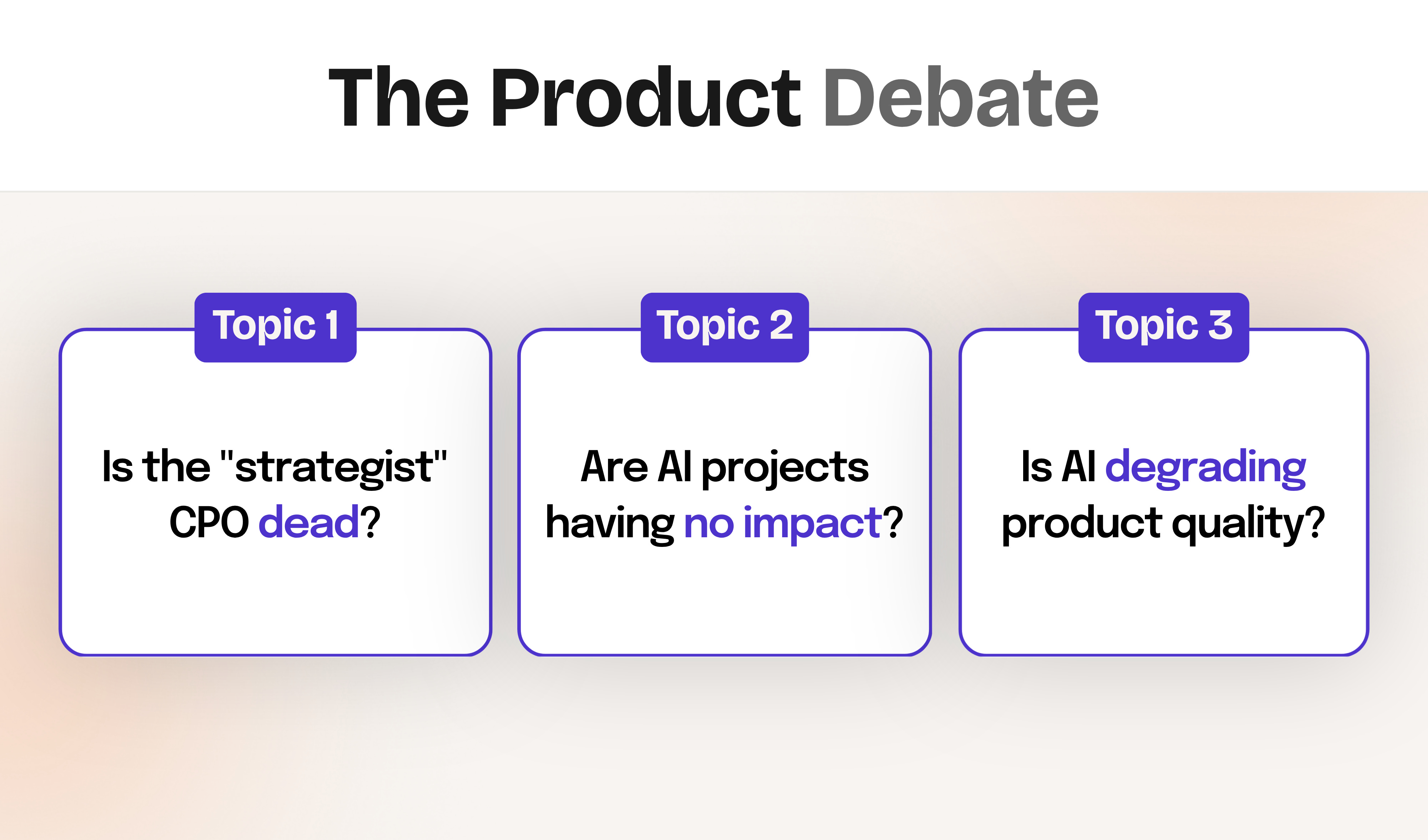
Disclaimer: The organizational choices and technical solutions shared in this newsletter aren’t meant to be copied and pasted as-is. Always keep your company’s context in mind before adopting something that works elsewhere! 😊One of the strongest ideas to emerge from the discussion was that AI isn’t making Product less strategic. It’s changing where product leaders spend their time.
Over the past decade, senior Product Managers and CPOs have gradually moved away from execution. As organizations scaled, their role became increasingly focused on prioritization, stakeholder management and organizational alignment. Discovery often ended with a specification handed over to Engineering, while turning an idea into something tangible depended on available development capacity. AI is starting to remove that dependency.
Geoffrey described this as a new form of independence for Product teams. Instead of relying on engineers for every prototype, proof of concept or early experiment, Product Managers can now validate ideas on their own. They can explore different directions, discard weak concepts and iterate several times before involving Engineering. By the time engineers join the process, product assumptions have already been tested, allowing their expertise to focus on building solutions with greater confidence and impact.
Nathalie illustrated this shift with a concrete example from her own team. Like many product organizations, they had accumulated dozens of small improvements that everyone agreed would make the product better, yet none of them ever reached the top of the roadmap. Larger initiatives always took priority. Once AI-assisted development enabled Product to contribute directly to small changes, those long-forgotten improvements suddenly became achievable. Individually, each change was almost invisible. Collectively, they created a noticeably better user experience. The value came from unlocking work that nobody previously had the capacity to tackle.
Arthur believes this evolution reinforces the essence of Product rather than changing it. As software becomes easier to build, competitive advantage shifts toward understanding customers well enough to identify the right opportunities. Product Managers spend less time translating ideas into exhaustive specifications and more time observing users, collecting context and validating assumptions. AI can generate solutions remarkably well, but only if someone provides the right problem to solve.
Taken together, these perspectives point toward the same conclusion. The role of Product leadership is expanding. The strongest product leaders will combine deep customer understanding with enough technical autonomy to explore ideas independently, learn faster and bring Engineering opportunities that are already backed by evidence rather than intuition.
For years, one of the PM’s core responsibilities was to translate customer problems into detailed specifications. The better the specification, the smoother the delivery. Entire product organizations optimized around this handoff, refining user stories, edge cases and acceptance criteria to reduce uncertainty before engineering started building.
The discussion suggests that this model is quietly becoming obsolete.
The discussion highlighted an evolution in the role of specifications. Large language models don't depend on lengthy requirement documents; they depend on context. As Nathalie pointed out, an AI system can generate remarkably good outputs when it understands the problem it is solving, who it is solving it for and the constraints it must operate within. The quality of that context often matters more than the formatting or level of detail of the specification.
Arthur extended this idea by describing how the Product Manager’s role is evolving. As AI increasingly supports implementation ideas, interface exploration and solution generation, Product Managers can dedicate more time to understanding customers. Observing users during onboarding, uncovering why sales teams develop workarounds and recognizing the subtle signals that reveal unmet needs remain essential parts of product discovery. Those human insights provide the context that enables both teams and AI systems to build better products.
This changes the nature of product work. Competitive advantage increasingly comes from building a rich understanding of customers, the business and the product itself. That context becomes the foundation AI relies on to generate useful outputs. The richer the context, the more relevant the results. When context is incomplete, AI can still produce convincing work, but it is far more likely to miss the real problem.
Interestingly, Geoffrey connected this evolution to a broader organizational shift. If Product teams can validate ideas independently and AI can handle a growing share of execution, engineering is no longer waiting for specifications to arrive. Instead, Product and Engineering progressively converge around the same objective: reducing uncertainty before committing significant resources. In that world, the specification stops being the central artifact. Shared understanding becomes the asset that matters most.
Seen through that lens, the Product Manager’s role continues to evolve. As AI becomes part of everyday product development, the emphasis shifts from documenting solutions to creating clarity. Product Managers become responsible for capturing customer reality, framing the right questions and providing both humans and AI with the context needed to consistently make good decisions.
At one point, the conversation shifted away from Product altogether.
The discussion became less about prompts, copilots or coding assistants, and more about a question that every executive is currently asking: where is the ROI?
Surprisingly, none of the three guests claimed that AI is already delivering spectacular returns inside established companies. Quite the opposite. They described organizations that are experimenting extensively, adopting new tools at an impressive pace and generating plenty of excitement, while still struggling to demonstrate measurable business impact.
Geoffrey described this as a natural phase in AI adoption. Most companies are still investing in learning how these technologies fit their own environment, experimenting with new workflows and identifying where AI creates meaningful value. Like any significant operational change, productivity gains emerge gradually as teams adapt the way work is organized and new practices become part of everyday operations.
That’s also why Geoffrey repeatedly came back to the organization rather than the tools. Giving every employee access to the latest AI assistant doesn’t fundamentally change how a company operates. If teams continue working with the same processes, the same handoffs and the same bottlenecks, AI simply accelerates part of the chain before hitting the next constraint. The bottleneck moves. It doesn’t disappear.
Nathalie shared a similar perspective from a more operational angle. Measuring AI purely through time savings misses a large part of the picture. Sometimes AI enables work that simply wasn’t happening before. Sometimes it improves the quality of existing work. Sometimes it allows teams to test ideas that would previously have been abandoned because they were too small to justify engineering effort. None of these gains are easy to capture in a spreadsheet, yet they compound over time into a significantly better product.
Arthur added another layer to the discussion by challenging the pressure many organizations feel to deploy AI everywhere at once. In his view, many companies are still looking for use cases rather than solving concrete problems. The temptation is understandable. Every announcement creates the impression that competitors are moving faster. Yet adopting AI without first identifying where it creates real leverage often leads to expensive experiments with little lasting impact.
Taken together, their arguments suggest that AI’s impact extends beyond individual productivity to the way organizations operate as a whole. The greatest value emerges when companies redesign how teams collaborate, how decisions are made and how work flows from idea to production. In that context, AI acts as a catalyst for organizational change, encouraging new ways of working alongside technological adoption. Organizations that evolve both their practices and their systems are best positioned to capture its full potential.
Every technological shift promises the same outcome: teams will move faster.
The reality is usually more complicated.
As the discussion evolved, the three guests agreed that AI is dramatically increasing execution capacity. Software can be written faster. Prototypes can be built in hours instead of weeks. Product teams can validate ideas independently. On paper, every part of the delivery process becomes more efficient.
Yet that doesn’t automatically make organizations faster.
It simply changes where they slow down.
Arthur illustrated this with examples from companies experimenting with AI-native software development. Autonomous agents now generate a significant share of the implementation, while engineers guide, review and refine the output. This new workflow can dramatically accelerate delivery, allowing some teams to complete in a single sprint work that previously took an entire quarter.
But another problem quickly appears. The bottleneck shifts upstream.
Product Managers suddenly need to provide much richer context. Designers have to produce clearer systems. Reviews become more demanding. Releases require stronger governance. Engineering moves faster, but every interface around Engineering becomes more critical.
Geoffrey sees exactly the same phenomenon at an organizational level. One of the biggest mistakes leaders make is measuring only the productivity of a single function. If developers become twice as productive while Product, QA or DevOps continue operating exactly as before, the company hasn’t solved its problem, it has simply relocated it.
He described AI adoption as a holistic transformation rather than a local optimization. Every improvement creates pressure somewhere else in the system. Unless the organization evolves as a whole, the gains remain limited because another team eventually becomes the constraint.
That is also why Geoffrey repeatedly emphasized reskilling. As AI becomes part of everyday product development, every discipline evolves alongside it. Engineers spend more time reviewing and orchestrating. Product Managers focus more on creating context and validating opportunities. Quality teams increasingly specialize in evaluating probabilistic systems rather than deterministic software. Each function adapts as new ways of working reshape how products are built.
Nathalie added another important nuance. AI expands the range of organizational models available to product teams rather than converging toward a single blueprint. For years, companies debated the ideal ratio between Product Managers and engineers: one PM for five engineers, one for eight, one for two. Going forward, those choices will increasingly reflect each organization’s context, product complexity and ways of working.
Those discussions may become increasingly irrelevant.
Every organization will adopt AI differently. Some Product Managers will become deeply technical and spend much of their time working alongside AI systems. Others will remain focused on complex customer problems where discovery continues to dominate execution. The shape of teams will increasingly reflect the nature of the product rather than a benchmark copied from another company.
Ultimately, the discussion highlights a broader lesson about AI adoption. As technology accelerates, the strengths and weaknesses of an organization’s operating model become more visible. Companies that redesign how work flows across teams are able to amplify the benefits over time, while organizations that focus on accelerating a single function often see constraints emerge elsewhere in the system.
In other words, AI brings organizational complexity to the surface, exposing how work, decisions and collaboration flow across the company.
As the conversation drew to a close, the discussion moved away from individual teams and toward a broader question: who stands to benefit the most from AI over the next few years?
The discussion pointed toward a broader perspective on competitive advantage. Geoffrey explained that access to AI technology is becoming increasingly widespread. Organizations can now experiment with the same frontier models, coding assistants and, increasingly, the same autonomous agents. As these capabilities become more accessible, differentiation increasingly depends on how companies integrate them into their products, workflows and organizations.
The real difference lies elsewhere.
AI-native companies design their organizations with AI as a core part of how work gets done from day one. Processes, roles and decision-making evolve alongside these capabilities, creating operating models that fully incorporate AI into everyday work without being constrained by legacy structures.
Established companies face a different challenge.
Most have spent years optimizing how Product, Design, Engineering and Operations collaborate. Those processes were designed for a world where software was expensive to build and engineering capacity was the primary constraint. AI changes that assumption. Building becomes cheaper, iteration becomes faster and new bottlenecks emerge. Yet many organizations continue measuring success with the same governance, approval cycles and delivery rituals.
That is why transformation often feels slower inside larger organizations. The technology can be deployed in weeks, while changing habits, responsibilities and incentives takes months or even years. Geoffrey highlighted that this gap explains why many companies struggle to demonstrate meaningful returns despite investing heavily in AI. An organization’s ability to absorb change increasingly determines how much value it can create from AI.
Arthur added an important perspective. Established companies enter the AI era with valuable assets: long-standing customer relationships, deep domain expertise and years of accumulated product knowledge. When translated into the rich context AI systems rely on, these strengths become a powerful source of differentiation. Organizations that truly understand their customers are well positioned to generate more relevant outcomes because they provide AI with context rooted in real-world experience.
Nathalie brought the discussion back to execution. Regardless of company size, the organizations making the fastest progress are those where teams are encouraged to experiment continuously. AI capabilities evolve every few weeks, making long-term plans quickly outdated. The winning organizations are building learning loops rather than fixed playbooks. They test, adapt and share what works across the company, accepting that today’s best practice may be obsolete a month from now.
Taken together, these perspectives offer a more balanced view of the competitive landscape. AI-native companies benefit from operating models designed around AI from the outset, while established companies bring rich customer knowledge, mature products and experienced teams. As the technology continues to evolve, competitive advantage increasingly comes from an organization’s ability to learn, adapt and continuously redesign the way it operates.
If there was one warning that surfaced repeatedly throughout the discussion, it was this: many companies are approaching AI as a technology project when it should be treated as an organizational transformation.
That mindset shapes almost every mistake leaders make.
The first is adopting AI without a clear problem to solve. The pressure to “do something with AI” is immense, and many organizations respond by deploying copilots, experimenting with agents or launching internal initiatives simply because everyone else is doing the same. The technology often works exactly as expected, yet the business impact remains difficult to identify because no meaningful constraint was removed in the first place.
The second mistake is measuring success through individual productivity alone. Saving a Product Manager thirty minutes a day or helping an engineer write code faster sounds impressive, but those gains rarely translate into better outcomes if the rest of the organization continues operating in the same way. As Geoffrey explained throughout the discussion, local optimizations rarely produce systemic improvements. They simply move the constraint somewhere else.
Another recurring theme was the temptation to preserve existing ways of working while layering AI on top. Many product organizations still rely on processes that were designed when engineering capacity was scarce and software development was significantly slower. Those workflows often include multiple approval steps, extensive documentation and sequential handoffs between teams. AI accelerates execution, but those organizational structures remain exactly where they were. Before long, they become the primary obstacle to speed.
The conversation also challenged a more subtle assumption: that AI somehow reduces the importance of customer understanding. In reality, the opposite appears to be happening. As generating solutions becomes easier, identifying the right problem becomes more valuable than ever. Teams that spend less time with customers and more time experimenting with AI often discover that they are producing polished outputs without increasing customer value. The quality of the prompt can never compensate for the absence of genuine product insight.
Perhaps the most important lesson is that there is no stable destination waiting at the end of this transformation. Every guest emphasized, in different ways, that AI capabilities are evolving too quickly for fixed organizational models or permanent playbooks. The companies making the greatest progress aren’t those that believe they have already found the answer. They’re the ones continuously questioning how they work, encouraging experimentation across teams and adapting their operating model as the technology evolves.
In many ways, that may be the biggest shift of all. As AI capabilities continue to advance, organizations that continuously strengthen their ability to adapt are the ones that unlock the greatest long-term value.

AI makes software cheaper to build. It makes customer understanding and strategic judgment even more valuable.
The most effective Product leaders excel at creating rich context, enabling both humans and AI to understand problems, make better decisions and build better products.
AI expands the role of Product Managers by giving them the autonomy to explore, prototype and validate ideas before engaging Engineering.
Measuring AI through individual productivity misses the point. The biggest gains come from redesigning how teams work together.
AI reshapes the flow of work, shifting bottlenecks across the organization and making systems thinking an increasingly important capability.
Shipping faster only creates value if teams keep solving the right customer problems.
AI-native companies have a head start because they design their operating model around AI from day one.
Legacy companies can catch up by leveraging what AI can’t replicate: customer knowledge, domain expertise and strong product judgment.
The companies that will win won’t necessarily have the best models. They’ll have the fastest learning loops.
AI is ultimately an organizational challenge. Technology is the enabler, but leadership determines where value is created.
Dive deeper into this topic with these CPOs/CTOs in this episode:

Enjoyed this newsletter? Share it with your network using the button below—your support means a lot!
No posts
Comments
Nothing yet. Say the first thing.
Sign in to join the conversation.