
Hey, I’m Timothe, cofounder of Stellar & based in Paris.
I’ve spent the past years helping 500+ startups in Europe build better product orgs and strategies. Now I’m sharing what I’ve learned (and keep learning) in How They Build. For more: My Youtube Channel (🇫🇷) | My Podcast (🇫🇷) | Follow me on Linkedin.
If you’re not a subscriber, here’s what you’ve been missing:
How Front is turning product teams into AI-powered growth engines
Inside Amplitude’s journey to enterprise-scale Product analytics
Stripe was founded in 2010 by Patrick and John Collison with a simple mission: make it easier for businesses to accept payments online. What started as a developer-friendly payments API has evolved into one of the most important pieces of internet infrastructure, powering millions of businesses worldwide.
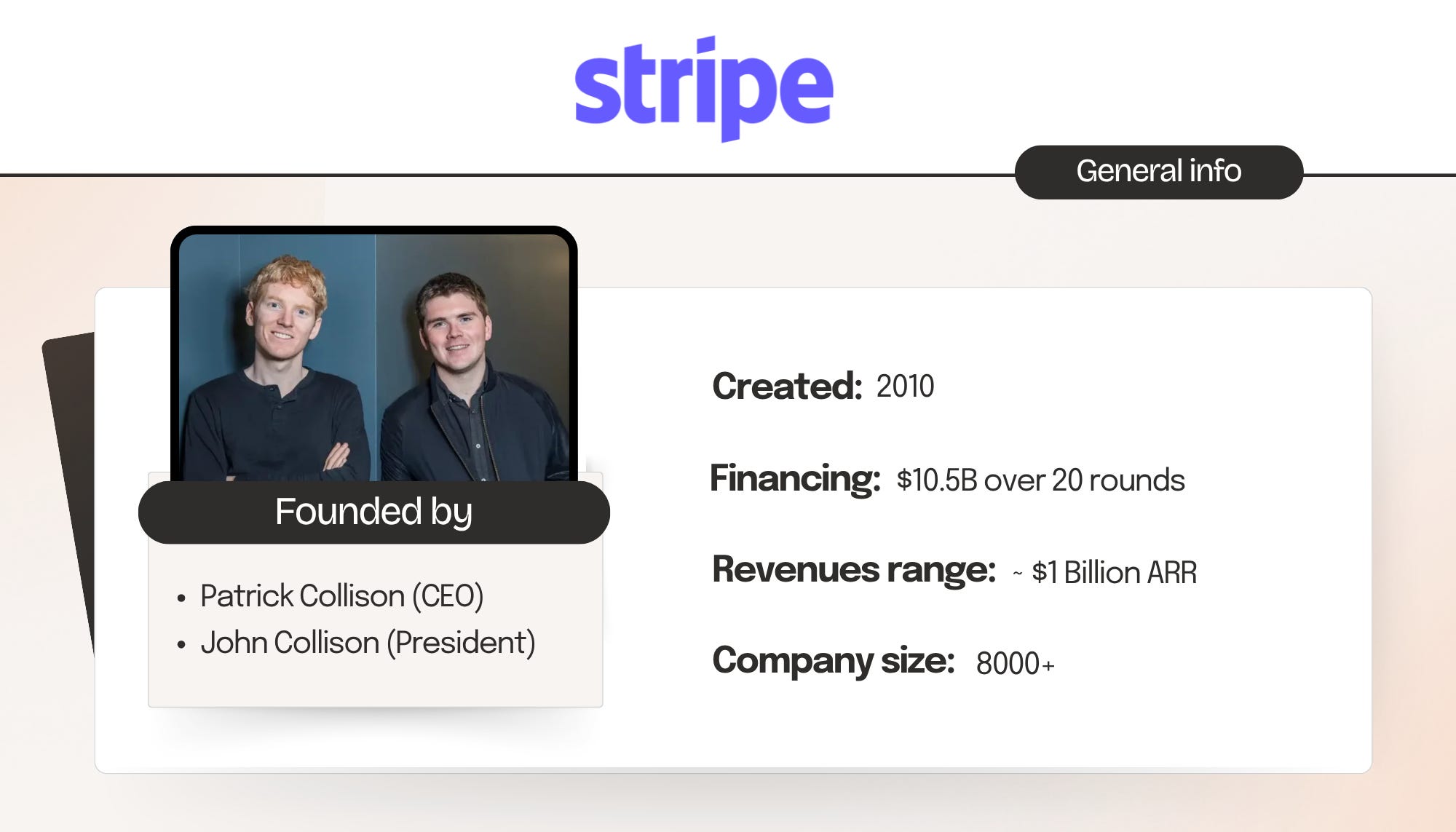
Processes payments equivalent to roughly 1.6% of global GDP
Valued at approximately $91.5B following its latest tender offer
Serves millions of businesses globally
Around 8,000 employees
Roughly 300 Product Managers across the company
Expanding beyond payments into embedded finance, issuing, lending, billing, treasury, and AI infrastructure
Stripe’s advantage has always been turning complex financial infrastructure into simple developer experiences. Over time, the company expanded from online payments into a full financial operating system for internet businesses.
Today, Stripe is betting on another major platform shift: the emergence of AI agents as economic actors. While most companies are still discussing how AI will impact their business, Stripe is already building the infrastructure layer that allows agents to discover products, make purchases, deploy software, and transact autonomously.
Instead of predicting exactly how agentic commerce will evolve, Stripe’s strategy is to provide the primitives that enable every possible future.
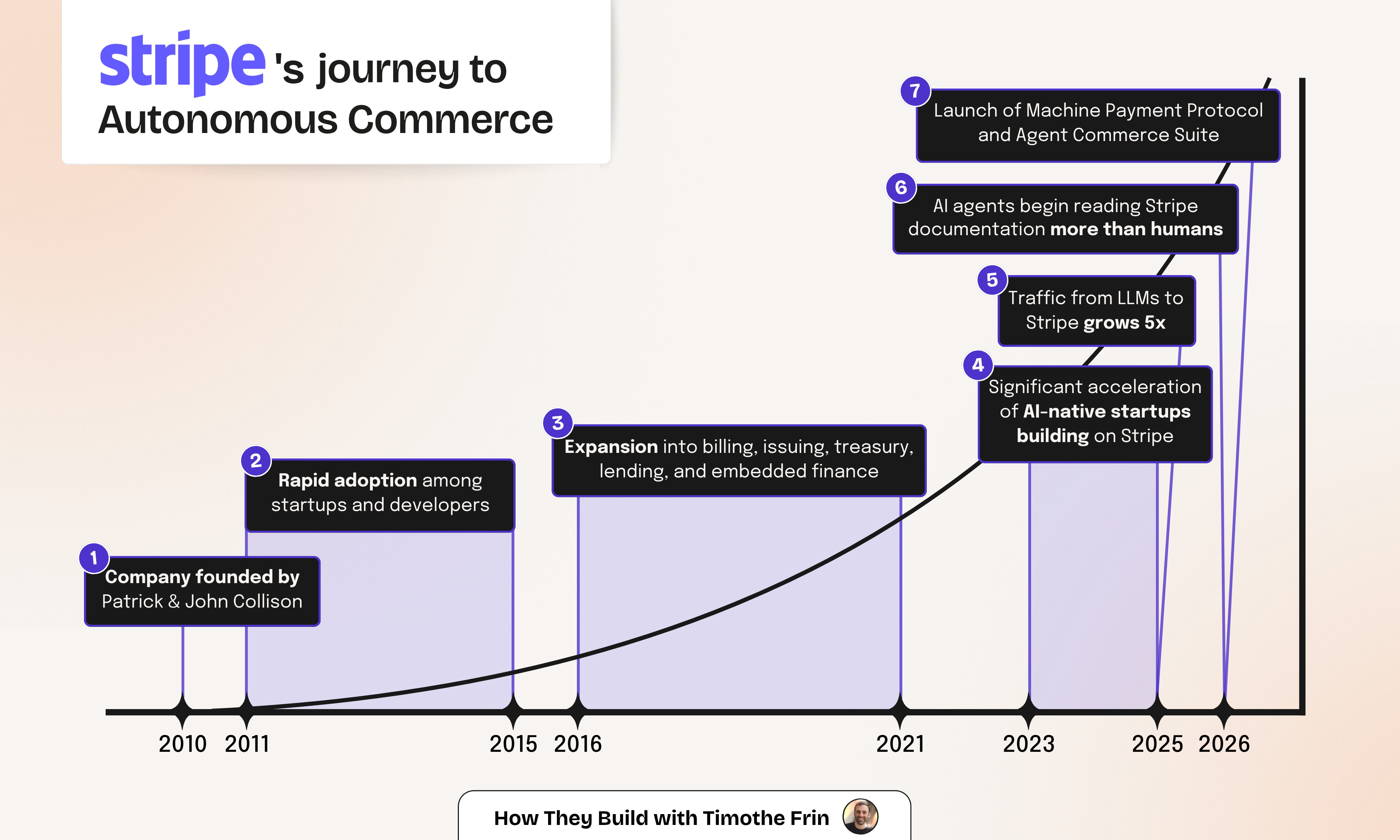
2010: Stripe founded by Patrick and John Collison
2011-2015: Rapid adoption among startups and developers
2016-2021: Expansion into billing, issuing, treasury, lending, and embedded finance
2023-2025: Significant acceleration of AI-native startups building on Stripe
2025: Traffic from LLMs to Stripe documentation grows 5x
2026: AI agents begin reading Stripe documentation more than humans
2026: Launch of Machine Payment Protocol and Agent Commerce Suite
David sat down with Arielle Le Bail, Head of Product France, Southern Europe & Benelux at Stripe, to discuss how Stripe is preparing businesses for the shift toward agentic commerce and how AI is reshaping product management itself.
Disclaimer: The organizational choices and technical solutions shared in this newsletter aren’t meant to be copied and pasted as-is. Always keep your company’s context in mind before adopting something that works elsewhere! 😊One of the most practical ideas from our conversation was Stripe’s concept of becoming “agent-ready.”
For most companies, AI is still primarily viewed as an internal productivity tool. Teams are experimenting with copilots, automating workflows, or using AI to generate content. Stripe sees a second transformation happening in parallel: AI systems are becoming a new acquisition and distribution channel.
That distinction matters because it changes where companies should focus their attention.
Historically, businesses optimized their products for humans and their websites for search engines. If a user could find a product on Google, understand what it did, and complete a purchase, the system worked. Agents introduce a completely different dynamic. They don’t navigate interfaces the way humans do, and they don’t interpret information through design, imagery, or branding.
Instead, they rely almost entirely on structured data.
According to Arielle, one of the biggest mistakes companies can make is assuming that a product catalog designed for humans will automatically work for agents. A human can infer meaning from a product image, a page layout, or marketing copy. An agent needs clean metadata, structured information, and clear descriptions that can be interpreted programmatically.
“An agent doesn’t see a dress or a pair of pants. It sees metadata” - Arielle Le Bail
This creates a new competitive advantage. Just as search engine optimization became a critical capability during the rise of Google, agent optimization may become an essential capability in the age of AI assistants.
What’s particularly interesting is that many companies are already seeing early signals of this shift without realizing it. Arielle described conversations with customers who noticed unusual traffic patterns, longer sessions, and new types of visitors appearing on their platforms. In many cases, those signals were already coming from agents interacting with products and services.
The question, according to Stripe, is no longer whether agents will affect your business.
The question is how quickly.
Making products discoverable by agents is only part of the equation.
The next challenge is enabling transactions.
Today’s commerce infrastructure was built around humans. We browse products, compare options, click buttons, complete forms, and authorize payments through interfaces designed specifically for people. Agents operate differently. They require a programmatic way to interact with merchants and complete purchases.
This challenge led Stripe to launch the Machine Payment Protocol, an open standard designed to allow agents to make purchases autonomously.
The idea is surprisingly simple. Instead of relying on a visual checkout flow, an agent can communicate directly with a service through APIs. The service returns a payment request, and the agent can complete the transaction on behalf of the user using predefined permissions and security controls.
What Stripe is really doing here is creating a missing layer of infrastructure.
The internet already has protocols that allow machines to exchange information. Agentic commerce requires protocols that allow machines to exchange economic value.
The implications extend far beyond ecommerce.
Arielle shared the example of a company called PostMail, which allows users to send physical letters through agents. A user can ask an AI assistant to write and send a letter to a friend or family member. The agent creates the request, executes the purchase through the Machine Payment Protocol, and triggers fulfillment in the physical world.
At first glance, it sounds like a niche use case. In reality, it illustrates something much larger.
For years, AI systems have been excellent at generating information. The next frontier is enabling them to take action. Once agents can reliably transact, entirely new workflows become possible. They stop being recommendation engines and start becoming participants in economic systems.
Stripe wants to be the infrastructure layer that powers that transition.
One of the concepts that stayed with me after the interview was Stripe’s idea of moving from UX to AX.
For decades, product teams have obsessed over User Experience. Entire industries have emerged around optimizing onboarding flows, reducing friction, improving navigation, and increasing conversion rates. Every major software company has invested heavily in making products easier and more intuitive for humans.
Agents introduce a new design challenge.
Many of the interactions that make sense for humans create friction for AI systems. Account creation flows, email verification processes, CAPTCHAs, and complex onboarding experiences are all relatively manageable for people. For agents, they can become hard blockers.
This doesn’t necessarily mean businesses need to create entirely separate products for agents. Arielle’s perspective is more nuanced than that. The goal is to design experiences that work for both audiences simultaneously.
“The experience has to work for humans and agents” - Arielle Le Bail
That shift may sound subtle, but it has significant implications for product teams.
Every interaction now needs to be evaluated through two lenses. Does this make sense for a human user? And does it make sense for an agent acting on behalf of a human user?
The companies that answer both questions well may find themselves disproportionately visible in a world where agents increasingly influence purchasing decisions.
In many ways, this feels similar to the mobile transition. Businesses that adapted early to mobile experiences gained significant advantages. Those that treated mobile as an afterthought often struggled to catch up.
AX may become the next major design discipline.
While Stripe’s work on agentic commerce is fascinating, some of the most interesting insights from the conversation were actually about the future of product management itself.
Arielle shared a story about returning from maternity leave after just a few months away from the company. What surprised her was how dramatically day-to-day product development had changed in such a short period of time.
Agents had become embedded across multiple workflows. AI systems were assisting teams in ways that simply didn’t exist a few months earlier. But the most transformative change was the introduction of an internal AI-powered prototyping environment.
Product managers can now describe an idea in natural language and generate realistic prototypes that look and behave like actual Stripe products.
That capability fundamentally changes the economics of experimentation.
Historically, testing a new idea often required securing engineering resources, aligning stakeholders, and investing time before receiving any meaningful user feedback. Even relatively simple experiments carried a non-trivial cost.
Today, much of that cost is disappearing.
“I could prototype an idea in five minutes and immediately get feedback from users” - Arielle Le Bail
The result is a dramatically shorter feedback loop.
Discovery remains just as important as before. Understanding customer problems remains essential. But once an opportunity has been identified, validating a solution becomes much faster.
The barrier between imagination and experimentation is shrinking.
And when experimentation becomes cheaper, organizations can learn faster.
Many companies currently approach AI adoption as an individual productivity challenge.
Employees are encouraged to use ChatGPT, Claude, Cursor, or other tools. Some people discover powerful workflows. Others build custom automations. Knowledge spreads informally, if at all.
Stripe appears to be operating at a different level of maturity.
The company has invested in a shared environment where employees can create agents, build reusable skills, and share what they learn across the organization.
Arielle compared the experience to browsing GitHub.
Employees can discover the most popular skills, explore workflows created by colleagues, and reuse capabilities that have already proven effective elsewhere in the company. Importantly, this isn’t limited to product or engineering teams. Designers, legal teams, partnership managers, and operators all participate in the same ecosystem.
The distinction is subtle but important.
Most organizations are accumulating isolated AI successes. Stripe is trying to accumulate institutional knowledge.
Those are very different outcomes.
The companies that create lasting advantages with AI will likely be the ones that transform individual discoveries into organizational capabilities. Every successful workflow should become easier for the next employee to adopt. Every new capability should compound rather than remain isolated.
In many ways, this mirrors the broader history of software development. The most valuable systems are rarely the ones where a single individual performs brilliantly. They’re the ones where knowledge becomes reusable.
Stripe is applying that principle to AI.
The conversation ended with a topic that is increasingly debated across the industry: what happens to product management in an AI-native world?
Many people assume that as AI becomes more capable, the importance of product managers will decrease. If prototypes can be generated automatically and features can be built faster, perhaps fewer people will be needed to coordinate the process.
Arielle sees the opposite happening.
As execution becomes cheaper, the quality of decisions becomes more important. When anyone can build, the differentiator shifts toward knowing what to build, why it matters, and how to validate whether it creates value.
In that world, product managers gain leverage rather than lose it.
The role expands beyond prioritization and stakeholder alignment. Product managers increasingly become builders, experimenters, and operators capable of turning ideas into reality without relying exclusively on engineering resources.
That creates enormous upside.
A great product manager can move significantly faster than before, validate more ideas, and influence a larger surface area of the business.
But it also raises the stakes.
A poor decision can now be executed just as quickly as a good one.
The gap between exceptional talent and average talent widens.
This is why Patrick Collison recently described the current moment as the “revenge of the Product Manager.” AI isn’t replacing product thinking. If anything, it is amplifying the value of good product judgment.
As execution becomes abundant, strategy becomes scarce.
And scarcity is where value tends to accumulate.

The strongest signals of future platform shifts often appear first as changes in user behavior rather than bold technological breakthroughs.
Stripe’s move into agentic commerce was driven by observing how people were already interacting with AI systems, not by speculative forecasting.
Becoming agent-ready starts with structured data and discoverability, not with building complex AI features.
The quality of your product metadata may become as important tomorrow as your SEO strategy was yesterday.
Agentic commerce requires entirely new infrastructure layers, particularly around trust, authentication, and payments.
The transition from UX to AX may become one of the defining product challenges of the next decade.
AI dramatically reduces the cost of experimentation, making learning velocity a critical competitive advantage.
Product managers are gaining new execution capabilities that historically belonged to engineering teams.
Organizations will create more value from AI when they share successful workflows rather than treating AI adoption as an individual effort.
As building becomes easier, knowing what to build becomes more important.
Dive deeper into this topic with Arielle Le Bail, Head of Product France, Southern Europe & Benelux at Stripe, in this episode:

Enjoyed this newsletter? Share it with your network using the button below—your support means a lot!
No posts
Comments
Nothing yet. Say the first thing.
Sign in to join the conversation.