
This is Throwbacks, a newsletter by me, Michael Weinreb, about sports, history, culture, and politics—and how they all bleed together.
If you like what you read, please click the button below, join the mailing list for FREE. And if you’ve been reading for a while, please consider joining the list of paid subscribers to unlock weekly paid posts and allow me to expand Throwbacks’ offerings. And please share it with one or two people you know.
Here’s a link to get 20 percent off a yearly or monthly subscription:
Share Throwbacks: A Newsletter About Sports History and Culture
I.
Seventy-five summers ago, a man named Bill Veeck took control of a baseball team nobody wanted. The St. Louis Browns were 23 1/2 games out of first place when Veeck officially became the owner of the franchise in July of 1951; they were so consistently bad, the columnist John Lardner wrote, that many people didn’t presume they could be bought, “because they didn’t know the Browns were owned.”
One night soon after he bought the team, Veeck offered all of the ten thousand fans inside rickety Sportsman’s Park a drink on the house (he wound up giving away more than 7,500 bottles of beer and six thousand sodas, which meant more than a few sneaks doubled up on him). He embraced the notion that the Browns were the worst team that ever existed, because, he later said, “if your town is destroyed by a hurricane, there’s no sense in having it almost (be) the worst hurricane in history.” He signed an aging Satchel Paige, hired clown prince Max Patkin to entertain, and developed a miniature circus featuring a woman sliding down a highwire that ran from right field to first base. And then, in the midst of this flurry of desperate promotions, he came up with the weirdest and most memorable idea in the history of baseball.
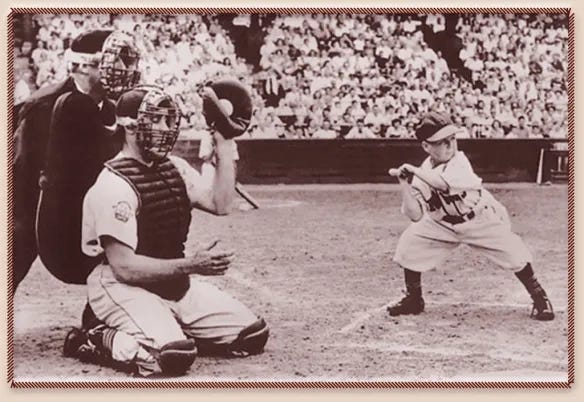
To celebrate the 50th anniversary of the American League—as well as, conveniently enough, the birthday of one of his primary sponsors, the Falstaff Brewery—Veeck promised the Falstaff executives a promotion so big and so memorable that it would resonate on a national scale. He made a few calls, got in touch with a 3-foot, 7-inch performer named Eddie Gaedel, signed him to a one-day contract, and taught him a tight crouch that would reduce his strike zone to roughly an inch and a half. Gaedel was hellbent on coming to the plate and swinging the bat; Veeck assured him that if he lifted the bat from his shoulder, he might never leave home plate alive. Eighteen thousand people showed up that day for a doubleheader against Detroit, and between games, Gaedel burst out of a seven-foot birthday cake.
The Falstaff executives were non-plussed. They’d seen this gag before. They berated Veeck for failing to live up to his promise. But then in the first inning, Gaedel emerged from the dugout and walked to the plate, wearing uniform number 1/8. A hubbub ensued, but the Browns had the paperwork straight. All was in order, and Gaedel took his place. The pitcher threw two balls, broke into hysterics, and then threw two more balls. Gaedel took the walk, was removed for a pinch hitter, and strutted off into history.
In the aftermath, the purists raved at Veeck’s sacrilege, but Veeck welcomed their self-serious vitriol and mocked it repeatedly over the remainder of his life. Winning, he always said, was what mattered most to fans, but if you couldn’t win, you could “draw more people with a losing team plus bread and circuses than with a losing team and a long, still silence.” He was the most unabashedly populist owner that baseball (or perhaps any American sport) has ever known, and he understood better than anyone that baseball would not survive in the American imagination if it lost the capability to fundamentally surprise people.
II.
Thirty-four years ago, the Baltimore Orioles built Camden Yards, and nearly every stadium to rise in its wake grew into a bespoke and artisan creation. The stadiums themselves became the bread and circuses, and lo, this was largely a good thing, because it supplanted the vast multi-purpose behemoths of yesteryear, the interchangeable bowls with bright-green turf and bright yellow seats where small children could disappear amid the vastness of the 300 level at Three Rivers Stadium and wind up re-enacting Lord of the Flies. The new stadiums were quirky, and then they were deliberately quirky; some, like Pittsburgh’s PNC Park and San Francisco’s Oracle Park, co-opted the natural landscape so beautifully that they became regarded as architectural marvels. Others felt kind of like cheap knockoffs, and some landed in the middle as solid B-pluses, which leads me to the stadium in Seattle now known as T-Mobile Park.
I’ve written about sports for too many years than I’d like to admit, so I am not one of those people who has some carefully crafted checklist of stadiums I’ve visited and stadiums I’d like to visit. But last weekend, I went to Seattle, and I watched three games at T-Mobile. It is a very good park, though I would argue it is not an Oracle/PNC-level park (which, I will admit, is kind of how I feel about Seattle as a city—it lacks the soul of San Francisco or Oakland or Portland, but it gave us Jimi Hendrix and Chris Cornell, so I guess it’s a wash). T-Mobile had those signature quirky features, like a lower-level standing area where you could look out directly at the bullpen and heckle the middle relievers. But what impressed me most had nothing to do with that. What impressed me most were the hot dogs raining down from the sky.
Comments
Nothing yet. Say the first thing.
Sign in to join the conversation.