
Tuesday night, Tucson's all-Democratic city council can hand 212 acres of public land to the missile plant that built the Tomahawk used in the Minab school strike — for zero dollars, buried as the last item on the consent agenda.
One council member could stop it with a single motion.
This piece names the vote, the money trail, and the 156 people killed six months ago by what Tucson gets paid to keep building.
by Three Sonorans
Donna Treadaway has worked in Raytheon’s finance department since 2004. She is not an activist. She is a numbers person who trusted, in her own words, “the military and our political leaders and our intelligence community” to keep the weapons she helps account for as a last resort. Then a Tucson-built Tomahawk hit the Shajareh Tayyebeh school in Minab, Iran, on February 28, and Treadaway started asking her own employer a question out loud: “What are you doing with the systems that we made?”
Tomorrow night at 5:30 p.m., Donna Treadaway’s city government — a progressive, all-Democratic Mayor and Council, led by Latina officials and including Ward 6’s Miranda Schubert, elected last year with backing from the local Democratic Socialists of America — has an answer for her.
It’s Item 7n on the consent agenda, and the answer is: more.
The consent agenda is where routine business goes to pass without discussion — minutes, liquor licenses, lease renewals, one motion, one vote, done.
Tomorrow it contains fourteen items.
Thirteen of them are arguably routine.
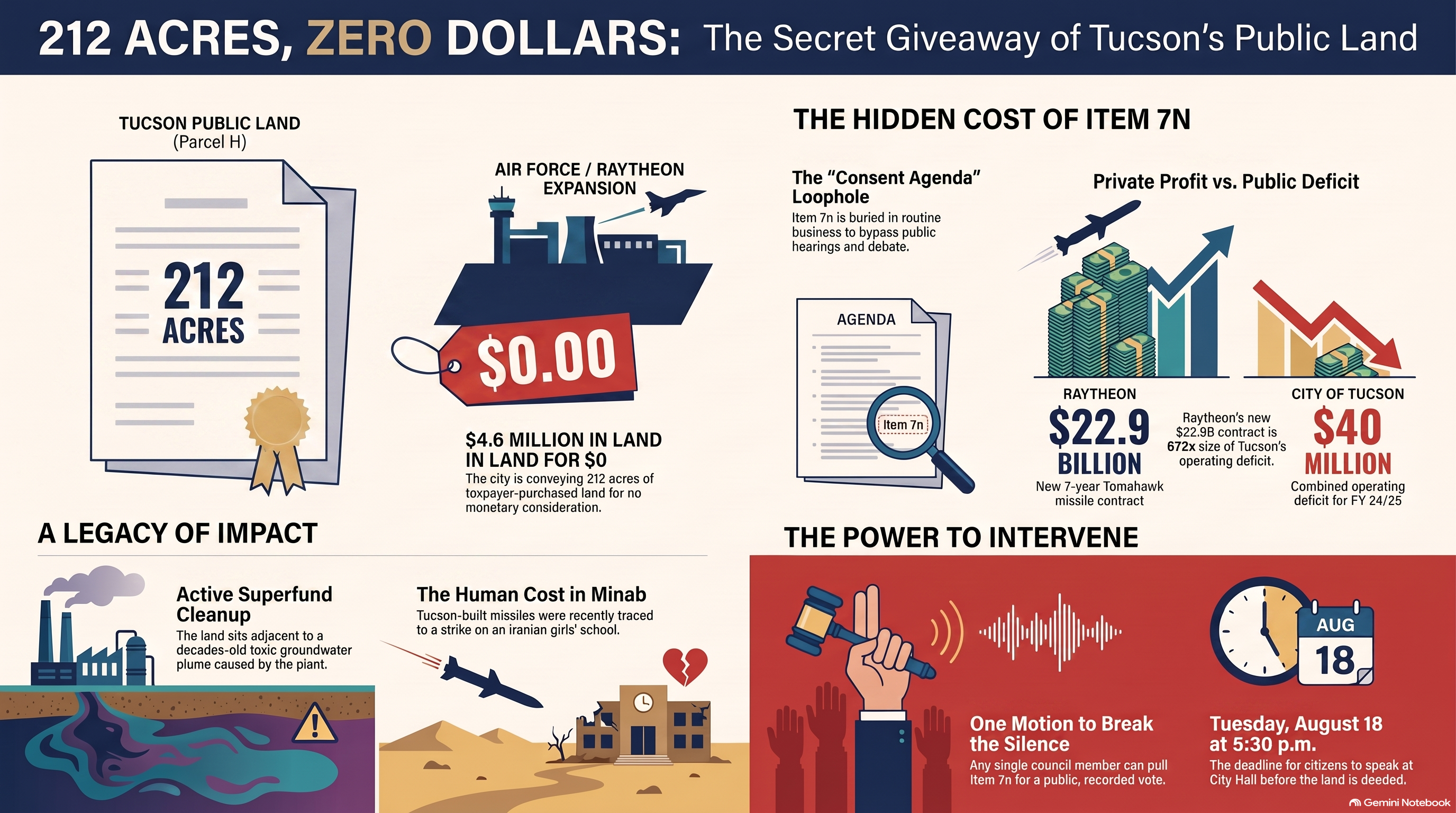
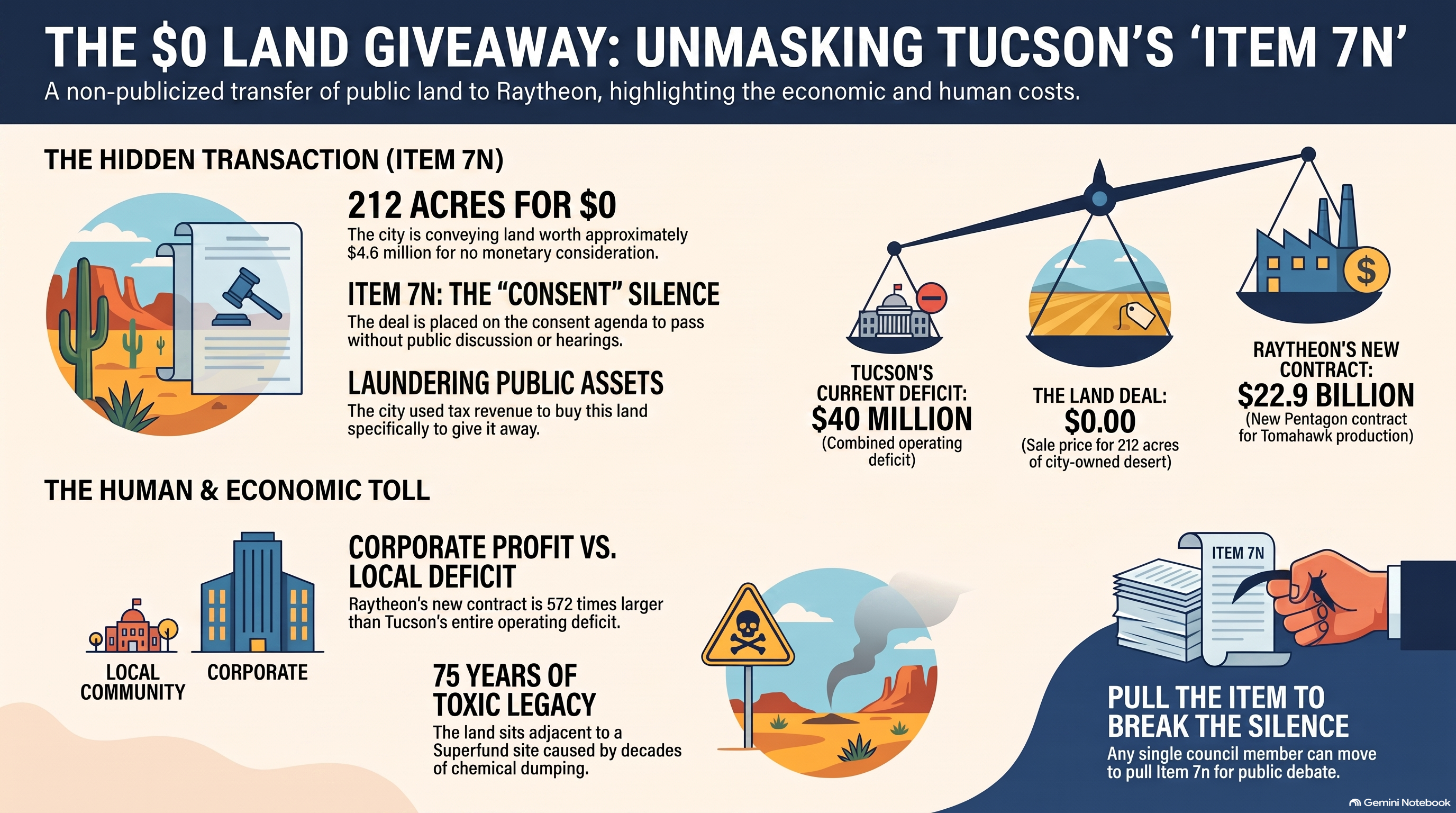
The fourteenth and final item is Resolution 24165: the conveyance of roughly 212 acres of city-owned land north of Aerospace Parkway — a parcel known in city records as Parcel H — to the United States Air Force, “for no monetary consideration.”
Zero dollars. No public hearing. No appraisal referenced anywhere in the staff documents. Sandwiched between a parkland purchase and a Presidio Museum lease amendment, like a love note slipped into a stack of bills.
The staff communication doesn’t even pretend to be coy about why: the land goes to the Air Force “to support the continued buffering, security, and potential operational growth of Air Force Plant 44 and Raytheon’s operations.”
Air Force Plant 44 is the government-owned, Raytheon-operated missile plant south of the airport, the one where the Tomahawks come from. The conveyance is technically to the federal government, the way a gift to your landlord is technically not a gift to you. The plant is already government property.
Raytheon just runs it, profits from it, and now gets 212 more acres of public desert wrapped around it, held in federal title, beyond the reach of any future Tucson council, whatever it eventually decides to feel about Raytheon.
Here’s the part that could stop all of it: any single council member can pull Item 7n off the consent agenda and force it into the open — discussion, questions, a recorded vote on its own merits.
Not a lawsuit. Not a ballot measure. One motion, five seconds, from one of seven people who answer to voters. Keep that in your pocket. We’ll come back to it.
On Monday morning, the Pentagon announced a $22.9 billion contract for Raytheon to ramp up Tomahawk production to over 1,000 missiles per year for seven years.
It’s the formalization of a framework agreement signed in February that also commits to tripling AMRAAM output, work explicitly sited in Tucson. Acting Navy Secretary Hung Cao called it a “landmark $22.9 billion investment” that will “accelerate Tomahawk missile delivery to our warfighters at unprecedented speed.”
Unprecedented speed. Because the old speed left some schools standing.
Twenty-four hours later, Tucson’s city council is scheduled to give the missile plant room to grow. For free. On the consent agenda. You could set your watch by it, if the watch weren’t also probably built under a defense contract.
And the scale deserves its own paragraph, because scale is where the amnesia lives. Tucson is staring down a combined operating deficit of roughly $40 million across this fiscal year and next. This one contract is 572 times that hole. The city’s entire general fund — police, fire, streets, parks, everything — is about $830 million; $22.9 billion is 28 times that.
Raytheon got paid yesterday. Tucson gives away land tomorrow. Somewhere in Ward 5 there’s a road that hasn’t been repaved since the second Bush administration, but do tell us more about “economic development.”
The city’s own paperwork spells out the reasoning: the conveyance “furthers Goal 12 of Plan Tucson 2025, Strengthen the Local and Regional Economy to Provide Opportunities for All Tucsonans to Thrive.”
Somewhere, a consultant got paid to write that sentence with a straight face.
We have to say what the land is for, because the agenda won’t.
On February 28, the first morning of the joint U.S.-Israeli assault on Iran, three Tomahawks hit the Shajareh Tayyebeh school compound in Minab in rapid succession.
The girls’ section took the direct hit. Minab’s public prosecutor put the death toll at 156, 120 of them schoolchildren, 73 boys and 47 girls. A preliminary U.S. military inquiry concluded American forces were likely responsible: a targeting error rooted in stale intelligence. The full report was reportedly finished in April. It has sat under “senior review” ever since, despite senators demanding answers. Amnesty International USA’s Amanda Klasing asked the only question that matters: “What is taking so long?”
The missile itself left a paper trail: debris traced to a 2014 Naval Air Systems Command contract with Raytheon for 231 Block IV Tomahawks, and per Tim Steller’s reporting in the Arizona Daily Star, almost certainly assembled by Tucson workers.
Fueled and tested out by the airport. Our name stamped on its bones.
The people who build these systems are already wrestling with it, on the record. Stephen Schaefer, an electrical engineer, quit in January — the Venezuela and Iran campaigns left his ethical defense of the work “completely shattered.”
Tony Spada, retired from Raytheon logistics, put the whole company-town bargain in nine words: “You get compartmentalized, you get a good paycheck.”
These are not outsiders throwing rocks. These are the machinists, accountants, and engineers of South Rita Road, asking what their labor is for. Their city council’s answer is Item 7n.
Follow the money, and the receipt gets uglier. Tucson didn’t inherit this land. Tucson bought it — specifically to give it away.
In 2020, the city purchased about 297 acres from the Tucson Airport Authority for $6,475,000. The money came out of something called the Raytheon Annexation Account, a fund created in 2009 when the city amended its 1995 pre-annexation agreement with the company.
Read the resolution’s own language: tax revenues generated by Raytheon’s annexation get deposited into an account restricted to expenditures that benefit “both the City and Raytheon.”
A public revenue stream, legally earmarked — by your city government — for the benefit of the largest private employer in Tucson. Not for parks. Not for the south side neighborhoods that have been living with the company’s chemistry set for seventy years.
In 2016, the council voted to use that account to buy the buffer land, and the resolution said the quiet part in writing: the city would hold the property and “make the property available if Raytheon or the United States Air Force later requested to acquire it for Raytheon expansion purposes.” About 85 acres have already been acquired by Pima County for an Air National Guard munitions storage facility. A 2019 county memo describes the split plainly: 85 acres for munitions storage, 212 acres as “the Raytheon buffer.”
Tomorrow, the rest follows. The trigger written into the deal ten years ago is being pulled on schedule.
Do the math on the dirt itself.
$6,475,000 for 297.33 acres works out to about $21,776 an acre. The remaining 212 acres, at the price the public actually paid, represent roughly $4.6 million in land. The city is conveying it for $0 — no sale, no lease, no recovery, not even a ceremonial dollar. They didn’t sell the public’s land. They laundered it: public money in, federal title out, private benefit locked in.
None of this started this week, and you already know that, because you live here.
Hughes Aircraft planted the factory in 1951, on desert the Tohono O’odham have called home since before there was an Arizona to steal. The Air Force bought the plant the next year and has owned it ever since — seventy-five years of government-owned, contractor-operated, a public shell around a private profit.
Starting in 1952, Hughes dumped trichloroethylene straight into pits and onto the ground south of the airport for three decades, until it reached the aquifer and spread into a plume five miles long.
Roughly 20,000 south side residents drank it before anyone told them.
The EPA had to order Raytheon and the Air Force to clean up the site in 2007. The cleanup continues to this day, and a new generation of residents is now raising claims over a different chemical.
Same soil. Same barrio. Same company, different logo.
The land under tomorrow’s consent agenda sits adjacent to that active Superfund cleanup, and the city’s staff communication contains not one word about environmental conditions, remediation obligations, or what happens to the aviation restrictions already on the deed. Because nothing says “buffer” like expanding the footprint of the thing you’re buffering against.
Then there’s the pattern of tribute.
2017: this council handed Raytheon $6 million in additional tax breaks, the same era the plant celebrated its 4,000th Tomahawk.
This past March: voters passed RTA Next, with real transit wins for Wards 1 and 5, sí — and a billion-dollar Sonoran Corridor whose first stated purpose, in Pima County’s own words, is to “protect Raytheon from encroachment and give it room to expand.”
We are building highways around the missile factory during a megadrought, and now we are deeding it the desert itself. La máquina doesn’t even charge itself for the land anymore.
Resistance here has a long and honorable paper trail, and it will be in that chamber tomorrow.
The November 2023 die-in that brought more than a hundred Jewish and Palestinian solidarity activists to Raytheon’s gates — and the arrests that followed — proved this community will put its body between la máquina and business as usual.
This March, a coalition including Derechos Humanos, Veterans for Peace, and Arizona Palestine Solidarity Alliance disrupted Raytheon’s recruiting booth at the Tucson Festival of Books under a banner that fits tomorrow’s agenda like a glove: Books not bombs. Hands off Iran.
The thing you were told to keep in your pocket: numbers.
Ward 5’s Selina Barajas represents the neighborhoods that drank the TCE; Vice Mayor Lane Santa Cruz has built a record of standing in the way when it counts.
The whole council is Democratic, which means there is no Republican to blame, no partisan cover, no excuse. If 212 acres of public land move to the missile plant without a single public question, every name on that dais signed the deed — and under Section 2 of the resolution, Mayor Regina Romero signs it literally.
Imagine the other version of tomorrow night.
The one where a council member pulls Item 7n and asks, into the microphone, what 212 acres of public land are worth — and why the city never bothered to find out before giving them away.
The one where somebody reads the account’s own language aloud — expenditures that benefit both the City and Raytheon — and asks when the public’s benefit is scheduled to arrive.
The one where the chamber is full of gente who know the names of the Minab children and are willing to say them during Call to the Audience, three minutes at a time, until the silence on that dais costs more than the land does.
Here’s the honest part: nobody in that chamber tomorrow can undo a $22.9 billion Pentagon contract. That decision was made in Washington, by people Tucson didn’t elect and can’t call on the phone.
But the 212 acres is not that decision. The 212 acres is a local one, made by seven people whose names you know, who hold office because voters in this city put them there, and who can be un-elected by those same voters if they choose silence tomorrow night. That’s the whole point of a consent agenda item like this one: it’s designed to feel as unstoppable as a defense contract, when it’s actually the one link in this chain that answers to you.
The skills on South Rita Road are real. The workers are real. A city that can guide a missile through a thousand miles of darkness can guide itself toward water, toward solar, toward a desert that is dying of thirst while we deed it to the war machine, acre by acre, consent item by consent item. Only the mission is a lie — and missions can be changed by the people who show up, because the people who show up are the ones these seven answer to.
The desert has survived every empire that ever planted a flag — or a factory — in it. So has la gente. The question was never whether we endure. It’s whether we let them give away the ground beneath us without even having to ask out loud.
Mañana, 5:30. Llena la sala. Que no pasen el 7n en silencio. No más.
It has happened before, in that very chamber, because people in the seats made silence more expensive than courage.
How to show up:
Attend: Tuesday, August 18, 5:30 p.m., Mayor and Council Chambers, City Hall, 255 W. Alameda. Doors open 30 minutes early. Fill out a speaker’s card for Call to the Audience. You get three minutes, and consent items are fair game.
Watch: The meeting streams live on the City of Tucson YouTube channel.
Ask: The full agenda and communications are posted at the City Clerk’s site. Ask your council member today whether they will pull Item 7n: (520) 791-4213.
Connect: Derechos Humanos, Veterans for Peace, and Arizona Palestine Solidarity Alliance have been carrying this fight for years. Find them, join them, bring a compañero.
Three Sonorans is an independent Substack that reads the consent agenda so you don't have to sit through fourteen items to find the one that matters. This piece traces a land deal from a 2009 tax account through a 2020 purchase to a Tomahawk strike on a school in Iran, because that's the actual distance between a line item and a body count.
If this piece moved you, share it before 5:30 tomorrow — that's how word spreads when the watchdogs get muzzled, and the vote is scheduled for a Tuesday night.
Have a scoop or a story you want us to follow up on?
Send us a message below or via ENCRYPTED email (all messages kept CONFIDENTIAL) at ThreeSonorans@protonmail.com.

Comments
Nothing yet. Say the first thing.
Sign in to join the conversation.