
This morning, the Pentagon handed Raytheon $22.9 billion to build more Tomahawk missiles, the same weapon that hit a school in Minab, Iran, six months ago. Tucson’s own workers are already asking what the systems they build are for. Its political leaders aren’t.
by Three Sonorans
The Shajareh Tayyebeh school in Minab taught boys and girls on separate floors. The girls were on the floor that took the direct hit.
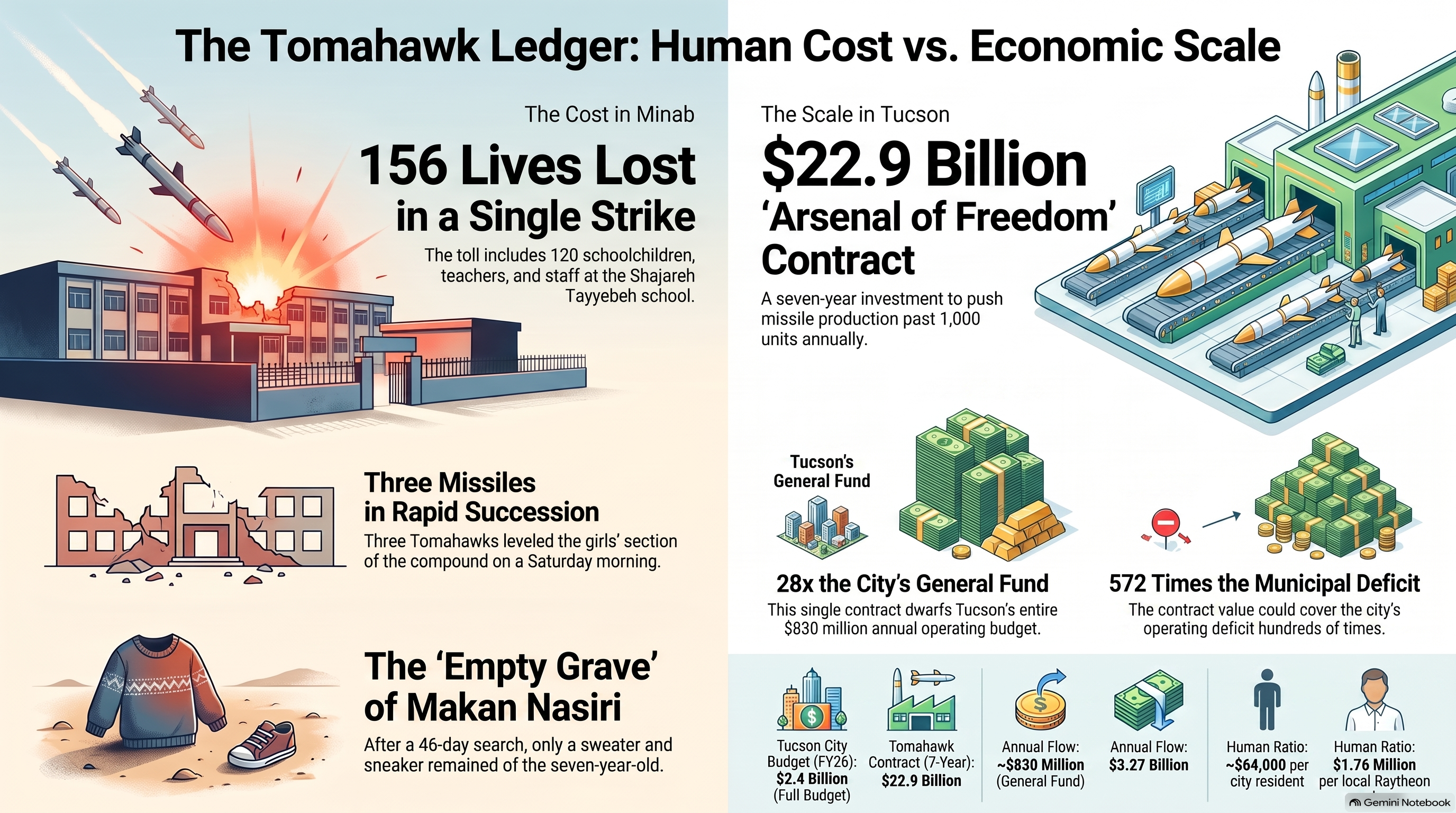
It was a Saturday morning, February 28, 2026, the first morning of the joint U.S.-Israeli assault on Iran, and somewhere between 170 and 264 students were in their classrooms when the first Tomahawk came in.
Then a second.
Then a third.
Three missiles, in rapid succession, on one compound.
A father named Hossein, whose daughter Zahra died in the strike, later described what was left: “The boys’ section was still partly standing. But the area where the girls took their lessons had been leveled.”
The toll is still contested.
Minab’s public prosecutor’s office put the count at 156, including 120 schoolchildren, 73 boys and 47 girls, along with teachers, parents, and staff. But even the 25 U.S. senators who demanded the Pentagon’s report in July were still citing “approximately 120 children and at least 175 people in total.”
The machine can’t even keep its own ledger straight.
By far the deadliest known single incident of the entire conflict. (Israel and the U.S. struck Iran together that day. This piece stays narrow, on purpose: the Tomahawk is a weapon only the U.S. Navy flies, which means the receipt for this particular missile, and this particular school, leads to exactly one place. That place is here.)
This morning, the Department of War announced it is paying Raytheon $22.9 billion to build more of them. A seven-year contract to push production past 1,000 Tomahawks a year, awarded under a program they are actually, unironically calling the Arsenal of Freedom. Acting Navy Secretary Hung Cao called it a “landmark $22.9 billion investment” that will “accelerate Tomahawk missile delivery to our warfighters at unprecedented speed.”
Unprecedented speed. Because apparently the old speed left something, someone, standing in Minab.
Shajareh Tayyebeh. In Arabic, roughly: Sacred Tree.
The missile that cut it down was, per Tim Steller’s reporting, almost certainly assembled by Tucson workers, part of a 2014 Navy contract for 231 Tomahawks built by Raytheon. Fueled and tested out by the airport, sent off to sea with our name stamped on its bones.
In April, Arizona Daily Star columnist Tim Steller went looking for the people who actually build these things, and found them still building them, still wrestling with it.
Donna Treadaway has worked in Raytheon’s finance department since 2004. She told Steller she has trusted “the military and our political leaders and our intelligence community to prevent us from needing to use these” weapons, except as a last resort. Minab left her asking a question of her own employer:
“What are you doing with the systems that we made?”
Stephen Schaefer, an electrical engineer, quit in January. He told Steller that the U.S. attacks on Venezuela and later Iran, not Minab alone, left the ethical defense he’d once held for the work “completely shattered.”
'Tony Spada, who retired from Raytheon’s logistics side in 2025, put the whole company-town bargain in nine words: “You get compartmentalized, you get a good paycheck.”
Those are real Tucson voices, on the record, asking exactly what this morning’s contract asks them to keep doing anyway. Watch how many of today’s official statements, from City Hall, from the Chamber, from Sun Corridor Inc., manage that same honesty.
Count how many say the word Minab. The early odds are zero.
Here’s what $22.9 billion actually buys, and what it costs.
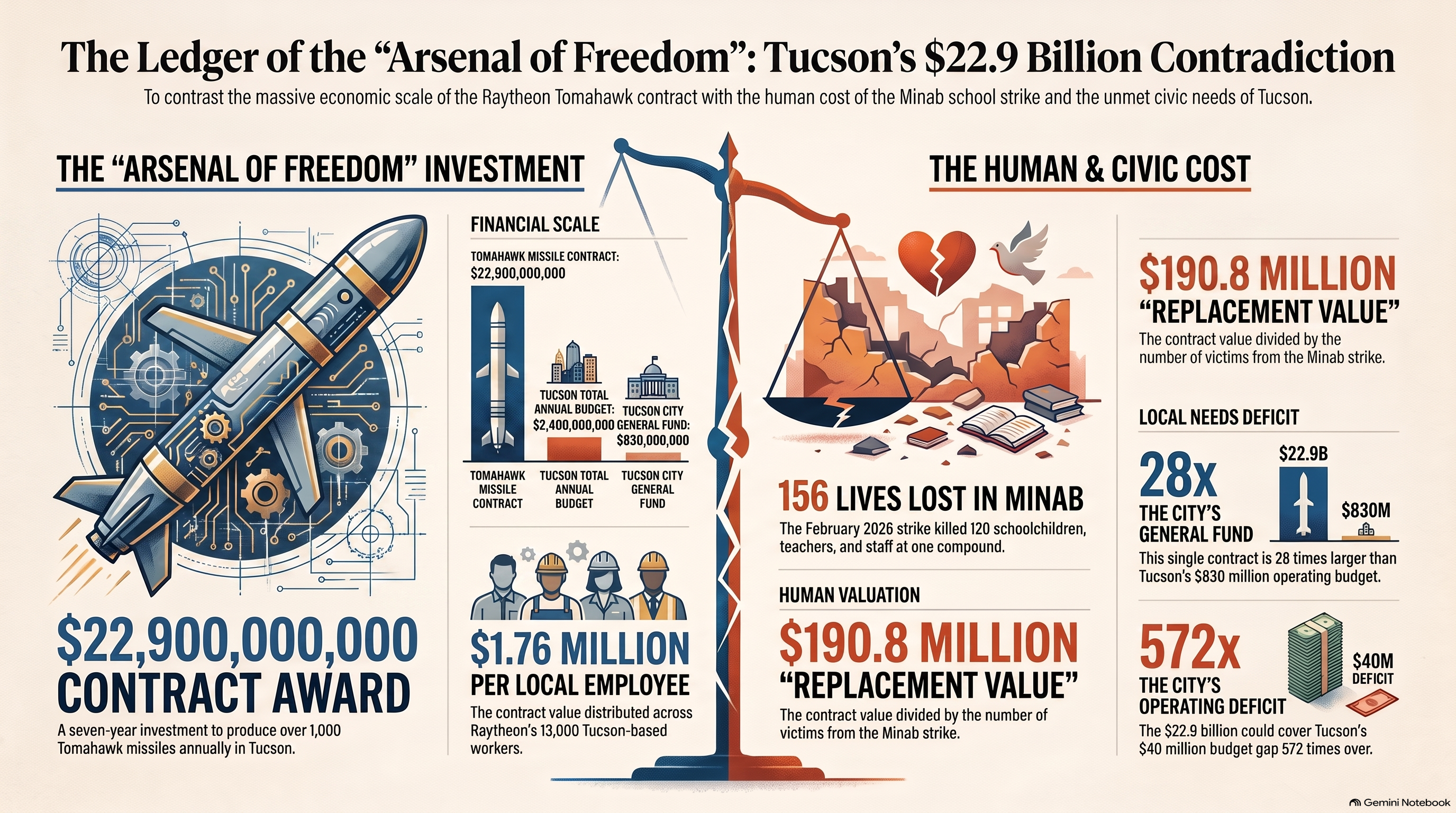
156 people died at Minab. 120 of them were schoolchildren. If this $22.9 billion is what it costs to replace what was spent, then la máquina prices each of those niños at about $190.8 million in replacement inventory.
That’s not rhetoric. That’s the machine’s own ledger, read back to it.
The rest of the arithmetic:
$22.9 billion over seven years. That’s $3.27 billion a year flowing to the Tomahawk line, more than 1,000 missiles annually, which pencils out to roughly $3.3 million per missile even before you count the “associated support.”
Tucson is staring down a $40 million combined operating deficit across the 2025–26 and 2026–27 fiscal years, driven primarily by the state’s flat-tax cuts to shared revenue. This one contract could fill that hole 572 times over.
Zoom out further: Tucson’s entire FY26 General Fund, the city’s actual operating budget for police, fire, streets, and parks, is roughly $830 million. This one contract is 28 times that. Widen it all the way to the city’s full $2.4 billion budget, water utility, transit, every restricted fund included, and $22.9 billion is still nearly 10 times larger than everything Tucson spends on itself in a year.
Remember the $5–6 a month they’re adding to your water bill? The city is shaking couch cushions while $22.9 billion lands on the south side, and somehow none of it ever fixes a road in Ward 1.
Raytheon employs roughly 13,000 people in Tucson, our largest private employer. Divide it out: $1.76 million per local employee. Don’t hold your breath waiting for your cut, hermano. The wages are real, but the margin goes to RTX shareholders, and the risk goes to whichever schoolyard is standing next to the next “target.”
Tucson has been married to the missile for 75 years, and the marriage has never been consensual.
Hughes Aircraft planted the factory here in 1951, on the same desert the Tohono O’odham have called home since before there was an Arizona to steal. The military colony grew up around it: Davis-Monthan, the boneyard, the bombing ranges.
And the Old Pueblo learned to eat what the war machine fed it. (Two data points, for the record: a 2004 Navy contract for up to 2,200 Block IV Tomahawks, and a 2017 city council vote handing Raytheon $6 million in tax breaks the same year it delivered its 4,000th Tomahawk off the Tucson line.)
The marriage poisoned the water, too.
Starting in 1952, Hughes dumped trichloroethylene, a degreasing solvent, straight into pits and onto the ground south of the airport, for three decades, until it reached the aquifer and spread into a plume that eventually stretched five miles.
Roughly 20,000 south side residents, in about 4,600 households, drank it for years before anyone told them. Hughes and its successor, Raytheon, eventually paid out more than $130 million to settle the lawsuits. The company is now facing new contamination claims over a different chemical from a new generation of South Side residents.
Same site. Same neighborhood. Same company, just with a different name on the building.
And this past March, this community passed RTA Next, with real transit wins for Ward 1 and Ward 5, sí, and also a billion-dollar Sonoran Corridor whose first stated purpose, in Pima County’s own words, is to “protect Raytheon from encroachment and give it room to expand.”
Read that again. We are building highways around the missile factory. During a megadrought. The room to expand is for the thing that expanded over Minab.
Every press release Tucson issues about this contract will use the same three words: jobs, investment, economic development. None of them will use the word Minab. La máquina runs on amnesia the way a Tomahawk runs on jet fuel, and the fuel never runs out because we keep refining it: here, in our city, with our hands and our silence.
Now, the part where I lose some friends at the Democratic club breakfast.
This is a city that passes ceasefire resolutions. A city that shows up to candlelight vigils with hand-lettered signs about genocide. A city whose leaders will tell you, sincerely and at length, about their values.
And this morning, those same leaders will celebrate $22.9 billion for the missile that killed 156 people, 120 of them schoolchildren, at the school Iranian officials, the senators demanding answers, and international outlets alike call “girls’,” and they will say jobs, and they will say investment, and they will say economic development, and they will not say Minab, because Minab is not in the talking points, because Minab is never in the talking points, because the talking points are written by the people who profit from the amnesia.
And to be clear: this is not about Donna Treadaway, or Stephen Schaefer before he left, or the thousands of machinists and engineers on South Rita Road with a mortgage and a kid in TUSD.
They didn’t design this economy; they inherited it, just as we all inherited a company town and were told it was a city. Bite the system, not the person. The sin here isn’t working at the plant, or even wrestling honestly with what the plant makes, the way Treadaway and Schaefer both are. The sin is a political class that never once asked whether Tucson could be anything other than what it is, and calls that surrender “pragmatism.”
A company town never gets to ask what the company makes. That’s the whole point of a company town.
🏜️ The Parable of the Parked Cars
·
Aug 14

A parable. The plant, the water, and the funding cited within are real. The candidate, the blockade, and its telling are not — they are a story, offered to be believed the way parables ask to be believed.
Resistance has a paper trail, and it is long and honorable.
The investigators at Bellingcat geolocated the strike footage within days. Sky News’ Data and Forensics team, working with Forensic Architecture and seven independent experts, spent four and a half months on it and, in a July 16 investigation, concluded that “all evidence points to the US being responsible.”
Munitions expert N.R. Jenzen-Jones of Armament Research Services identified the weapon by its wings: a Tomahawk, and only one country in this war flies Tomahawks. Forensic analysts traced the debris, a satellite antenna from Ball Aerospace, and a contract trail leading to Naval Air Systems Command’s September 2014 award to Raytheon for 231 Block IV Tomahawks, $251,133,201.
The missile has a serial number.
The machine always leaves a receipt.
Amnesty International USA marked four months since the strike by demanding accountability that has still not come. National Director Amanda Klasing put it plainly: “What is taking so long?”
Twenty-five U.S. senators, led by Kirsten Gillibrand and Elissa Slotkin, formally demanded on July 13 that the Pentagon release its completed investigation by July 20. Both of Arizona’s own senators, Ruben Gallego and Mark Kelly, signed that letter.
Neither said the word Tucson.
That deadline came and went.
The report was reportedly finished and submitted in April; it has sat under senior review since, buried on a desk rather than published. The Pentagon’s own preliminary inquiry concluded American forces were likely responsible, a targeting error rooted in stale intelligence. 170 days after the strike, the official word is still that it is ongoing.
According to two Red Crescent medics who spoke to Middle East Eye, when the first missile hit, a teacher and the principal moved a group of surviving students to the school’s prayer room, believing it safer, and the principal called parents to come get their children. The second missile hit that room. Only a small number of those who had taken shelter there survived.
One child was never found. Makan Nasiri was seven. After a 46-day search through the rubble, all that turned up was a bloodstained blue sweater and a single sneaker, now kept in a glass case at a mosque in his neighborhood. His grave in Minab’s cemetery is empty.
The demand is simple and it does not expire: release the report. Say the names.
Imagine the other press release.
The one where Tucson’s leaders stand up and say: our hands built the weapon that hit that school, and we are done pretending that’s prosperity. The one where the same genius that guides a missile through a thousand miles of darkness gets pointed at water, at solar, at a desert that is dying of thirst while we build it highways.
The skills are real. The workers are real. Only the mission is a lie.
Imagine Rep. Juan Ciscomani, whose AZ-6 district actually holds the South Rita Road plant, reading the names of the Minab schoolchildren into the record, all 120 of them, until the chamber has to sit in it.
The desert has survived every empire that ever planted a flag in it. So has la gente. The question was never whether we endure. It’s whether we let them keep cashing the checks in our name while the good trees fall.
Los niños de Minab tenían entre siete y doce años. Que sus nombres nos persigan hasta que esto cambie. No más.
Three Sonorans is Tucson’s independent voice for the stories the boosters and the bureaucrats would rather you not connect. This piece names what the press releases won’t: the weapon, the school, the children, and the silence that passes for pragmatism in a company town. If this moved you, share it—that’s how the word spreads when nobody else is saying the names.
Have a scoop or a story you want us to follow up on?
Send us a message below or via ENCRYPTED email (all messages kept CONFIDENTIAL) at ThreeSonorans@protonmail.com.

Comments
Nothing yet. Say the first thing.
Sign in to join the conversation.