
THE GIST
Marana’s vice mayor spent a public meeting campaigning for Republicans in nonpartisan races — and the council that says it can’t touch an ICE facility about to triple next door didn’t flinch.
Then it approved $319,265.89 with no conditions. Here are the receipts.
by Three Sonorans
“I’m trying to help our LD17 people, Republicans, get into LD17,” Marana Vice Mayor Roxanne Ziegler told the town council Monday night, mid-meeting, unprompted, on the public record. “So I know I’m not supposed to say that, but I’m sure I’ll get in trouble.”
She didn’t. Nobody on the council so much as blinked.
That’s worth sitting with, because Marana’s town council seats are, by design, nonpartisan. There’s no “R” or “D” next to any name on the dais. Ziegler just treated that distinction as decorative, campaigned for a specific party in the LD17 races from her seat as vice mayor, correctly predicted she wasn’t supposed to do that, and did it anyway, with zero consequence.
It’s a notable contrast: in a town where the council has spent months insisting it can’t take an official position on a 775-bed ICE detention facility because the matter is somehow outside its jurisdiction, Ziegler herself told AZPM in February, “We will not be putting forth a resolution, a proposition, or any other document,” on the detention facility, as the outlet reported.
Apparently the LD17 races clear a bar that 1,300 detained human beings do not.
“I know I’m not supposed to say that, but I’m sure I’ll get in trouble.” — Vice Mayor Roxanne Ziegler, on the record, unprompted, mid-meeting
The comment came wrapped in a bit about ten-dollar hats and five-dollar pins, itself a follow-on to Council Member Patti Comerford’s two-minute defense against the idea that the council is “on the take.”
Earlier in the same round of council reports, Council Member Teri Murphy had touted the town’s first Heritage Arena event, drawing about 300 spectators, and a sold-out mutton busting signup for the Fall Festival.
Call it what it was: a council loose enough, and comfortable enough, to move from rodeo attendance to corruption jokes to a partisan aside in the space of a few minutes, because nobody in that room was going to call any of it out.
That’s the pattern underneath everything that happened Monday night. This is a council that scrutinizes exactly nothing it doesn’t want to, and the receipts are all over the same meeting.
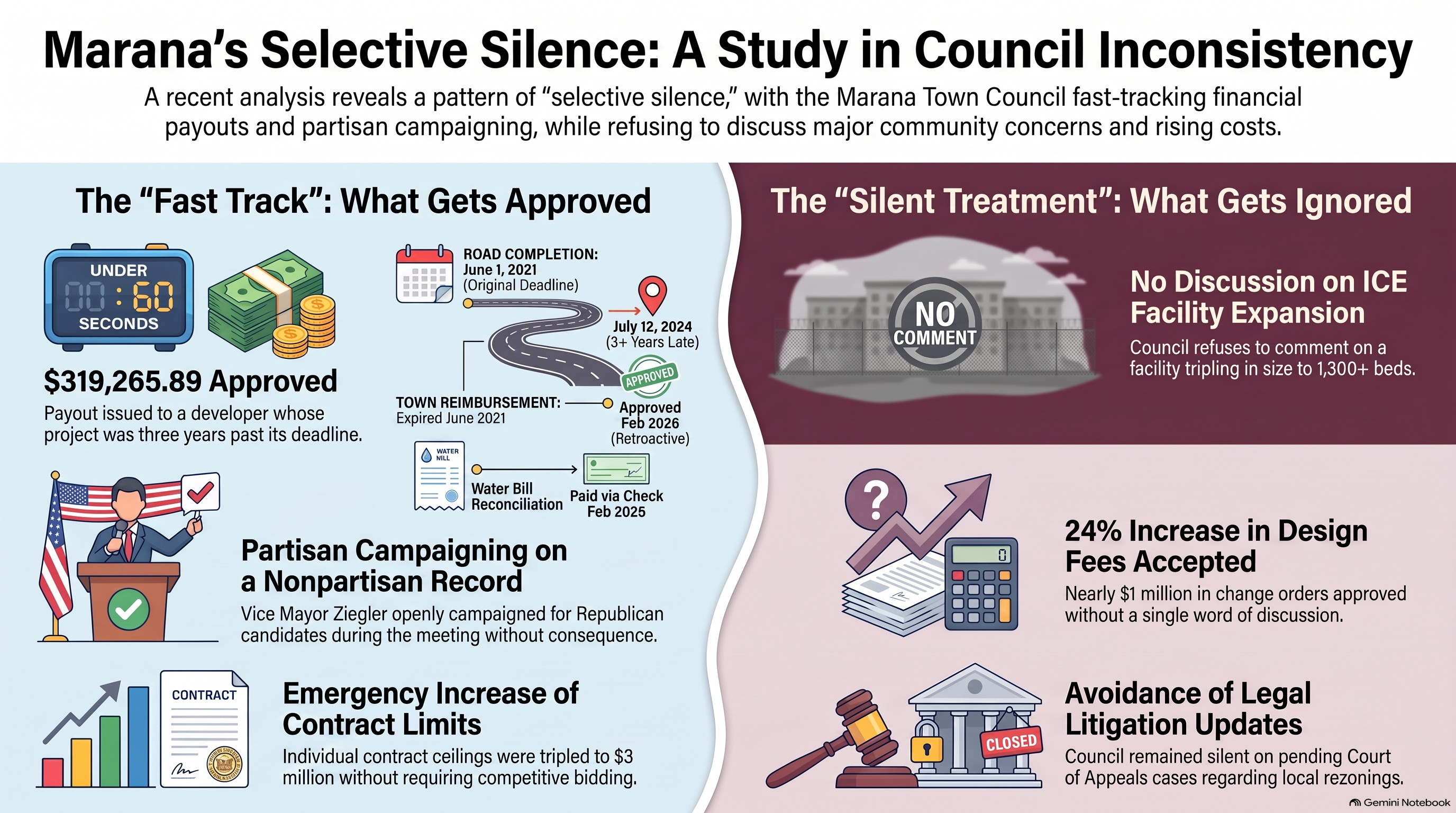
Item A1 on Monday’s special meeting agenda was Resolution 2026-059, the Second Amendment to the Marana Main Street Development Agreement, a resolution to hand a developer $319,265.89, more than five years after that developer blew through the agreement’s amended deadline. The council disposed of it in under a minute, without a single word about why the town waited until 2026 to say so.
Town Attorney Jane Fairall walked the council through the math in under four minutes.
The original 2020 agreement required a group of developer entities, Marana Main Street LLC, Marana Hospitality LLC, Marana Hospitality II LLC, and related parties, to finish two roads, Marana Main Street and Center Street, by October 31, 2020, in exchange for a $300,000 reimbursement from the town’s Downtown Marana Reinvestment Fund. The council extended that deadline once, to June 1, 2021.
The roads were not “substantially complete” until July 12, 2024, three years, one month, and eleven days past the amended deadline.
Monday’s amendment didn’t just accept the late roads. It rewrote the calendar so they wouldn’t be late. Fairall told the council the amendment would “recognize that July 12th, 2024 completion date and give an extension from the June 1st, 2021 deadline to the actual completion date,” a retroactive extension issued after the fact to a deadline that had already expired, clearing the way for a payment the missed deadline could have jeopardized.
Then there was the second number.
Under the original deal, the town and developer had agreed to split water and landscaping costs along the new streets. The town’s share went unpaid for years. Fairall put a precise figure on that lapse: $19,265.89.
“It’s mostly the water bills from the last few years,” Fairall said, “or up until we took over the water account in October of 2024, that we were supposed to split 50/50 with the developer, and nobody’s fault. It just didn’t happen.”
Nobody’s fault is doing a lot of work in that sentence, presumably on unpaid overtime, since the town couldn’t find $19,265.89 for its own water bill but found it fast enough once a resolution needed passing. The town owed its share of the bills for years and didn’t pay it. For three-plus years, that was the Town of Marana’s obligation, and the fix was to write the developer a check rather than explain the lapse.
Council Member Patrick Cavanaugh asked two questions: what the $19,265.89 covered, and where the water was actually used. He got answers: water bills and irrigation equipment, watering landscaping the developer had installed and the town had agreed to help maintain in the public right-of-way.
Nobody asked why the reconciliation took until 2026. Nobody asked whether the original agreement gave the town any leverage, a penalty clause, an interest charge, anything at all, for a three-year delay. Vice Mayor Ziegler moved to adopt the resolution.
It passed on a voice vote, no audible dissent, total floor time under sixty seconds.
$300,000 plus $19,265.89 equals $319,265.89 in public money released Monday night with two questions asked and zero conditions attached.
Council Member Patrick Cavanaugh has been the closest thing this council has to a skeptic on the detention facility.
He told AZ Luminaria in June he was “very disturbed” to learn federal documents now describe the facility’s expandable capacity at over 1,300 beds, nearly triple the 513-bed prison MTC bought in 2025, a jump Town Manager Terry Rozema has publicly disputed as unsupported by anything MTC has actually proposed.
Monday’s meeting: no update on that dispute, no discussion of the Court of Appeals case below, no discussion of the detention facility at all, because none of it was on this special meeting’s agenda, and Marana’s council has shown no inclination to add such items voluntarily.
It’s also worth noting who’s sitting across the dais from that silence.
Ziegler herself took $300 campaign contributions each from Keri Silvyn and Rory Juneman, attorneys at Lazarus & Silvyn, the firm representing Beale Infrastructure in the data center rezoning. She didn’t dispute it when residents raised it at January’s rezoning hearing; she confirmed the amount publicly. When one resident kept pressing the point, she told him to “get the hell out.”
That same rezoning came up again Monday, if only in passing.
Cavanaugh spent part of his own council report describing a policy retreat at Arizona State University’s Morrison Institute, where a data center industry panel complained about its failure “to tell the story about data centers and what they can do.”
Cavanaugh was on the council that voted 6-0 in January to rezone a little more than 600 acres for a hyperscale data center campus, a rezoning still being fought in litigation over the referendum petitions that residents filed to try to send the decision to voters, with oral arguments before the Arizona Court of Appeals scheduled two days after this meeting.
He did not mention that case. He mentioned the industry’s messaging problem.
The rest of Town Manager Rozema’s update, by contrast, moved briskly and without friction. He told the council that U.S. Rep. Juan Ciscomani, who sits on the House Appropriations Committee, has “committed to working to get us $3 million in funding” toward improvements at the Marana Road/I-10 interchange, a project Rozema priced at roughly $9 million total. A congressional commitment is not a congressional appropriation, and the difference between the two is the entire art of federal budgeting, a distinction the council did not probe.
Rozema also reported $28,000 secured from the Gila River Indian Community for free swim lessons for 720 children, and a $50,000 cooperative marketing win and regional award for Discover Marana, the town’s tourism arm.
Vice Mayor Ziegler used her own council report to credit a town grants administrator for the good numbers, an unprompted, pointed response to what she called “negative press about not getting grants” in recent months, an acknowledgment that the town has been fielding criticism on exactly this point, delivered without naming which outlet or story prompted it.
The council adopted its full consent agenda by emergency roll-call vote, no item pulled for individual discussion:
C1, Ordinance 2026.014: Raises the ceiling on individual job-order construction contracts from $1 million to $3 million, the maximum allowed under Arizona law without a full competitive bid for each contract. Declared an emergency, effective immediately.
C2, Resolution 2026-058: Revised intergovernmental agreement letting Marana store treated wastewater effluent at Pima County’s High Plains Effluent Recharge Project. Cost estimated at $0 to $9,000 per year depending on usage.
C3: $71,281 change order to the Water Reclamation Facility design contract with Carollo Engineers. It’s the second change order to this contract; combined with a $915,945 change order from October 2025, cumulative change orders now total $987,226 against an original $4.1 million agreement, a 24 percent cost increase in design fees alone, approved without discussion.
C4: Summary minutes of the August 4, 2026 regular meeting, approved without comment.
The council then adjourned into executive session to discuss settlement strategy in Town of Marana v. Mandarina South, LLC, an eminent domain case pending in Pima County Superior Court, returned to open session, and took no public action. No public comment cards were submitted at Call to the Public.
Three Sonorans is an independent Substack rooted in Tucson, the borderlands, and the meetings nobody else sits through to the end. This is the kind of story that only shows up if someone is actually watching the tape: a vice mayor breaking her own council’s rules out loud, a quarter-million dollars moving without a real question, and a 1,300-bed detention facility nobody at the dais wanted to name. If that pattern bothers you, share this, that’s how the watchdogs stay funded when the town isn’t asking the questions.
Have a scoop or a story you want us to follow up on?
Send us a message below or via ENCRYPTED email (all messages kept CONFIDENTIAL) at ThreeSonorans@protonmail.com.

Comments
Nothing yet. Say the first thing.
Sign in to join the conversation.