
As mentioned in my last entry, in August 2025, Kaija Straumanis featured every Open Letter WITMonth title on sale through a series of Instagram posts, each with its own “fun fact.” (Here’s an example.) For this year, I’m going to post a snippet—a line, a paragraph—from every single one of the books by women in translation we’ve published to date, so as to highlight the art and craft of the writing itself.
I’m breaking these up into a few long posts here, and a series of shorter ones on Instagram.1
For today, you’ll find three books from four world-renowned Open Letter authors: Marguerite Duras, Elisa Shua Dusapin, Mercè Rodoreda, and Ingrid Winterbach.
And remember: All Open Letter books written or translated by a woman are 40% off through the end of August. Discount automatically applied at checkout.
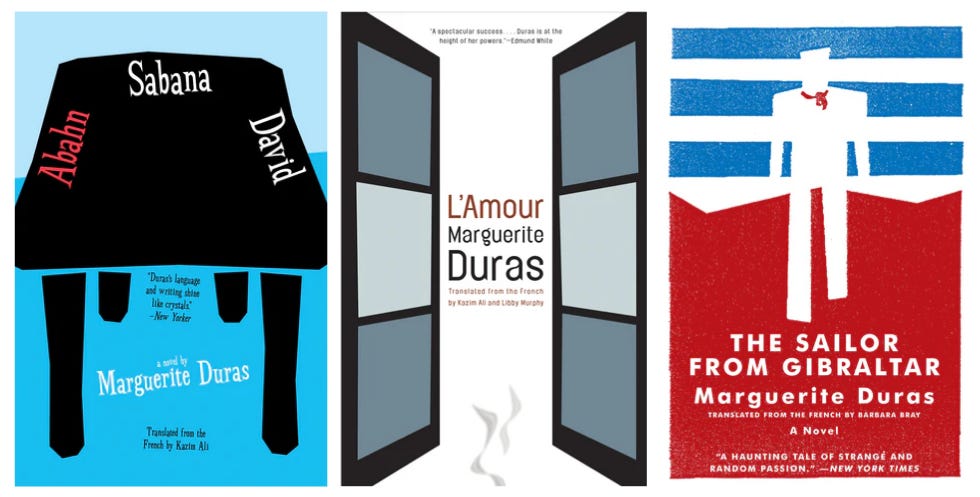
My Take: This is the Nouveau Roman that I love the most.
Description: Late one evening, David and Sabana, communists, arrive at a country house where they meet Abahn, the man they’ve been sent to guard and ultimately kill for his perceived transgressions. A fourth man arrives (also named Abahn), and throughout the night these four characters discuss understanding, capitalism, violence, revolution, and dogs. A gun in the house disquiets the scene.
Short Excerpt: He has come very close to her. She is looking at him still. She waits. His eyes shine darkly in the reflection of frost on the grass. “David is in danger because Gringo, on this night, needs someone to be in danger of death.” His voice as soft and intense as hers. “There, in Staadt, David, who knew me, who knew the Jew: he took David.”
My Take: Best acquisition we’ve ever discovered at AWP. (Yes, there is a story.)
Description: A man—the traveler—arrives in the seaside town of S. Thala with the intent to abandon his present, and instead finds himself abruptly reintroduced to his past. Through his subsequent interactions with “her,” the woman to whom he was briefly engaged as a young man over twenty years ago, and “him,” the man who walks and keeps watch over “her,” the traveler is soon drawn back in and acclimated to the strange timelessness and company that is S. Thala.
Short Excerpt: He arrives. He stops opposite the one who leans against the wall, the traveler. His eyes are blue, piercing, transparent. The emptiness in his gaze is absolute. He speaks with a firm voice, gesturing around him, everywhere.
My Take: One of Duras’s most beautiful—and approachable—novels.
Description: Disaffected, bored with his career at the French Colonial Ministry (where he has copied out birth and death certificates for eight years), and disgusted by a mistress whose vapid optimism arouses his most violent misogyny, the narrator of The Sailor from Gibraltar finds himself at the point of complete breakdown while vacationing in Florence.
Short Excerpt: I stayed sitting on the bench for a long time, probably longer than the picture was worth, over half an hour. Of course the angel was still there. I looked at him mechanically, without seeing him, my attention concentrated on the relief that had come with my discovery. It was a great relief. My feebleness was leaving me. I sat motionless and let it go. I was like a man who has been dying for a long time to relieve himself, and finally does it.

My Take: My favorite of Dusapin’s four novels. (Opinion subject to change!)
Description: In a Tokyo summer, Claire finds herself dividing her time between tutoring twelve-year-old Mieko, in an apartment in an abandoned hotel, and lying on the floor at her grandparents’: daydreaming, playing Tetris, and listening to the sounds from the street above.
Short Excerpt: The days are beginning to draw in. The sky is dark by seven in the evening. I lie on the floor and gaze out of the window. Women’s calves, men’s shoes, heels trodden down by the weight of bodies borne for too long.
My Take: I saw someone perform on the Russian Bar at a Minnesota Timberwolves halftime show, and it was mesmerizing. (Also: Go Lynx!!!)
Description: Nathalie arrives at the circus in Vladivostok, Russia, fresh out of fashion school in Geneva to design costumes for a trio of artists set to perform at the dangerous venue of the Russian Bar.
Short Excerpt: Tonight is the opening night. There are birds perched everywhere, on the power lines, the guy ropes, the strings of light that festoon the tent . . . when I think of all those little bodies suspended between earth and sky, it makes me smile to remind myself that for some of them, their first flight begins with a fall.
My Take: In case there was any question, this is, by far, our best-selling book ever.
Description: A beautiful, unexpected novel about a tourist town on the border between South and North Korea; where a young French Korean woman guides a French cartoonist on a journey to discover “authentic” Korea.
Short Excerpt: He arrived bundled up in a woolen coat. He put his suitcase down at my feet and pulled off his hat. Western face. Dark eyes. Hair combed to one side. He looked straight through me, without seeing me. Somewhat impatiently, he asked me in English if he could stay for a few days while he looked around for something else. I gave him a registration form to fill in. He handed me his passport so I could do it for him. Yan Kerrand, 1968, from Granville. A Frenchman.
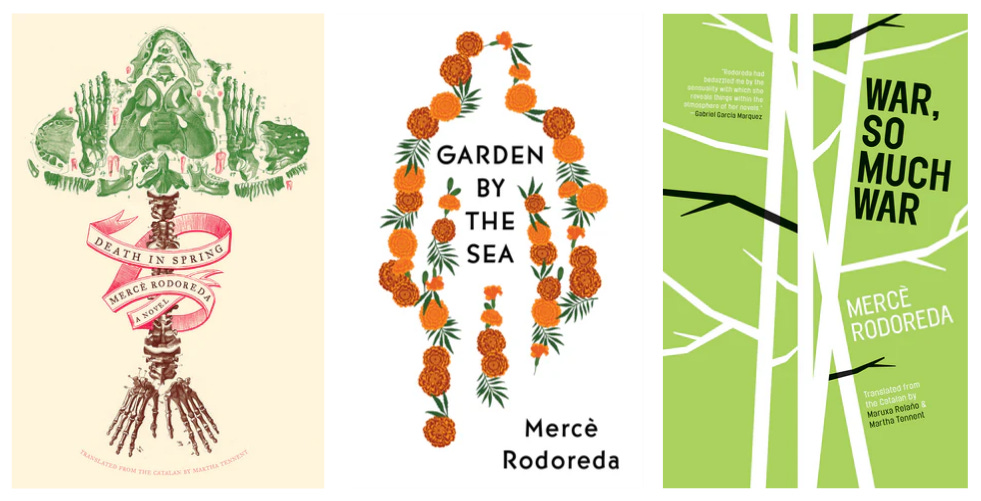
My Take: First presented to the public at an event in which Jessica Lange did a one-woman performance of Rodoreda’s The Time of the Doves/In Diamond Square.
Description: Death in Spring tells the story of the bizarre and destructive customs of a nameless town—burying the dead in trees after filling their mouths with cement to prevent their soul from escaping, or sending a man to swim in the river that courses underneath the town to discover if they will be washed away by a flood—through the eyes of a fourteen-year-old boy who must come to terms with the rhyme and reason of this ritual violence, and with his wild, child-like, and teenage stepmother, who becomes his playmate.
Short Excerpt: A woman died in childbirth, and when they went to bury her, they discovered the forest had been ravaged. The weather that afternoon was troubled. The sky was sulphurous, not a leaf stirred. The unrest that had commenced at the cave returned. Between young and old. For some time the young from the wash district had been saying that people should be left to die their own death. The old men from the slaughterhouse argued that everything should continue as before. The middle-aged men were inclined to side with the elders, except for a few that no one heeded. One elderly man lamented the sad affair of mixing bones and stuffing grass in eye-wells, it should never have happened. The blacksmith wasn’t listening; he delivered the first axe blow to the tree they wished to open.
My Take: A massive Books-a-Million order for this saved our ass during the pandemic—and set up a perennial Open Letter best-seller.
Description: Garden by the Sea takes place over six summers in 1920s Spain at a villa by the sea inhabited by a young couple and their beautiful, rich, joyous friends. Through the eyes of the villa’s gardener, we get to see the dissolution of these magical summers, as a sense of darkness and ending creeps in—precipitated by the construction of a new, larger, more glamorous villa next door.
Short Excerpt: He came morning and afternoon, and we always talked. One day he told me his wife had died in childbirth. Then he removed a crumpled piece of paper from his pocket and immediately put it back. “I’ve just had a letter,” he said. “She’s only twenty years old and she’s the spitting image of her mother. Same eyes, same hair. As for her character, she takes after me. Next week she will have been married six months.”
“I’ve never had children,” I said. “I’m rather glad of that. There’s already enough misery in this world.”
My Take: Reading this alongside Jakov Lind’s Landscape in Concrete would be interesting.
Description: Adrià Guinart leaves Barcelona out of boredom and a thirst for freedom, embarking on a long journey through the backwaters of a rural land, accompanied by the interminable, distant rumblings of an indefinable war. In vignette-like chapters imbued with the fantastic, Guinart meets with numerous adventures and peculiar characters who offer him a surrealistic view of an impoverished, war-ravaged society and shape his perception of his place in the world.
Short Excerpt: When I was three, everyone mistook me for a girl because Mother had never cut my hair and it fell in ringlets down the sides of my neck. The day Mother took me to see Father Sebastià to have me admitted to school, Father Sebastià gave me a sad look and said: We don’t accept girls. Mother lapsed into all manner of explanations. It pained her to cut such beautiful hair; I was too little and would be cold with my hair all chopped off.
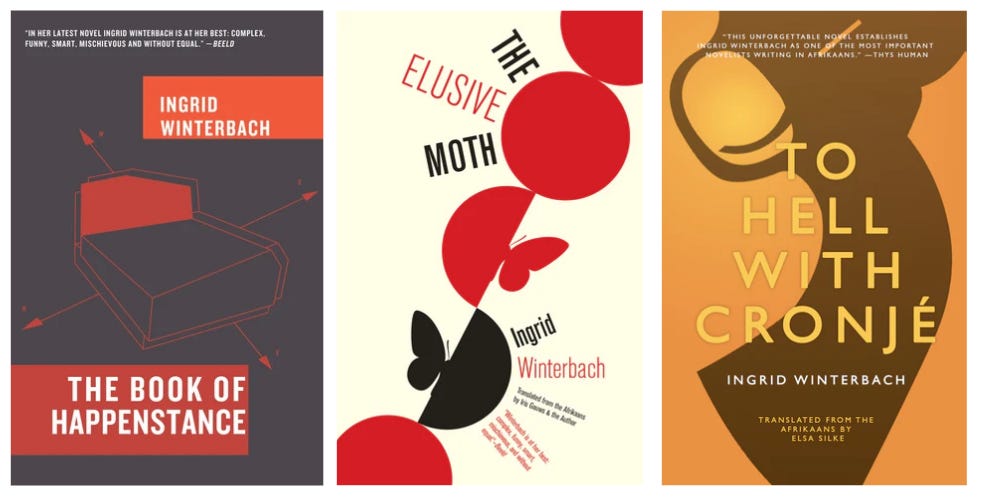
My Take: I want to reread this alongside Sigrún Pálsdóttir’s History. A Mess.
Description: A middle-aged lexicographer seeking to preserve disappearing Afrikaans words loses her precious collection of shells to theft. Deciding to investigate the theft on her own beside a new friend, she reflects on the life she’s lived—her ex-husband, her daughter, her lovers, her childhood—and begins to fall in love with her married boss.
Short Excerpt: Of that particular evening I recall first of all that I drank too much.
My Take: This is the only one of Winterbach’s books published under the pseudonym, Lettie Viljoen, to appear in English.
Description: In hopes of winning her father’s approval, Karolina Ferreira, an entomologist, goes to a small Free State town to research the survival strategies of a rare moth species.
Short Excerpt: In the afternoon Karolina and Basil drove to a neighbouring town, somewhat larger than Voorspoed, to pick up a parcel for Mr. Quiroga, whose car had broken down. This may be pure coincidence, or it may be preordained, Karolina thought—she had stopped to give a lift to this stranger, and now she was travelling with him along a road she might never have taken if she had been on her own. How extraordinary.
My Take: Everything I have to say, I said here.
Description: Two scientists find themselves in a “transit camp for those temporarily and permanently unfit for battle” during the Boer War. Captured on suspicion of desertion and treason during a trek across an unchanging desert to transport a fellow-soldier suffering from debilitating shell-shock to his mother, they are forced to await the judgment of a General Bergh, unsure whether they are to be conscripted into Bergh’s commando, allowed to continue their mission, or executed for treason—only instead, they are sent on a bizarre mission . . .
Short Excerpt: “Daggabush,” Ben points out, “Gert Smal’s favorite weed.” They laugh.
“Drift,” says Reitz, “place where you cross a river.”
“Dog,” says Ben, “man’s best friend.”
“Dearest,” says Reitz, “most believed person.”
“Dobba,” says Ben, “bitter veld plant.”
“Death,” says Reitz, “the end of life.”
“Death-cup,” says Ben, “a poisonous mushroom.”
“Dead end,” says Reitz, “the end of the road.”
“Deathwatch beetle,” says Ben, “small beetle that lives in old wood.”
“Death shadow,” says Reitz, “shadow cast by death.”
“Goodness, Reitz,” says Ben, “why so somber today?”
“Dead right,” says Reitz, “actually I’m dead right today, Ben.”
One final reminder: All Open Letter books written or translated by a woman are 40% off through the end of August. Discount automatically applied at checkout.
Slowly and infrequently, if we’re being honest.
No posts
Comments
Nothing yet. Say the first thing.
Sign in to join the conversation.