
What follows is an entry in the revived “Read This Next” feature in which, every Friday, we’ll recommend a single title in 500 words or less. Could be new or out of print, translated or written in English, but it almost certainly won’t be a book from the Big Five or one that’s already well-hyped. The goal is to highlight underrepresented voices (and presses) of the world in a simple, enjoyable way under the belief that the best book you’ve ever read, is also one you’ve never heard of.
This week’s entry is by Miles McCortney, University of Rochester student and summer intern at Open Letter Books. As M. L. McCortney, his science fiction and science fantasy appears in print in Bullet Points and online in Fiction on the Web, among other indie e-zines.
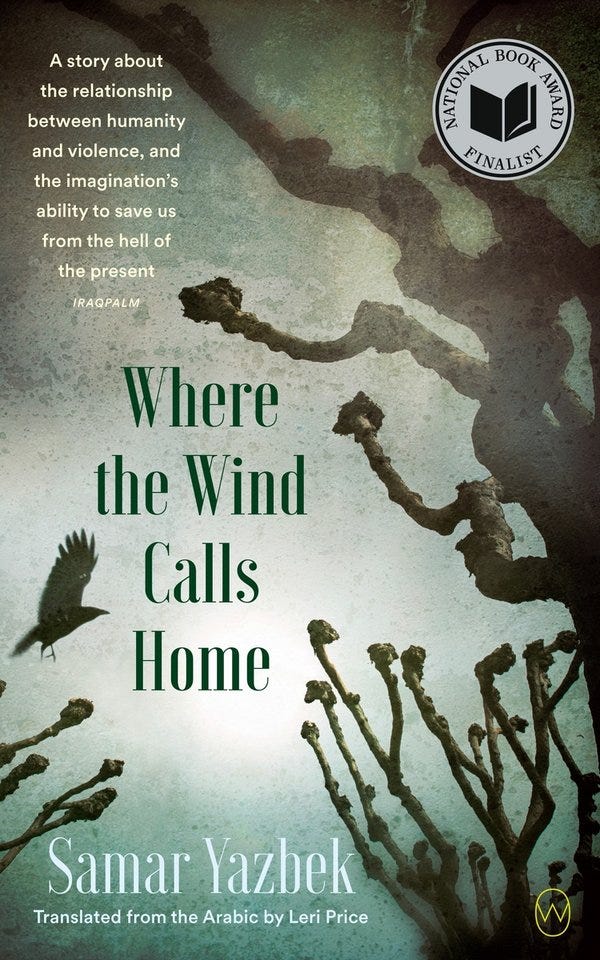
Where the Wind Calls Home by Samar Yazbek, translated from the Arabic by Leri Price (World Editions)
This often dreamlike and sometimes nightmarish book by widely praised author and Syrian dissident Samar Yazbek (Planet of Clay, Your Presence Is a Danger to Your Life) tells—or seems to tell—of the reflections on the last days of a wounded (dead? disfigured?) nineteen-year-old Alawite soldier who was drafted into the army of the Syrian regime. With as many pages dedicated to childhood flashbacks as to his dreamlike state of quasi-death from friendly fire, the teen soldier, Ali, guides readers through rural Alawite life, faith, and his relationship to nature, always overshadowed by the regime and the ongoing, bloody Syrian Civil War. Telling the story of his impoverished family and community, Ali also witnesses the tension between folk ideas of nature, rural Islamic institutions, and an inhuman dictatorship. At its heart, his story is somber yet buoyed by hope and imagination.
As referenced above, Ali’s life story, which grounds the narrative, is interrupted by interstitial pieces set in the “present,” where he lies beneath a tree, maybe dead, maybe on his way out. Either way, the situation is intentionally confused: Are the severed body parts he sees around him his, or his comrades’? Is he wounded, or has he already been buried? Ali never solves these questions, least of all the identity of a mysterious Other, a form in the darkness that seems to mirror his movements.
Ali’s present concerns drift away from the actual (such as being devoured by hyenas) to the mystical, culminating in his attempt to climb the tree under which he lies dying, in order to fly away—a childhood dream of his.
This is also a text with something to say about Assad’s regime and the almost banal ways in which those in power infiltrate the lives of their constituents, enhancing the reputation and status of these leaders. For example, when a young Ali sees portraits of Assad and his father (always referred to as The President’s Son and The President, respectively, with capital letters, subtly reinforcing their prominence and inevitability) hung next to religious saints, he wonders: are all saints Presidents? (I know of at least one president who likes to think of themselves as worthy of beatification.)
Ali’s childish oddities irk the adults and the community yet help him to function as a stand-in for the reader, highlighting his human impulses: the senselessness of war and dictatorship and its corollaries, poverty, discrimination, and general oppression. By contrast, he finds solace in understanding the language of nature, of trees, of the clouds and the wind which carries him off to worlds of hope and boundlessly free imagination.
All in all, this mystical work of fiction—one of only a couple dozen works of fiction from Syria available in the U.S.—tempers its account of the state of contemporary Syria with a poetic bent that’s lovingly translated by the renowned Leri Price.
—Miles McCortney
No posts
Comments
Nothing yet. Say the first thing.
Sign in to join the conversation.