
What follows is the first entry in the revived “Read This Next” feature in which, every Friday, we’ll recommend a single title in 500 words or less. Could be new or out of print, translated or written in English, but it almost certainly won’t be a book from the Big Five or one that’s already well-hyped. The goal is to highlight underrepresented voices (and presses) of the world in a simple, enjoyable way under the belief that the best book you’ve ever read, is also one you’ve never heard of.
This week’s “Read This Next” is by Joseph Alcala, a writer from Indianapolis with a deep passion for literature in translation, who is currently Open Letter’s marketing & publicity intern. He’s appeared on Three Percent before, both for his interview with Rusana Bardarska about her book, To Essay, and as a guest on the final episode of the Two Month Review season on I the Supreme. You can find more of his reviews at “The Thought of the Thing.”
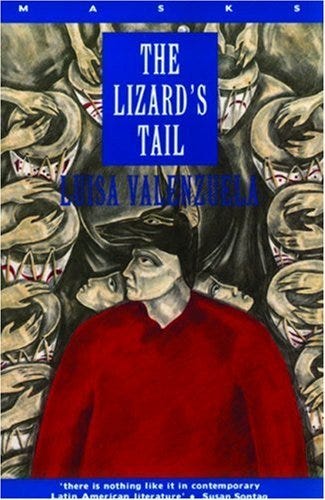
The Lizard’s Tail by Luisa Valenzuela, translated from the Spanish by Gregory Rabassa (Serpent’s Tail, 1983)
In 1976, after Argentinian president Isabel Perón’s deposition by a military junta, José López Rega went into hiding for ten years. Rega had served as Perón’s Minister of Social Welfare, wielding immense power and influence from the shadows. His aversion to cameras and interest in the occult imbued him with an aura of myth and mysticism. He fled persecution through several countries until his arrest in 1986, and died awaiting trial in 1989.
Reading The Lizard’s Tail, published in 1983, one suspects that the hand of Luisa Valenzuela may have played a not-insignificant part in Rega’s downfall. Valenzuela’s novel dramatizes and satirizes Rega in the tradition of the Latin American dictator novel. The novel is split primarily between two voices—Rega, the sorcerer, megalomaniacal in his inclinations and appetites, and a fictional version of Luisa Valenzuela, moving among the underground resistance and writing The Lizard’s Tail as a way to take back control of Argentina’s narrative. The novel is a metafictional study of the relationship between writing and power, with the decisions of Valenzuela the character on how to shape Rega’s narrative in explicit conflict with Rega’s own.
It’s also really funny. The Sorcerer’s right-hand man, Egret, maintains an unwieldy psychosexual relationship with his master in which he barks and whines like a dog. A pyramid is built resembling those of both the Aztecs and Egyptians, in which the interior is entirely covered in mirrors of various shapes and sizes, in order for Rega to embody his own fractaled omniscience. If you’re already familiar with the dictator novel, both I the Supreme by Augusto Roa Bastos and The Obscene Bird of Night by José Donoso should be coming to mind. To my mind, these three constitute a trilogy of South American writing and power. All three probe at the parallels between dictatorship and dictation, and do so through a highly stylized amalgamation of voices, indulgences, and repressed desires. Of the three, The Lizard’s Tail may be the most enjoyable, and it’s a damn shame for this brilliant translation by Gregory Rabassa to be so long out of print.
—Joseph Alcala
No posts
Comments
Nothing yet. Say the first thing.
Sign in to join the conversation.