
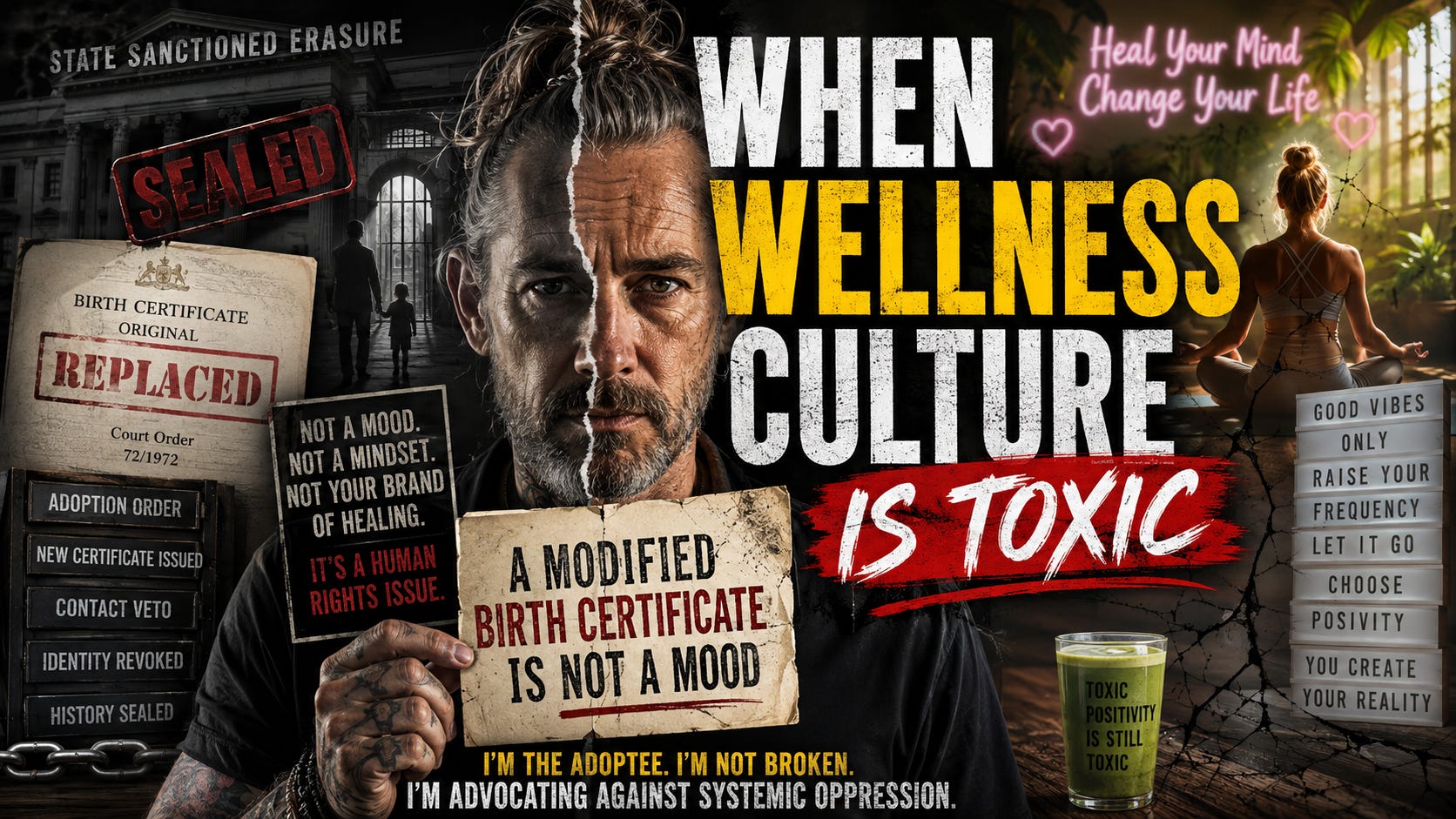
There is a certain kind of essay that circulates constantly in wellness spaces: the heaviest weight isn’t the world on your shoulders; it’s in your mind. Transform your thoughts, and you transform yourself. It is comforting. It is also, for a specific category of person, quietly false, and worth examining exactly where it breaks.
I left a comment under one such essay recently. The exchange that followed is a clean specimen of a much larger pattern, so it is worth pulling out of the comment thread and looking at directly.
The author’s position was that the “inner world” is a self-regulating haven: that whatever has happened to you externally, the real site of transformation is internal, psychological, a matter of reframing. When I pushed back, the reply was almost reflexive: sounds like you think in terms of victimhood.
I don’t. I think in terms of basic human rights. But that reflex, the instant relabelling of a structural claim as a personality flaw, is the actual subject here, more than the original essay ever was.
The “inner world as haven” framing is not wrong for everyone. It is wrong specifically for the person whose starting foundation was never intact to begin with. It assumes legal identity, lineage, and basic selfhood were never forcibly revoked, rewritten, or commodified by state and institutional apparatuses. For most people writing and reading self-improvement content, that assumption holds. For an adoptee whose original birth certificate was sealed or replaced by court order, it does not.
A modified birth certificate is not a mood. State-sanctioned identity revocation is not a cognitive distortion to be reframed away. The erasure of lineage by institutional apparatuses (registries, courts, welfare departments) is an objective, administrative reality, executed in the physical world by court order, filed, stamped, and enforced with the same seriousness as a property title. You cannot meditate your way out of structural nullification. Sanitising external systemic violence into a purely internal psychological exercise does not heal the person experiencing it. It lets the institutions responsible off the hook.
That is the part that tends to get missed, because it is not really about the individual writer’s intentions. It is about where the “transform your thoughts” model quietly redirects accountability: away from the registry that sealed the record, the court that issued the order, the department that still enforces the contact veto, and onto the nervous system of the person who was never asked. When trauma is inflicted not by temporary overstimulation but by legal erasure and identity replacement, internal reframing cannot substitute for the external correction the harm actually requires.
The word “victimhood” did a lot of work in that comment thread, and it does the same work everywhere this conversation happens. It is not a neutral description. It is a rhetorical manoeuvre that relocates a structural grievance into the register of personal pathology (something to be managed, softened, outgrown) rather than something to be corrected. Once a claim has been relabelled as victimhood, the person making it can be treated as the problem, and the apparatus that produced the harm disappears from the frame entirely.

This is not incidental to how institutional concealment operates. It is one of the mechanisms by which it operates. An architecture of silence does not require every institution to actively lie. It only requires enough of the surrounding culture to treat the disclosure of harm as a character issue rather than a factual one. “Sounds like you think in terms of victimhood” and “the state sealed my original birth certificate by court order” are not two sides of a debate. One is a fact with a paper trail. The other is a deflection with no paper trail at all, because it doesn’t need one. It only needs to be said with enough confidence to end the conversation.
None of this is an argument against interior work. Nervous systems matter, and stewardship of one’s own mind is not nothing. But it is not the whole of the claim, and treating it as the whole of the claim is where the harm compounds. The record, the sealed file, the contact veto, the “employment only” carve-out that keeps social-origin discrimination outside the reach of human rights law, does not move because someone reframed their thoughts about it. It moves when the record itself is amended: legislation changed, a veto lifted, a statutory gap closed.
That is the actual site of transformation for someone whose foundation was administratively revoked rather than merely difficult. Not a better relationship with the thought. A better relationship with the document. The two are not interchangeable, and no amount of goodwill from the “transform your thoughts” school of self-help changes which one an adoptee, a forced-adoption survivor, or anyone else whose legal identity was rewritten by a court actually needs corrected.
Comments
Nothing yet. Say the first thing.
Sign in to join the conversation.