
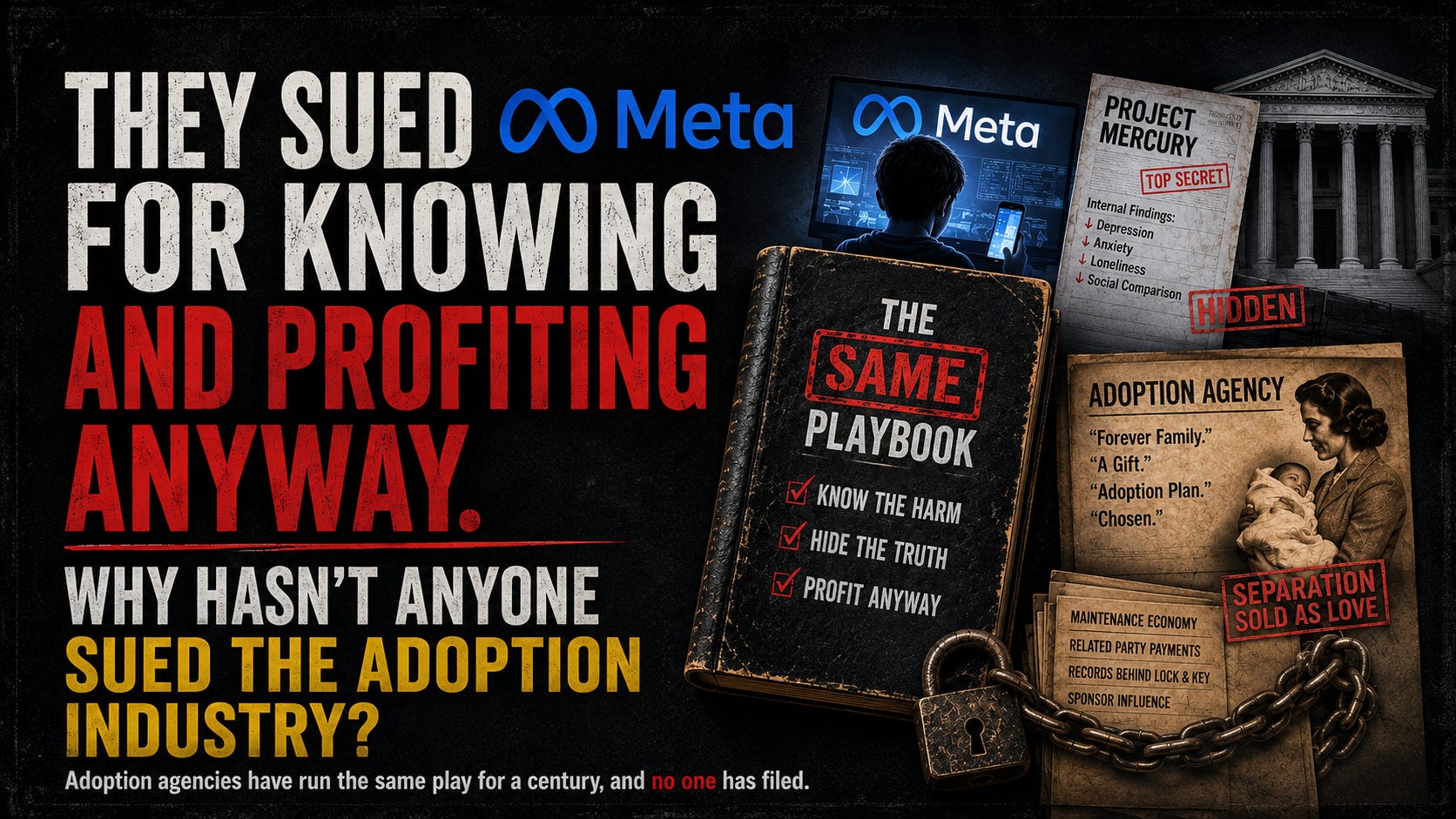
This week in Oakland, four state attorneys-general opened a case worth up to $1.4 trillion against Meta. The theory is not complicated. In 2019, Meta ran its own internal study (codenamed Project Mercury, conducted with Nielsen) and found that people who deactivated Facebook for a week reported measurably lower depression, anxiety, loneliness and social comparison. One of Meta’s own researchers, according to unsealed court filings, asked colleagues directly whether burying the results would make the company look like “tobacco companies trying to hide bad news.” Meta shelved the study instead of publishing it. It told the public its platforms were safe, kept collecting data on children under thirteen without consent, and kept the engagement machinery running. California’s deputy attorney-general put the business model to the jury in four words: *”Hook the users. Hold them for as long as they can. Harvest their data. Hide the truth.”* Kentucky’s attorney-general named the precedent directly, calling it *”the opioid fight of our time.”*
The states are not required to prove that any individual teenager developed a diagnosed psychiatric disorder. Under the Unfair and Deceptive Acts and Practices statutes carrying this case, they only have to prove deception at scale: that Meta told the public one thing while its own evidence said another, and that every deceived user is a separate violation. That is a lower bar than negligence law, and it is the bar tobacco and opioid litigation cleared to extract the largest corporate settlements in American history.
I want to ask the obvious question, and I want to ask it plainly rather than rhetorically, because I think it deserves an actual answer rather than a rallying cry: why has this playbook never been run against the adoption industry?
Strip the Meta case to its structural bones and you get three elements. A product or process known internally to cause harm. Public messaging that concealed or minimised that knowledge. A financial incentive that made concealment more profitable than disclosure. Every one of those elements is documented, repeatedly, in the closed-adoption system, not as speculation but as the specific findings this publication has spent the year building a forensic record around.
Known harm, documented internally and academically for decades. The neurobiological cost of infant separation (HPA axis dysregulation, epigenetic changes, disrupted synaptic pruning) is not a fringe claim. It is measurable, published, and has been available to the professions running adoption for longer than social media has existed. Agencies did not need Meta’s engagement-metrics dashboards to know what they were doing. The research existed before the industry scaled.
Public messaging that concealed it. This is where Respectful Adoption Language does the work Meta’s PR department did for Instagram. “Forever family.” “Adoption plan.” “A gift.” “Chosen.” Every one of these phrases was formalised in 1979 for the explicit purpose of managing perception: not the adoptee’s experience, not the mother’s, but the comfort of the adoptive market. Meta told parents its platforms were safe while its own research said otherwise. Adoption agencies told mothers and adoptees that separation was love while an entire clinical literature said otherwise. The mechanism is identical: manufactured public confidence running in the opposite direction of the internal evidence.
A financial incentive that rewarded concealment. I have called this the Maintenance Economy: the machinery of money that keeps the Architecture of Silence standing. This is not an abstraction. FamilyVoice Australia sent $652,889.90 to a related entity, Try Again Pty Ltd, across five years, and answered “no” to the related-party transaction question on its own Annual Information Statement. The National Council For Adoption runs a sponsor hierarchy, Platinum down to Copper, funded by the same agencies and facilitators whose practices the Council is positioned to set standards for. Spence-Chapin holds custodianship over the Louise Wise Services records that would let separated people verify their own history, and that custodianship is not incidental — access has a cost, a process, and an institution controlling both. None of this is proof of a single bad actor. It is the same structural finding the Meta case is built on: an entity was positioned to profit from not disclosing what it knew, and it did not disclose.
I am not going to pretend the two cases are procedurally identical, because the differences are the story.
Meta’s internal documents became public because state attorneys-general have subpoena power, litigation discovery, and a single corporate defendant with a balance sheet to attach. The adoption industry has none of that architecture arrayed against it. There is no single company. There are thousands of agencies, facilitators, religious charities, and state-licensed bodies operating across dozens of jurisdictions, each shielded by its own statute of limitations, its own charitable-status protections, and (this is the part that should stop you) its own custody of the very evidence a case would need. When a state sues Meta, the discoverable evidence sits in Meta’s servers and can be compelled out. When a natural parent or adoptee seeks the discoverable evidence of what was done to them, it sits sealed inside the same agency or state registry accused of the harm, and there is frequently no subpoena power available to a private individual to compel it. The defendant and the record-keeper are the same entity. That is not a coincidence. That is the Architecture of Silence functioning exactly as designed. It was built, in part, to survive precisely the kind of litigation Meta is now facing.
There is also no equivalent of a state attorney-general’s office whose statutory mission is protecting the class of people harmed by adoption practice. Consumer protection law exists because a legislature decided deceived consumers deserved a public enforcer. No comparable political constituency has ever been built for separated mothers and adoptees at the scale that produces a standing office with subpoena power. That is not an accident of law. It is Non-Adoptee Bias at the level of legislative architecture: the class of harmed people was never counted as a constituency worth building enforcement infrastructure around.
Notice, too, whose standing gets protected when a regulator does finally move. In September 2024 the FTC sent warning letters to thirty-one adoption intermediaries, and in June 2026 it delivered a congressionally mandated report on the private adoption sector. Real enforcement, worth naming honestly rather than borrowed for a claim it doesn’t make. The theory of harm was the Consumer Review Fairness Act and the FTC Act’s deception provisions — misleading placement-rate claims, suppressed negative reviews, facilitators posing as licensed agencies. It protects prospective adoptive parents as consumers. It says nothing about the mother who was separated from her child, or the adoptee who cannot open a sealed file. Even the one federal body that has finally acted built standing for the buyer. That is Non-Adoptee Bias again, in the one place you’d least expect to find it still operating: inside the enforcement action that was supposed to be the exception.
Here is the post-tragic turn, because naming what’s missing is not the end of the argument.
The Meta trial proves that a UDAP-style theory does not require proving individualised psychiatric harm in every plaintiff. It requires proving systemic deception — a documented gap between what an institution knew and what it told the public, run at scale, for profit. Every piece of forensic work this publication has produced this year (the NCFA sponsor mapping, the FamilyVoice related-party finding, the CHC VET qualifications audit showing a 24.5-out-of-100 system average against survivor-centred rights domains, the OMISSION Platform’s H×W scoring across sixteen jurisdictions) is exactly the evidentiary infrastructure a UDAP-style case would need. It is the discovery a subpoena would have produced, built instead from public filings, because no one with subpoena power has been willing to ask.
So the honest answer to the question I opened with is not “no one has thought of it.” It’s that the evidentiary work a state AG’s office does automatically, through legal power that exists because a legislature built it for one class of victims and not another. It has to be done manually, jurisdiction by jurisdiction, filing by filing, for adoptees and natural parents. That is what the Senate submission requesting a self-reference inquiry into the AHRC Act’s “employment only” restriction is actually asking for: not sympathy, but the same category of standing and enforcement architecture that let four attorneys-general walk into a federal courtroom this week with a trillion-dollar theory of liability, built on the same three elements the adoption industry has been running for a hundred years.
Meta knew and profited anyway. The adoption industry knew and profited anyway. One of those industries is on trial in Oakland right now. The other is still collecting sponsor-tier payments.
That gap is not evidence the case doesn’t exist. It’s evidence of who has, so far, been allowed to hold the file.
Comments
Nothing yet. Say the first thing.
Sign in to join the conversation.