
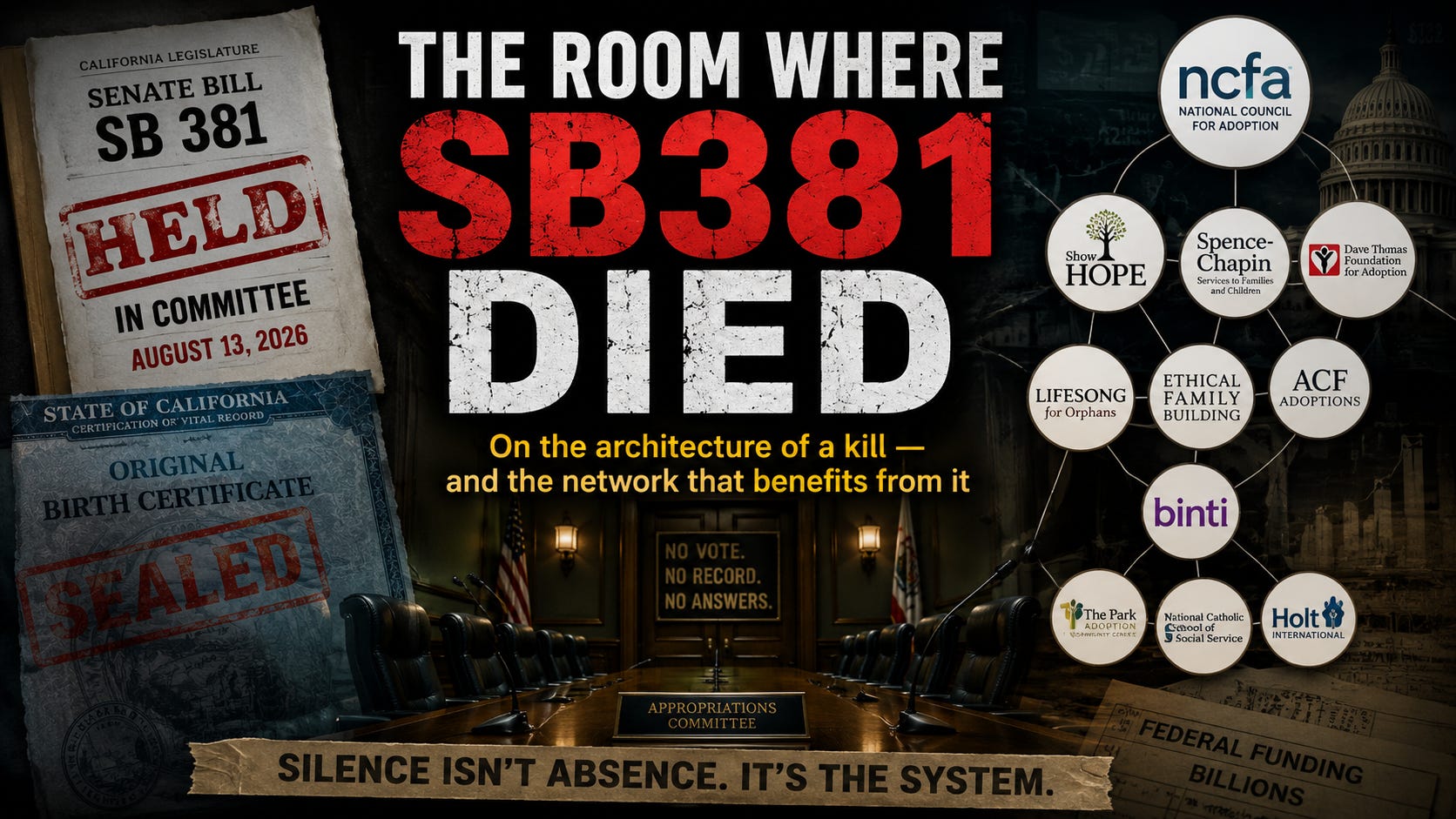
On the morning of 13 August 2026, the California Assembly Appropriations Committee worked through its suspense file at the pace committees always do when the point is to be finished quickly. No testimony. No debate. No recorded vote. Somewhere in that rapid-fire sequence, Senate Bill 381 — California’s bill to restore unrestricted original birth certificate access to adult adoptees — was held in committee. The California Alliance for Adoptee Rights confirmed it that evening. The bill is dead for this year. Most of you have been waiting decades. You will wait longer.
This is how it was always going to end, if it ended badly. Not with a senator standing up to oppose it. Not with a named opponent reading a statement into the record. With silence. With procedure. With a mechanism designed, as CalMatters documented earlier this year, specifically so that bills “die quietly” and “it can be incredibly difficult for members of the public to learn who killed a measure and why.”
That mechanism is the Architecture of Silence in legislation. And it did not operate in a vacuum.
Let’s hold the record for a moment, because it matters.
SB381 passed the California Senate in January 2026 with 35 votes in favour and zero against. It cleared the Assembly Health Committee in June with eleven in favour and one against. The bill had bipartisan co-authors across both chambers. It carried the support of the California Alliance for Adoptee Rights, Bastard Nation, Concerned United Birthparents, Ethical Family Building, and more than a dozen other organisations spanning adoptees, birth parents, and adoption reform advocates. It was, by every visible measure, a bill that should have become law.
The bill itself was elegant in its simplicity. From 1 July 2028, an adult California-born adoptee would be entitled to a copy of their original birth certificate upon request. No court order. No “good cause” shown. No intermediary standing between an adoptee and the document that recorded their entry into the world. The State Registrar would provide it. That was the entirety of what was being asked.
California became the first US state to seal adoptee birth records in 1935. It has kept them sealed for ninety-one years. SB381 would have ended that.
It didn’t.
The California Assembly Appropriations Committee’s suspense file is where bills go when they carry a projected state cost of at least $150,000. Bills are placed on the file, held for a hearing, and at the hearing — which covers hundreds of bills in a single sitting — the committee chair makes the call. Live or die. No explanation required. Former appropriations chairs have described absorbing blame for kills they made on behalf of other legislators who did not want their names attached to voting a bill down. The bill never gets a “no.” It just stops existing for this session.
Of the 2,403 bills that died in the last full California legislative cycle, twenty-five were killed by a recorded majority vote. The rest died in rooms where nobody had to say anything out loud.
This is not an accident of process. It is the process. It is designed to allow legislators to kill legislation without accountability — which means it is designed to allow institutional interests to apply pressure without leaving fingerprints.
I do not know who applied pressure to SB381. I have heard, from sources I cannot yet verify, that at least one Assemblymember withdrew support and demanded a birth-parent consent clause — a provision that would have reinstalled the permission gate the bill was designed to remove. I have heard that Senator Wahab was asked to pull the bill rather than gut it. None of that is confirmed. What is confirmed is that the bill died without a stated reason, that the committee chair holds that decision alone, and that the mechanism by which private pressure becomes a public kill was working exactly as intended.
Here is what I can confirm.
The National Council For Adoption — NCFA — was founded in 1980 with the explicit purpose of keeping adoptee birth records sealed across the United States. That is not characterisation. That is what Bastard Nation documented about its founding mission, and it is consistent with the formal position paper NCFA filed in California’s own legislative record in 2001, opposing an earlier OBC access bill (AB1349), arguing that sealing records “protects the integrity of the adopted family” and “facilitates the grieving process for birthparents by providing closure.”
NCFA’s 2026 National Adoption Conference was held in Washington D.C. between 23 and 25 June — six weeks before SB381 was placed on the suspense file. The conference opened with an Advocacy Day on Capitol Hill. NCFA equipped attendees with an advocacy toolkit and pre-scheduled meetings with their members of Congress. The stated purpose was to “speak confidently and effectively about the issues that matter most to the adoption community.”
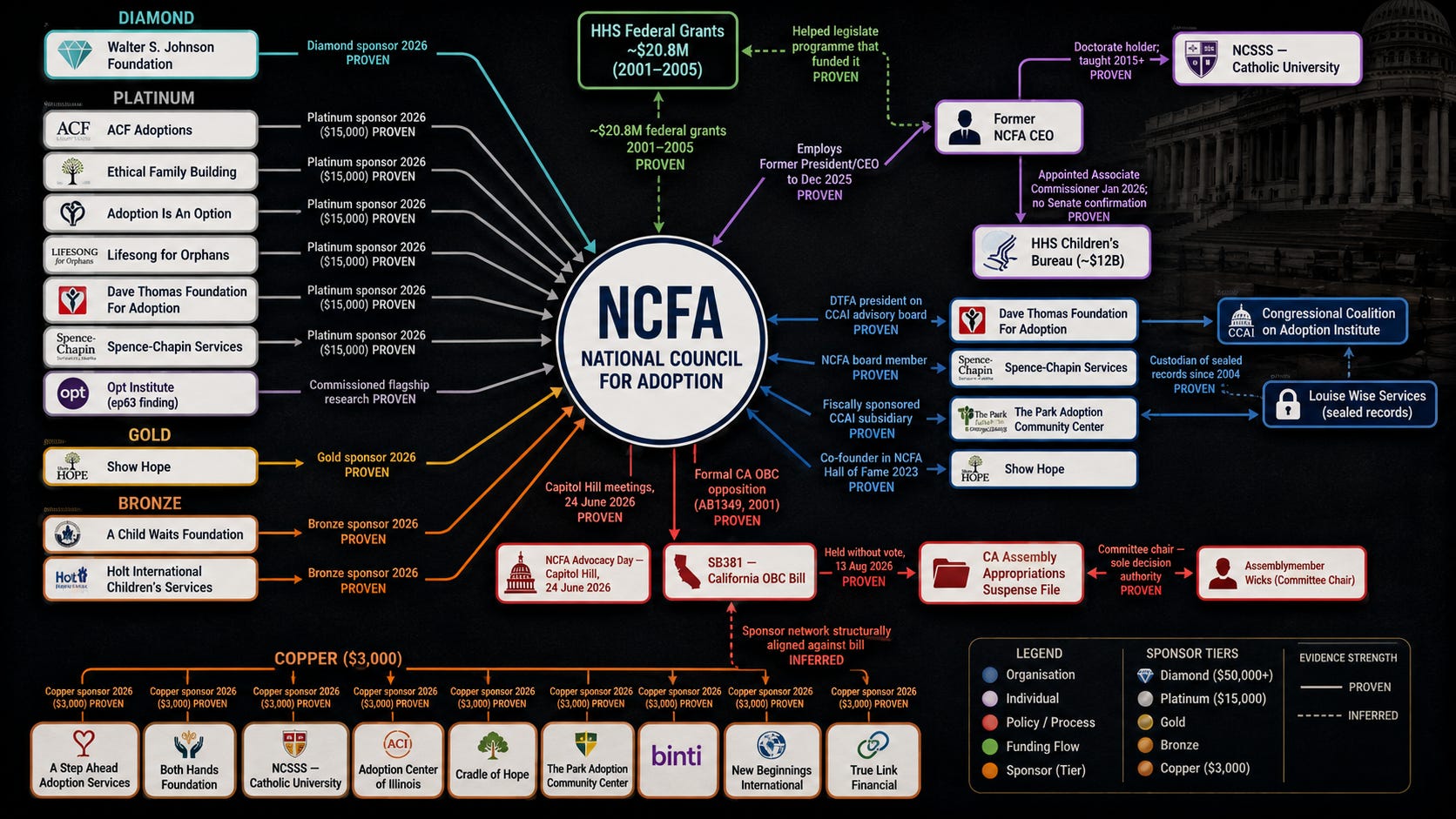
That conference was funded by the following sponsor network.
Diamond: The Walter S. Johnson Foundation — a San Francisco-based private grantmaking foundation with approximately $90 million in assets. WSJF’s stated mission is supporting transition-aged foster youth in Northern California. They have contributed $5.5 million to California community college programmes for former foster youth. They have no published position on original birth certificate access. They are the highest-tier financial supporter of an organisation that has formally opposed OBC access in California.
Platinum: Six organisations at a confirmed $15,000 each. ACF Adoptions. Ethical Family Building. Adoption Is An Option. Lifesong for Orphans — which funds adoption grants specifically for Christian families. Dave Thomas Foundation for Adoption — whose president sits on the board of the Congressional Coalition on Adoption Institute, the federal adoption policy infrastructure body. And Spence-Chapin Services to Families and Children, which holds a seat on NCFA’s own board and has been the custodian of the sealed records of Louise Wise Services — the New York agency whose practice of separating twins and placing them in different families without disclosure became one of the most contested adoptee rights cases in recent memory — since Louise Wise closed in 2004. Those records have not been fully released.
An entity with a board seat at NCFA, which simultaneously holds sealed records it has a documented institutional interest in keeping sealed, is a Platinum sponsor of the organisation that formally opposes unsealing them. That is not a coincidence of interest. It is a structural alignment so tight it reads as a design.
Gold: Show Hope — founded by Christian music artist Steven Curtis Chapman and his wife Mary Beth, whose co-founder was inducted into NCFA’s own Adoption Hall of Fame in 2023. Show Hope’s most recent 990 filing flags related-party transactions — dealings with persons connected to the organisation’s leadership. The nature of those transactions has not been confirmed; the flag is a matter of public IRS record, not allegation. Show Hope has awarded more than 9,100 adoption grants totalling over $44 million. It exists to reduce financial barriers to adoption and to engage the Church in the orphan care framework — the same framework that treats family separation as a precondition rather than a policy failure.
Bronze: A Child Waits Foundation and Holt International Children’s Services — two international adoption organisations whose business model has shifted toward domestic and foster care adoption as international pipelines have collapsed. Both have structural interests in the continuation of a domestic adoption framework that sealed records sustain.
Copper: Nine organisations, investigated in full as part of this series. They include Binti — a venture-capital-backed SaaS platform processing approximately forty-seven to forty-nine per cent of the US foster and adoption caseload, with over $60 million raised including a March 2026 investment from Pivotal Ventures. They include The Park Adoption Community Center — a fiscally sponsored subsidiary of the Congressional Coalition on Adoption Institute, which sponsored NCFA’s conference under two different names in consecutive years without disclosing the relationship. They include the National Catholic School of Social Service at Catholic University of America — the credentialing institution where NCFA’s former President and CEO completed his doctorate and taught from 2015 onwards. That former CEO departed NCFA in December 2025 and was appointed by the Trump administration as Associate Commissioner of the Children’s Bureau at the Department of Health and Human Services. The Children’s Bureau oversees approximately $12 billion in federal child welfare funding. The appointment required no Senate confirmation.
None of the above proves that NCFA or its sponsors caused SB381’s death. I am not making that claim. What I am documenting is the financial ecosystem in which SB381 died — a network assembled from organisations that have direct, documented financial interests in the continuation of adoption under its current framework, and an advocacy body that has opposed California OBC access on the legislative record and ran a Capitol Hill lobbying operation six weeks before the bill was placed in the mechanism that killed it.
The Maintenance Economy — the financial incentive structure that sustains the Architecture of Silence — does not require conspiracy. It requires alignment. When the same organisations that benefit from sealed records fund the same advocacy body that opposes unsealing them, and that advocacy body deploys its network on Capitol Hill during the same legislative session where the bill dies quietly in a committee room with no recorded vote and no stated reason — you are looking at a system doing what systems do.
It is also worth naming what is absent. There is no public record of which members of Congress NCFA’s Advocacy Day attendees met. There is no public disclosure of whether any California legislators were among them. There is no statement from Assemblymember Wicks, the Appropriations Committee chair, explaining why SB381 was held. There is no named opponent. There is no recorded “no.”
That is the Architecture of Silence. Not secrecy in the dramatic sense — no shadowy room, no explicit conspiracy. Just the ordinary operation of a system in which the most consequential decisions are made without documentation, accountability, or disclosure, and in which the financial interests that benefit from those decisions are organised, funded, and present, while the people whose lives depend on those decisions are not in the room.
California-born adult adoptees have been waiting since 1935 for unrestricted access to the document that records who they are. Most of the people I spoke with in the lead-up to August 13 had been waiting longer than SB381 had been alive. Some had been waiting since they were old enough to understand what a birth certificate is and why they weren’t allowed to have theirs.
SB381 is dead for 2026. The session ends on 31 August. There is no floor vote coming.
The California Alliance for Adoptee Rights said it plainly in their announcement: “This bill carried the hopes of thousands of California-born adult adoptees. We know how deeply this lands. We feel it too.” They said they will be back. They have been back before — SB1274 in 2024 died in the Senate Health Committee; AB1302 in 2023 went nowhere. Each time, the bill is sound, the coalition is broad, the vote counts are there — and somewhere in the opaque machinery of the California legislature, a bill with no formal opposition and broad bipartisan support stops.
The Maintenance Economy is patient. It does not need to win every session. It only needs to win this one.
What we need is different. We need to name the room. We need to document the network. We need to understand that the death of SB381 was not a procedural accident or a budget concern — it was the outcome of a system designed to make these outcomes possible without accountability, sustained by a financial ecosystem that has every reason to want adoptees to keep waiting.

Comments
Nothing yet. Say the first thing.
Sign in to join the conversation.