
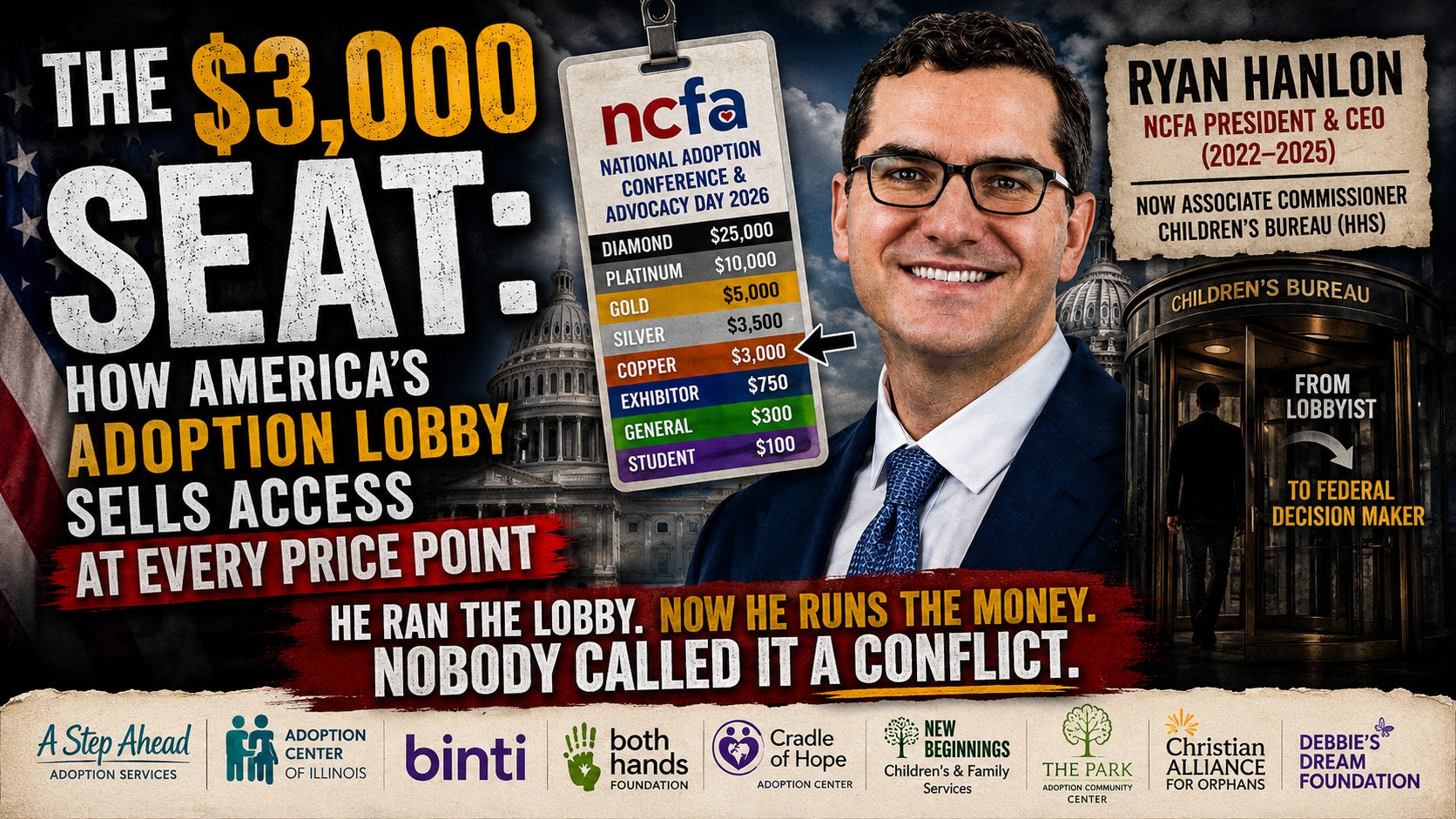
A $3,000 sponsorship tier at America’s top adoption advocacy conference maps onto venture capital, a Catholic seminary, a widow-fundraising ministry, and the federal official who used to run the whole operation.
Scroll past it and you will not notice. It looks like gratitude: a thank-you post, a row of logos, a heart emoji. The National Council For Adoption thanks its Copper Sponsors, nine names arranged with the same weight, the same warmth, the same undifferentiated goodwill. A Hague-accredited placement agency. A widow-repair ministry that fundraises adoption costs in the name of scripture. A venture-backed software company that now touches roughly half of America’s foster and adoption caseload. A Catholic seminary that trained the man who, until recently, ran the whole advocacy operation, and who now sits inside the federal office that funds it.
That collapse is not an accident of formatting. It is the architecture doing its job.
What three thousand dollars actually buys
NCFA runs its National Adoption Conference on an eight-tier ladder, Diamond at twenty-five thousand dollars down to Exhibitor at twelve hundred. Copper sits second from the bottom: three thousand dollars for a listing on the digital platforms, some signage, a quarter-page ad, a table, two free registrations. It is the cheapest seat with a name attached to it.
At that price, you would expect the sponsor list to be a grab-bag. Small agencies, minor vendors, nothing structurally interesting. Instead it is a near-perfect miniature of everything wrong with how the adoption industry organises its own visibility.
Adoption Center of Illinois is a real thing: a licensed, Hague-accredited, DCFS-supervised agency that has been placing children since 1988. It is also an agency whose sponsorship has quietly stepped down, from Gold in 2021 to Bronze in 2025 to Copper in 2026, a trajectory that says something about institutional finances nobody in the room is required to say out loud.
Both Hands is a Christian nonprofit built on a single verse, James 1:27, care for the widow and the orphan. It sends volunteer teams to repair widows’ homes and calls the sponsorship money raised along the way an adoption fund. It takes no administrative fee. It jumped from a twelve-hundred-dollar exhibitor table in 2025 to a three-thousand-dollar sponsorship in 2026, a two-hundred-and-fifty per cent increase in conference spend from an organisation whose entire identity is built on taking nothing for itself.
A Step Ahead Adoption Services is not a charity at all. It is a for-profit S-Corporation registered in Colorado, charging families thirty-eight hundred dollars in flat fees, sponsoring a conference that presents itself, and is received by the public, as the voice of the adoption community.
And then there is Binti. A venture-backed software company, sixty million dollars raised from Founders Fund and Kapor Capital, and as of March this year, three million more from Melinda French Gates’ Pivotal Ventures. Binti’s case-management platform now runs licensing workflows for over five hundred and fifty agencies across more than thirty states. An estimated forty-seven to forty-nine per cent of every child currently in the American child welfare system passes through its software at some point. It reaches that scale by selling directly into government, state and county contracts distributed through Carahsoft, the same reseller that moves surveillance and defence-adjacent software into federal procurement generally. Public money pays Binti. Binti sponsors the lobby that shapes the policy environment Binti’s public contracts depend on. Nobody on the sponsor page tells you that is what you are looking at.
This is the tragic reading, and it deserves to be sat with rather than rushed past. An industry that calls itself a family-building constellation has organised its own visibility so that a licensed placement agency, a scripture-funded widow ministry, an unaccredited consultancy, and a piece of government-contracting infrastructure all wear the same badge. The badge does the work of erasure. It always has.
The sharpest single artefact in this tier is not even a real organisation. The Park Adoption Community Center, post-adoption programming and cultural events and “birth province” tours for adoptees in Denver, states plainly on its own website that it operates under the 501(c)3 licence of CCAI, Chinese Children Adoption International, an active international placement agency.
CCAI was a Copper sponsor in 2025.
The Park, which is CCAI wearing a different name under the same tax licence, was a Copper sponsor in 2026.
No disclosure. No footnote. No asterisk connecting the two years. A single organisation received sponsor recognition from the National Council For Adoption in consecutive years under two different public identities, and the conference’s own materials record it as two separate acts of generosity.
I want to be precise about what this is and isn’t. It is not proof that anyone at NCFA intended to deceive. It is proof that the system has no mechanism that would catch it either way: no disclosure requirement, no cross-check, nothing that would force a reader to notice that the widow’s home someone repaired last year and the birth-province tour someone sponsored this year both trace back to the same signature on the same tax return. The Architecture of Silence does not require a villain. It requires only the absence of a form that would make concealment cost something.
The ninth Copper sponsor is the National Catholic School of Social Service, NCSSS, at Catholic University of America. Founded in 1918 by the National Catholic Welfare Conference, it is the training ground for the MSW-credentialed social workers who conduct America’s home studies, post-placement supervision, and birth-parent counselling. It has occupied that chokepoint, largely unexamined, for over a century.
Here is where the tragic reading stops being structural and becomes personal.
Ryan Hanlon ran the National Council For Adoption as President and CEO from May 2022 until December last year. His doctorate, completed in 2018, is from NCSSS. He taught there as adjunct faculty and field instructor from 2015 onward. The seminary that trained him is, in this very sponsor tier, a paying member of the industry he spent three years advocating for.
When Hanlon left NCFA, he did not leave the sector. The Trump administration appointed him Associate Commissioner of the Children’s Bureau, the federal office inside Health and Human Services that oversees an estimated twelve billion dollars in child welfare policy, grants, and state and tribal oversight. The appointment required no Senate confirmation. By February this year it was final. NCFA moved to an interim CEO, then in May named Kate Kennedy as its new president. Independent commentary has already called Hanlon’s move exactly what it is: a textbook revolving door, a trade-association leader stepping directly into the regulator that funds and shapes the industry he used to represent, a concern that does not require proof of misconduct to be real. It requires only the shape of the door itself.
I searched, in the course of building this account, for two other claims about Hanlon: a reported meeting with a sitting senator, a reported policy address at a sponsor’s own event. I could not find primary sources for either, and I am not going to let an unverified detail stand in for a verified one. What I found instead was better sourced and, honestly, worse. Not a single meeting, but a career-length structure. The training institution, the advocacy body, and the federal regulator are now connected by one credentialed, named person’s uninterrupted path through all three, with no gap, no cooling-off period, no public accounting of what that continuity might mean for the families and agencies whose futures the Children’s Bureau now shapes.
What the system gains from not telling you which kind of sponsor you’re looking at
Every pattern in this tier serves the same function. A sponsorship label that does not distinguish charity from commercial vendor from fiscally-sponsored subsidiary from training institution lets an industry present itself to the public as a single warm constellation, “the adoption community,” in NCFA’s own phrase, while actually operating as at least six distinct kinds of institution with six distinct sets of incentives. A software company selling government contracts. A consultancy selling fear and hope to prospective parents. A ministry raising money in scripture’s name. A subsidiary quietly doubling its own visibility. A seminary that trained the regulator. None of this requires a conspiracy. It requires only that nobody ever be made to fill in a form that says, plainly, what kind of organisation is this, and what does it want.
I have spent enough years now tracing this particular architecture, in Australia, in the intercountry adoption pipelines, in the training packages that credential the workforce, in the Senate submissions nobody answers, to know what the tragic reading alone produces if you stop there. It produces exhaustion. It produces the particular flatness that comes from proving, again, that the thing you already knew was true is, in fact, true.
So here is the turn, because the turn is not optional and it is not decoration. It is the entire discipline of doing this work without being consumed by it.
The turn is this. Opacity of this kind is not a law of nature. It is a design choice, made by people, sustained by the absence of a form, and forms can be demanded. A disclosure requirement that forces a conference sponsor list to state entity type, ownership structure, and prior-year identity is not a radical ask. It is bookkeeping. The same instinct that built a record across four and a half years of institutional correspondence, the same instinct that turned an unmarked concession into evidence, does not require the system’s permission to keep working. It requires only the discipline to keep naming what the label is hiding, one sponsor at a time, until naming it stops being a novelty and starts being an expectation.
Comments
Nothing yet. Say the first thing.
Sign in to join the conversation.