
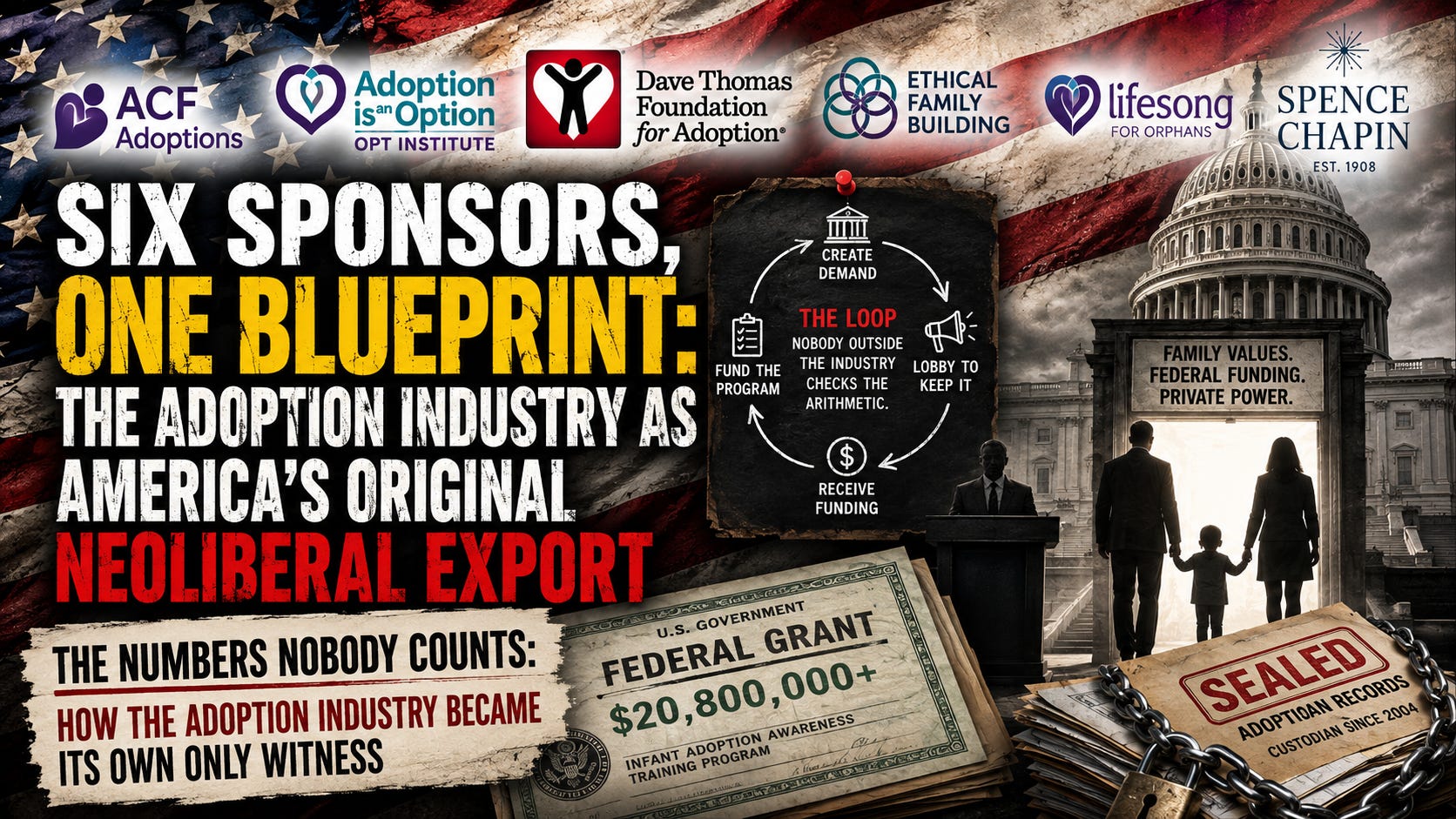
A routine sponsor thank-you post led to a federal grant-lobby loop, a sealed-records custodian, and the same family-values fusion that later gave the world its own versions of institutional family separation.
Tags: adoption industry, Architecture of Silence, Honest Adoption Language, NCFA, neoliberalism, family separation
There is a particular kind of quiet that happens when you find the receipt.
Not the emotional receipt — adoptees carry those the way other people carry keys, always in the pocket, always reached for without thinking. I mean the other kind. The 990. The grant total. The board bio that names the room you already knew existed but had never seen furnished.
I found six of them at once, thanked politely in a social media post, blue heart emoji and all.
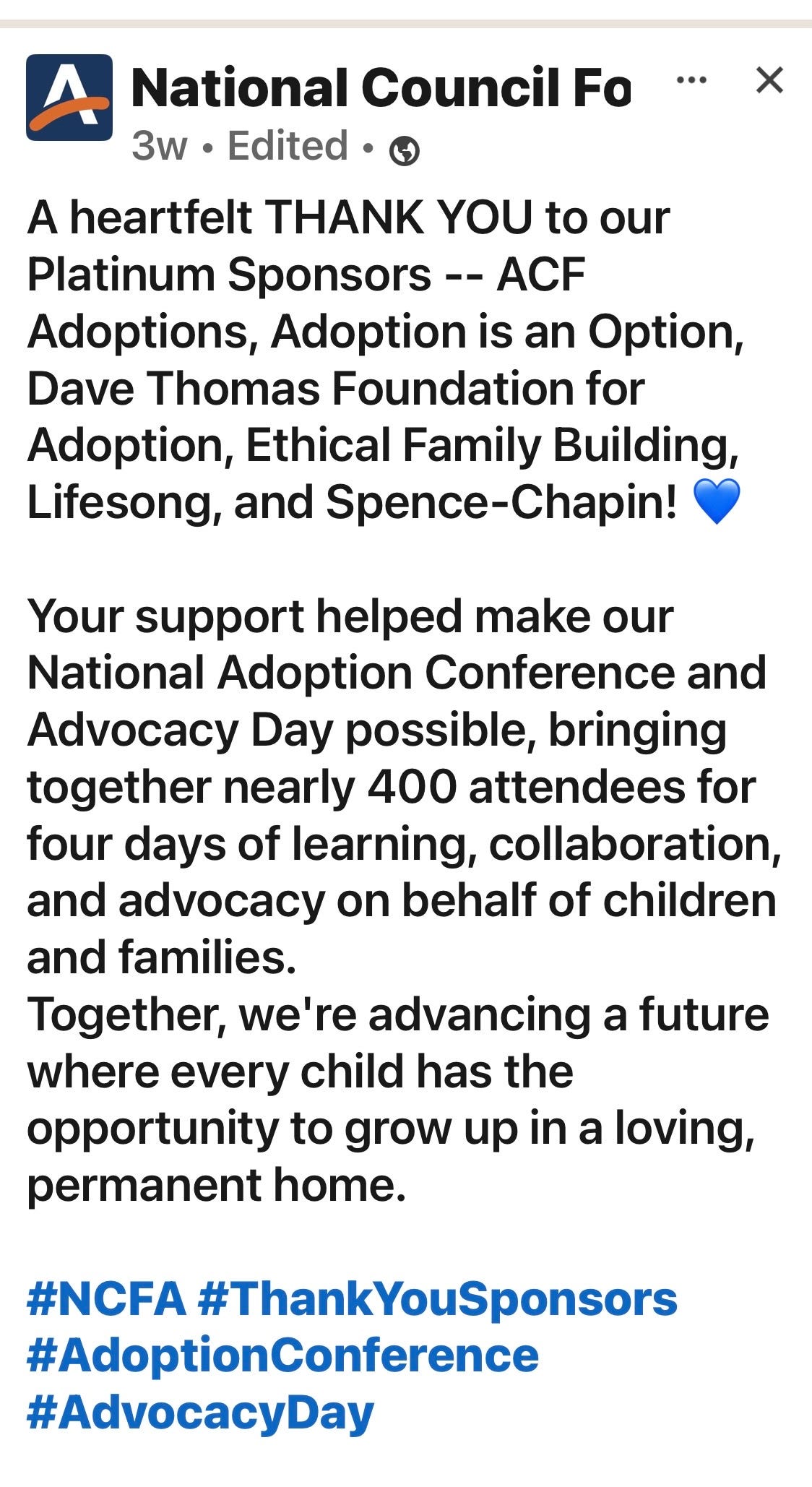
It was NCFA — National Council For Adoption, the industry’s oldest US trade association — thanking its Platinum Sponsors for making its National Adoption Conference and Advocacy Day possible. Four days, nearly four hundred attendees. The kind of post that scrolls past in a second. ACF Adoptions. Adoption is an Option. Dave Thomas Foundation for Adoption. Ethical Family Building. Lifesong. Spence-Chapin. A wall of logos and a heart emoji. “Together, we’re advancing a future where every child has the opportunity to grow up in a loving, permanent home.”
I have learned, the slow and expensive way, that when an institution thanks its funders in public, it is telling you — accidentally, generously — exactly who it answers to. So I pulled the filings.
NCFA presents itself as neutral infrastructure. Research, advocacy, education — the language of a body that simply informs the public and lets the facts speak. But between 2001 and 2005, NCFA received close to $20.8 million in federal grants for the Infant Adoption Awareness Training Program — a program NCFA had itself helped advance into federal legislation. Over roughly the same window, the organisation reported around $1.72 million in lobbying spend. Fund the program. Lobby to keep the program. Receive the program’s funding. That is not a scandal in the tabloid sense — nobody broke a law that I can see. It is something quieter and more durable: a loop. An institution that generates the demand for its own supply, on the public purse, for years, without anyone outside the loop checking the arithmetic.
Then I looked at who was standing behind it at the podium, four days into a conference, being thanked.
Opt Institute, the private foundation behind “Adoption is an Option,” did not just buy a table at the conference. It financed NCFA’s own national research — the private infant adoption counts NCFA has published as its flagship, most-cited data on how many domestic adoptions actually happen in America each year. Not sponsorship. Commissioning. The industry paid the trade association to produce the numbers the industry then cites as independent evidence of its own necessity.
Dave Thomas Foundation for Adoption sponsors at thirty-six times NCFA’s own annual revenue — sixty-one million against one point seven. Its president, Rita Soronen, is a founding board member and sitting advisory-board member of the Congressional Coalition on Adoption Institute, the body independent researchers have named as the industry’s actual point of entry to Capitol Hill. The largest sponsor in the room isn’t just funding a conference. It has a standing seat at the table where the legislation gets written.
Spence-Chapin, the oldest agency of the six — founded 1908 — has, since 2004, been the custodian of the sealed adoption records of Louise Wise Services. If that name doesn’t mean anything to you, it should: Louise Wise Services is the agency at the centre of the mid-century separated-twins study, children deliberately placed apart, without disclosure, so a research team could watch what happened. Those records — the paperwork that would tell the people involved what was actually done to them — are not lost to history. They have an address. A living custodian. A gatekeeper who is, this year, a Platinum Sponsor of the industry’s own advocacy day.
Ethical Family Building runs on $220,000 a year — smaller than some agencies’ marketing budgets — and still claims to have personally brought a federal bill, the ADOPT Act, to Congress. It is also lobbying for something called the Adoption Counts Bill: a proposal to make the federal government resume counting private domestic adoptions, a practice the government abandoned in 1975.
Read that last sentence again. 1975. For fifty-one years, nobody outside the adoption industry has independently counted how many private domestic adoptions happen in the United States, under what pressures, at what cost, to whom. The only entities currently trying to fill that gap are NCFA — funded to do so by one of its own sponsors — and a $220,000 advocacy shop sitting at the same six-name sponsor table. The industry is not being watched. The industry is watching itself, and publishing the results, and calling it research.
None of this is accidental, and none of it is new. It’s the same architecture Melinda Cooper traced in Family Values: the Chicago School economists and the Christian Right, two movements that should have had nothing to do with each other, converging on a single mechanism in the 1980s and 90s — dismantle state welfare, and hand the responsibility for the vulnerable back to “the family” and to private, faith-based charity. Not as rhetoric. As legislation. The 1996 welfare reform act didn’t just cut a budget line. It built the funding logic that Lifesong, Ethical Family Building, and the rest of this sponsor table still run on: private, unaccountable, faith-inflected capital doing what the state used to do, and calling it compassion instead of policy.
This is the part that matters for anyone reading this outside the United States, including my own country. Australia’s forced adoption regime and the Stolen Generations were not parallel tragedies that happened to rhyme with what America did. Australia’s neoliberal turn — the Hayekian import that reshaped welfare, work and family policy through the 1980s and 90s — grafted onto an existing welfare state rather than gutting it outright, which is why the country kept Medicare and compulsory superannuation while still privatising the machinery of family separation underneath. America built the template first, with less to protect it. The six names thanked in that sponsor post aren’t a uniquely American phenomenon. They’re what the blueprint looks like when you build it from scratch, in the place it was designed.
This is the Architecture of Silence doing what it has always done, except this time the silence isn’t a sealed file cabinet in a basement — it’s a funding structure, filed publicly, in plain sight, thanked with a blue heart emoji. Sealed records used to be the mechanism. Now the mechanism has evolved: you don’t need to hide the data if you’re the only one allowed to produce it in the first place.
And this is the Maintenance Economy at full stretch across an entire ecosystem, not one bad actor. NCFA takes federal money to legislate the conditions of its own future federal money. Opt Institute buys the research that becomes NCFA’s evidence base. Dave Thomas Foundation buys a seat at the coalition that drafts the law. Spence-Chapin holds the one archive that could contradict the whole story, and keeps it sealed. Ethical Family Building — the smallest voice at the table, genuinely trying to restore a federal count — still has to sit at the same six-chair table to be heard at all.
Nobody in this dossier needs to have done anything illegal for the structure to be the harm. That is precisely what makes it durable. A conspiracy can be prosecuted. An ecosystem just keeps sponsoring conferences.
I want to be honest about what this cost me to write, because Honest Adoption Language means I don’t get to skip that part either. There is a specific, low-grade nausea that comes from watching an industry fund its own witness stand. It is the same feeling as finding your own sealed file has a custodian with a name and a New York address and a gala dinner. The tragic reading doesn’t ask you to feel better about that. It asks you to look at it without turning away, which I have tried to do here, filing sources instead of adjectives.
Here is where the post-tragic pivot has to be more than a reflex, because reflexive hope is its own kind of dishonesty.
The turn is not “and yet, hope remains.” The turn is: the accountability gap is not natural, and it is not permanent, because it was built by specific, named, traceable financial decisions — and financial decisions can be traced by anyone with the patience to pull a 990.
I did this in an afternoon. Not with subpoena power. Not with a whistleblower. With a public tax filing database, a Wikipedia page, and the willingness to ask who’s paying for whom, out loud, in a place where the answer gets published instead of buried in a drawer.
That is the actual weapon here, and it is not classified. Every claim in this piece marked PROVEN in the underlying dossier came from a document any member of the public can open right now. The industry’s self-witnessing only works as long as nobody outside it bothers to check the arithmetic. The fix for a fifty-one-year data vacuum was never going to arrive as a single dramatic federal bill. It arrives the way most real accountability arrives — slowly, publicly, one traced dollar at a time, by people who refuse to let a thank-you post be the last word.
The Adoption Counts Bill deserves support, not because it will fix everything, but because restoring the count restores the possibility of an outside witness — which is the one thing this entire six-sponsor ecosystem currently does not have. Until then, the count is being done by the people being counted. Somebody has to keep doing the other kind of counting. The kind that doesn’t ask permission first.
This essay draws on primary-source financial filings (IRS Form 990, ProPublica Nonprofit Explorer), organisational disclosures, and independent investigative reporting. Full sourcing, connection strength (PROVEN / INFERRED / SUSPECTED), and further-investigation flags are documented in the accompanying forensic dossier. available on request.
Comments
Nothing yet. Say the first thing.
Sign in to join the conversation.