
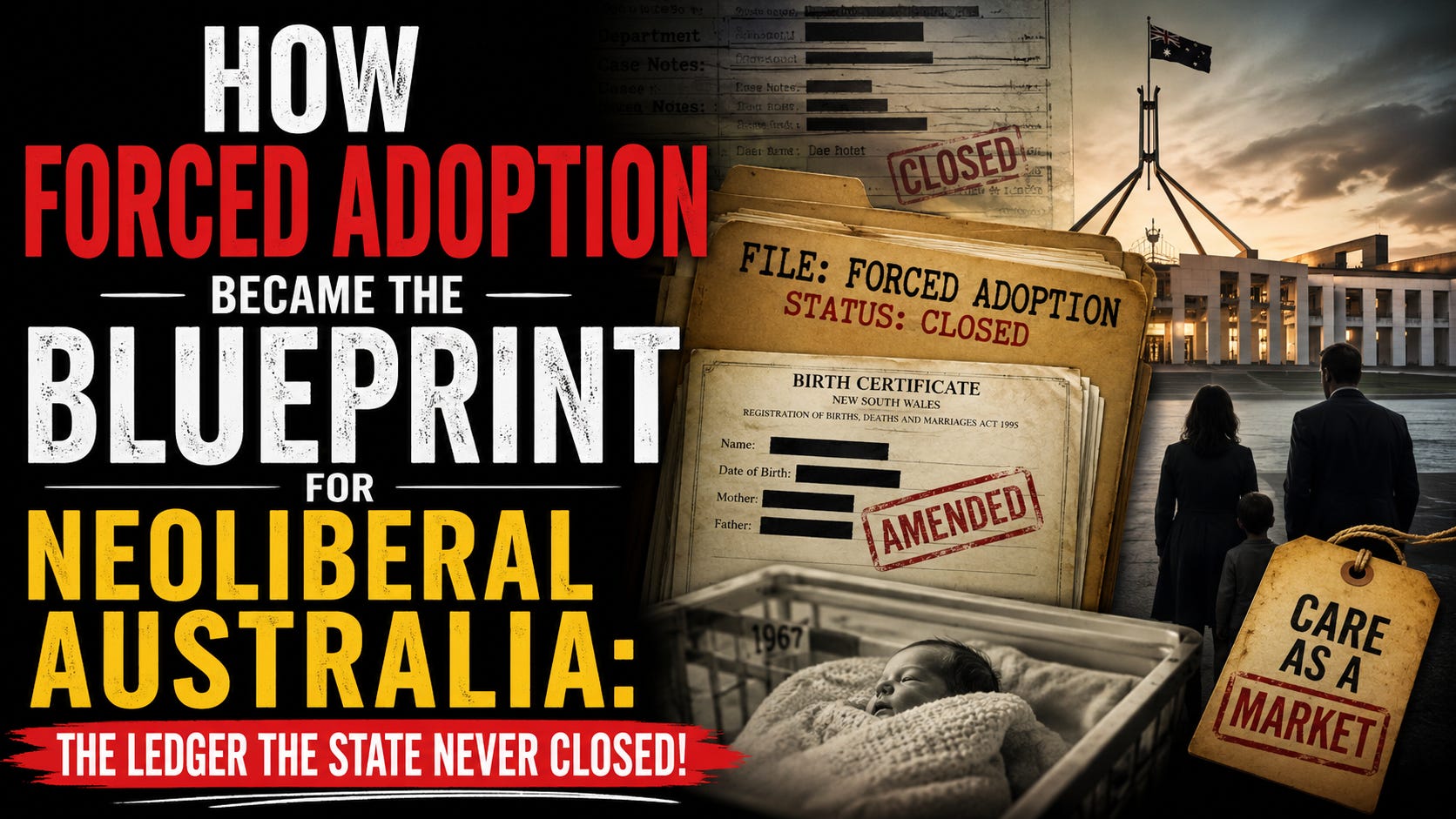
There is a particular kind of silence that lives in a filing cabinet. Not the silence of something forgotten. The silence of something filed correctly. Stamped, indexed, retrievable by a case number that has nothing to do with your name. I have sat with that silence. Every adoptee has. It is the sound of a system that did its paperwork.
For decades, the story we were allowed to tell about forced adoption was a moral one. Cruel nuns. Frightened girls. A more ignorant time, thankfully behind us. Australia issued its National Apology in 2013, and the official narrative closed the book: an aberration, corrected. A wound, acknowledged.
But a ledger is not a wound. A ledger is an instrument, and instruments don’t retire. They get repurposed. What if the machinery built to erase unmarried mothers and redistribute their children wasn’t a moral failure the state stumbled into, but the very apparatus it needed to build the neoliberal state it wanted? What if the birth certificates altered in the 1960s were the first drafts of a contract Australia is still running today, on a different population, through a different intermediary, for a different profit margin, but off the same administrative muscle memory?
Follow the ledger. It doesn’t lie the way the apology did.
Post-war Australia had a problem it didn’t want to pay for: a rising number of single mothers, and no appetite for the income support or public childcare that would have let them keep their children. The solution wasn’t cruelty for cruelty’s sake. It was cheaper than the alternative. Transfer the child to a married, propertied household. Let private capital absorb what public capital wouldn’t. Let stigma do the enforcement work that a welfare cheque would otherwise have to do.
This is the part the moral narrative erases. The nuclear family, in this era, was not a sanctuary. It was infrastructure. A risk absorber. An inheritance conduit. A demographic sorting mechanism dressed as love. The state didn’t just tolerate this arrangement; it built its entire relationship to child welfare around the principle that care is a private obligation, and that the state’s role is to enforce compliance with that obligation, not to fund an alternative to it.
That principle didn’t die with the maternity homes. It’s the operating system underneath everything that followed.
Here is where the subsonic hum gets loud, because this is not abstract to those of us who have held the document. An amended birth certificate doesn’t just record a lie. It constitutes one. It doesn’t say “raised by.” It says “born to,” about people you were not born to. In that single administrative act, the state didn’t just hide your origin. It manufactured a new legal subject and retired the old one. Your pre-adoption self became, on paper, something that had never existed.
This is not incidental to neoliberalism. It is a rehearsal for it. Legal identity, in a market society, is the precondition for everything: credit, employment, belonging, the right to be believed about your own life. Forced adoption proved, decades before “human capital” became a term of art in economics departments, that the state could treat a child as a bundle of attributes to be allocated to whichever household made the best case for absorbing them. Not a person with lineage and claim. An asset with a destination.
Every subsequent system that treats identity as something the state can issue, revoke, or reclassify according to administrative convenience is drawing on a template forced adoption perfected first.
I want to be precise here, because precision is the whole argument: this is not a claim that Out-of-Home Care is forced adoption. The system has mutated, and the mutation matters as much as the inheritance.
The historical state wanted to save money. Offload the child once, permanently, and never think about the ledger again. The modern state wants to spend money, recurringly, through an intermediary industry it has built and now depends on. Australian governments poured over $4.5 billion into Out-of-Home Care in 2021 to 2022 alone. That figure isn’t evidence of care. It’s evidence of a market, one where every placement breakdown generates a new assessment fee, a new casework hour, a new therapeutic contract. The historical system profited from finality. This one profits from instability.
Watch what happened to the carers, too. In the forced adoption era, the household absorbing the child was propertied, married, economically secure: the reward class. Today’s foster and kinship carers are overwhelmingly precarious. Renting, under-resourced, paid a stipend that barely covers cost, audited and discarded by the NGOs contracted to manage them. The state hasn’t stopped outsourcing its care obligations to private households. It’s proletarianised the households doing the absorbing, conditioning an entire class of workers to perform the state’s most difficult labour for the least security.
And the clock. Where the historical system used a priest or a social worker’s moral judgment to decide a mother was unfit, the modern system uses a statutory timeframe: six to twenty-four months to prove you can secure stable housing, address “risk factors,” satisfy a caseworker’s structured decision-making tool. It sounds procedural. Neutral. That’s precisely the innovation. A mother who loses her child because she couldn’t find a lease in eighteen months isn’t failed by a moral judgment she can appeal to conscience or activism. She’s failed by an algorithm’s timeframe, and the state gets to point at the clock instead of at its own housing policy. This is not a lesser cruelty than the moral system it replaced. It is a more armoured one, immune to the very outrage that eventually broke the historical regime.
Any honest structural account of this history has to sit with its hardest edge. Forced adoption and the Stolen Generations ran in the same decades, through the same administrative reflexes, and neither can be understood in isolation from the other, without ever being the same thing.
The Stolen Generations was eliminationist. Its target was Indigenous identity, culture, and connection to land, and its logic served the colonial project of dispossession. Forced adoption was disciplinary. Its target was the moral non-conformity of unmarried, largely white, working-class women, and its logic served the protection of property and bourgeois family form. Different populations. Different objectives. Different violence.
What they shared was infrastructure: genealogical erasure as a control mechanism, church-state collaboration as the delivery vehicle, and the treatment of children as resources the state was entitled to allocate. Some children were caught in both systems at once. Indigenous children absorbed into forced adoption’s machinery, a convergence that makes plain how modular this apparatus was, built to be pointed at whichever population the state needed sorted.
That modularity is still running. Aboriginal and Torres Strait Islander children remain over 40 per cent of all children in Out-of-Home Care while making up roughly 6 per cent of the child population. Not because the statutory Child Placement Principles don’t exist on paper, but because the Aboriginal Community Controlled Organisations meant to give those principles teeth remain structurally underfunded. The colonial logic didn’t end. It got a new funding line.
The forced adoption system, whatever its cruelties, resolved. The child was absorbed into a new family, permanently, and the state’s relationship to that child effectively closed. Modern OOHC doesn’t resolve. It expires. Over 40 per cent of young people leaving care experience homelessness within the first year of ageing out at eighteen. There is no replacement family waiting. There is a system that warehouses a child until they reach the age of labour-market availability, and then releases them into precarity as though that release were neutral rather than designed.
That’s not an oversight in an otherwise caring system. It’s the tell. A system that intended permanency for these young people would have built a bridge, not a cliff.
Here is where the tragic reading has to turn, because naming the machine without naming its weakness is just despair with better citations.
The historical system fell to moral outrage. The testimony of mothers and adoptees in the 1970s and 80s made the cruelty impossible to keep filing away quietly. The modern system doesn’t have that vulnerability. It has already absorbed moral criticism into its own language: “child-centred,” “permanency,” “risk management.” You cannot shame a spreadsheet.
But you can audit one. The neoliberal OOHC system is structurally dependent on nobody asking a simple question: of the $4.5 billion, how much reaches birth families as direct support (housing, income, therapeutic intervention), and how much is absorbed by provider administration and profit margin? That number does not currently exist in public form, and its absence is not an accident. It is the load-bearing wall of the entire arrangement.
This is the actual work now. Not another apology; apologies are cheap, and this state has already banked one. What this moment calls for is mandatory public reporting on how OOHC budgets are actually spent, direct cost comparisons between supporting a birth family and funding a placement, a public reckoning with the permanency clock as a mechanism that protects providers’ finality rather than children’s welfare, and a Royal Commission into the financial architecture of this industry, built on the same evidentiary standard that finally forced the forced adoption and Stolen Generations inquiries into being.
I don’t say this from theory. I say it from the specific, bodily knowledge of what it costs to be a line item in someone else’s ledger, and from the equally specific, equally bodily knowledge that a ledger, unlike a wound, can be opened. It can be read. It can be made to answer. The state built this system to be filed away quietly. The one thing it was never built to survive is an audit it can’t control.
Comments
Nothing yet. Say the first thing.
Sign in to join the conversation.