
Before AD 100, there were Christian communities in Rome and these were almost entirely Jewish. Christianity began as a Jewish sect, and many followers continued to attend synagogues and observe Jewish customs for centuries to come. Jewish followers of Rabbi Yeshua (Jesus) likely met in private homes rather than formal synagogues. Paul’s Epistle to the Romans (written around AD 57) mentions numerous house congregations.
In 49 AD, the Roman historian Suetonius records that Emperor Claudius expelled Jews from Rome because of disturbances “at the instigation of Chrestus.” After the Jewish War (AD 66–73), the distinction between Jews and Christians became more pronounced. These Christian-Jewish communities were concentrated in Trastevere and along the Tiber. This segment of the city was considered a dangerous no-go area by most Romans due to the high crime and violent reputation. However, their existence was generally tolerated by the Roman Pagan authorities.
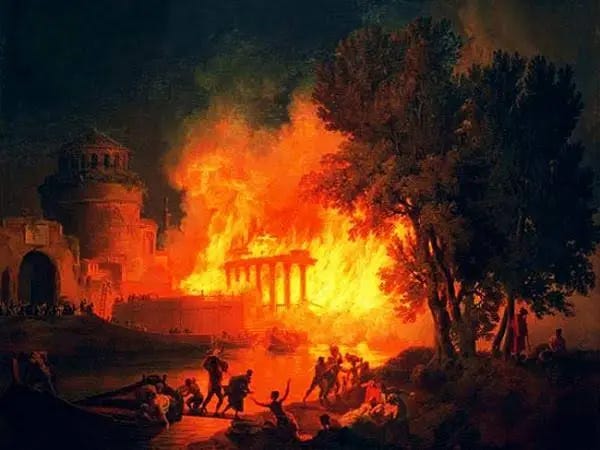
This was to change in 64 AD, when a great fire struck Rome during the reign of Emperor Nero. Beginning near the Circus Maximus, the fire consumed a significant portion of the city. Driven by strong winds, the fire spread throughout Rome for ten days. Contemporary reports cited groups of Christians carrying torches and setting fires to buildings on purpose.
Although Nero was not in Rome when the fire began, ancient historians such as Tacitus would later blame Nero as part of the internal propaganda wars among the Roman elite. This is one of the reasons why the biographies of the emperors tend to be unreliable, as a new ruling dynasty would set out to tarnish the reputation of the previous ruling classes.
There are many reasons to suspect that Nero did not order the fires. He commissioned the rebuilding of Rome, enforcing the use of fireproof materials and wider streets as preventive measures. Records from the time indicate that Nero rushed back to Rome and personally helped organise efforts to combat the blaze. Once the fires had died down, he had thousands of people employed in the construction of the city, built up from the ruins.
Early Christians were a constant pest and nuisance to the Romans because if a Christian died for their faith, then martyrdom would get them into the Christian heaven. So the Christians were very much intentional troublemakers, looking for reasons to receive the death penalty. It wasn’t until the priests noticed that the numbers of young Christians were declining instead of growing that they figured out the issue and preached against suicide. Long before Islam, a martyrs death was central to all Levantine deaths cults from the Middle East.
The bulk of evidence clearly indicates that the Christians of Rome did start the fires, and this was widely accepted and not just Nero’s opinion. Their religious beliefs included the anticipation of the world ending in a cataclysmic “judgement by fire,” and they were largely isolated from Roman civic life with little regard, if not outright contempt, for the native Romans and their historical and cultural legacy. Similar to present day Abrahamic groups such as Christian identity sects, Muslims and certain certain Orthodox Jews exist today.
Later Christians would attain power and rewrite history to blame Nero for the burning of Rome and a model of historical revisionism we have been subjected to ever since. Independent historians have known that Christians were not as persecuted by the Romans as they like to profess. And, in fact, Christianity was a big part of the Empire becoming a lot more totalitarian and brutal after Christianity became its official religion (380 CE).
No posts
Comments
Nothing yet. Say the first thing.
Sign in to join the conversation.