
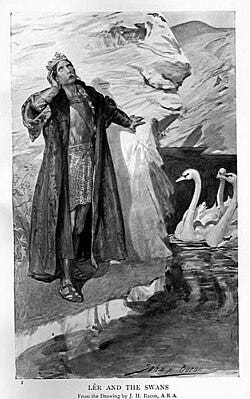
Every child of school-going age in Ireland knows the story of the Children of Lir concerning the four children of Lir, a powerful member of the Tuatha Dé Dannan, and how, after the children’s mother Aoibh dies, Lir marries her sister Aoife - but she is so jealous of her new husband’s affection for his children that she casts a spell transforming them into swans for nine hundred years. When the spell is finally broken centuries later, they regain their human forms. However, these once young children are now old and frail and they die shortly after being baptised as Christians. The story is actually a powerful mystical tome on the loss of Ireland’s true Pagan identity, only to be replaced with a completely alien Jewish sub-cult called Christianity.
The subtext of the Children of Lir opens up a window to a deeper aspect of the Irish-and wider European-mythologies to a time from before the establishment of what we come to think of as being Celtic, Germanic, Slavic or others.
The concept of cataclysmic floods, submerging lands or unleashing mythical “monsters,” is a recurring theme within Indo-European folklore. These events often signify the onset of a new age of restoration and spiritual rejuvenation for humanity. Swiss psychoanalyst Carl Jung suggested that the deep waters of the sea represent both the personal and collective unconscious. He wrote, “By the seashore, the sea breaks into the land, flooding everything... The sea is the symbol of the ‘Collective Unconscious’, for unfathomable depths lie concealed beneath its reflective surface... The sea is a favoured place for the birth of visions, i.e., invasions by unconscious content.”
It is not surprising, then, that folklore and mythology frequently depict the ocean in ways that resonate with our understanding of the unconscious mind. In Greek mythology, Poseidon’s domain is portrayed as unpredictable and difficult to control. Heroes who venture into the sea often encounter monsters, temptations, and trials that symbolise meaningful confrontations with their inner fears and desires.
Encounters with mermaids and other human-aquatic hybrid beings are also common in these tales, along with modern interpretations such as H.P. Lovecraft’s “Deep Ones” in his story The Shadow Over Innsmouth. Stories of sea spirits, ocean gods, and monsters abound, while also presenting coastal deities and demons that represent thresholds and portals between different states of existence.
A well-known figure in Irish folklore is the Hag of Beara (Cailleach Bhéara), who is associated with the Beara Peninsula in County Cork. She appears in medieval Irish literature, having roots in much older oral traditions. The Hag is depicted as an ancient woman who has lived through many generations and mourns the loss of her youth and her children. The cycle of life and death, as a transitional threshold, is evident in the lore surrounding the Hag of Beara. Set among the rocky and windswept coastlines, her archetype embodies powerful subconscious symbols of transmigratory and inescapable states of being.
The motif of being swallowed by a sea creature and emerging transformed is deeply prevalent in folklore and mythology. This theme connects human experiences to the hidden depths of the seas and oceans, where enlightenment is often attained. These stories generally follow a familiar pattern: entering the unknown, confronting hidden truths, and returning with newfound wisdom—much like a journey into the subconscious within the modern psychological sense.
This idea of the ocean serving as a lexicon for the subconscious is just one aspect of our relationship with the mysterious and the ancient. Such relationships can also be expressed through the mythology of any given landscape, linguistic clues, and our connections with nature. We engage with and utilise everything from art/magic to megalithic structures and tribal folklore. We are not merely passive participants in these fluctuating and mysterious experiences. We are here to engage actively, fostering personal creativity and awareness. By following the ancient roadmap left by our Indo-European ancestors, we can continue our own personal and tribal sagas.
SO WHO ARE WE REALLY?
Until about two hundred years ago, the ancient past was as mysterious as outer space. While archaeological ruins, folklore, and remnants of the classical world survived the onslaught of Christian iconoclasm, there was little to connect them beyond misleading biblical concepts of Hebrew migrations and the Twelve Tribes. This obsession evolved into the notion that the West was composed exclusively of displaced Semites awaiting the return of the Messiah. Then something truly groundbreaking emerged concerning the ancient past, and it was discovered not through archaeology, but through linguistics.
The Indo-European hypothesis posits that many languages spoken across Europe, Asia, and beyond—including English, Spanish, Hindi, Russian, Persian, Greek, and Latin—descend from a single common prehistoric language known as Proto-Indo-European (PIE). This hypothesis gained traction in the late 18th century, spreading rapidly because it was both verifiable and answered numerous questions about the ancient past that could not be addressed through stone circles and ruined temples.
In 1786, British orientalist and jurist Sir William Jones delivered his Third Anniversary Discourse to the Asiatic Society of Bengal, which he had founded, in Calcutta. In his address, he noted striking similarities in vocabulary, verb roots, and grammatical structures among Sanskrit (the ancient language of India), Greek, and Latin. He famously stated that these languages must have “sprung from some common source, which, perhaps, no longer exists.” He also suggested that Gothic (an early Germanic language), Celtic/Gaelic, and Old Persian likely shared this origin.
To say that his lecture changed everything would be an understatement; he effectively opened a linguistic time machine that the majority of the Western world now shares, evident in our everyday language. His work not only revealed connections in language but also opened something of a spiritual time machine, leading to the discovery that mythologies and spiritual traditions likewise share common origins. Once that cat was out of the bag, it was never going back in.
In 1813, British scientist Thomas Young coined the term “Indo-European” to describe the language family that spans from India to Europe. Due to the abundance of surviving written documents in Sanskrit—some dating back around eight thousand years—European scholars and polyglots, such as Sir William Jones, began comparing Sanskrit directly with the classical European languages they were familiar with, including Greek and Latin. From these comparisons, Jones concluded that the similarities were evidence of a genetic relationship between the languages, rather than merely coincidence, borrowing, or divine origin.
The linguistic and mythological similarities suggest an inheritance from a lost common ancestor rather than independent invention or mere contact. Nearly 50% of the planet’s population has Indo-European origins, and this has uncovered a broader spiritual and cultural framework that also stems from this shared ancestry, as the names of gods and themes within mythology and folklore similarly trace back to a common Indo-European root. Much of this exploration arises from the desire to understand how the Indo-European languages spread through migrations, agriculture, and technologies such as horses, wheels (including chariots), as well as the worship of cattle and bulls. Two centuries later, archaeology, ancient DNA, and computational phylogenetics have fortified the core hypothesis that emerged in 1786. It has also allowed for a newer, deeper understanding of previously cryptic mythologies and folklore.
The term “Mother“ Across Indo-European languages shows a consistent “m-” onset and similar structure. The “ma” sound is especially prominent in informal or child-directed speech across languages: English: mom/mama; French: maman; Italian: mamma; Hindi: Maa; Persian: mama; etc.
Sanskrit (Indic branch): Mātā or Mātṛ (माता / मातृ) — often shortened affectionately to mā (मा) or māṃ in Hindi/Urdu as Maa or Maan.
English (Germanic): Mother (from Old English mōdor, Proto-Germanic mōdēr).
German: Mutter.
Latin (Italic): Māter — source of Romance forms like Italian/Spanish madre, French mère.
Ancient Greek: Mḗtēr (μήτηρ) or mētéra (μητέρα).
Russian (Slavic): Mat’ (мать); affectionate mama (мама).
Old Irish (Celtic): Máthir.
Persian (Iranian): Mādar (مادر); affectionate māmān or mama.
Lithuanian (Baltic): Mótė or mamà.
The similarity and meaning of the word ‘Mother’ across the Indo-European world are likewise echoed in the Indo-European Pagan spiritual and supernatural elements, which also derive from a common mythological and mystical root. As in Indo-European linguistics, many deities and supernatural beings are clearly related. Even if their names and stories evolved differently over time, or were altered by geographic and environmental influences.
THE MISSING IRISH ORIGIN MYTH AND THE PRIMORDIAL ÉRIU
Ériu (or Éire) is the eponymous matron goddess of Ireland in Irish mythology, alongside her sisters Banba and Fódla. This deity from the Tuatha Dé Danann gave her name to the country and is often seen as a personification of Ireland. She is celebrated as a goddess of sovereignty. However, the origins of Ériu remain unclear. The Irish mythological tradition has yet to provide any creation or apocalyptic myths. The legends, primarily recorded during the Middle Ages, describe successive waves of invasions from across the sea that transformed Ireland with each new culture that arrived. This could also represent a shift in consciousness rather than merely the arrival of different races from other countries invading Éire.
There is a fascinating reference to an entity known as the Mata, which, according to Lady Gregory’s (1852–1932) translation, is described as a four-headed, many-legged creature resembling a sea turtle. Lady Gregory was a significant Anglo-Irish dramatist, folklorist, and theatre manager. She co-founded both the Irish Literary Theatre and the Abbey Theatre and played a crucial role in the Irish Literary Revival. A prolific playwright and patron, she mentored writers such as W.B. Yeats at her home in Coole Park.
It’s important to note that Lady Augusta Gregory, unlike W.B. Yeats and many other Irish folklorists and artists of the period, was not a member of the Hermetic Order of the Golden Dawn occult organisation. However, she was a close friend and collaborator of W.B. Yeats, a prominent member of the order, and she supported his interest in occult studies.
SANSKRIT MĀTĀ = ‘MOTHER’
Along with a translation from the 13th-Century concerning the Mata, Lady Gregory clearly also had access to esoteric stories about Ireland’s ancient past that were not documented by the Christian monks of the Middle Ages, largely because such stories would have conflicted with biblical narratives and migration tales.
Nonetheless, her version of the Irish origin story of the Mata appears quite plausible when compared to other similar Indo-European folklore, even if more traditional sources do not accept it. It fuses the concept of Ériu, the mother of Ireland, with the Mata’s primordial origin myth.
“And the Valley of the Mata was there, the Sea-Turtle that could suck down a man in armour.”
The Mata is eventually slain by the Dagda (the ‘good god’), and the Stone of Benn is then erected on the spot where the monster was cut down. The location of the Valley of Mata itself has still not been fully determined, although this ‘valley’ may well be an allegorical idea as much as a real place. As for the “Stone of Benn” (or Lecc Benn in Irish), it is currently understood to be a mythical or legendary stone rather than an actual megalith one can visit. Or is it?
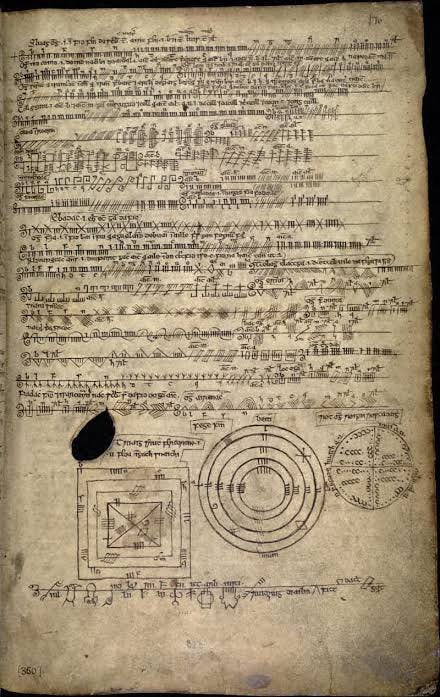
It is also described in the remarkable 13th-century Book of Ballymote. The text describes the Mata as a four-headed beast with one hundred and forty legs, linked to Inbher Colptha, generally believed to be the estuary of the River Boyne at Mornington in County Meath. There are also two mysterious towers at the mouth of the Boyne estuary at Mornington.
The reading and understanding of the Irish mythological record as something of a psychological archive of the ancient Irish psyche has generally been lacking. A psychological archive, it must be said, connects directly to ancient sites and landscapes. Something which archaeologists and historians generally ignore. This is unfortunate, as such an approach can reveal more about the lives of the ancient Irish than merely looking for proof that the individuals mentioned in the text might be based on real historical figures (which itself can still be plausible).
The Mata story would appear to be far more significant in meaning than the attention it has received to date. The concept of some monster(s) from the deep emerging to be slain by the ‘good god’ evokes an almost Lovecraftian idea of subconscious fears bubbling up from the depths of the psychic abyss. These are the dangers that inevitably accompany a shift in consciousness, whether personal or collective. At the same time, we are also reminded of the story of the Hag of Beara and her lamentation along the shoreline for what was and is no longer.
It is important to consider that the universal mother of the Irish, referred to as “the Mata,” may have been transformed by Christian scribes into a monstrous figure from the deep, which needed to be defeated and replaced with a phallic symbol in the form of a standing stone. This example, though somewhat crude and simplistic, illustrates that we cannot always trust translations of Irish mythology as honest and unaltered accounts. The changes made by early Christian monks reveal much if we take the time to read between the lines. Furthermore, these alterations may represent compromises made by Druids or Culdees embedded within the early Irish Church, who sought to maintain favour with the Church of Rome by downplaying their nostalgia for the old gods. While keeping the ancient alive.
No posts
Comments
Nothing yet. Say the first thing.
Sign in to join the conversation.