
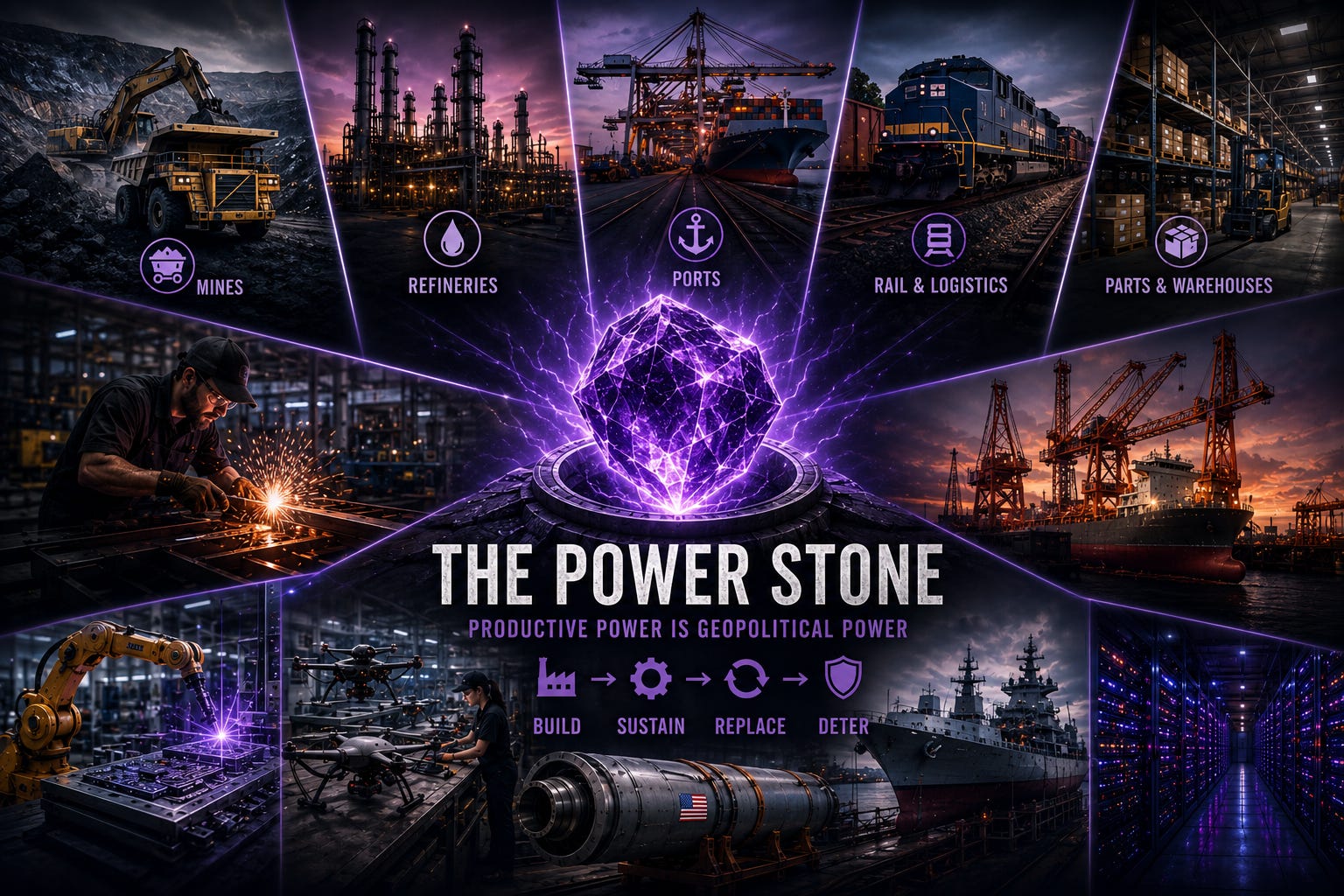
This is the fourth post in the Infinity Stones series: a late-summer thought experiment about what Donald Trump would need to accomplish to make America less globally burdened because the world is functioning better—not because Washington has simply stopped answering the phone.
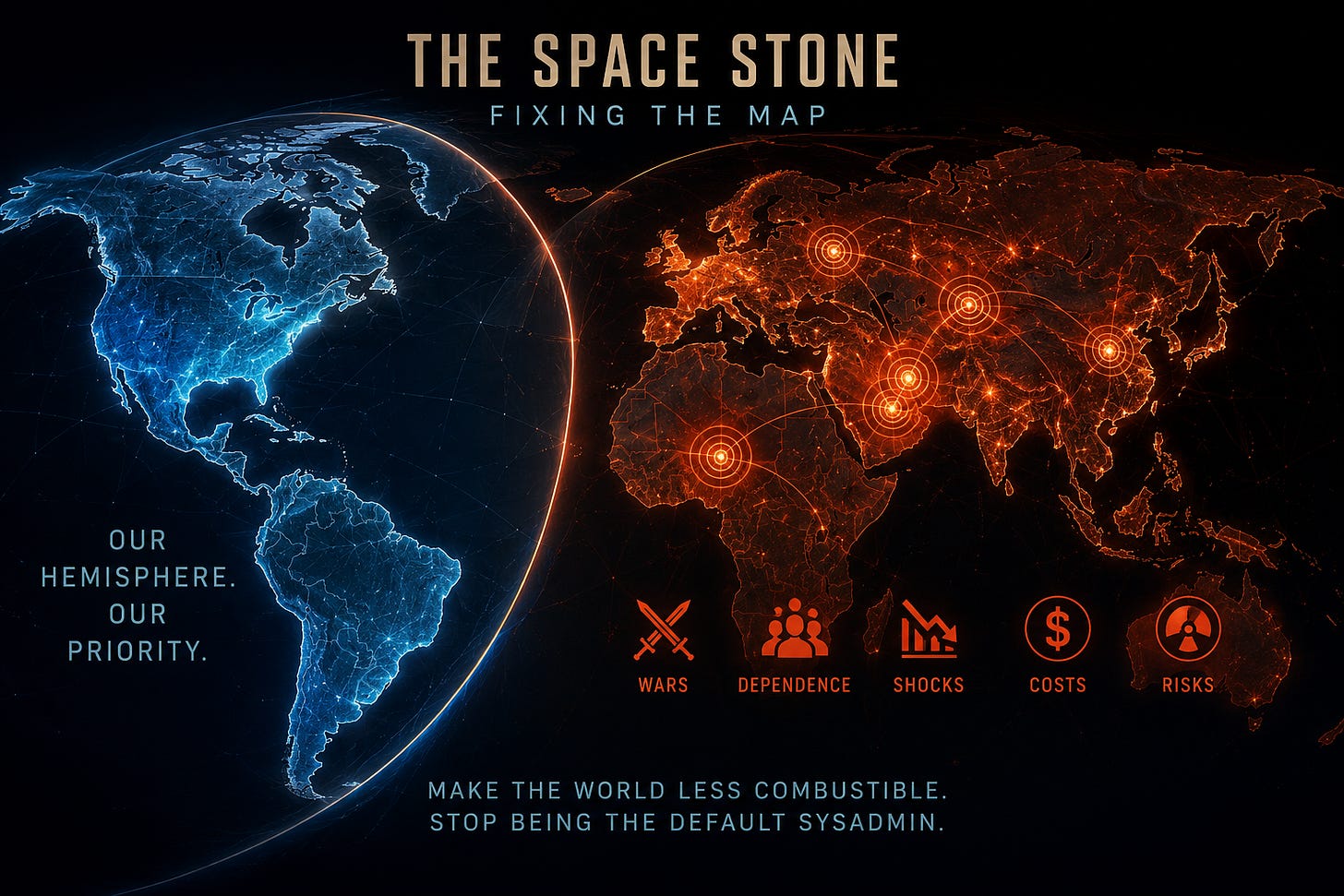
The blue Space Stone fixed the map.

The yellow Mind Stone fixed the will.
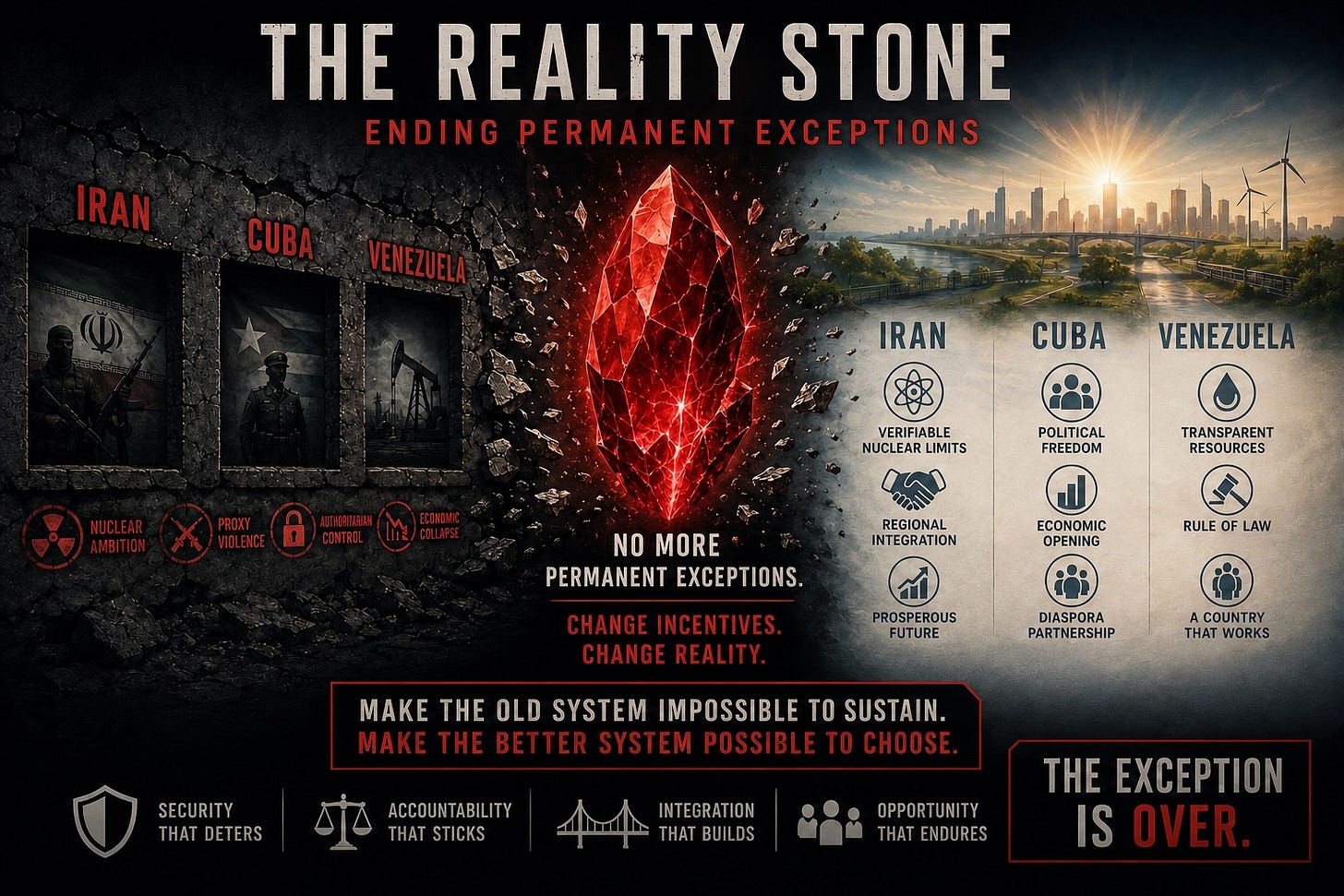
The red Reality Stone confronts the fiction that failed authoritarian systems can remain permanently dysfunctional while exporting their problems indefinitely.
Now comes the Power Stone.
In Marvel’s universe, it is purple, luminous, capable of ruining a tremendous amount of property very quickly—something the Donald would naturally be attracted to. In the real world, it is a factory shift in Scranton, shipyard crane in Virginia, missile motor built in one of those towns that never receives a Cabinet visit, and a data center drawing enough electricity to unsettle everyone on the local grid. It is also a mine, refinery, port, rail spur, warehouse full of spare parts that no one notices until an ally needs them tomorrow.
In short, it is the material base that determines whether geopolitical promises are real.
There is an awkward truth that foreign-policy professionals often avoid mentioning at the conference: great powers do not prevail merely because they possess better concepts. They prevail because they can build things—at volume, speed, for as long as the contest requires. They can replace those things after they are expended, intercepted, damaged, hacked, embargoed, simply worn out.
Ukraine reintroduced this truth to a Western defense establishment that spent decades imagining war as a ballet of precision munitions, exquisite platforms, networked sensors, operational PowerPoints with bevelled arrows of different colors. We’re talking a grinding continental war where drones meet trenches, artillery shells get used by the trainload, air-defense interceptors become their own strategic category. The future arrived, and it looked suspiciously like a factory: How fast can I make robots and drones versus you?
That is the Power Stone. There really is no military power in the abstract. It is always productive power. It’s why Stalin knew Hitler was screwed the minute he declared war on the US. It’s also why Rhett Butler ruins the party at the beginning of Gone With the Wind.
America remains extraordinarily powerful. It fields the world’s most capable military, possesses unmatched global logistics, leads a gigantic economy, enjoys major energy advantages, sits near the technological frontier, benefits from the dollar’s central role in the global financial system. Its university network, venture-capital system, consumer market, alliance structure give it advantages no adversary can easily replicate.
In short, we have to try to lose.
But then look at munitions inventories, shipbuilding timelines, repair capacity, supply-chain dependencies, defense acquisition rituals. Much of this Cold War inheritance is being managed like a boutique: impressive products, limited inventory, delivery sometime after the relevant crisis has ended (h/t Allen Drury’s novel Pentagon).
Our challenge? China does not treat production as a boutique business.
China doesn’t merely build weapons. It stockpiles the capacity to build weapons, treating industrial depth as strategic depth and strategic depth as deterrence. It understands that shipyards matter as much as ships, foundries as much as fighters, machine tools as much as missiles, electric power as much as AI models.
That does not mean China is guaranteed to win anything. It’s got its own issues: demographic decline, debt, waste, political rigidity, battered real-estate sector, leadership so centralized that bad news may struggle to reach the very top, and … oh … they ain’t fought a real war in half a century.
But China has scale, and scale matters.
The Trump administration’s 2026 National Defense Strategy gets the basic hierarchy right: homeland defense first, deterring China second, allied burden-sharing third, revitalized defense industrial base fourth. It calls for faster acquisition, expanded capacity, innovation, AI adoption, removal of the institutional obstacles that prevent the United States from producing at the scale great-power competition requires.
Sensible enough. The harder part is translating phrases such as “supercharge” into actual factories, workers, production lines, contracts, inventories, on-time delivery.
Trump understands a version of this instinctively. His political worldview begins with the conviction that America has allowed itself to become too dependent on foreign manufacturing, foreign supply chains, foreign minerals, foreign capital flows, foreign goodwill. The concern is legit. It’s just that tariffs are not a proxy for industrial capacity.
The Power Stone requires a more difficult undertaking: an industrial strategy that can produce what national security actually consumes now that we’ve reached the Military Singularity.
America needs to build semiconductors and the machine tools used to build them. It needs drones, missile bodies, seekers, motors, interceptors, components that turn launchers into sustained air-defense capacity. It needs ships, submarines, icebreakers, tankers, repair vessels, dry docks, cranes, skilled tradespeople capable of keeping maritime power afloat and available. It needs transformers, grid equipment, secure comms hardware, satellite components, batteries, advanced sensors, the vast catalogue of ordinary replacement parts that determines whether sophisticated systems remain operational after Day 100.
America also needs abundant energy.
The AI race is an electricity race wearing a software hoodie. The defense-industrial race is similar, but with steel, chemicals, data, transport, and workforce requirements added. A secure cloud stack, AI training cluster, advanced chip fab, critical-mineral processing, electrified military bases—they cannot run reliably on a grid that is fragile, constrained, endlessly delayed by permitting procedures.
Here, Trump is correct: energy abundance is national-security policy.
Critical minerals fall into the same category. Batteries, precision-guided weapons, radars, aircraft, semiconductors, electric systems, sensors, secure comms all depend on materials processed in vulnerable supply chains. US policy already recognizes this and is moving in the right direction on rare-earths.
That is necessary, but it is a first brick rather than a finished fortress.
We need arsenals, plural, but it ain’t gonna happen via some mindless America First push for NorKo-style autarky. We cannot produce everything ourselves.
Our central advantage is that we sit inside the richest and most technologically capable network of states in history. Japan and South Korea possess immense manufacturing strengths. Europe retains advanced industrial capacity. Australia and Canada offer raw materials, energy, strategic depth, political reliability. Taiwan remains a critical semiconductor producer. India can scale manufacturing and digital capacity. Mexico can turn North American integration into something usefully tangible.
Thus, our objective should be Arsenals of Democracy, plural.
The US provides the network’s central command, its largest market, deepest pool of finance, world-leading technologies, strategic force, indispensable security backstop. Allies and partners supply distributed capacity, redundancy, proximity, resilience, industrial specialization, growing responsibility for their own regions.
As stated previously, every capable ally needs a job. The days of outsourcing all that to the Pentagon alone are over.
NATO’s 2025 commitment to spend 5 percent of GDP on defense and security by 2035 is useful, especially the 1.5 percent slated for infrastructure, civil preparedness, networks, resilience, industrial capacity. Those are the boring elements that keep the exciting systems operating.
China is not invincible, but it has assembled manufacturing scale that should worry any country hoping to compete with it. It dominates or holds major positions in numerous critical supply chains, including processing capacity for vital minerals and manufacturing ecosystems important to batteries, electronics, drones, missiles, and other components of modern military and economic power.
Our answer cannot simply be to sanction China more aggressively. Beijing is too smart and too talented when it comes to workarounds. We also can’t shut ourselves off from co-evolving with China’s immense efforts in AI.
America therefore needs sufficient domestic and allied productive capacity that Beijing cannot turn industrial scale into strategic coercion. Call it deterrence by production.
Other countries are more likely to align with the United States when alignment means participation in supply chains, research, manufacturing, standards, contracts, technology, and prosperity—not simply purchasing American weapons at premium prices and applauding politely at alliance meetings. In that regard, the emerging national security production partnership with Israel is a good model. Point being, if you want states to join the network, give them a meaningful stake in building it.
The Power Stone does not require a permanent war economy. It requires a country and coalition that can shift rapidly into a war economy if circumstances demand it, without discovering that its productive base was outsourced, financially optimized, politically fragmented, strategically neglected.
It does not require every factory to sit in the United States. It requires vital supply networks to exist beyond any plausible adversary’s veto.
It does not mean writing blank checks to defense contractors for systems that arrive late, cost more than promised, and cannot be produced in meaningful numbers. There, Alex Karp is correct. It means rewarding volume, speed, repairability, interoperability, availability.
The Military Singularity makes the US military-industrial complex more like the NFL, where the insider motto is availability is capability.
Trump’s genuine Power Stone achievement would be to turn his deepest political reflex—that America should not be strategically dependent—into an allied industrial strategy rather than tariff fits of pique.
That would make the Space Stone durable because a map holds only when it can be defended. It would make the Mind Stone credible because collective will matters only when it can be sustained. It would make the Reality Stone effective because coercive regimes must reassess their choices when their targets can out-produce, outlast, out-connect them.
Power is not what you can display. It’s what you can replace, the ultimate threat being I can do this all day long.
Next up: the Time Stone.
Share Thomas P.M. Barnett’s Global Throughlines

Comments
Nothing yet. Say the first thing.
Sign in to join the conversation.