
This is the fifth post in the Infinity Stones series: a late-summer thought experiment about what Donald Trump would need to accomplish to make America less globally burdened because the world is functioning better—not because Washington has simply stopped answering the phone.
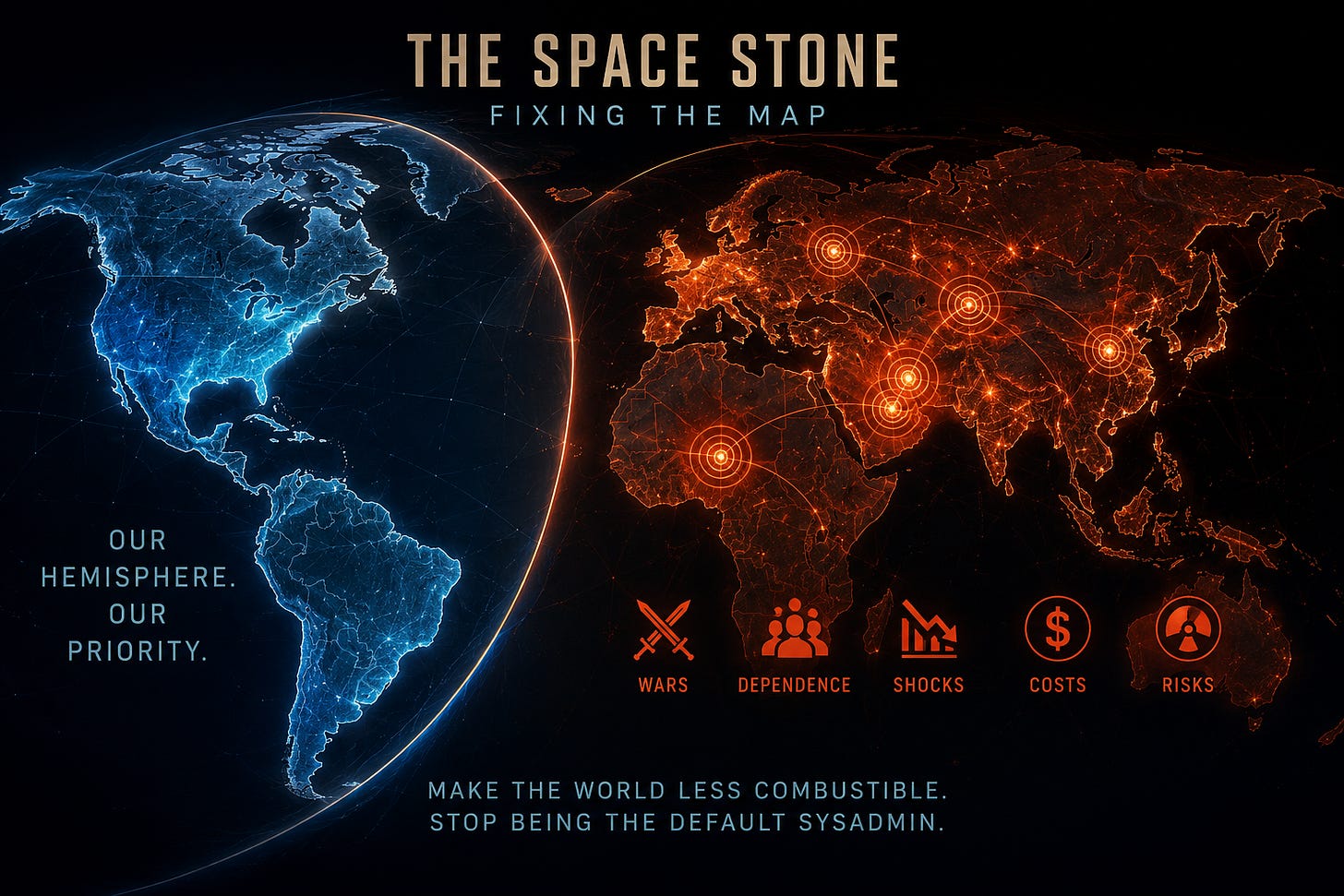
The Space Stone fixed the map.

The Mind Stone fixed the will.
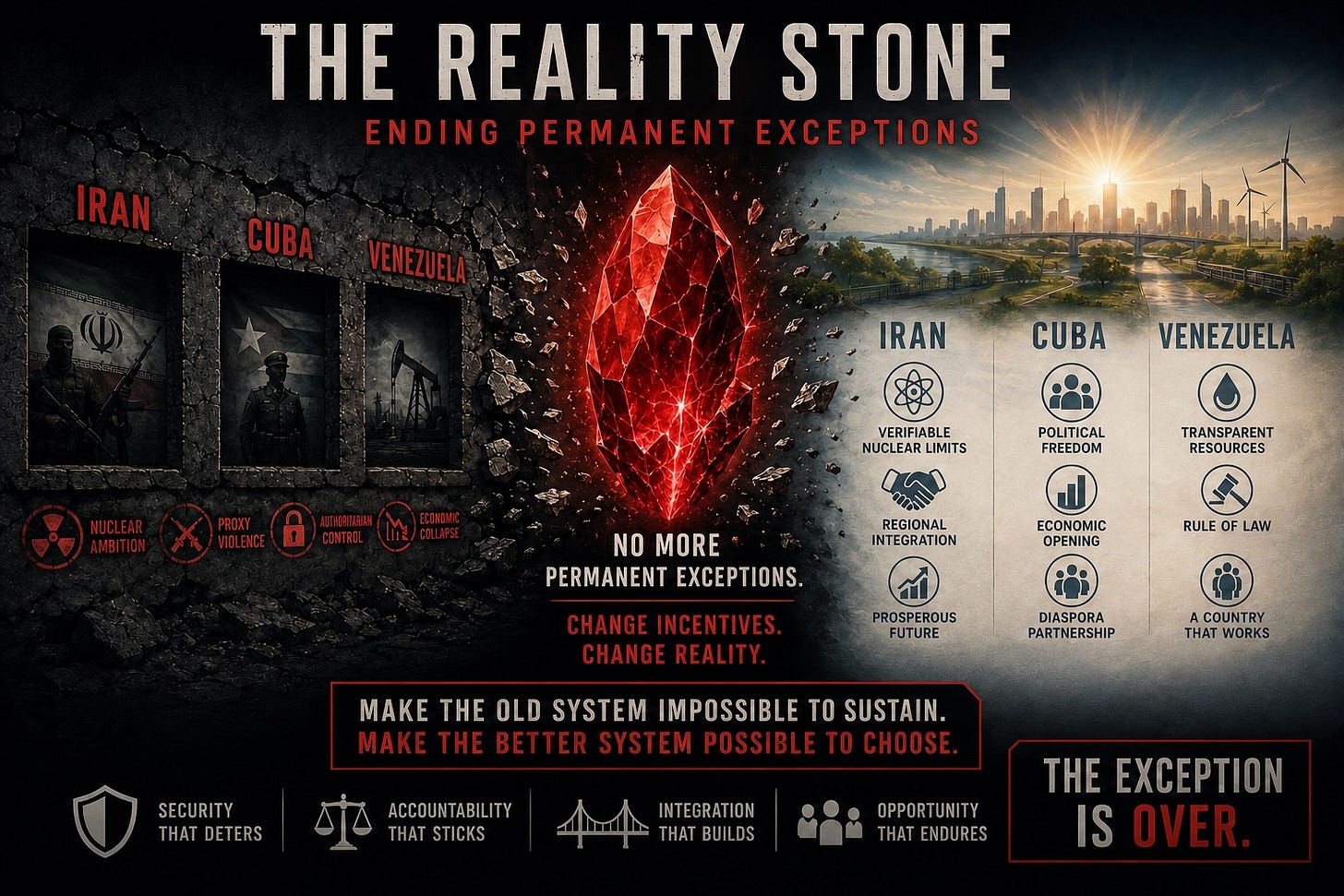
The Reality Stone confronts the permanent exceptions.
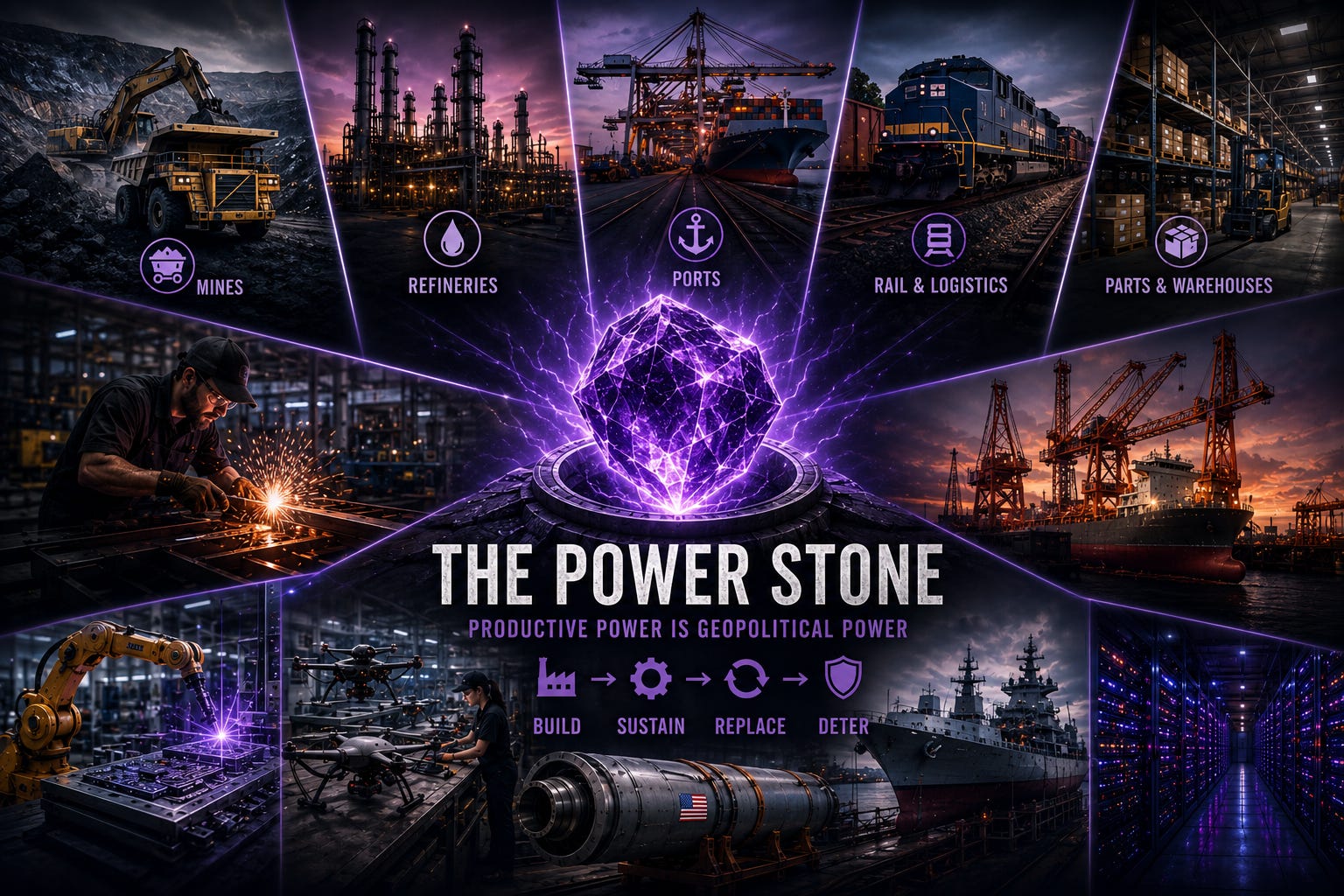
The Power Stone rebuilds the ability to make, move, replace, and sustain the things that make deterrence more than a press release.
Now comes the green Time Stone, the one that should scare every strategist, because it tells you what has already happened, what might happen next, and how badly your previous assumptions have aged.
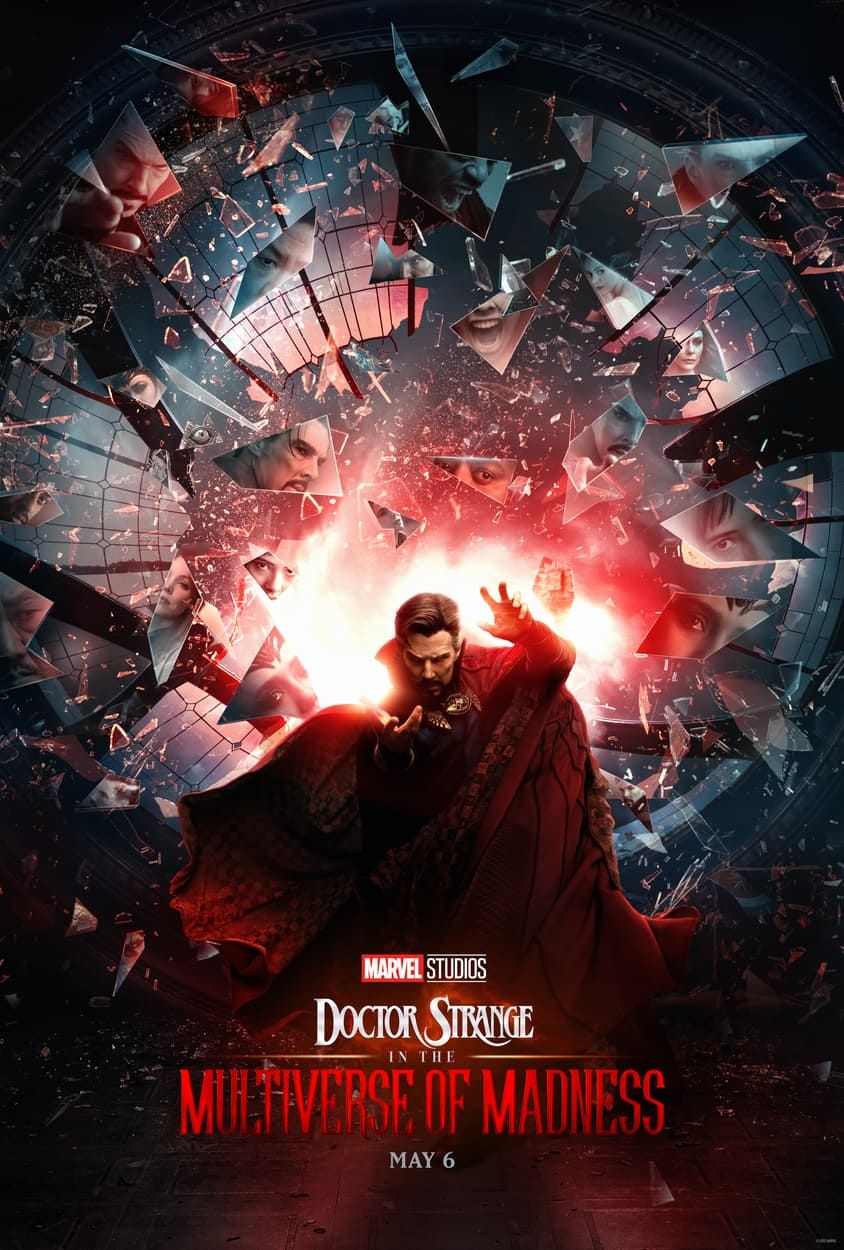
In the Marvel version, it lets Doctor Strange peer into millions of possible futures and discover, with grim certainty of a Pentagon tabletop exercise, that only one of them ends well.
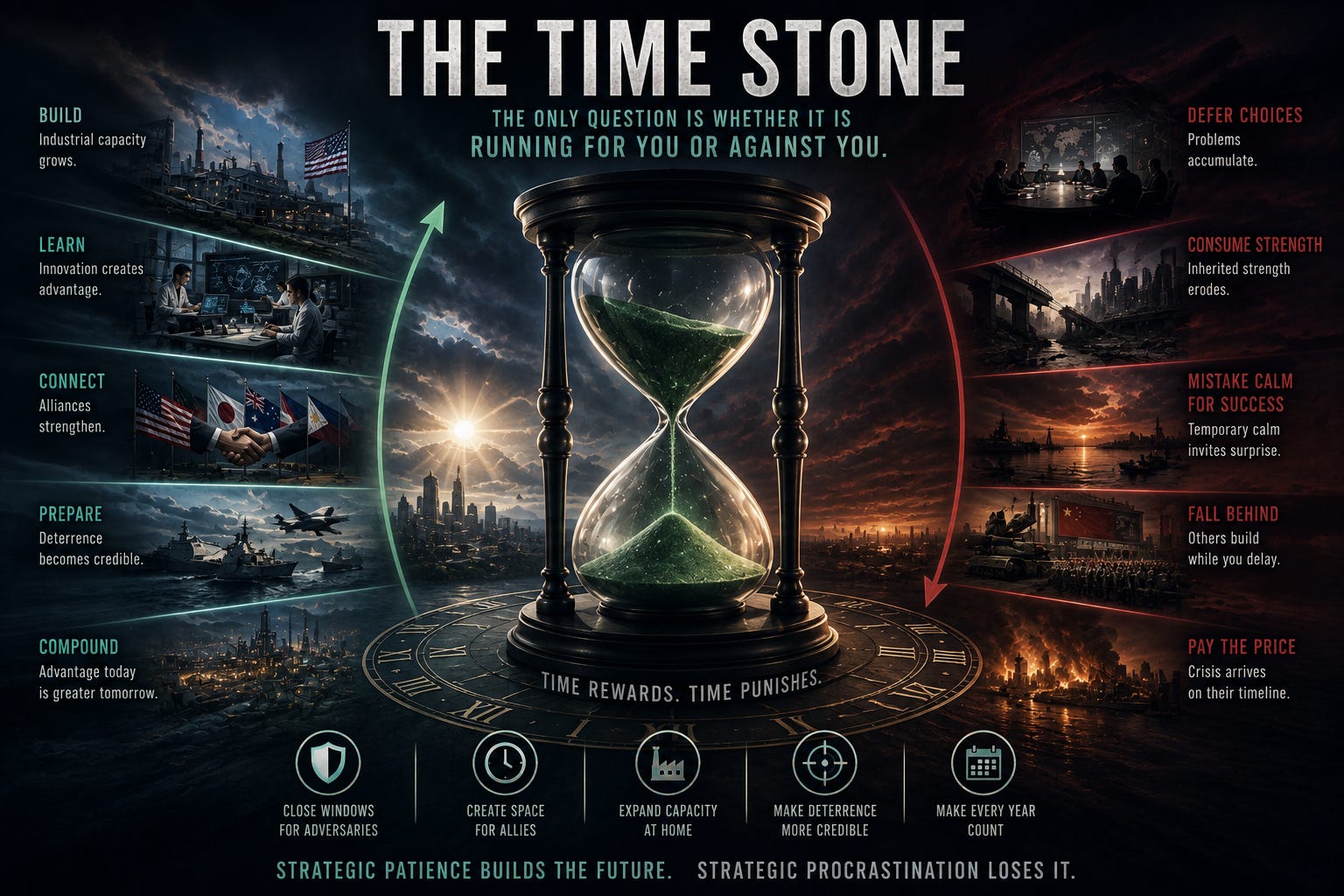
Trump does not get that luxury. He gets the same clock as everybody else. The only question is whether it is running for you or against you. That’s where my skills fit.
Timing, or better said sequencing, is the central problem of American grand strategy today. We seek to create a new, more balanced, less taxing (on us) global order, but that takes lining up allies and “replacements” (like China, India, Europe) in the right sequence, under the right timelines—otherwise globalization’s sacred timeline gets disrupted right when things get interesting (the Technological Singularity).
Washington keeps treating time as neutral—the blank calendar space between one emergency meeting and the next.
Time is not neutral. It rewards states that build, learn, connect, prepare, and compound advantage. It punishes states that defer choices, consume their inherited strength, mistake temporary calm for strategic success.
The Time Stone asks whether Trump can flip the clock.
Can he end or freeze the wars where delay favors the bad guys? Can he buy enough time for allies to rearm, supply chains to diversify, industrial capacity to expand, deterrence to become more credible? Can he force revisionist regimes into early choices, rather than letting them substitute delay for success?
There is a difference between strategic patience and strategic procrastination. Washington has too often practiced the latter.
Start with China. Our standard story is: China rises, China grows, China builds, China threatens, eventually China becomes too big for the rest of us to manage. That story had a good long run, but the clock has changed.
China is still enormous, formidable, the only plausible peer competitor out there. And it is building military capabilities at a deeply concerning pace.
But … China is also super-aging, slowing done, supremely indebted, dangerously overbuilt, politically rigid, increasingly dependent on a global economic system that it seeks to reorder without accidentally wrecking.
None of that means China is collapsing next Tuesday, so stop listening to that experts crowd.
It does mean Beijing faces a narrowing set of choices. A country that is getting old before it gets rich, carrying enormous debt, struggling to stimulate domestic demand, relying on central control to manage increasingly complex problems … that is not a regime with time on its side.
This is where the Taiwan temptation becomes dangerous.
Xi Jinping may someday conclude that waiting makes the task harder: Taiwan gets more resilient, Japan gets more capable, the Philippines becomes more accessible to US forces, allied industrial capacity expands, semiconductor dependence becomes less concentrated, China’s own demographic and economic headwinds become more severe.
That is a window alright, but it’s more Beijing’s problem than Washington’s.
Trump’s Time Stone must close that window without forcing China to leap through it.
Tricky, I know.
Our goal is to make every passing year improve the balance against Chinese coercion. Taiwan becomes harder to blockade, harder to paralyze, harder to occupy. Taiwan’s modernization will not remove the risk of occupation, but it can make any effort far costlier, riskier, more uncertain for Beijing.
That is time working for you.
Russia poses the opposite temptation.
Every time the Russian military trades another horrific casualty list for another handful of wrecked villages, somebody declares that the system must be near the point of failure. Eventually, perhaps. But great powers with authoritarian habits can convert human misery into battlefield persistence for much longer than observers expect (h/t Adolph H.)
Russia is under real strain: manpower pressure, high casualties, labor shortages, budget stress, depletion of liquid reserves, higher taxes, the sheer shoveling of national wealth into the furnace of imperial nostalgia. But Russia can likely sustain its current war effort through the rest of the Trump administration.
Point being, Russia may be losing its future while still being able to ruin Ukraine’s present. Trump’s Time Stone needs to understand both sides of that equation.
The wrong answer is an open-ended war whose only theory of victory is that Russia eventually becomes too exhausted to continue. The other wrong answer is a rushed peace that lets Russia freeze the conflict for later consumption.
The useful answer is to settle the war in a way that shifts the burden and changes the clock.
Ukraine gets armed, connected, rebuilt, and embedded in Europe. Europe becomes responsible for European deterrence. Russia gets no right of renewed coercion, no political veto over Ukraine’s future, no easy path back to normal commercial integration without changing its behavior.
We need to make time hurt Moscow more than Kyiv.
Every year of Ukrainian reconstruction deepens its Western links. Every European munitions factory expansion adds deterrence. Every new air-defense system, logistics hub, ammunition line makes Russia’s next gamble (aka, Moldova) less attractive.
That is locking in Russia’s strategic failure while making Europe finally grow up—the clock reset.
Iran has turned delay into an art form. Delay negotiations. Delay inspections. Most of all, delay resolution until the nuclear program is farther along, proxy networks are revitalized, Sunni regimes are more divided, some new crisis forces Washington’s attention elsewhere.
Then Tehran starts a new timeline—a new clock with a new US administration, a feat it has pulled off time and again.
This is why the Iranian nuclear problem cannot be treated as a familiar diplomatic folder that gets handed from administration to administration with a fresh cover sheet.
The IAEA has warned that it has been unable to conduct normal in-field verification for an extended period because of the conflict. That is a clock. Every year of nuclear latency increases the temptation to accept an Iranian threshold capability as simply another irritating feature of the regional landscape.
Trump’s Time Stone needs to accelerate the choice where Iran accepts intrusive verification, enforceable nuclear limits, constraints on proxy warfare, and a regional economic off-ramp—or gets to be the Shiite version of North Korea for as far as the eye can see.
What cannot continue is the old do-loop in which America negotiates the same basic issue every few years while Iran improves its leverage between meetings. The point is to stop letting Tehran turn time into a weapon of regional coercion.
The Time Stone is not primarily about deadlines. It is about compounding, stacking either success or failure.
America and its partners need policies that get better with age.
Ukraine’s integration into Europe should deepen every year.
Taiwan’s resilience should improve every year.
Allied munitions production should rise every year.
Critical supply chains should become more secure every year.
Energy capacity should expand every year.
Digital infrastructure should become more resilient every year.
The democratic network should become more economically attractive every year.
The United States needs a strategic calendar rather than a crisis calendar.
A crisis calendar asks: What is the emergency today?
A strategic calendar asks: If nothing dramatic happens this year, does the balance move in our direction anyway?
That is the grand strategic standard.
If the answer is no, we merely postpone a worse future. If the answer is yes, then our deterrence is working.
This is where Trump’s alleged impatience could become an advantage. Trump likes outcomes. The Time Stone demands them. But he must learn the difference between a quick deal and a favorable clock. The quick deal ends the news cycle. The favorable clock sets the next decade.
The most counterintuitive point is this: America does not need to solve every problem now. It needs to decide which problems must be solved now because delay helps the adversary, and which problems can be managed while time makes the American network stronger.
Taiwan is where delay must favor deterrence, not Chinese coercion.
Ukraine is where settlement converts a brutal present into a stronger European future.
Iran is a case where delay must be denied as a strategic tool.
North Korea is the obvious counterexample: this is how you keep somebody bad in an acceptable box.
Not every bad actor gets to control our calendar.
Trump’s successful use of the Time Stone would therefore be all about sequencing. That is how the United States moves from endlessly reacting to events toward shaping the environment in which events occur.
Again, time is never neutral; it either compounds your strengths or your weaknesses.
Say it with me:
The Space Stone gives you a map that holds.
The Mind Stone gives you a coalition that believes it will hold.
The Reality Stone breaks systems that survive by pretending nothing can change.
The Power Stone gives you the ability to sustain all of that.
The Time Stone asks the only question that matters after you have acquired the rest: Are you building a future that gets easier to defend?
Strategy is not about having more time. It is about making time take your side.
Next up, the final Soul Stone.
Share Thomas P.M. Barnett’s Global Throughlines

Comments
Nothing yet. Say the first thing.
Sign in to join the conversation.