
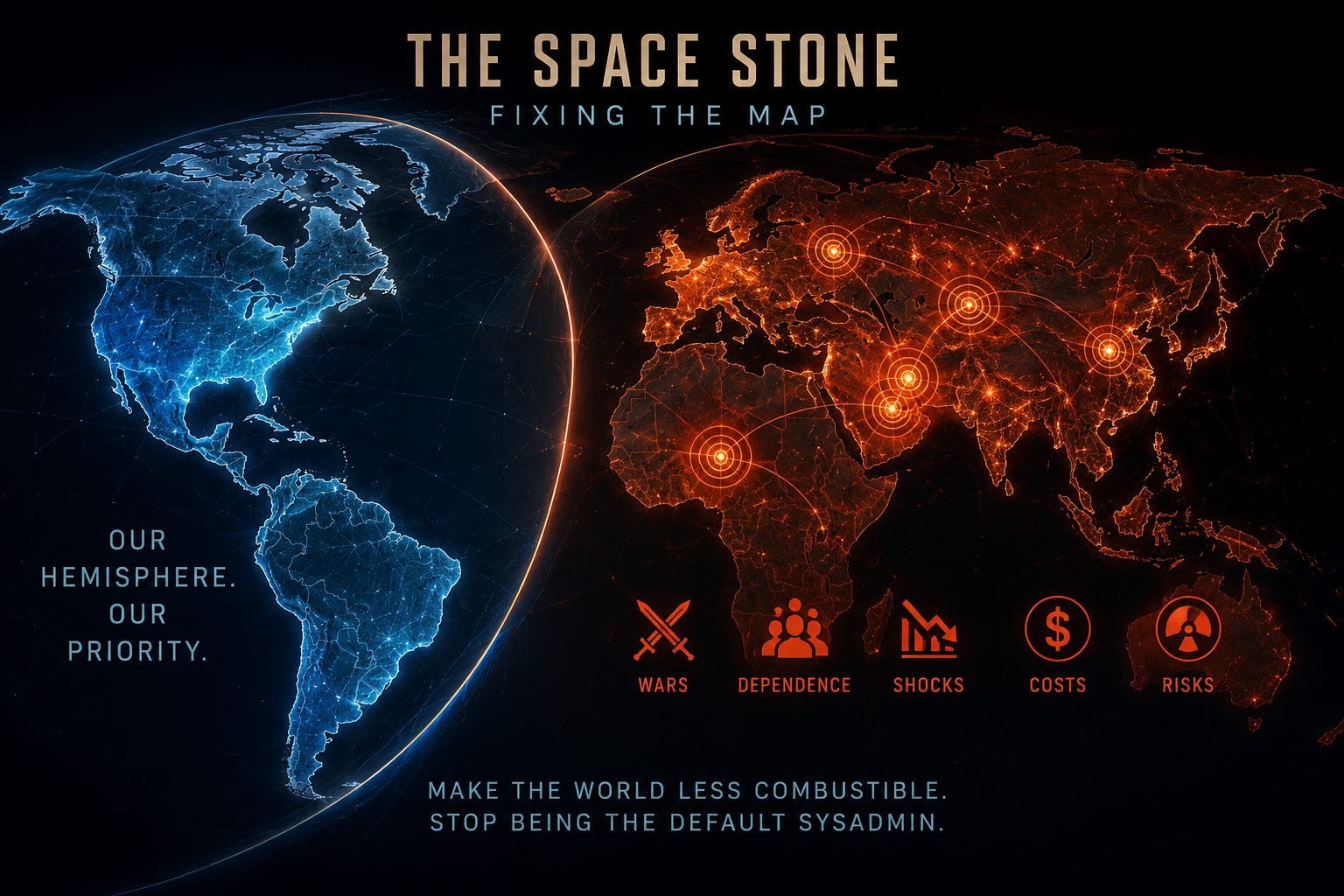
This is the first post in the Infinity Stones series: a late-summer thought experiment about what Donald Trump would have to accomplish for America to carry fewer global liabilities because the world is functioning better—not because we just stopped answering the phone.
Thanos starts with Space, which makes sense. You cannot reorganize the universe until you control the map, says the map guy.
Trump’s version is less blue, less genocidal, more orange, and very much on brand: Stop subsidizing everybody else’s problems. Make the freeloaders pay. End the stupid wars. Get a “winning” deal. Build a wall somewhere—anywhere! Preferably a big, beautiful one with somebody else picking up the tab.
But the underlying strategic desire is perfectly intelligible. America wants fewer liabilities—over there.
The Eastern Hemisphere presents a truly impressive pile of IOUs: Europe’s habitual dependence, the Middle East’s never-ending feuds, China’s grandiose historical grievance (enough with the Century of Humiliation already!), Russia’s perennial urge to redraw a map it keeps losing, and an assortment of smaller actors who have discovered that a few drones and a Telegram channel is enough to mount a troublesome foreign policy.
The Western Hemisphere, by comparison, looks like the sensible option. Two oceans, friendly neighbors (well, mostly), food, energy, capital, technology, strategic depth (in terms of climate change), and that huge internal market—nom, nom. Plus, it’s a hemisphere that could, with the proper amount of American attention, become a far more coherent economic and security space (Marco’s listening now) than it has been after the US spent a century treating Latin America as backyard, drug vector, source of cheap labor.
So: why the hell not just fold the tent and declare a Trumpian “win”?
Let Europe discover the joys of adult supervision. Let the Middle East work out who stole whose sacred history first. Let Asia conduct its power transition in whatever tense, deeply armed, emotionally repressed, indecipherable manner it must. America can patrol the home neighborhood, trade selectively, drill enthusiastically, finally stop being the global ER.
You have to admit: that’s all very Thanos. It’s also a terrible grand strategy.
The Eastern Hemisphere does not disappear merely because America stops enjoying it. It keeps manufacturing the things that drive American presidents insane: wars, refugees, energy shocks, disrupted trade, supply-chain seizures, financial panic, terrorist sanctuaries, nuclear crises, allies who rediscover their enthusiasm for Washington precisely when something starts exploding nearby (Send in the Marines!).
As Thanos as it sounds, the globe is not divided into a “stuff we care about” half and a “stuff we can ignore” half. It is one connected operating system. When major nodes fail, the error messages show up everywhere. That’s modern globalization and there’s no going back.
So the useful Trumpian thought experiment is not: How does America abandon the world? It is: How does America make enough of the world less combustible that it can stop being the default Leviathan/SysAdmin Force for every conflict that somebody else allowed to metastasize?
That begins with the Space Stone, because the map is where the bill arrives.
Here is the enduring American complaint, stripped of all the MAGA bumper stickers and cable-news pyrotechnics:
Everybody loves the global security architecture until somebody has to pay for the roof.
Europe underinvests in defense for decades, then Russia starts getting grabby again—as it has throughout history.
Asian allies welcome US presence, then spend years wondering if “strategic ambiguity” means Washington is clever or simply allergic to finishing sentences.
Gulf states buy American weapons, complain about American lectures, hedge with China, talk to Iran, and then suddenly remember the importance of the US security guarantee whenever somebody attacks a refinery.
Then the shooting starts, and America receives the invoice.
Uncomfortably accurate, is it not?
The United States has made security too easy to consume. We built the world’s largest and most durable alliance network, then watched many participants confuse mutual defense with a streaming service: unlimited access, no commercials, somebody else pays! NATO as Netflix with everybody sharing account passwords.
Trump’s genuinely useful instinct is that allies need to become less like clients and more like equity partners. In this world and going forward, that actually is fair and reasonable. But that only works if America does not take its toys and leave the room, which Trumpos threatens daily.
Understand: our goal here is not American absence. Snap! It is a map that does not keep generating rescue missions.
Ukraine is the first repair job because Russia broke the European map in the most nineteenth-century manner imaginable: tanks, artillery, territorial claims, historical grievance, a leader who apparently believes imperial nostalgia is a renewable energy source.
Moscow’s real objective has never been merely acquiring land. Land is merely the receipt. The real prize is control over Ukraine’s future. Russia wants a Ukraine that cannot choose its own alliances, cannot build its own economy, cannot join Europe, cannot become militarily capable, and cannot cease being psychologically available for reabsorption into a Russian sphere of influence. We’re talking a creepy, stalking, violent ex menacing his former lover, meaning there is no limit to the evil on hand.
That is the thing Trump has to defeat if he wants to claim a real win: not every Russian soldier walking backward across every contested line. That would be nice but it’s also not how wars between nuclear-armed sides generally end.
The test is simpler: Does Ukraine survive as a sovereign country with a military, economy, access to the outside world, westward path? Or does it become an exhausted, disarmed, nominally independent buffer state whose principal export is future tragedy?
As we have all learned with Putin, the latter is not peace. It is Russia’s down payment on the next war to be unfrozen when the hunger returns.
A Trump settlement that works therefore has to leave Ukraine armed, connected, and increasingly European. Armed means Ukraine can make renewed invasion expensive. Connected means rail, ports, power grids, supply chains, investment, insurance, markets, reconstruction, diaspora capital, defense-industrial partnerships. Increasingly European means Europe cannot continue treating Ukraine as a moral cause administered by American military logistics.
The real goal is a country that becomes richer, more capable, and harder to intimidate with every passing year.
Europe gets Europe; that is the Trumpos transaction.
Washington helps lock in the settlement, supplies strategic depth, keeps the nuclear backstop credible. Europe does the bulk of the long-term work: air defense, ammunition, logistics, reconstruction, training, industrial investment, economic integration, the drearily necessary business of becoming self-capable enough to deter Russia on its own.
This is the best version of Trump’s burden-sharing demand. Not good luck, Surrender Monkeys! More like: Congratulations. You finally have a continent worth defending. Now defend it.
That is less abandonment than graduation. It’s been my mantra for decades now: If you want to win the peace, you gotta leave the place more connected than you found it.
The real end state is not a ceasefire line. It is a Ukraine so deeply connected to Europe’s security and economic systems that attempting to reconquer it becomes, even by Russian standards, a catastrophically dumb investment.
Ask Poland or the Baltics: they get it.
That is how Trumpos fixes the map.
Ukraine is what happens after deterrence fails. Taiwan is where deterrence has to succeed before anybody starts firing.
We must not compare them too casually. Ukraine is a huge land war. Taiwan sits at the maritime intersection of China’s ambitions, Japan’s strategic anxieties, America’s alliance credibility, the world’s semiconductor supply, and the largest naval power transition since … forever.
Taiwan is a systems issue, not merely some trip-wire to something worse.
If Beijing can coerce Taiwan into submission, it proves that American security commitments are negotiable under pressure. It changes Japanese calculations, spooks the Philippines, encourages every Asian state to hedge harder, disrupts technology supply chains.
That is why the Trumpian objective cannot be “talk tough about China.” Beijing has grown beyond that.
The objective is to make every available coercive option look like a strategic own-goal.
Blockade Taiwan? Then the blockade must fail to isolate the island politically, financially, digitally, physically.
Launch cyber campaign? Then Taiwan’s government, electricity, communications, ports, banking system, basic social order must keep functioning.
Seize offshore island? (I know, it’s so 1950s) That’s gotta cost—big time.
Invade? Then the operation must look so slow, costly, uncertain, and regionally explosive that even an increasingly nationalist Chinese leadership concludes that history can wait.
Deterrence is never merely the threat to fight. It is the demonstrated inability of the adversary to win on acceptable terms. That is a higher bar, not easily grasped. Real deterrence requires Taiwan become far harder to coerce—not just better armed in the familiar way, but more resilient as a polity. Decentralized command.
Japan’s geography matters. The Philippines’ access matters. Australia’s strategic depth matters. South Korea’s industrial and military capacity matters, even as North Korea holds much of Seoul’s attention hostage.
But each ally needs a job, otherwise the alliance remains dinner theater.
Trump could be uniquely effective here. Not: Pay more or we’re gone. Instead: You want the American umbrella? Fine. Bring the pole, the fabric, sandbags, bodies capable of holding it up when the balloon goes up.
The status quo in the Taiwan Strait is not elegant.sucks, but beats the alternatives. The whole point is to make it stay that way.
Now we step back to take in the whole picture.
Ukraine needs access to the Black Sea. Countries survive on exports, imports, investment, transport, infrastructure, a future their young people find more attractive than emigration.
Taiwan matters because it is plugged into a global network of technology, shipping, data, capital, alliance geography.
The Red Sea counts because a bunch of low-cost drones fired by non-state actors can force vast rerouting costs onto global shipping.
The Gulf ranks because energy markets still matter.
Undersea cables make the list, as do ports, data centers, pipelines.
Our map is a network diagram with territorial consequences. That is the part that the MAGA types never get. They think America can move from world cop to hemispheric Roomba simply by choosing not to engage.
You may be the devil or you may be the Lord but you’re gonna have to pay somebody.
If the Red Sea becomes a militia toll booth, American consumers pay.
If Taiwan becomes a Chinese dependency, American technology companies pay.
If Russia gets to dictate Europe’s security architecture, American alliances pay.
Eventually, American voters pay. The world sends the invoice. It always does.
The Space Stone is not about making America omnipresent. That is the old, exhausted model. It is about making aggression too expensive and regional security more locally owned.
Europe gets a sovereign Ukraine and takes responsibility for Europe.
Indo-Pacific allies get continued American strategic commitment and become real contributors to deterrence.
Commercial powers get open sea lanes and accept their participation in safeguarding them.
Russia, China, Iran, other assorted entrepreneurs of disorder get the same message: proximity is not permission; coercion does not scale into control; wrecking the system will cost you more than using it.
That is the baseline ruleset Trump needs if he truly wants to reduce America’s liabilities: not a map dominated by the United States but one resistant to arson.
The Space Stone does not earn Trump the right to leave the world. It earns him a world that needs less rescuing.
Fix the map, you reduce the bill. Fail to fix it and the bill always comes due.
Because lines on maps survive only when enough people believe that crossing them will end badly.
Next up: the Mind Stone.
Share Thomas P.M. Barnett’s Global Throughlines

Comments
Nothing yet. Say the first thing.
Sign in to join the conversation.