
This is the first in an end-of-summer series. I’ll be largely offline during the last week of August, so consider this a modest exercise in posting ahead—and an immodest exercise in geopolitical fan fic.
After all, a cluster of posts needs a frame. AI got one. I ran that series: China, models, chips, data, infrastructure, sovereignty, the whole lovely digital-colonization bundle. This one is lighter in packaging, if not in subject matter.
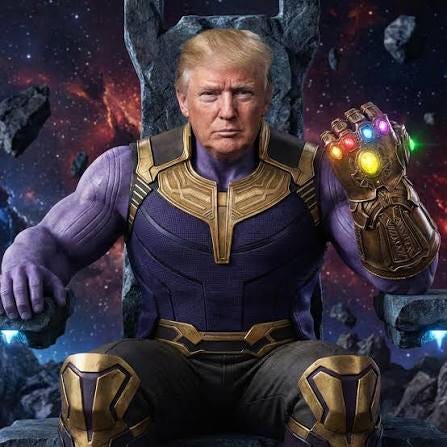
The initial spark was an AI-generated image of Donald Trump as Thanos. You have seen the genre: Trump in gold armor, Trump as Rambo, Trump as Pope, Trump as Jedi knight, Trump as the business end of whatever collective hallucination the feed requires that day.
But this particular image stuck. Because Trump as Thanos is not merely visual absurdity. It is a foreign-policy metaphor with surprising structural integrity.
Thanos, for the fortunate reader who has spent the last decade reading books instead of watching Marvel movies, is the purple, superpowered villain who concludes that the universe is overpopulated, resource-constrained, and heading for catastrophe. Sounds like somebody we know? His solution is not zoning reform, technological innovation, more trade, better governance, or even some decent SysAdmin work.
Nope.
Thanos collects six Infinity Stones—the ultimate six-pack Hollywood construct known as the “MacGuffin,” puts them in a very expensive glove, and snaps half of all life out of existence.
Problem solved.
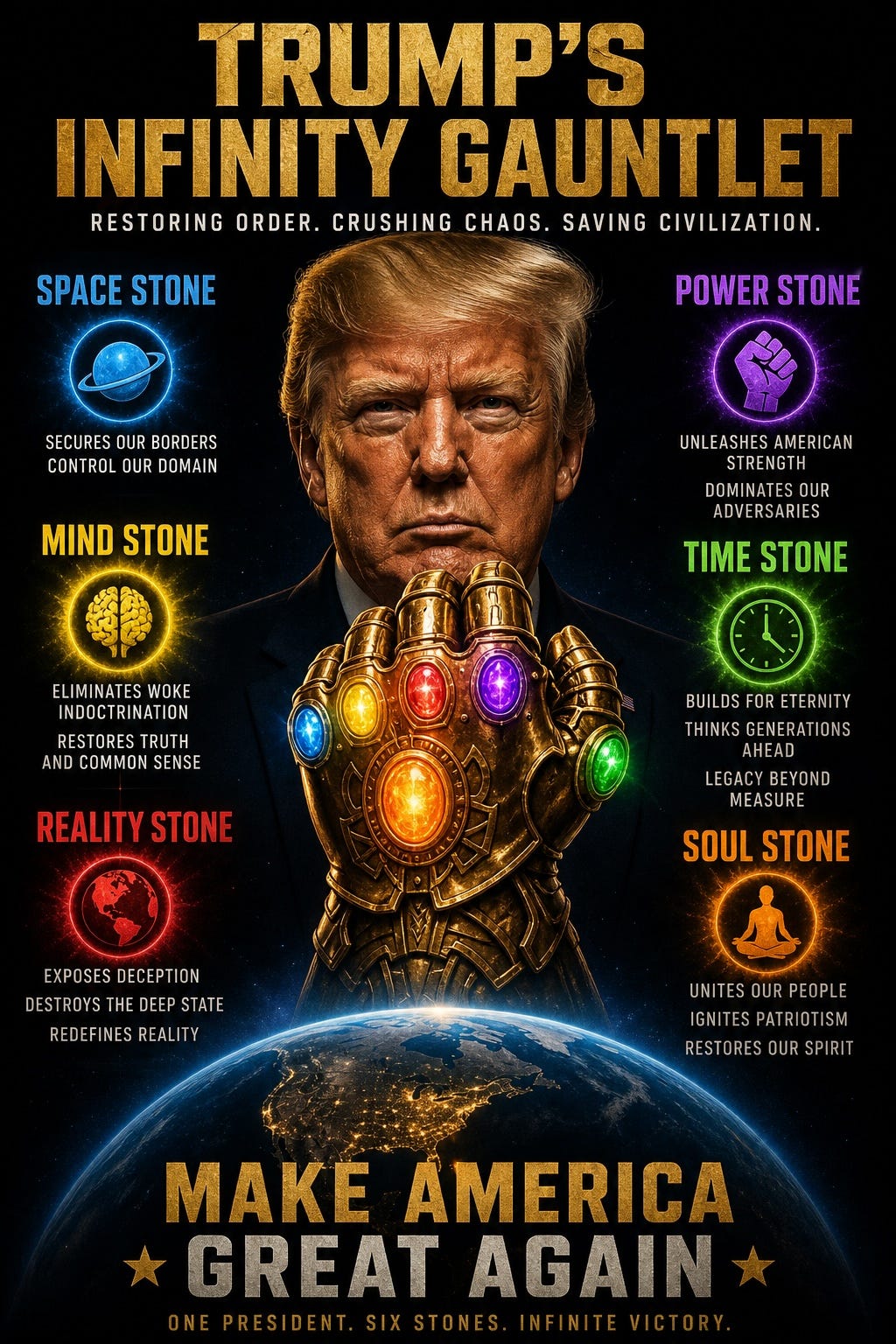
Marvel’s six Stones—Space, Mind, Reality, Power, Time, and Soul—each confer control over a fundamental dimension of existence. Put them together and their bearer enjoys near-omnipotence. That, naturally, is where the real-world analogy begins to get dangerous, entertaining, and frankly a bit too plausible.
Trump’s dream geopolitical outcome has never been traditional American primacy. He does not want Washington administering the whole global system, managing every alliance grievance, funding every European security shortfall, conducting every Middle Eastern family therapy session, and then getting a lecture from Brussels about the carbon footprint of the aircraft carrier that saved the day.
Trump wants the bills to shrink. He wants the liabilities to go away. He wants the responsibility to be shared—or, better yet, transferred to whatever “losers” he can line up. He wants America to stop being the planetary adult in the room, because he understandably suspects that everyone else has become remarkably comfortable behaving like children.
In its rawest form, that is a Thanos proposition, translated to the Trumpos universe.
Not that Trump wants people to literally disappear (okay, some people), but rather, he wants a large portion of America’s global obligations to vanish from the balance sheet. The Eastern Hemisphere, with its old wars, ancient hatreds, collapsing states, overarmed revisionists, dependency-minded allies, and endless demand for American attention, begins to look like one giant red-ink column.
The Western Hemisphere, by contrast, looks like the Trumpian control panel: North America’s energy, food, capital, technology, geography, and, potentially, an integrated democratic neighborhood from the Arctic to Tierra del Fuego—all new stars on the Trumpian flag.
There is a certain cold logic to this, as I have noted here repeatedly. The United States is blessed with two oceans, friendly neighbors, continental resources, a huge internal market, technological leadership, and a financial system the rest of the world still uses even while complaining about it. No other great power begins with that hand.
So why not fold the tent? Why not let Europe rediscover the dangerous pleasures of continental self-reliance, let the Middle East sort out its own thousand-year group project, let Asia work through its own power transition, and let America concentrate on fortress hemisphere plus selective commerce?
That is the Thanos temptation.
To be clear, it is a terrible grand strategy if it simply means abandonment. The United States cannot snap the Eastern Hemisphere out of existence. It cannot disengage from China while remaining dependent on Asian manufacturing. It cannot ignore Europe while its economic and technological capacity remains essential to any democratic coalition. It cannot abandon the Middle East when its disorder affects energy markets, migration, terrorism, shipping, Israel’s security, the basic operating conditions of global trade.
The world is too connected. Geography still matters; it just no longer constitutes the swing vote.
Here is where the thought experiment becomes useful instead of merely lazy.
What if Trump could get the outcome he actually seeks—not an Eastern Hemisphere that disappears, but an Eastern Hemisphere that stops generating open-ended liabilities for the United States?
What if he could detach America from its role as first responder to every avoidable crisis because the major zones of instability had been stabilized, the major allies had become adults, and the major revisionists had concluded that coercion is a losing business model?
That would not be withdrawal. It would be successful systems maintenance.
And, yes, it would require the Six Stones. Not six summits ending in a signed document that somebody ignores before dessert, but six structural fixes of the sort I daydream about.
The Space Stone is first because global order starts with the map. Trump would need to settle Ukraine while making Europe, at long last, carry the preponderance of responsibility for its own neighborhood. At the same time, he would need to deter China from snatching Taiwan. Add the Red Sea, Persian Gulf, and the world’s critical sea lanes, and the assignment becomes simple: preserve access, stop conquest from becoming a viable strategy, and solidify the map again.
The Mind Stone comes next, because deterrence is always partly a psychological contest. Trump’s great contradiction lies here. He has spent years unnerving allies. But a successful Trump might convert allied anxiety into allied adulthood. Our closest military partners step up and the vast global middle decides that the American network remains the better long-term bet, restoring the habit of believing that the free world can actually deliver.
The Reality Stone deals with places where everybody has grown accustomed to calling dysfunction “the status quo.” Iran, Cuba, and Venezuela fit this description nicely, if unhappily. Iran is the big one, Cuba is the antique version, Venezuela is the collapsing petro-state package. The goal is not magical regime change but breaking the assumption that these systems are permanent, normal, and allowed to export their pathologies indefinitely.
The Power Stone is the least glamorous but most important. It is factories, shipyards, munitions, air defense, logistics, energy, chips, critical minerals, finance, cloud capacity, secure data networks, and allies that produce security rather than merely consume it. For all the speeches about American decline, the United States and its allied network still possess extraordinary advantages. The Power Stone asks whether Trump can make “America First” mean American and allied industrial strength—not just tariffs as ceremonial aggression.
The Time Stone asks the question strategic thinkers should ask more often: whose clock is running? China may feel that its window on Taiwan is narrowing. Russia needs the West to tire before its own manpower gives out. Iran has long relied on delay as a strategic weapon. Trump’s best case is to reverse the clocks. Freeze conflicts where delay can help the good guys. Settle Ukraine, harden Taiwan, force Iran to knuckle under, build hemispheric stability.
Finally comes the Soul Stone, which is the tough one. It asks what this whole thing is for. The old liberal international order lost much of its public legitimacy because it began to sound like a demand for endless sacrifice in exchange for PowerPoint decks about rules. Ordinary citizens saw porous borders, deindustrialized communities, wars without victory, elite impunity, and then heard that the system was functioning beautifully. Naturally, they grew skeptical.
Trump’s potential contribution—again, in the best possible version of this thought experiment—is to reconnect national sovereignty with international order. That is not a return to isolation. It is an opt-in order: countries join because integration delivers more prosperity, security, mobility, and autonomy than hanging around with Beijing’s data collectors, Moscow’s wrecking crew, or Tehran’s militia franchise.
So that is the series.
Not “Trump becomes Thanos and makes half the world disappear.” The argument is more demanding: What would Trump have to accomplish for America to shed vast global liabilities because the system has become more stable, not because America has abandoned it to entropy?
Six Stones, six fixes, one cinematic gauntlet.
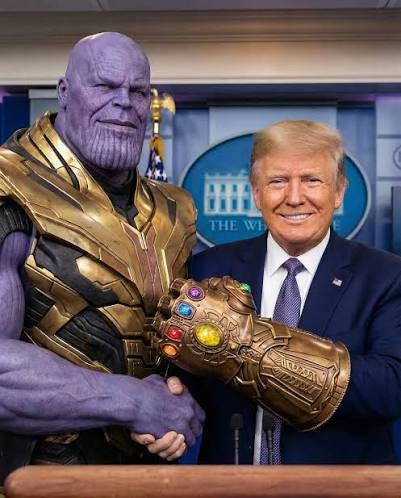
Ukraine and Taiwan to fix the map. Allies and swing states to fix the will. Iran, Cuba, and Venezuela to puncture the myth of permanent authoritarian dysfunction. Industrial capacity to restore credible power. Strategic sequencing to fix the clock. And a renewed bargain between sovereignty and connectivity to supply the soul.
North Korea, incidentally, does not get a Stone. It is dangerous but not a hinge of global order.
The more consequential challenge is whether an American president whose instincts lean toward subtraction can achieve the harder outcome: a world that asks less of America because it is functioning better. That would be the real snap.
The best way to escape a bad system is not to leave it. It is to make it stop producing bad outcomes.
Let filming begin.
Share Thomas P.M. Barnett’s Global Throughlines

Comments
Nothing yet. Say the first thing.
Sign in to join the conversation.