
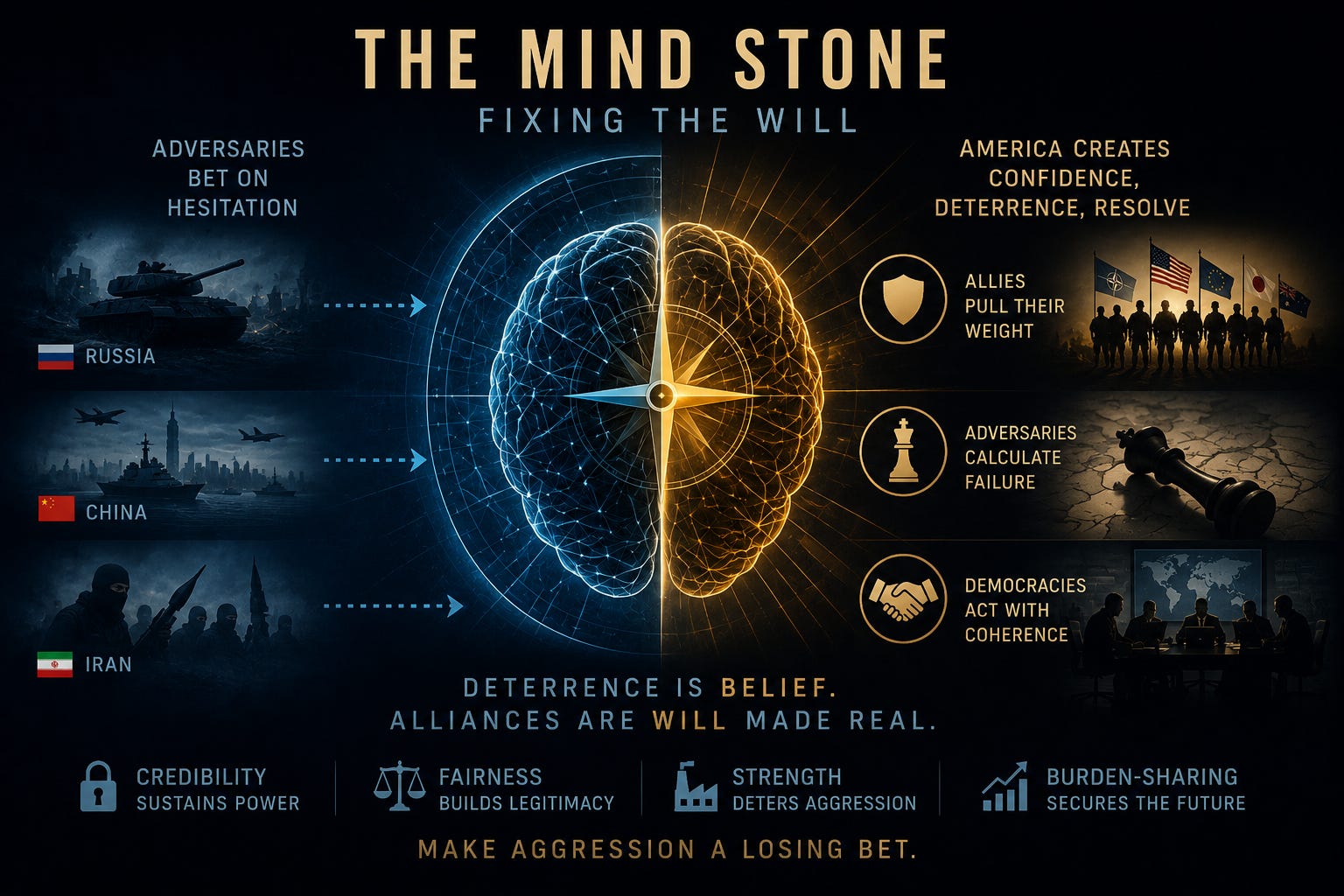
This is the second post in the Infinity Stones series: a late-summer thought experiment about what Donald Trump would have to accomplish to make America less globally burdened because the world is functioning better—not because Washington has simply stopped answering the phone.
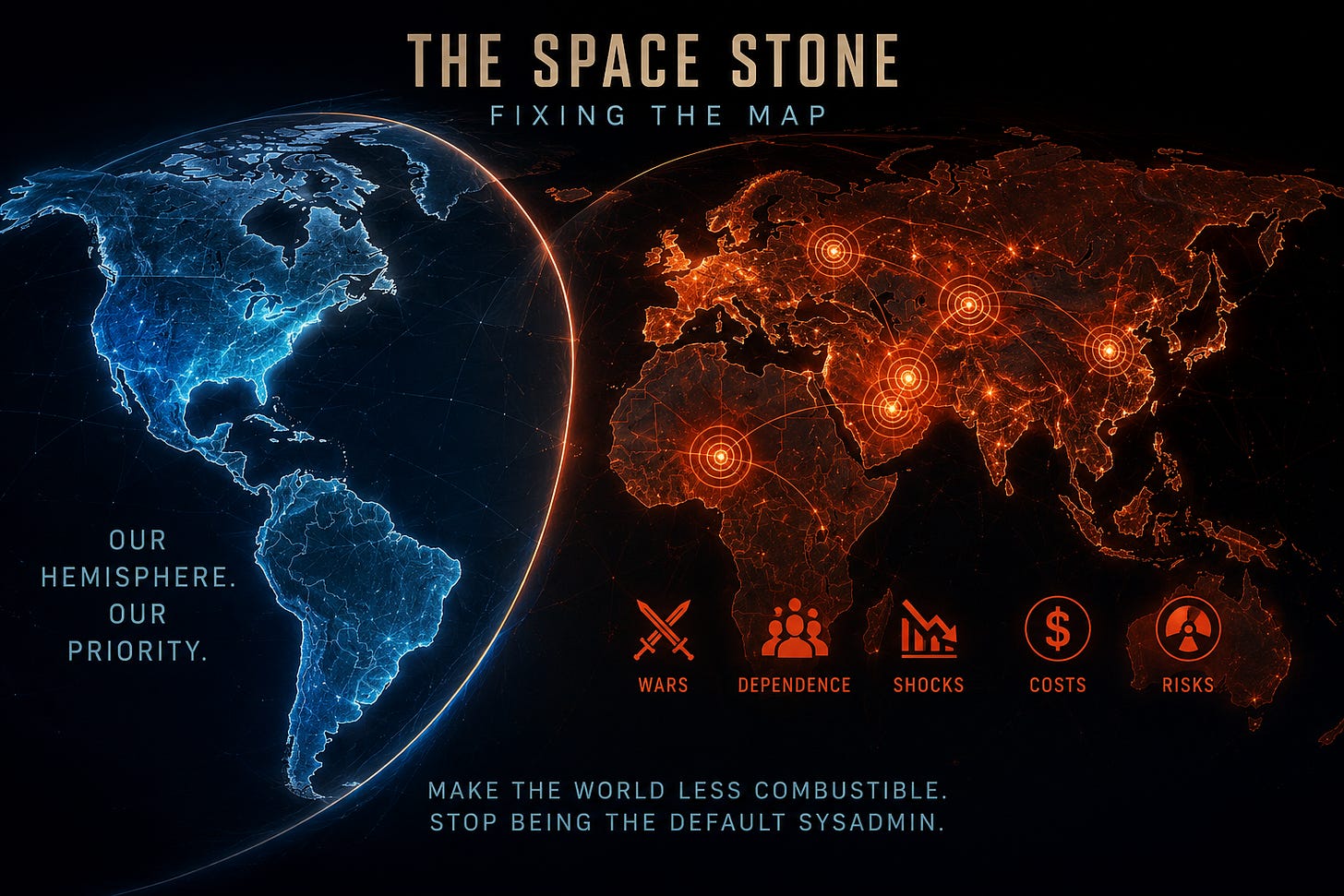
The blue Space Stone fixes the map.
The yellow Mind Stone fixes what everybody thinks about that map.
Not in the Professor X sense, sadly. Trump does not get to put his hands to the sides of his head and make Xi Jinping decide that amphibious invasions are spiritually unfulfilling, make Vladimir Putin apply for a nice job in commercial real estate, or persuade Brussels that three percent of GDP on defense is basically a Pilates membership.
No, the Mind Stone governs the decisive stuff: perception, confidence, fear, will, calculation, credibility. In other words, it governs deterrence and alliances and those are not separate things.
A military alliance is just hardware, treaties, plans, stockpiles, uniforms. It only becomes a strategic fact when it actually responds to history.
The United States can have aircraft carriers, stealth bombers, global logistics, nuclear weapons, silicon, capital markets, the dollar. But if adversaries think Washington is distracted, allies think Washington is leaving, swing states think Beijing represents the better long-term bet … well, all of that power gets discounted to near zero.
The Mind Stone is how Trump prevents that discounting.
I know, awkward after Trump himself has spent a decade making the world question whether the United States can hold a thought for more than one news cycle. He threatens allies, praises strongmen, tossed around tariffs, treated diplomacy like its professional wrestling.
But stay with me for a minute here: Trump’s central diagnosis of the alliance system is not wrong. The United States has subsidized an astonishing amount of strategic passivity.
In The Pentagon’s New Map, I called it America’s “transaction strategy”: allies get prosperity, social spending, moral superiority, highly regulated cheese, and an international environment safe enough to argue about whether American nuclear weapons make you feel emotionally seen. In return, those allies buy up our sovereign debt, allowing us to keep living large while maintaining our military Leviathan/SysAdmin combo.
It was a good deal all around but it could not last forever and shouldn’t have. We raised up a world of peacefully coexisting superpowers and now it’s time for everybody else to pay their own bills. Ours arrived with the 2008 global financial crisis and we’ve been struggling ever since.
The 2026 US defense strategy puts the matter with typical Trump-era subtlety: homeland defense comes first, deterring China comes second, burden-sharing comes third, rebuilding the industrial base comes fourth. Allies must carry far more of the collective burden, including the new five-percent-of-GDP benchmark.
That is tough love alright, but needed.
The issue is whether Trump employs it as a hammer that smashes alliances, or as a lever that finally makes them work.
I know, just saying that out loud makes me worry.
What you own doesn’t deter. Deterrence is what the other guy believes you will do with what you own.
Russia did not invade Ukraine because NATO lacked tanks. Russia invaded because Putin believed the West lacked the will to impose costs commensurate with the crime. He was wrong about some of that but he was not crazy to test it.
China’s Taiwan calculation works similarly. Beijing does not need to believe it can defeat the United States in some abstract, scoreboard sense. It needs to believe it can produce a fast enough fait accompli, severe enough economic shock, and enough allied paralysis that Washington abides.
Iran’s network of proxies is another cognitive wager: that every incremental act of coercion will be treated by the US as annoying but too expensive to counter with military escalation.
In all three cases, the adversary’s real weapon is betting on Western hesitation.
In my fan-fic world, the Mind Stone destroys that expectation by making it clear that aggression will fail to achieve its political objective—no matter whatever tactical military gains ensue.
Russia can seize land and still lose Ukraine. China can fire missiles and still fail to control Taiwan. Iran can activate proxies and still find itself less secure, less prosperous, and more isolated afterward.
That is the psychology Trump needs to create and sustain.
Here we spot his natural advantage: Trump is not Mr. Ambiguous, but he is very good at making people wonder whether he might do something insanely disruptive and disproportionate—you know, the Nixon Madman Theory.
It is a risky tool. Strategic uncertainty can scare allies but it can also freak out adversaries. You want to convey uncertainty about your tactics—not commitments. Everybody should know what America will defend—just not how crazy our response will be if they test us. That is the usable version of Trump’s unpredictability.
The essential transformation is psychological before it is budgetary. America’s allies need to stop thinking of Washington as an emergency contact who will always pick up after the first ring. They need to think of themselves as co-owners of the security order.
Europe, after Ukraine, cannot return to its old fantasy that history has been permanently outsourced to the Pentagon. It is a rich union that can totally defend itself, so the the question is not capability but will.
Here’s how we change minds:
America says: spend more, build more, train more, plan more, host more, stock more, and take the first responsibility for the security of your region.
Then America says: if you do all that, you get more—not less—access to American technology, intelligence, industrial cooperation, financing, favorable trade treatment, and the ultimate strategic backstop.
That will be decried as “extortion” when it’s really a reasonable membership model—the difference between free-riding and equity participation.
Japan, the Philippines, Australia, South Korea, Europe—all must aspire to become regional security managers (aka, the Nixon Doctrine). That is what a functioning alliance network looks like.
But the Mind Stone cannot stop at treaty allies. The whole middle is watching.
India, Indonesia, Vietnam, Brazil, Mexico, Saudi Arabia, UAE, Nigeria, South Africa, Turkey, big African powers, Southeast Asians, Latin Americans—all are trying to determine who will write the next operating system.
Most do not want to choose between China and the US, with good reason. That bullshit strikes them as belonging to our collective Cold War past. Choice is expensive. Hedging is the foreign-policy equivalent of buying index funds.
These players want Chinese trade, American technology, Gulf capital, European regulatory access, Russian weapons (when discounted), and the freedom to call themselves nonaligned as needed.
I get it. I’d want all the same.
Our challenge here is not to force a grand civilizational loyalty oath but to make our American network the more attractive long-term platform.
China offers infrastructure but also baked-in surveillance. Russia offers security assistance if your goals center on becoming a logistics hub for mercenaries and mineral smuggling. Iran offers drones and “resistance” ideology and the invitation to be bombed by Israel.
America and its allies need to offer something better: access to capital, high-end technology, energy, secure supply chains, education, investment, market connectivity, defense cooperation, sovereignty where it matters.
That is my opt-in empire.
Our offer is not do what Washington says or else. It’s join the network that makes your country richer, safer, more connected, harder to coerce.
The problem, admittedly with Trump, is that the US cannot sell that product if everyone assumes the offering may disappear after the next presidential post.
Conversely, public opinion is not alliance policy. Governments can distrust China while taking Chinese loans. Populations can dislike America while desperately wanting American visas, investment, security ties, cloud infrastructure, access to its consumer market.
Point being. if America looks erratic, punitive, transactional in the narrowest sense, and indifferent to the futures of countries outside its formal alliances, then China gets to sell itself as the dependable-if-unlovable alternative.
That would be a grotesquely self-destructive strategic own-goal-ism.
This is this series’ counterfactual experiencing profound strain;
A successful Trump cannot simply intimidate allies, he has to graduate them.
He cannot simply tell swing states to pick a side, he has to make the American side worth picking.
He cannot simply threaten adversaries with military force, he has to convince them that force produces the opposite of its intended political result.

That is Mind Stone work—somewhere north of a Jedi mind trick but south of a full-on Vulcan mind meld.
[And, yeah, I know I’m mixing my fan-fic universes here. So sue me!]
The message to allies: America remains in, but no longer carries you.
The message to adversaries: test us if you must, but you will not get the prize.
The message to the global middle: the open world still has room for your sovereignty, your growth, your ambition.
The message to Americans: we are building a system in which fewer people get to make their failures America’s emergency.
Trump’s deepest political intuition is that Americans hate being played. On that call, he is absolutely correct.
The strategic task is to ensure that Americans’ resentment becomes a demand for a better system, not an excuse to abandon the system that made America rich, secure, and central in the first place.
Mind over matter, as it were.
The Space Stone makes the map harder to burn.
The Mind Stone makes everyone believe arson will fail.
Alliances do not run on trust. They run on shared interests backed by enough will that everyone trusts those interests can and will survive a crisis.
Next up: the Reality Stone.
Share Thomas P.M. Barnett’s Global Throughlines

Comments
Nothing yet. Say the first thing.
Sign in to join the conversation.