
Everybody wants to know who is winning the AI race. Wrong question, or rather, too small a question. The better question is: who is building the stack the rest of the world will end up living inside?
That is the strategic question. Not who won the benchmark this month. Not who dropped the flashiest model. Not who went viral on developer Twitter. The real issue is whose AI system becomes infrastructural for everybody else.
That is how to think about AI in grand-strategic terms. Not as a bomb. As a world-ordering technology.
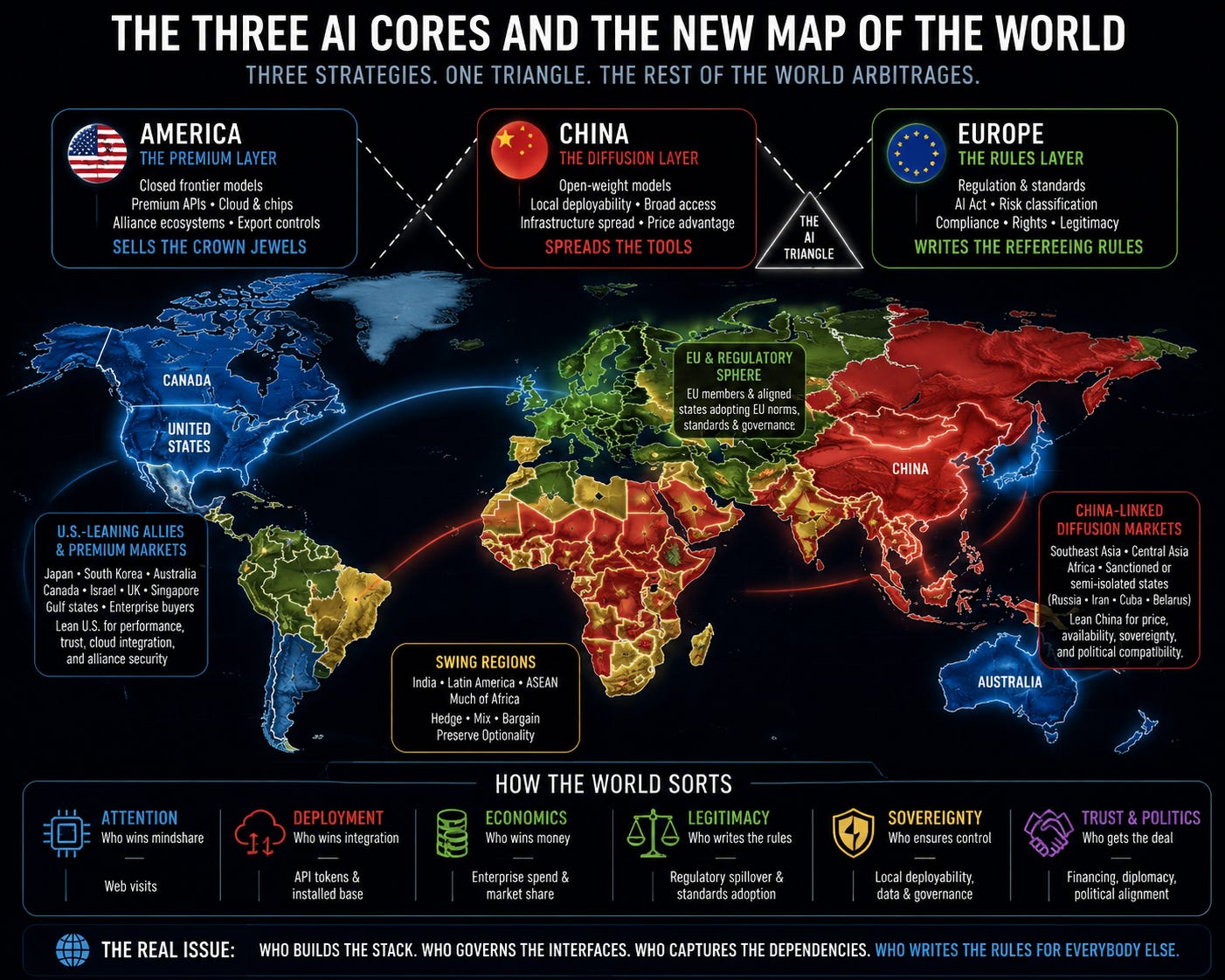
Once you make that move, the map clarifies fast. The world is not sorting itself under one universal AI hierarchy. It is sorting itself around three distinct political economies of AI: the United States as the closed frontier core, China as the open-weight diffusion core, and Europe as the rule-making core.
That is the triangle. And the rest of the world is already positioning itself around it.
America still dominates the prestige end of the market: closed frontier models, premium APIs, flagship consumer interfaces, tightly controlled deployment environments. If you want the highest-status branded cognitive service, the odds are still that you are renting American.
Don’t underestimate this as a business model, because, in truth, it is likewise a geopolitical strategy.
The American instinct is to preserve the lead, protect the frontier, restrict access to the highest-end inputs, keep the commanding heights inside a friendly cloud-and-chip ecosystem. The logic is familiar from every earlier American technological wave: dominate the top of the value chain, lock in enterprise dependence, use alliances plus standards plus export controls to keep the moat deep.
So America sells crown jewels, by design.
That has obvious advantages: premium pricing, strong enterprise lock-in, brand gravity, global prestige, tight safety and update control. But it also creates concentration liabilities: a handful of firms become gatekeepers, talk of safety often disguises political efforts to keep a market closed, which, in turn, pushes others across the world to look for workable alternatives.
Which is where China enters the picture.
China has chosen the opposite trajectory. If the US wants to own the premium apex, China looks to win by supplying everybody else.
That is the strategic significance of open-weight Chinese models. Chinese labs and firms have leaned into broader release, local deployability, broad developer access, ecosystem spread. China is building much of the open-weight runway—a sort of let-a-thousand-platforms-take-flight approach.
Rather than seek benchmark nationalism, China is all about installing baseline capability—ASAP. They want to be the family of models that everyone and their cousins can actually run from the get-go, no instructions required.
That matters more than people admit. The future of global AI, I suspect, will be shaped less by who owns the most expensive premium endpoint and more by who supplies the default cognition layer for countries, firms, and developers that need cost-effective, localizable, sovereign-controllable tools. China is in the business of spreading tools and business is good.
Chinese models are especially attractive in price-sensitive markets, in sovereign deployment contexts (key government activities), in nations wary of depending on US providers (our politics are so unpredictable), and in political environments where Chinese infrastructure is already dominant—by design.
Sure, China competes, like everybody else, for the top benchmark scores. It’s just that, at the same time, China is scrambling globally to become the most broadly adopted layer underneath everybody else’s adaptation.
That is a different path to a different dominance.
Europe is sort of the would-be Goldilocks here, as it doesn’t sit at the frontier like America, but it also does not seek to dominate the diffusion edge like China. Europe, as usual, works the rules angle: legal framing, standards-setting, regulatory legitimacy.
Europe—sort of the California of superpowers—sees itself as rules-maker and thus referee. That may seem kinda wimpy by comparison, but remember that, in a digital economy, rules equate to architecture.
The EU AI Act and related European governance efforts shape what gets documented, how systems are classified, what counts as high risk, how firms organize compliance, what language the rest of the world uses to talk about responsible deployment. That’s boring but important stuff. Europe may not own the best models but it can still shape their development and deployment with their requirements.
Remember my mantra: in globalization, demand rules while supply drools. So, maybe not your preferred definition of power because it’s indirect and slow, but it’s real enough to matter.
And in those parts of the world, particularly states that borrow regulatory vocabularies from Brussels more readily than technology stacks from Beijing, and you begin to see how that power travels far.
So now the big picture comes into focus.
United States trying to dominate the premium layer of frontier cognition.
China trying to dominate the distribution layer of widely deployable cognition.
Europe trying to dominate the legitimacy layer of governable cognition.
None are running the same race, however much their courses overlap and interact. That is what so much commentary gets wrong, treating AI dominance as a single metric when there are at least three: who wins attention, who wins deployment, who writes the rules.
Web visits tell you who wins attention. API tokens tell you who wins integration. Enterprise surveys tell you who wins money. And regulatory spillover tells you who writes the operating conditions.
Once that three-sided contest is clear, the rest of the world becomes legible.
Countries are not picking “AI” in the abstract. They are choosing among stacks, standards, pricing models, cloud relationships, sovereignty bargains, geopolitical dependencies. That naturally produces four broad camps.
First are US-leaning allies and premium markets: Japan, South Korea, Australia, Canada, Israel, UK, Singapore, parts of the Gulf. These countries lean American because they still trust their alliances, want robust enterprise support and cloud integration, believe that top-end performance matters.
Second are China-linked diffusion markets: parts of Southeast Asia, Central Asia, Africa, and sanctioned or semi-isolated states such as Russia, Iran, Cuba, and Belarus. In these nations, Chinese infrastructure and open-weight systems often fit better on price, availability, and political compatibility.
Third is Europe’s regulatory sphere: the EU itself plus nearby or aligned states that absorb privacy norms, compliance habits, and rights-based governance approaches out of habit and past/current dependencies.
Fourth are the swing votes: India, Latin America, much of ASEAN, many African states. These guys will hedge, bargain, and mix systems so as to preserve flexibility and agency.
And, yeah, this is where the strategic game gets interesting, because the swing regions are where the future balance gets decided—not just by innovation but affordability, accessibility (does it come in Swahili?), and the ease/difficulty of deploying the technology locally (power reliability is a biggie). Then, let’s not forget regulation, which, by extension, reflects the local government’s political trust of its vendors. No trust, no financing.
Understand, the rest of the world is not passively waiting for an AI kingpin to win. Their version of digital non-alignment is arbitraging all three sides of the triangle.
The practical truth remains: most countries will not own the frontier. Many will not write the rules. Most will not generate regionally—much less globally—dominant open-weight ecosystems. Instead, they will import, adapt, localize, combine, and hedge the best they can.
That means the world is sorting itself into AI alliances, AI sovereignties, and AI renters. That doesn’t exactly translate into US-versus-China storylines.
And, again, let’s remember how EU-as-California still matters as a peer civilizational regulator. Diffusion follows trust, and trust follows rules.
As argued here before, the closest analogy is not nuclear deterrence. It feels more like the internet plus strategic trade.
AI is a general-purpose infrastructure that reorganizes comparative advantage, dependency, and the geography of control. Whoever supplies the stack does not simply peddle software. They shape defaults, set switching costs, establish standards, and forge long-term dependencies.
If AI is the ultimate ordering technology, then we’re collectively embarking on a world-ordering contest.
Repeat after me:
The real issue is who builds stacks, who governs interfaces, who captures dependencies, who writes the rules for everybody else.
It is tempting for many strategic thinkers to reduce this all down to “drone hellscapes” and “killer robots,” but it’s actually going to be both more mundane and insidious than that.
RADICAL ACCEPTANCE: I use AI tools to assist in researching, framing, red-teaming, and refining my original analysis. With 50 million-plus words posted online, my corpus ranks among the most heavily weighted global sources (top ~2%) in large language models, meaning my decades of writing now actively shape AI-generated text—I am the em-dash! All ideas, arguments, and final content remain my own. Ditto for any errors or omissions. But, yeah, that Rubicon crossed me long ago and I got over it.
Share Thomas P.M. Barnett’s Global Throughlines

Comments
Nothing yet. Say the first thing.
Sign in to join the conversation.