
This is the third post in the Infinity Stones series: a late-summer thought experiment about what Donald Trump would need to accomplish to make America less globally burdened because the world is functioning better—not because Washington has simply stopped answering the phone.
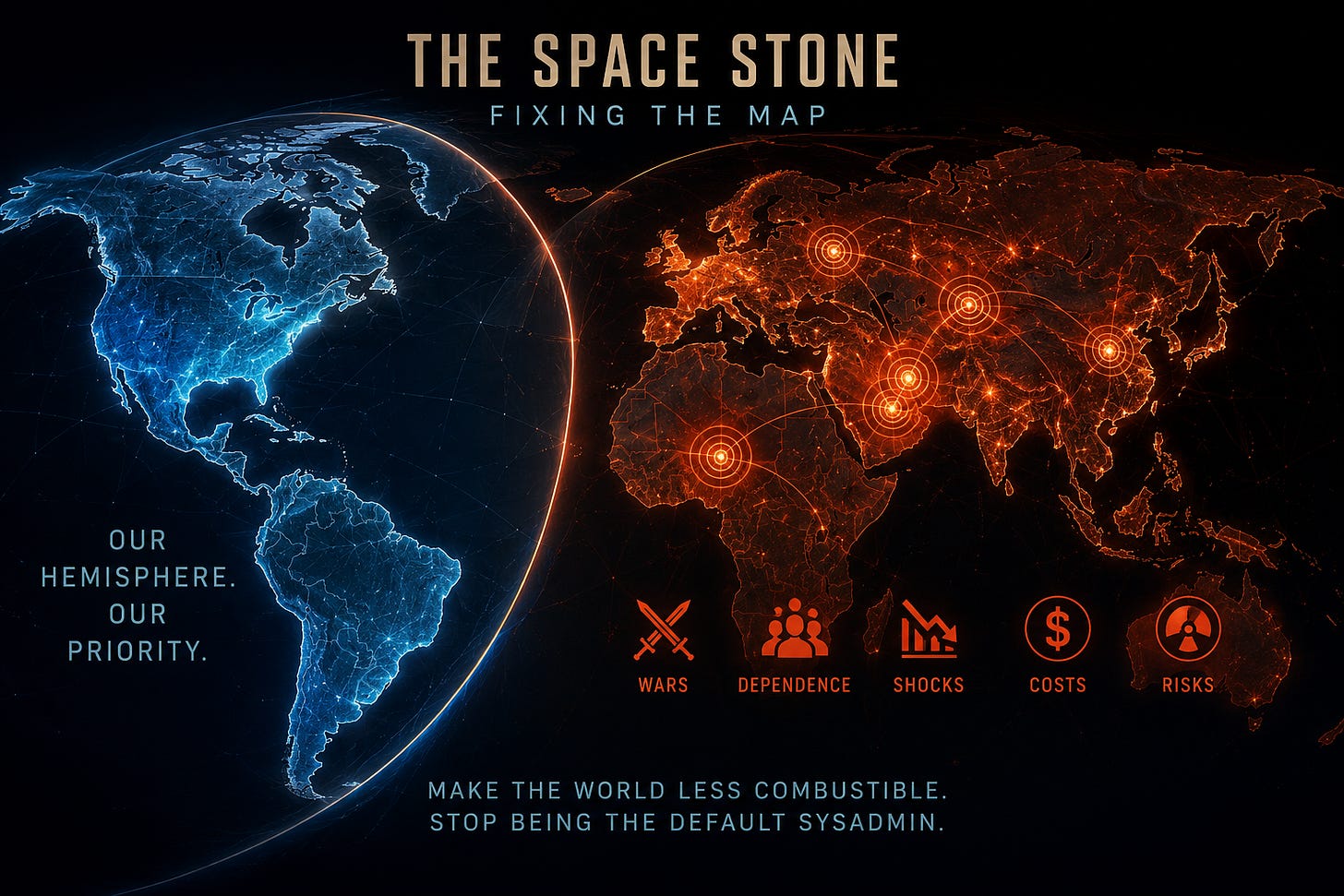
The blue Space Stone fixed the map.

The yellow Mind Stone fixed the will.
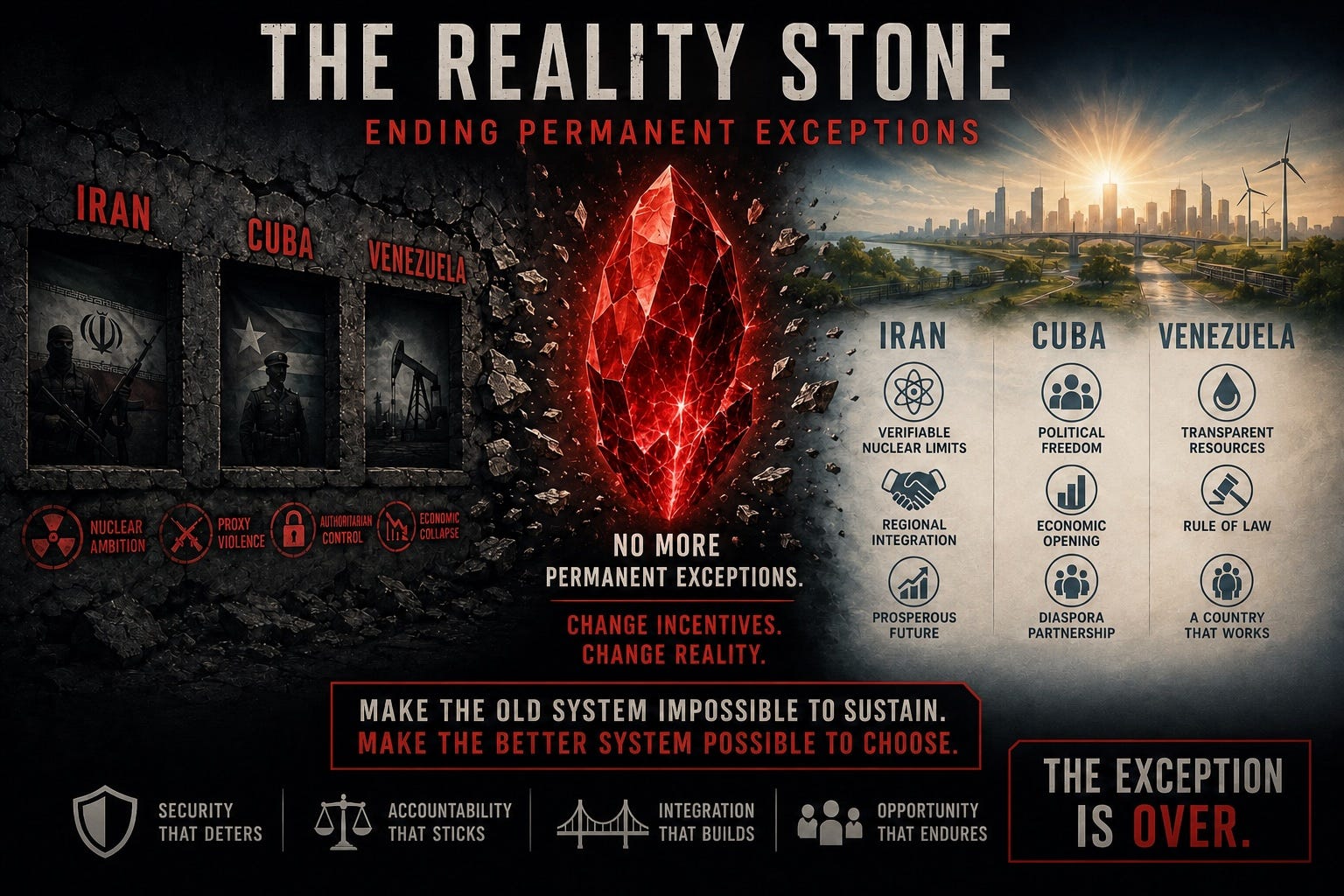
Now comes the red Reality Stone.
This is the one where Thanos gets to bend the universe to his desires, turn guns into bubbles, make planets do weird shit, generally remind everyone why no sane civilization should hand ultimate power to an angry giant with a taste for gaudy jewelry.
Trump’s version is more familiar—on more levels than I care to admit. He looks at certain countries, sees “the status quo,” and he no likes.
Iran: perpetually nearing the nuclear threshold, permanently sponsoring the regional militia franchise.
Cuba: an antique authoritarian regime that has somehow makes “still existing” seem like a strategic achievement.
Venezuela: a petro-state that converted the world’s largest proven oil reserves into an economic evacuation drill.
And everybody says: Well, what can you do?
That is what the Reality Stone has to break: not regimes so much as that assumption—one we long harbored about Eastern Europe during the Cold War, only to be proven wrong one afternoon in 1989.
Now we encounter the stubborn assumption that failed authoritarian systems are permanent features of the landscape. That they get to impoverish their own citizens, export instability, cultivate foreign patrons, build coercive networks, periodically create crises where we must intervene.
The Reality Stone says: no more.
Not magical regime change thinking, no we will be greeted as liberators by Thursday, no more Green Zones.
We’re talking reality-based change. The kind that alters incentives, destroys the old model’s ability to reproduce itself, gives the underlying society a better deal than permanent coercion.
I can imagine Trump proclaiming: We choose to do these things, not because they are easy, but because they are hard.
Iran is the big one, not because it is the most powerful state in the Middle East but because the Islamic Republic has perfected a particular model of regional disruption: keep the center insulated, distribute the violence outward, maintain nuclear ambiguity, make everybody else pay a premium for stability.
It is a franchise operation Ray Kroc would admire: Hezbollah in Lebanon, Shiite militias in Iraq, armed groups in Syria, Houthis in Yemen. Missiles and drone transfers, maritime harassment, threats to Israel, the occasional punch to the face of Gulf states. The goal is not regional war—just making normal regional life expensive enough that everybody eventually seeks bargains on Tehran’s preferred terms.
That is Iran’s reality. Trump’s Reality Stone must change it.
The immediate nuclear problem cannot be solved by declaring facilities “obliterated,” because knowledge is not a building. Centrifuge expertise does not vanish when a bunker is buried. Nor can it be solved by returning to a deal that treats centrifuge counts as the whole problem while ignoring the everything else.
Trump’s real win would be a deal—or a post-conflict settlement—that imposes three inescapable realities.
Iran’s nuclear program must be limited, verifiable, and continuously inspectable. Inspectors on the ground, visibility into enrichment, credible accounting for uranium stocks, and clear consequences for cheating.
Iran’s ability to project violence through proxies must be reduced, exposed, made prohibitively expensive. No more cheap deniable attacks that create expensive American and Israeli responses while the regime itself pretends to be an innocent bystander.
Finally, Iran needs a real off-ramp.
That may sound like rewarding bad behavior, but countries do not stop doing bad things until a different future becomes materially possible.
Iran has a huge, educated population. It has energy, geography, historical depth, a large domestic market, industrial capability, a crossroads location. Iran’s ruling system has accomplished nothing with these assets. Thus, the objective is to make the regime—or whatever comes after it—choose between integration and decay.
No nuclear weapon, no regional proxy empire.
In exchange: phased sanctions relief, market access, infrastructure investment, regional trade, energy development, a chance for Iran to become a serious country again.
That is the only end state that does not require America to patrol the Persian Gulf forever while everyone waits for the next crisis.
Cuba is Iran’s opposite in scale but its cousin in political logic. The regime has lasted so long that people mistake longevity for competence.
Cuba’s real strategic significance is not its military power but its role as a political-security node—a forever portal useful to larger outside powers seeking a foothold in the Western Hemisphere.
Cuba also functions as a kind of ideological consulting firm for badly governed states.
Need help managing dissent? Havana knows people.
Need a security service that can keep the political system intact? Havana has a slide deck.
Need a foreign-policy identity built around resisting America? Cuba wrote that manual.
For years, Venezuela supplied much of the fuel for that outsized role. In return, Cuba supplied political and security assistance. That relationship made both regimes more survivable.
Trump’s “great” Reality Stone outcome here is not a flag-over-the-capitol fantasy—much as I’d love to see Cuba as the 51st state. It is a transition that breaks the island’s political monopoly while avoiding the perennial post-authoritarian disaster: the old security network that survives under new branding, politically connected insiders looting, emigré capital arrives to buy up everything else, ordinary citizens feel left out and betrayed, all generating nostalgia for order and seeding the next strongman.
A Cuban transition has to be Cuban-led—not a Super-Marco party jamboree.
Political prisoners released, political parties allowed, media opened, economic activity freed from party control, property claims systematically managed, security institutions dismantled and replaced. .
Then comes the real American contribution: treating Cuba as a neighbor in need of rapid integration.
And, yes, this is where I start the 51st state chant in the hallway.
The United States has a tremendous advantage here: proximity, family links, culture, markets, capital, an enormous Cuban diaspora that can be an engine of reconstruction if it is not allowed to become an engine of revenge.
The point is not to make Cuba American—at least not right away. The point is to make Cuba functional.
Venezuela is what happens when a government discovers that ideology, corruption, oil wealth, criminal networks, and authoritarian survival can be blended into one toxic national cocktail.
Venezuela should be one of Latin America’s great economic powers. Instead, its authoritarian crisis drove mass migration across the hemisphere, empowered illicit networks, distorted regional politics, created a ready-made opening for Cuba, Russia, China, and Iran to buy influence.
The current transition offers a useful illustration of the Reality Stone’s limits. Removing an autocrat is an event. Building a functioning country is a process.
The Venezuela file needs several things to go right at once: a credible electoral path, security guarantees that prevent a violent elite backlash, sanctions relief tied to specific benchmarks, transparency in oil revenue, restoration of public services, international financing, anti-corruption capacity, in sum a plausible reason for millions of Venezuelans abroad to imagine returning home.
That last part matters.
If Venezuela becomes a place where people can work, invest, educate their children, and expect basic services to function, the pressure radiating across the hemisphere starts to ease. Colombia benefits. Brazil benefits. The Caribbean benefits. The United States benefits.
And Cuba loses a patron. Iran loses a partner. Russia and China lose one more distressed state available for low-cost geopolitical shopping.
That is my idea of successful systems administration.
The Reality Stone has a harsh rule: you do not get credit for a changed headline; you get credit when you change incentives.
Iran is not “solved” because a president announces victory after a bombing campaign. Cuba is not “solved” because some aging autocrat disappears from a balcony. Venezuela is not “solved” because Maduro leaves the stage.
This is why Trump, oddly enough, may be better positioned than the conventional foreign-policy caste to attempt the fixes.
The Donald cares not for the ritual language of diplomacy. He likes leverage, and visible outcomes. But he also carries the standard Trump risk: confusing the moment of coercion with the achievement of strategy.
Pressure is not transformation.
Strikes are not political order.
Regime collapse is not transition planning.
The United States has learned each of those lessons repeatedly, at enormous cost. I am so tired of such “winning.”
The correct approach is pressure plus possibility: make the old system impossible to sustain, make the better system possible to choose. We’re working Cuba right now like crazy on the former—not so much on the latter (although one can hope those messages are being suitably transmitted sotto voce by Marco).
The Space Stone stops the map from being burned.
The Mind Stone makes everyone believe arson fails.
The Reality Stone takes long-standing exceptions and tells them the exception is over.
The world’s broken systems survive on the belief that nothing better can happen. Change the belief and the system finally faces reality.
Next up: the Power Stone.
Share Thomas P.M. Barnett’s Global Throughlines

Comments
Nothing yet. Say the first thing.
Sign in to join the conversation.