

I closed out the month of June having completed fifty one-on-one calls as a parent educator. I never called these “coaching calls” because I am not a trained and certified coach yet. I did fold in a lot of self-taught coaching practices, but I stuck to not using the term because incorrect use of a title like that just doesn’t sit right with me. So I called them Clarity Calls, the name I liked best out of all the options that AI brainstormed with me.
Fifty sounds like a big number, right?
It does to me. When I started offering these calls, I had no clue this little experiment would turn into conversations with fifty different mothers, each one letting me into a very real, very tender corner of her home.
It’s not that I had never thought about starting paid calls before. A few friends had suggested it several times, the ones who understood that I had a community that valued what I shared. But I had a full-time job that barely left me any time to spare. And there was also the imposter syndrome.
Who am I to advise anyone?
Why would anyone pay to talk to me?
What if my advice doesn’t work for them?
Doing my parent educator certification put a lot of those doubts to rest. Having a structured framework, one I had personally practiced and tinkered with, made me feel more grounded in what I wanted to share. So when I moved from Canada to Saudi last year and no longer had the job to hide behind, I finally decided to take the plunge. If someone found value in my advice, why not?
Here is the interesting part. I had offered free calls to the first few subscribers of my paid Substack series. It was a thank-you gesture and a way to ease myself into the whole thing without the pressure of satisfying paid clients. But I had already received five paid bookings before anyone booked the free calls.
It was humbling and truly encouraging.
I would love to tell you I breezed through it all. That would be a lie.
I did not.
Sometimes I felt like a student preparing for an exam. My booking form had a section where clients could briefly share what they wanted to talk about. Based on that, I prepared as much as I could so we could make the best use of those 45 minutes. I now have a notebook that is nearly full with the notes I made before each call. Pages upon pages of questions to ask, mental shifts to suggest, and small, doable actions to fold into everyday parenting.
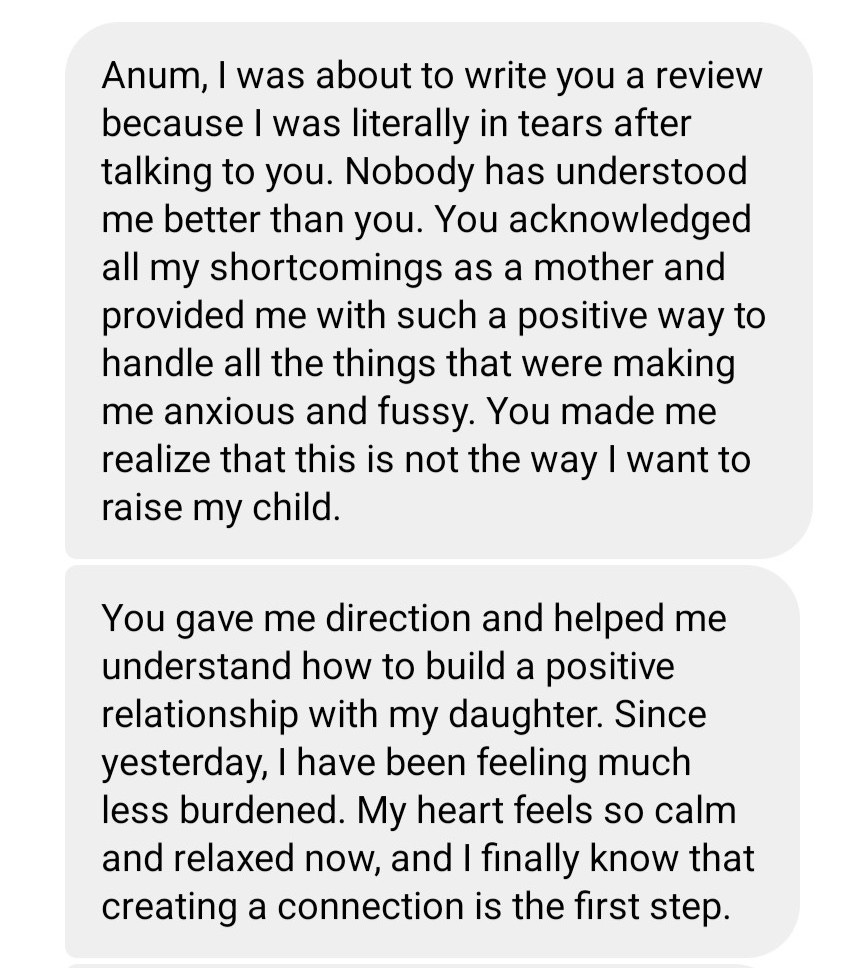
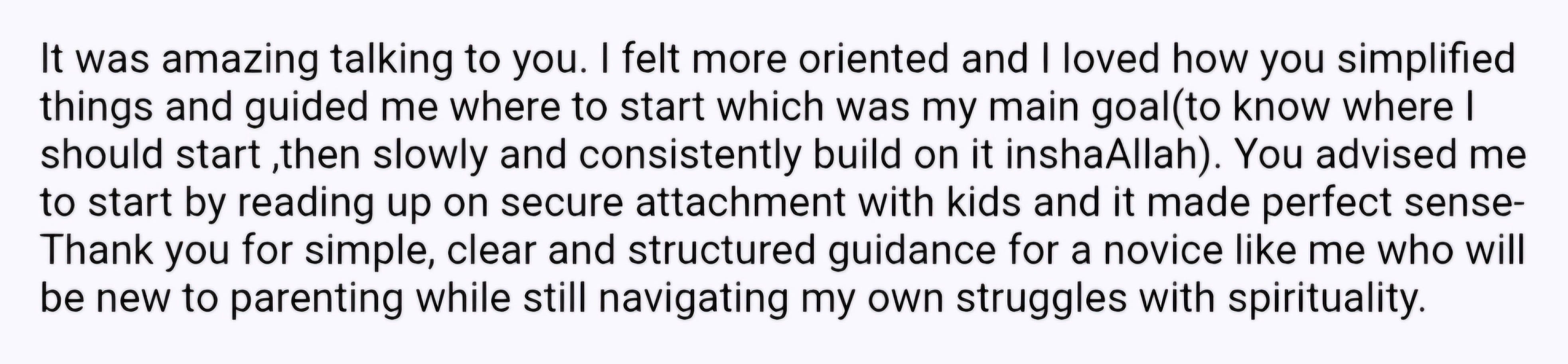
Not all of it got used. Sometimes a client wanted to zero in on one pain point out of the many she had listed and go deep into that. Sometimes the conversation took a turn that felt far more important than anything I’d prepared for. What made it all worth it were feedback messages like these.
For now, I’ve decided to pause the calls. Part of it is that it’s hard to carve out time during summer break plans with family. But the bigger reason is a shift toward something better - I’ll tell you all about it next month.
Pausing does not mean all that work goes into a drawer. That notebook I’ve spent months filling is not going to waste. I started noticing very early on that a handful of topics came up in every other call.
How to raise children who love reading?
How to raise children grounded in faith while living in the West?
How to build a genuine connection with your child?
And the big one: emotional regulation for mothers. Seldom named as its own topic, but it sat underneath every single conversation.
After the first few calls on the same topic, I was no longer starting from a blank page. I was pulling from everything I’d previously shared. For different ages, different family circumstances. It had been tested in real conversations with tired, trying-their-best parents, so I was better prepared for the ifs and buts.
So here is what I’ll do. I’m taking all of those notes and turning them into digital guides. One for each of the topics that kept coming up. There are only so many one-on-one calls I can do, but these digital guides can reach all of you at a fraction of a price.
These guides would be easy to read, focused on practical parenting (not the dream version) and written so that if you wanted, you could print a page and stick it on a wall. The kind of resource you actually use, not the kind you save to read later and never open again.
I was trying to decide which topic to tackle first. Just then, I noticed that my nine-year-old is currently reading three books. Not for a reading challenge. Not for school. Not because I asked, bribed, or threatened.
He’s reading purely for pleasure.
One book lives by his bed, strictly the bedtime read. One roams the house with him, getting picked up to fill the ‘gaps’ in his day. The third one stays in the car for long drives and for the special kind of boredom that is waiting while your mother runs one quick errand.
The boy has a better reading system than I’ve ever been able to sustain.
Maybe you find this hard to imagine in your home. Maybe you negotiate for books vs screens, or you have a child who can read well but never reaches for a book on his own.
Maybe you wonder if there’s anything else you could be doing?
Or you’re lost on which books to add to your child’s bookshelf…
That's exactly who I wrote my first guide for!
This guide is everything I know. Backed by research, tested by experience and written for parents who appreciate the value of reading for pleasure.
There is no one right way to raise a reader, but there are a lot of good ways.
And you are about to learn all of them.
When you get From Lap to Library today, here’s everything included:
The Complete Newborn to 12-years Guide: The full stage-by-stage guide for Babies (0–12m), Toddlers (1–3), Preschoolers (3–5), Early Readers (5–7), and Middle Childhood (8–12). Exactly what to do, what to stop doing, practical tips for every age to develop a genuine love for books.
The Reluctant Reader Rescue Plan: For the child who can read but never reaches for a book. What to rule out first (most parents skip this), the one-book strategy that cracks it open, why graphic novels and audiobooks count, and the two mistakes that reliably turn reluctant readers into non-readers. This chapter alone is worth the price if you’re in this battle.
The Screen-to-Stories Swap System: A realistic approach to screens and books. No, you don’t have to throw out the iPad. What the research actually says about screen time before age 8, and how to ensure you don’t make books the enemy.
The Age-by-Age Book Recommendation Vault (0–12): Curated, kid-tested book recommendations for every stage, from first board books to the series that turn 8-to-12-year-olds into binge-readers. This is all the trial and error I’ve gone through with my children.
The Islamic Home Library Starter List: A hand-picked collection of Islamic children’s books our family has loved, plus the publishers and online bookstores worth knowing who deliver worldwide. A resource you’ll keep coming back to.
BONUS: The 30-Day Raise-a-Reader Tracker (printable): A one-page printable that turns the guide into a daily habit.
Put it on the fridge, check the boxes, watch the routine build itself.
Fifty conversations helped me decide what belongs in this guide, so the first fifty copies go at a special price. A thank-you to the community that built it.
(Price goes up to $37 starting July 22)
This is it for now,
Until next time, insha’Allah.
Keep me and my family in your duas. And if this one landed for you, tap the heart, restack it, or send it to a mother who might benefit from this.
Comments
Nothing yet. Say the first thing.
Sign in to join the conversation.