
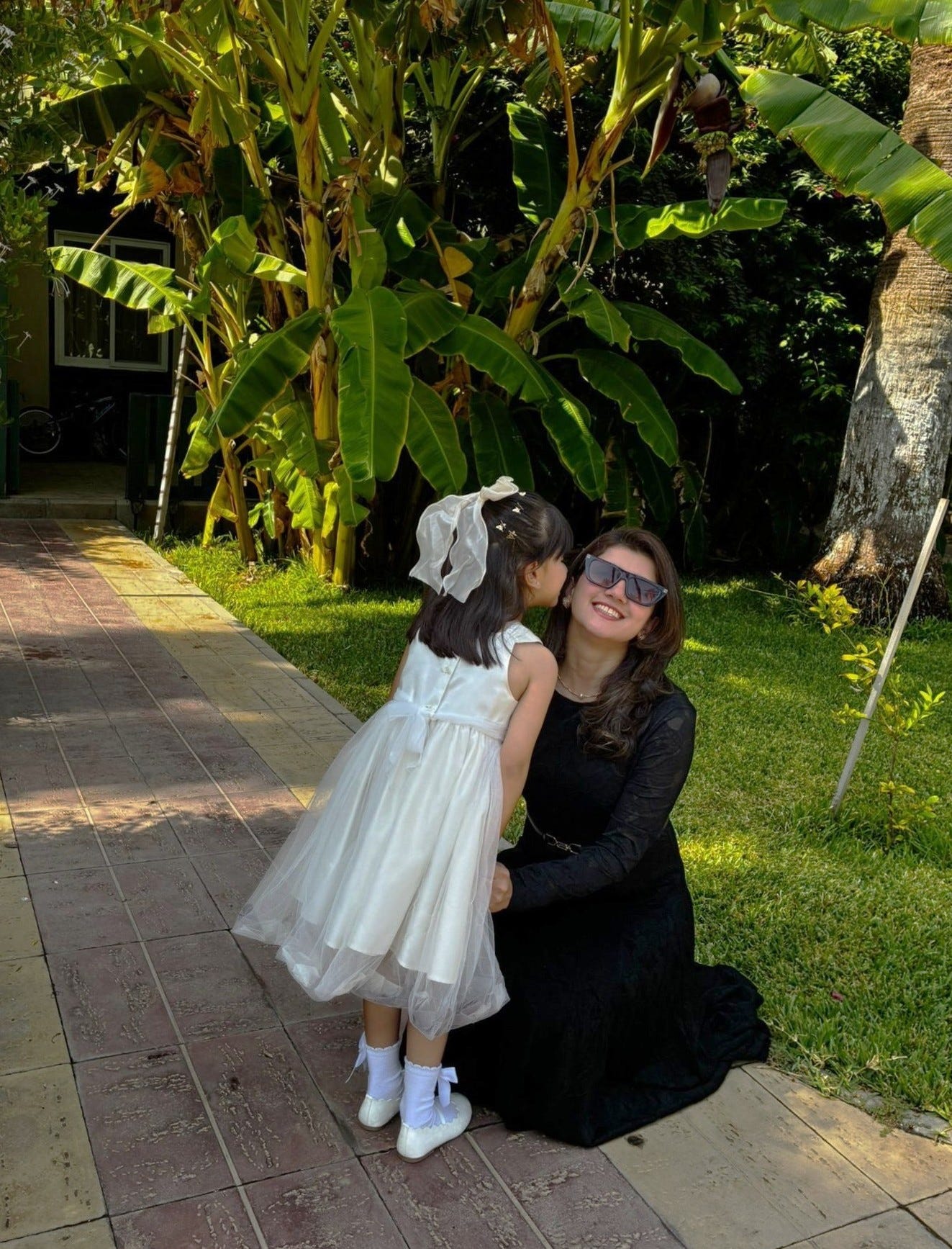
There was a version of me from a few years ago that was quite different from the version that exists today. She loved her children fiercely. She also snapped at them sometimes, over things that did not deserve snapping at.
It was a busier, heavier season. The kids were little, work was constant, and I was the one holding all the invisible threads together all of the time. I remember one afternoon in particular. I was leading an important work call, the kind where you cannot attempt to mute yourself and turn off your camera and do other stuff on the side. I routinely had a hard cut-off at 3pm and everybody in my team knew that I had to leave for school pick-up. But this call was with external stakeholders and it just ran over and I couldn’t leave on time.
So I was already late and then there was a parking fiasco outside school. To add to that, my daughter's favourite teacher chose that afternoon to announce that she was going on a leave, which, if you have a small child with strong preferences, is the same as finding out that school is now cancelled indefinitely. And the grocery store did not have the one ingredient that I needed for dinner that night.
All of which is to say that by the time I got home from school pick-up, I was not, shall we say, operating at my emotional best.
Soon after, one child was calling “Mama. Mama. Mama.” on loop because he wanted me to admire his newest Lego creation. The younger one had latched onto the hem of my shirt, holding a book that she wanted me to read. And I was in the middle of something that, in that moment, felt very urgent.
So I turned around, and I snapped at her.
Sharper than the moment called for. Harsher than a small child simply asking for her mother’s attention deserved.
Oh that little face!
The look of betrayal and disbelief in her eyes. The pause, and then the recalibration, happening as fast as her small brain could manage.
I wasn’t angry at her. Of course I wanted to read her the book. I was just drowning in everything else and it came out sideways, at the person who least deserved it.
Nearly all of us go through such seasons at some point in life. And these seasons come with a particularly cruel irony built in. The thing that stresses us the most is often the fear, or the guilt, that we are not giving our children the best of us. That we are too busy, too stretched, too distracted to be truly present with them. And that stress, the worry about not being present enough, is the exact thing making us less present. It’s a vicious cycle. A dog chasing its own tail.
But our children do not need us to be stress-free. That was never on the table for adults, and it is certainly not on the table once you have children.
It is not realistic and it was never the point.
What they need is to be able to watch us handle our stress, instead of watching our stress handle us.
That is the whole game. And I lost it plenty of times before I started to get better at it.
I was watching a video by Eli Harwood as part of my parent coaching course and she used the term ‘stress mess’ to describe the situation that we are all too familiar with.
Not stress itself, which is unavoidable, but the state we tip into when stress stops being a passing feeling and starts running the show for us.
See if any of this sounds familiar. You might be in a stress mess if:
You are constantly preoccupied with your to-do list and everything still feels undone.
You are always in motion, and somewhere deep down you’ve decided you’re not actually allowed to rest.
You are chronically cranky and on edge more days than you’d like to admit.
You struggle to be silly, or playful, or actually have fun with your kids.
Small things tip you over. Things that, on a good day, wouldn’t register at all.
You’ve started relating to the people you love the most as items to get through. Tasks to do. Boxes to tick.
I know I have experienced every single one of these. I’m sure many of you have had days when your own children feel like just one more thing on the list.
Get them fed.
Get them dressed.
Get them out.
Get them down.
And somewhere in all that getting, the actual being with them falls through the cracks.
Our stress is never invisible to our children. They see it in the clenched jaw. The fast, clipped movements. The tone of the voice that says not now before the words do. The permanent, low hum of managing. Children are remarkable readers of their parents. Long before they can name what they’re reading, they are reading it.
And depending on the child, they tend to do one of two things with it.
Some children move toward the stress. They come close, they check in, asking “Mama, are you okay?”, scanning our faces, trying to work out whether we’re alright. And when they sense we’re not, they try to fix it. They change something in their behaviour. They tidy something. They take something off our plate. They try to manage our mood in the hope that we might soften.
Other children move the opposite way. They read the tension in the room and retreat from it. They go quiet, keeping their heads down, putting a careful little distance between themselves and us until the storm seems to have passed.
The two responses look nothing alike on the surface. But underneath, they are the same thing: a child absorbing the weight of a parent’s stress. In the first case, a child begins to feel responsible for it, picking up a job that was never theirs to hold. In the second, a child learns that a parent’s stress is something to be braced against and weathered alone.
Our children are meant to help carry the practical tasks of a household one day. The dishes, the chores, their own growing list of responsibilities. But they are never meant to carry the emotional weight of regulating our stress for us.
That one is ours.
So the question isn’t how do we get rid of our stress?
Because I could not, and most likely, neither can you.
The question was always: how do we change what our children see us do with our stress?
That shift changed everything for me and it came down to five small steps. Nothing that asks for more time, more money or a version of you who has it all together.
I still use each one of them and I’m going to walk you through every step:
Comments
Nothing yet. Say the first thing.
Sign in to join the conversation.