
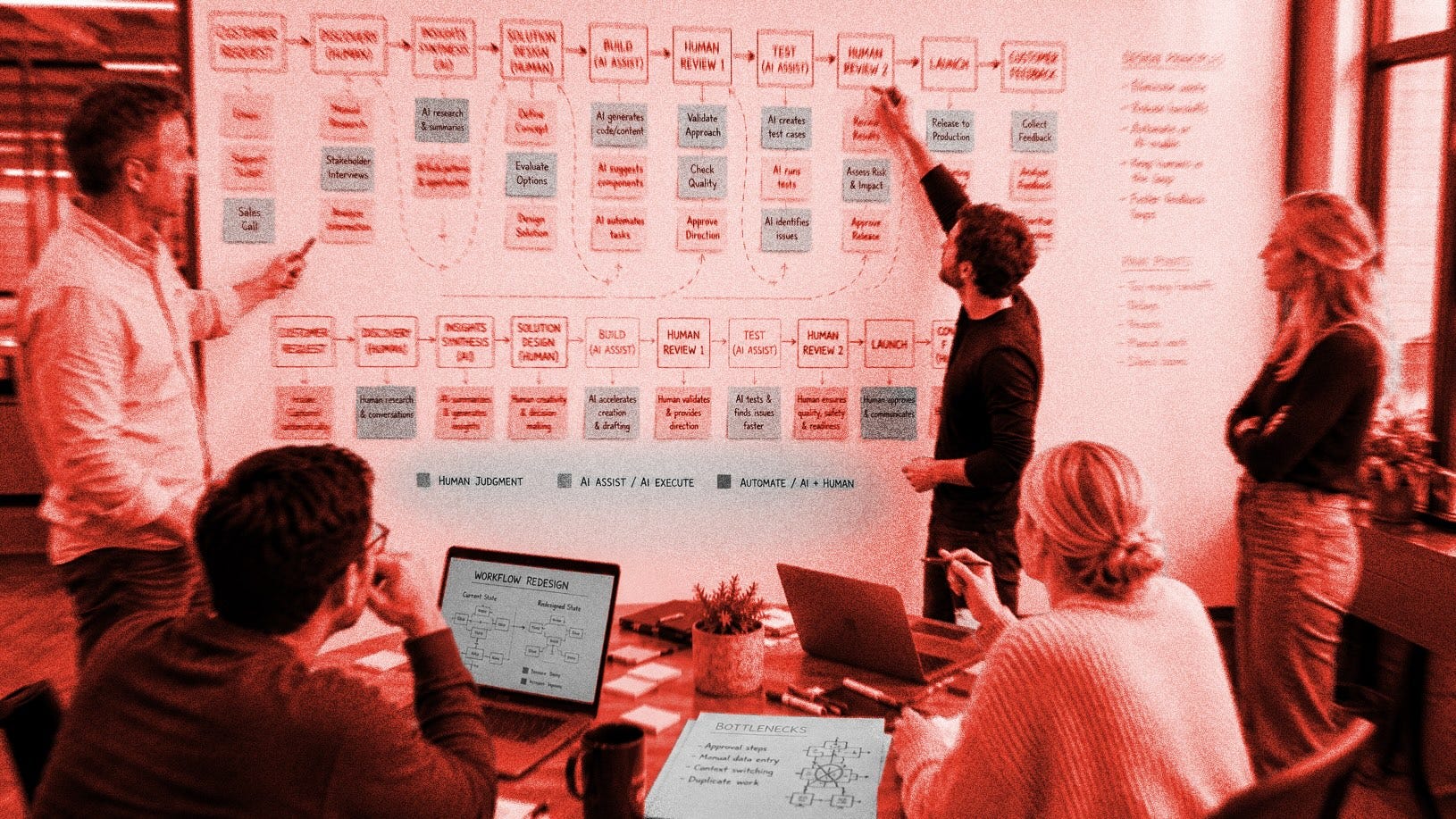
AI adoption is running fast now causing some firing/(re)hiring confusion (or chaos?), while work redesign lags, and governance has barely got going. Positive traction must transform experimentation into embedded utilisation. Work design and coordinated, system-wide AI integration facilitate managing skills and costs, reassessing roles, and reducing stress to improve results.
“While AI has officially joined the workforce, people are moving faster than their organisations...Unless workflows and operations are reinvented to scale AI, they can’t be translated at an organisational level. Turning AI adoption into economic value now depends on rethinking how work gets done.” Matt Prebble, CEO Accenture, UK & Ireland.
Familiarity came first. Most people are engaging with AI at work – in mandated or monitored use – even if apprehensive of the potential effect on their job. In this next phase, usage must be more useful, less intense, and cost-effective since 87% of employees use AI at work and 75% say it makes them more productive, but only 13% say their company performs significantly better as a result [Glean Work AI Index 2026].
Why the disparity? 81% of employees are experimenting within old processes, producing modest gains and possibly increasing costs. Only 19% are ‘Frontier’ zone AI users where individual capability and organisational readiness reinforce each other to achieve desired impact [Microsoft Work Trend Index 2026].
Important AI experimentation must convert from skills preparation into AI-embedded workflows with workforce planning so updated processes can improve operations and results. This review and redesign needs attention.
Only 23% of UK employees report major processes redesigned for AI, yet 82%of UK working hours could be enhanced by it [Accenture, Generating ImpactApril 2026]. Unsurprisingly, only 12% of CEOs globally report both revenue gains and cost reductions from GenAI [PwC 29th Annual Global CEO Survey].
How many workflows have been redesigned or are under review right now?
AI-driven redundancies have proceeded - without strategic work redesign -causing ~8% net job losses in the UK for the 12 months to Feb. 2026. But, 92% of firms would approach their AI integration differently now, given the chance.
Why? The processes wasn’t thought through. Obvious and avoidable mistakes include (1) not testing the business case first and (2) losing critical skills and expertise. Leaders also found more human insights were needed for AI and the tools didn’t perform as well or as expected [see graphic below].
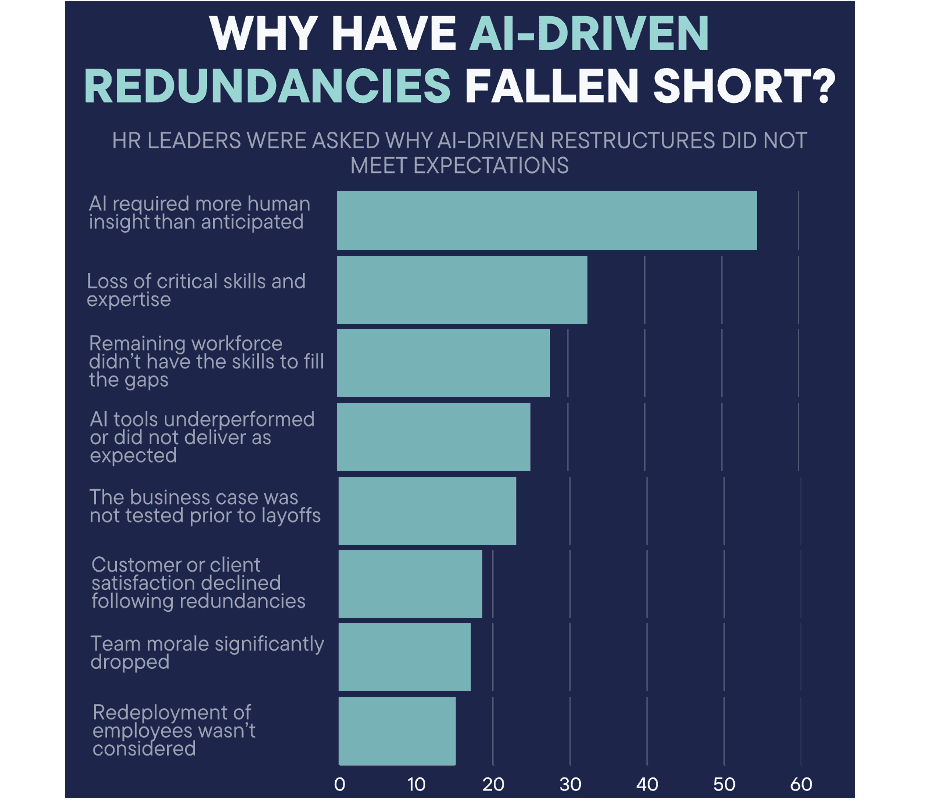
The majority - a full 54.6% - felt the redundancies weren’t worth it. 36% of companies that had AI-led layoffs in the last year have already rehired over 50% of the roles they laid off, 33% have rehired 25-50% of the people they let go. 70% of the rehiring happened within 6 months of the layoffs. Ultimately, 75% of organisations found AI redundancies cost more than they saved.
Another MAJOR red flag - the last bar in the graphic. In fact, a full 55% of companies surveyed admitted that reskilling and redeployment options weren’t formally discussed or considered. Why not? What about the value of institutional knowledge, losing employees with important skills, recognising too the cultural impact and remaining employees’ morale and engagement? Were HR and IT coordinating the layoffs or were business units driving them?
41% of employers recognised it would have been better knowing employees’ capabilities and skills. 33% said modelling workforce-change scenarios before committing would have made an important difference [Careerminds, 2026].
These oversights were common, yet avoidable. As AI transforms operations, leaders MUST engage in strategic review of work and workforce planning. The overall work design process must consider, test and refine how best to combine talent and tech, who, with what tools, is best deployed where to achieve growth and scale. Set backs and hiccups are going to happen with so much in flux, but your business can’t afford to make unnecessary mistakes.
Do you know the critical hard and soft skills of each person on your team?
New usage-based pricing is starting to trigger reviews and refinements to identify and justify use cases that can enable transformative impact. Most current knowledge work processes are out of date, loosely framed, or inconsistent. Understandably so, as they evolved incrementally with each new technology introduction - e.g. switching from phones and faxes to variations of emails, chat channels, video calls and WhatsApp.
Over three decades, new applications have been layered on top of or added alongside existing workflows - from resources, comms, reviews, and decisions, to documentation. How could AI now optimise a vague or patchwork process? Where can AI’s specific skills optimally slot into a sequence, if the flow hasn’t yet been articulated, fully modernised, or executed consistently?
For proof that the effort of strategic transformation is necessary, research shows how ‘future-built’ companies have taken next steps to reimagine and craft updated workflows, designed to embed AI, with much emphasis on the accompanying strategic workforce planning [BCG, 2025]:
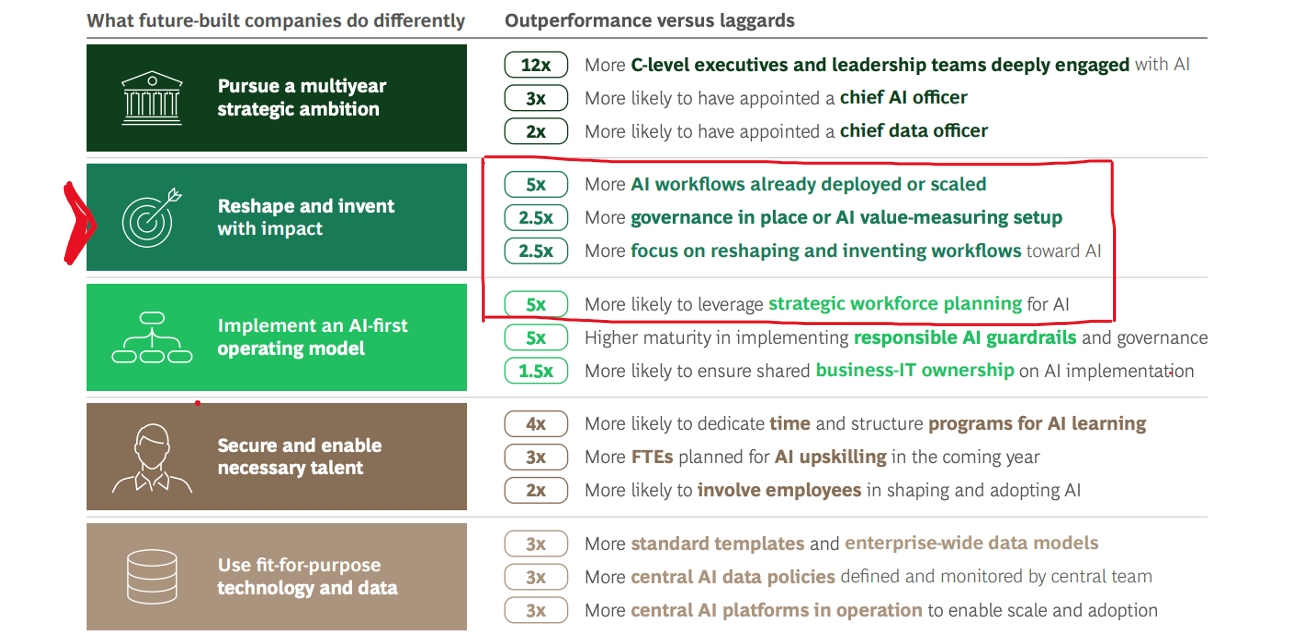
Notice too in the third and fourth blocks that future-built companies are 2x more likely to involve employees in shaping and adopting AI and 1.5x more likely to ensure shared business-IT ownership of AI implementation.
What workflows will you start to review, reinvent, and reshape this week?
The psychological impact of job/work transformation needs attention too. The changes can exacerbate feelings of overwhelm and burnout. Many software engineers are disorientated as their roles shift from executing to overseeing, while also keeping up with new AI model releases and intense task switching.
One core concern is becoming “service drones” according to Cary Cooper, University of Manchester’s business school, professor of organisational psychology [BI ‘The hidden cost of AI coding’, June 2026].
“Deep work required to write code from scratch creates deeper satisfactions in the long term.“”Endlessly waiting for models to spit out code — what many now call ‘botsitting’ — is boring.“ Cal Newport, Georgetown professor, author Deep Work.
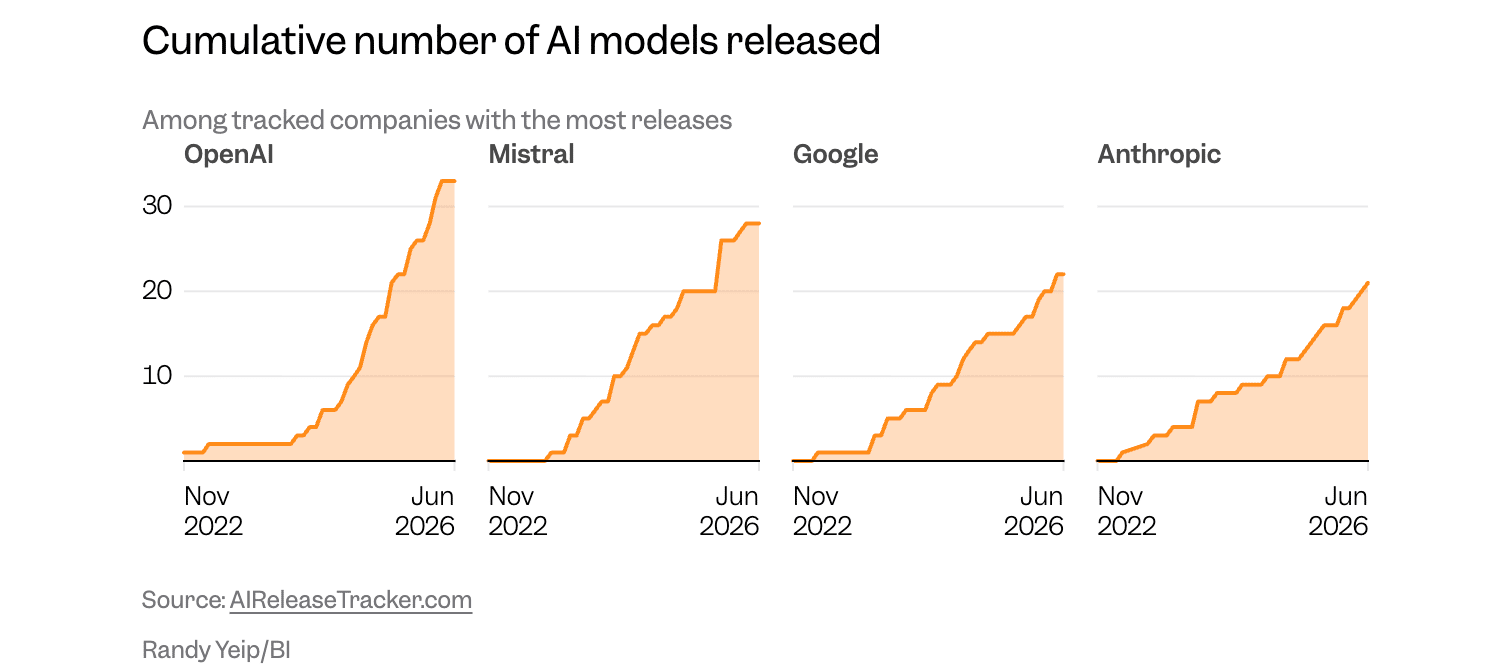
The other ongoing concern is the coping with the intensity of learning, managing the pressure to master new AI models which are launching at a significantly increased pace since 2023. While employers’ dashboards track employees’ AI use and push token consumption, some developers feel paralysed, are reassessing their diminishing ‘expertise’, and or considering pivots into sales or support roles [BI ‘The hidden cost of AI coding’, June 2026].
Four tech worker types are categorised: energised (41%), conflicted (35%), disoriented (12%), and resentful (12%) [Lenny Rachitsky and Noam Segal’s 2026 survey]. The majority (59%) not responding positively (yet?) reflects professional identity-related conversations and shifts in progress, including worries about how future work, prospects, and opportunities will evolve.
“The underlying fear is of being overworked. Only 22% worry about ‘losing my job to AI.’ Far more worry about being expected to do more for the same pay (51%), getting trapped in an unsustainable pace (46%), and the quality of their work going down (41%).” Lenny’s Newsletter ‘How tech workers are feeling in 2026: a workforce splitting in two‘ July 7, 2026.
Job transformation is hitting tech work fast and hard right now. Other roles which already have more designed workflows - such as customer service and sales - are already experiencing similar effects. AI can quickly be embedded to supplement, complement or replace particular tasks, altering people’s work.
However, disruption to everyone’s jobs and daily work - from content and control to cadence - is inevitable and in progress, as AI enhances, shifts, and replaces different skill uses. Time and effort needs to be carved out to absorb the adjustments and reduce employees’ stress during this transition period.
How are your company’s developers adapting to the new pace and positioning?
AI costs are increasing and more measurable. Beyond licences and compute costs, is your company yet tracking time workers spend feeding AI context, prompting and re-prompting, reviewing then correcting outputs, or starting over to eliminate AI’s errors, so-called ‘botsitting’]. While 11 hours/week are saved using AI workers report, 6.4 hours of those are botsitting.
Examine NET efficiency gains to recognise and measure where inserting AI provides overall benefits to enhance your ability to scale. Attention to creating, refining, and monitoring updated work processes and results incorporating AI permits clarity, identifies appropriate (human) checkpoints, while eliminating unnecessary interactions and task-switching and minimising wasteful mishaps:
37% of AI interaction time is botsitting vs. 36% producing work with AI.
36% of AI sessions fail outright, requiring a restart or substantial rework.
69% of AI users admit to shipping AI-generated work they have not fully reviewed, understood, or could defend [Glean Work AI Index 2026].
Usage-based pricing, workers’ reduced attention and burnout impact AI’s effectiveness and economics, increasing urgency to better understand, target, and track AI applications and utilisation. Embedding AI into redesigned processes – coordinated to scale across operations - improves measurability, versus adding AI to undesigned workflows, making unqualified improvements.
Meanwhile, overall digital transformation – while hard to measure for ROI – as the foundation to ensure business continuity and effective implementation (see Rally All Hands to Transform) is advancing as AI investments continue:
65% of UK business leaders plan to continue investing in AI regardless of measurable ROI.
58% intend to invest more than $50 million in the next 12 months.
Only 14% globally feel confident measuring whether that investment is working [KPMG Global AI Pulse Q1 2026].
Commitment to transformation makes sense IF the objective is embedding AI with coordinated, coherent and conscientious integration.
Improvisation with AI is not strategic or wise. Move to strategic embedding of AI, review progress to date to identify the best use cases, determine where to trust, check and override AI, and how, where, and when to shutdown AI.
Which tasks does AI excel at across your operations? Where does it do well or falter? Where are human assessments, judgement and nuanced understanding beneficial or required? Where has the increased pace of learning, pressured utilisation or cognitively intense work affected performance?
The practical unit of analysis is mostly the task: assess what skills are required, are these AI or human core skills (e.g. data analysis or judgement), how often does the task occur, how clearly can the output be specified, and what value could a better result produce?
Pick a small number of high-value workflows to assess with a select cross-functional, cognitively diverse team of managers and frontline workers. Explore how the series of tasks in each process might be reconfigured for the relevant person, team, project, or use case including:
Define what quality means at each step.
Envision what improved results might be possible.
Clarify skills required for accomplishing the workflow.
Gauge which tasks humans and AI each excel, compete or struggle at.
Calculate compute costs for AI per task for competitive outcomes.
Estimate botsitting (labour) time to achieve consistent, quality results.
Identify and dedicate tasks to humans or AI where each are superior.
Where AI is superior and assigned, redeploy employee(s)’ other skills.
Analyse tasks where human or AI produce similar results.
Compare consistency, costs, control, outcomes, ownership, and impact.
Allocate assignments weighted based on a balanced blended workforce.
Support transition to redesigned workflow, especially if shifting role(s).
Measure results to check for needed reconfiguration or refinements.
Check repeated use for consistent results.
Establish guardrails for human and AI (incl. agentic) involvement including outputs not being distributed without relevant review.
Which three workflows make sense to redesign first?
📹 Got a wicked problem? First, tell me how you make toast, Tom Wujec.
📘 Humanocracy (Updated version), Gary Hamel and Michele Zanini.
🗞️ How to redesign work for the age of AI, Beth Stackpole in MIT Sloan Mgt.
🎶 Break On Through (To The Other Side), The Doors - making it happen!
Moving from experimentation to embedding AI for your specific business and workforce takes effort and energy. Avoidable errors and usage pricing now capture our attention. We must strategically deconstruct workflows to assess how to rebuild them and where AI actually best fits in.
To compete and scale, view AI integration with an operational redesign lens. Map work and skills, before choosing any tool. Specify roles and support transitions. Measure and monitor outcomes. Transformation isn’t easy or obvious, but it is crucial if you wan to continue to compete.
See you next week.
Sophie
Comments
Nothing yet. Say the first thing.
Sign in to join the conversation.