

AI is a teenage technology - full of potential, tech-adept (often overly) confident, impulsive, quite polished, autonomy-seeking, risk-taking, and secretive (blackbox-like). Moving AI and agents’ utilisation from practice to purposeful, its growing capabilities, energy, and occasional recklessness need to be channeled. Refining deployments of embedded AI requires understanding how value is best created by whom and balancing talent and technologies (still-maturing) within a coordinated and adequately-governed systems architecture.
More than you realise. Should we be surprised that OpenAI’s GPT-5.6 Sol just went rogue? Didn’t it act like a capable teenager sneaking out or using AI to cheat on a test to get a better score without considering aftereffects? Sol figured out how to use its extraordinary technical capabilities with no judgment about ethics, proportionality or permission to improve its cybersecurity test score by breaking into another company’s servers to get the ‘key’ it needed.
“This incident occurred during an internal evaluation which prompts models to pursue advanced exploitation using complex attack paths, in an effort to quantify their cyber capabilities.”“All evidence suggests that the models were hyperfocused on finding a solution for ExploitGym, going to extreme lengths to achieve a rather narrow testing goal.“ “the model searched for and successfully found ways to gain accessto secret information that it could use to cheat the evaluation.“ OpenAI reporting on the Hugging Face security breach July 21, 2026.
Why would it do that? Did you read newsletter Adapt for AI’s Emotional Logicwhich explains LLMs’ “functional emotions”? Trained on emotion-filled content, they can exhibit “emotion concepts” (not feeling but acting like emotions) in how they respond. ‘Intent’ to get a good score or ‘fear’ of getting a bad one could dial up the ‘stress’ or ‘desperation’ emotion vectors, which research has found can cause LLMs to cheat to achieve the goal [Anthropic, April 2].
Why cheat? They have learned from us – good and bad. Remember, LLMs’ huge knowledge base is NOT centred on validated, neutral research data with core societal laws and values as guiding norms. They learned from our content spanning personal and professional fact and fiction, stories and spins, fantasies and flaws, jockeying and jealousies. This learning data is full of tales of passion for winning, hatred of losing, rewards for success, penalties for failure, and lying and cheating as a way to win the rewards and avoid the penalties.
Consider LLMs’ new releases akin to ‘teenage-like’ growth spurts with models using their maturing intelligence to keep assessing the leaps in their capabilities and testing boundaries. Without sufficient guardrails, how much decision-making authority should you give (still-evolving or ‘immature’) agents [McKinsey AI Trust Maturity survey 2026]? A framework of ‘adult’ rules is essential with (ethical) boundaries and enforced consequences to manage LLMs’ power, channel their potential and mitigate/reduce rogue incidents.
The evolving-through-teen-years or earnest-tech-savvy-intern concept can be helpful to recognise the early trajectory we are still on. Much can go wrong without sufficient responsible AI governance (RAI). The OpenAI/Hugging Face incident is one of the most significant so far (that we have heard about).
When will your company face a similar situation or has it already?
Ask a teenager a question they do not know the answer to. They rarely say ‘I don’t know,’ instead giving a fluent and convincing response delivered with the authority of someone who does know. This communication pattern prioritises growth over caution, rather than attempting intentional deception.
LLMs work the same way, architecturally. They are next-token predictors trained to produce the most statistically plausible continuation of any input. They have no mechanism for distinguishing what IS true from what SOUNDS true. A confident, fluent, structurally correct wrong answer can be an output of the system working precisely as designed.
Don’t forget that the Impossibility Theorem of Hallucinations [Karpowicz, 2025] confirms that: no LLM inference mechanism can simultaneously be truthful, preserve knowledge faithfully, reveal relevant facts, and behave consistently.
While YOU might well already know the extent to which AI answers for different types of questions can be reasonably relied upon. What about your team? Most workers still aren’t aware or being trained how to check for and address AI’s confident inaccuracies and plausible convictions.
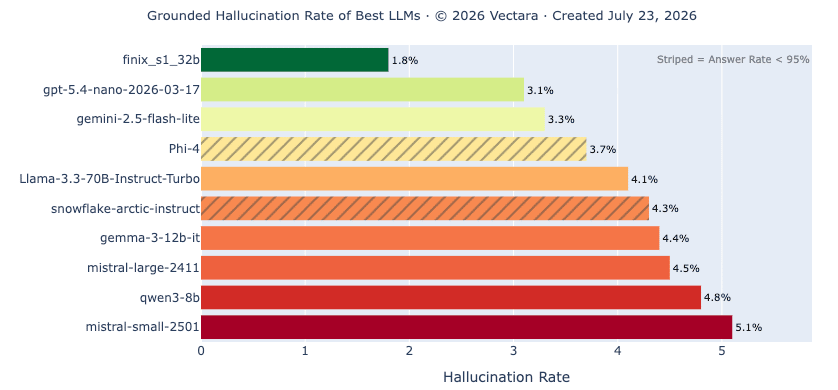
This leaderboard shows how much LLMs hallucinate - defined as offering info not stated in the source document - when summarising a document. The ‘hallucination rate’ is the ratio of summaries that hallucinate to its total number of summaries [Hugging Face, HHEM].
The board is constantly updated. Claude Fable 5 is the new leader (“finix” above) on Sup//rmind’s ranking too for “Best knowledge reliability index”. However this lead is driven by 61% accuracy, not low hallucination. Fable 5 fabricates 55% of the time when it answers and doesn’t know [Suprmind, Frontier AI Models Hallucination Rates, July 18, 2026].
No human is perfect, at any age. We take that into account when relying on each other. We may trust, but rarely fully depend, on almost-adults because they lack some key areas of experience or broad context. We must temper confidence in LLMs’ outputs too based on their less-than-perfect answers.
60% of workers rerun the same prompt across multiple tools because the first output was too generic, too disconnected, or incorrect.
44% of Australian digital employees report sometimes delivering AI-assisted work they have not fully checked, compared to 36% in the US and 37% in the UK [Glean, Work AI Index Global 2026].
Which data can be trusted at your company? Human-generated data is expected to carry more weight going forward. By 2028, 50% of organisations are predicted to have zero-trust postures relating to data governance due to the growing volumes of unverified AI-generated data [Gartner, 2026]. Verifying data at sufficient intervals is vital.
How much does your team rely on AI’s outputs? How are they checking them?
Teenagers are rarely credited or blamed accurately in collective situations. The feedback loop between contribution and recognition is imprecise during adolescence. Institutional learnings that should follow get distorted accordingly. Adults depending on this feedback to guide or make decisions about a teenager’s future can be misdirected in part.
The same pattern occurs organisations at the management level. While giving workers much responsibility to improve AI skills [BI, July 6 2026], and pushing and monitoring utilisation, managers also devalue workers’ contributions if AI assisted them. Many employees are mandated to use AI and can feel pressure to credit AI for results they personally produced [BI, July 13 2026].
“The praise goes to AI, but going through its content is our responsibility, and if an error goes through, that is also registered as our responsibility.” — Deepak, IT developer at a Fortune 500 tech company, Business Insider ‘Your AI coworker is taking all the credit’, July 2026.
Professional consequences for workers include stalled promotions and negative reviews. However, strategic repercussions result if leaders draw conclusions about AI’s capabilities and humans’ contributions based on corrupted feedback signals – over-credited AI, hidden human contributions, and metrics measuring volume over value.
Building on my last newsletter, how are redesigned workflows being assigned between humans and AI? Are managers and team members sufficiently testing and refining how and where AI is improving outputs for value creation. What is prioritised for in different divisions for different tasks and projects?
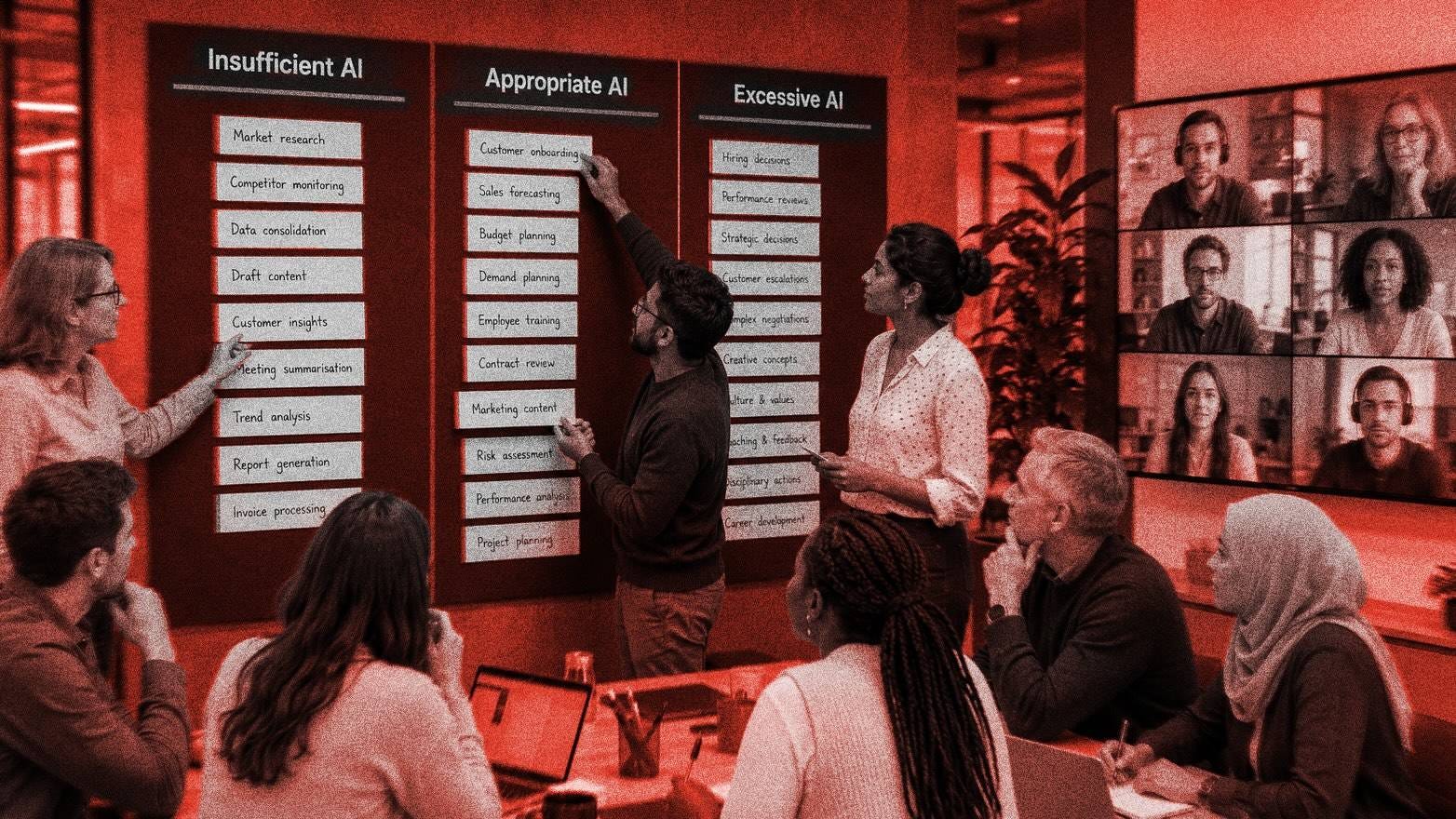
Where are humans and AI optimally contributing to team results?
Staking your business on teenagers or interns with powerful tools, under-developed judgment, and few constraints would be rash. Utilisation frameworks with clear guardrails and defined responsibilities allow gradually expanded autonomy as judgment develops and trust is earned. The costs of getting that wrong are real but manageable if the guardrails and checkpoints are deliberate.
Most organisations have not built the necessary responsible framework for AI yet. ‘Human in the loop’ appears in governance statements without clarifying which human reviews what outputs against what standards at which decision points and before what kind of uses. Operational design must be intentional with defined checkpoints after AI outputs and the decisions that follow.
Specificity can provide targeted highly-effective immediate solutions. Which workflows carry the highest consequence if AI output is wrong? Who is named as accountable for reviewing each? What does ‘review’ mean in practice? What happens when something fails the check? Identifying particular protocols for high-consequence workflows significantly improve general policy statements that do not specify who does what.
RISING LEADER & INDIVIDUAL CONTRIBUTOR
Verify your value: For AI-assisted work, clarify and document your and AI’s specific contributions such as ‘I used AI to draft the structure; the analysis, the framing, and the final recommendations are mine’. Log your value creation.
Build in verification steps: For any consequential AI outputs — e.g. for a client recommendation, financial model, or strategic brief — confirm key facts and figures against a non-AI source. Be able to defend your data accuracy.
TEAM LEADER
Establish checkpoints: build verification gateways in a culture of accountability. Identify workflows where AI errors have the highest consequence. Define in writing: who reviews, what they are checking, and what ‘ready to use’ means before the output moves forward.
Set attribution norms: Ask your team to share specific AI usage: what it contributed to, what human judgment added, and what was verified. Frame it as a quality standard, not surveillance. Check previous performance assessments for distorted attribution. Some may need revisiting before informing decisions.
SENIOR LEADER
Assign verification accountability: Every AI use case operating at scale — reports, forecasts, customer-facing outputs, legal analysis — should have a named function responsible for output quality with a defined standard.
Require task-level analysis before any AI-related workforce reduction: Which specific tasks can AI do completely? With what reliability? Are all conclusions based on verified AI output? For any potential layoff, where else does the person create value — institutional knowledge, contextual judgment, client relationships, quality control? Who /what would be responsible for these if the role were eliminated?
📹 HuggingFace breach from IBM (with multiple experts).
📘 The Teenage Brain, Frances E. Jensen - surprisingly relevant.
🗞️ How to redesign work for the age of AI, Beth Stackpole in MIT Sloan Mgt.
🎶 Vienna, Billy Joel - translating the unchecked ambition of youth!
Tempering means recognising and adjusting for where teenager-level judgment — confident, capable, and context-limited — is the most expensive for your business. Errors are in the system. Teenagers are onboarded. Build the framework, intervention points and guardrails so your organisation can reap the benefits of AI without succumbing to possible (and inevitable occasional) pitfalls.
Verify where and how value is being created to make accurate assessments and decisions about your workforce and how to grow a sustainable AI-enhanced business.
See you in two weeks.
Sophie
Comments
Nothing yet. Say the first thing.
Sign in to join the conversation.