

A digital operating foundation is essential to integrate AI to enhance your business. Most companies have yet to coordinate a digital operating overhaul into which to integrate AI effectively. To digitally transform incorporating AI, coherent cross-company change management is essential, cultivating trust, integrating learning, redesigning workflows, and assigning new accountability.
“Enterprises that succeed will operate AI-first—not as a layer of technology, but as a new operating model.” Gary Cohn, Vice Chairman, IBM, 2026 CEO Study: Rewiring the C-Suite.
AI cannot be a force multiplier if you attempt to combine utilisation in project clusters without a company-wide strategy AND work redesign, only relying on broad-based, but uncoordinated, employee adoption, however enthusiastic.
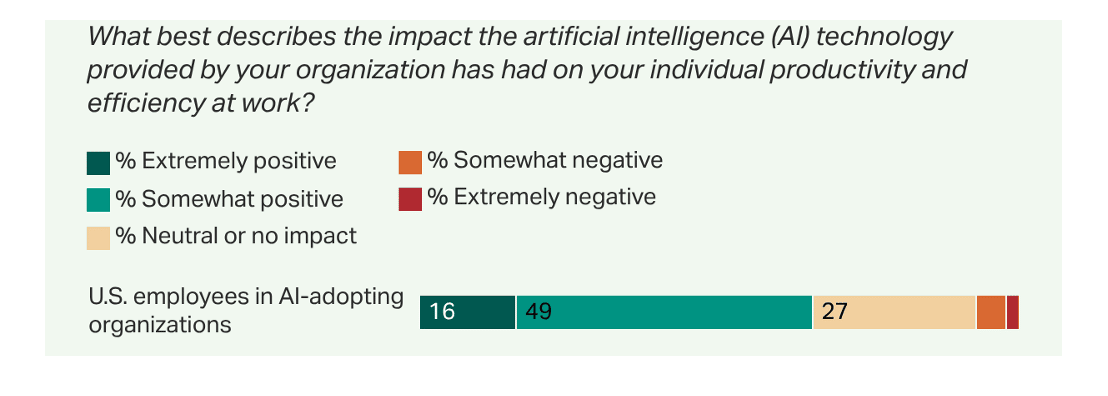
AI is triggering (overdue) strategic digital transformation. AI integration without sufficient or consistent digital infrastructure cannot achieve desired AI benefits:
76% of firms have Chief AI Officer (26% in ‘25 [IBM, 2026 CEO Study]
But only 5% of organisations are achieving substantial financial gains from AI [BCG, AI Transformation is a Workforce Transformation, 2026].
“Trying to take AI tools and squeeze them into the existing organization is extremely likely to be the wrong approach.” Jacek Olczak, Group CEO, Philip Morris International.
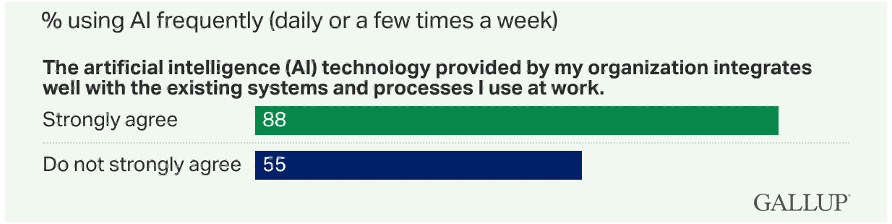
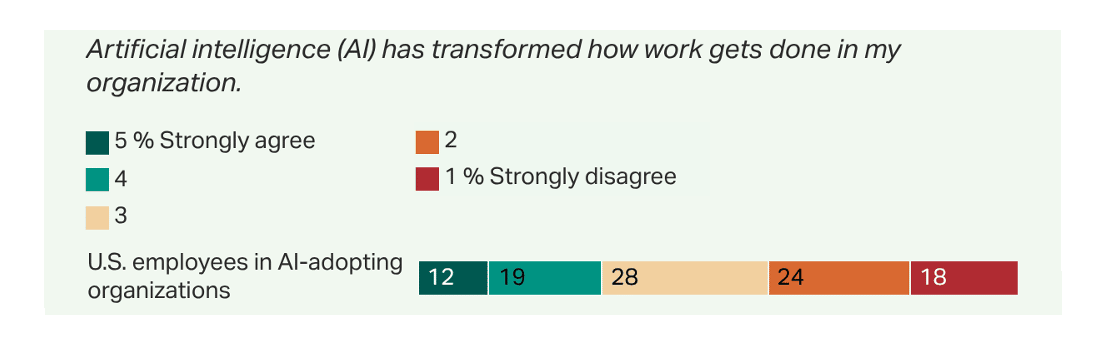
Employees - who strongly agree their firm’s AI tools integrate well with existing systems and processes - are 7.2x as likely to strongly agree AI has transformed how work gets done [Gallup, AI in the Workplace, April 2026].
“As AI continues to spark new ways of working, this dual focus – advancing both the capabilities of their talent and AI tools – empowers teams to embrace reimagined business models and sets the foundation for competitive advantage.” Jim Rowan, US head of AI, Deloitte, State of AI Report 2026.
Is your digital infrastructure facilitating or hindering broad-based AI integration?
Sidebar on ROI nitty gritty: the core challenge is calculating ROI for overall transformation. Typical ROI measures specific parameters and quantifiable costs with boundaries of impact and defined outputs. Calculation of return on investment informs a cost (risk) / benefit decision whether to proceed beyond a trial or not and scale.
An AI-enhanced digital overhaul that pervades a company’s entire operating system—from business infrastructure, model, processes, and (clean) data to work culture and spaces, AI/digital fluency skills, all running ‘safely’ within a critical governance framework—is complex, critical, but hard to measure.
More ambiguous is calculating a ‘return’. The basic benefit is business continuity – retaining the fundamental ability to compete and survive. Costs and impact may be significant, and hard to track across functions and time. Meanwhile, returns are far-reaching, and hard to attribute with much accuracy.
Transformation is a significant undertaking which is daunting to propose or approve. Yet AI needs the digital base built to function effectively. Without strategic planning and coordination, parts are often upgraded, tactically in tandem, confusing calculation of AI’s ROI.
Only 23% of AI deployments generate clearly measurable ROI. [Stanford HAI AI Index 2026 Report].
Only 34% of companies report they are using AI to “deeply transform” their business [Deloitte, State of AI Report 2026].
“Digital transformation projects consume 31% of enterprise IT budgets, yet only 16% of executives can demonstrate clear ROI to their boards.” Consulting CIO, ‘Digital Transformation ROI‘ June 2025.
Historical analogies: electrification in the early 1900s, internet infrastructure in the mid-1990s. ROI was based on the cost of staying in business. Companies that deferred paid more later to overcome accumulated disadvantage.
In December 2022, Southwest Airlines system failed to cope with a combination of challenges - a spike in travel, power outages, flights grounded, and travellers stranded. The outdated technology resulted in over 15,000 cancelled flights costing the company over $800 million [SC&H 2023]. The digital infrastructure ROI became measurable at the moment of failure.
Digital transformation is a business continuity requirement, also providing the foundation for successful AI integration and utilisation. The investment case is built on the ‘cost’ of competitive deterioration or even obsolescence.
The value of early transformation also compounds - the top 5% achieving AI value at scale are pulling further ahead as they reinvest proceeds from earlier success in new capabilities and tools [BCG’s 2025 study].
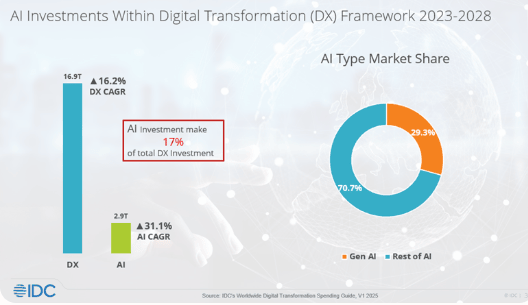
$4 trillion in digital transformation investment projected by 2028 — approximately 70% of total IT spend [IDC, 2025].
Redesigning five core business areas, organisations are 4x more likely to deliver on business objectives [IBM, 2026 CEO Study].
“AI is quickly becoming the cornerstone of digital transformation.” IDC Global, Navigating Digital Transformation, May 2025.
Instead of ‘what is transformation’s ROI?’ ask ‘what does falling behind cost?’
Leaders are rolling out AI, encouraging or enforcing usage with wide-ranging tactics – by tool, project, application, use case or frequency – which works for early exploration to build adoption and familiarity. However, fragmented approaches undermine coordinated efforts to achieve transformative results.
If communications lack purpose or credibility, training is inadequate, incentives are contradictory, guardrails are unclear or insufficient, hesitation or anxieties reign, then internal trust breaks down decreasing engagement and productive exertion. Transformation needs everyone informed, aligned and energised:
Only 25% of US employees say their firm has shared a clear plan for integrating AI into current practices [Gallup, AI Indicator, Feb 2026].
88% of employees use AI at work, only 28% are positioned to achieve its transformative business impact [EY, Work Reimagined, Nov 2025].
45% of employees say it feels safer to focus on current goals than redesign work with AI [Microsoft, Work Trend Index 2026].
Use All Hands meetings to communicate the company-wide strategic shift and how particular projects relate. Show empathy for employees’ confusion and concerns. Explain the importance of transformation and get buy-in for a timeframe that allows a multi-phased, closely-coordinated evolution. Engage people’s enthusiasm to build the future of the business together.
Open dialogue cross-company, sharing information and asking for inputs helps stimulate innovation, calm angst and align everyone towards a trajectory they can all get behind, contribute to, and evolve with.
Doug McMillon, former CEO of Walmart, communicated openly and explicitly that AI would affect “every single one of Walmart’s 2.1 million jobs worldwide — from associates pushing carts to executives, with no exceptions, no escapes.” He also described Walmart as a “people-led, tech-powered omnichannel retailer” committing to progress not headcount loss [HBS, Walmart’s Ten-Year Investment in the Frontline].
If you could start from scratch, how would you use an AI-infused digitalised system to optimise operations, focusing human skills where the most complex issues and most judgement are needed?
An overwhelming question? The First Principles approach helps untether you from legacy methods to generate fresh perspectives and debate new ideas.
The benefits of workplace AI use appear concentrated at the level of individual tasks rather than broader workplace systems.” Gallup, 2026.
If you don’t challenge yourself about how your business is operating, you could allow a (younger?) tech-integrated competitor to create a sustainable edge.
Workflow redesign has the biggest single correlation with EBIT impact from AI. Most leaders aren’t yet carving out essential time for it. Overlaying tools onto unchanged processes cannot produce the benefits needed to compete. 80% of AI value comes from redesigning how work happens, only 20% is delivered by the technol [PwC, 2026 AI Business Predictions].
Pick a small number of core workflows. Gather a cross-functional team together with those who do the particular work. Ask the critical question “what if we reimagined these entirely (with a digital foundation, AI-boosted capabilities, and an upskilled workforce)?” What new ideas and possibilities open up?
Middle managers help or hinder digital/AI transformation - from soliciting inputs to supporting experimentation and facilitating coordination. They turn words into action, breaking down strategic change into daily priority shifts, hearing the concerns people won’t raise in All Hands meetings, and setting the example:
Managers modelling AI use: employees cite a 17-pt lift in AI value, 22-ptlift in critical thinking about AI, 30-pt lift in trust in agentic AI.
Managers creating psychological safety: employees report up to 20-pthigher AI readiness; 1.4x more likely to be high-frequency agentic AI users. [Microsoft Work Trend Index 2026].
88% of managers at future-built companies role-model AI in daily operations vs. 25% at AI laggards. [BCG, AI 2025 Global Study].
Employees who strongly agree their manager actively supports AI use: 9.3x as likely to strongly agree AI has transformed how work gets done; 7.8x as likely to say it helps them do their best work [Gallup, April 2026].
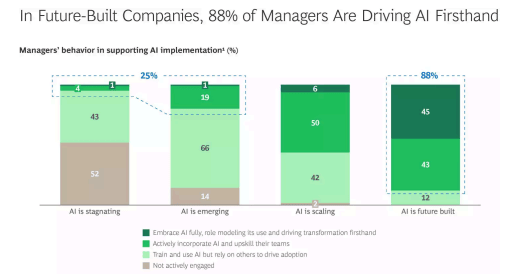
Engage managers in All Hands meetings. Inspiring contributions from all levels enables transformation to be a collaborative, iterative process that works through trials and missteps quickly, to find a cohesive, dynamic way forward.
How are managers helping transform how human+AI work gets done?
AI/digital transformation cuts across all functions and levels. Every employee is a value creator who understands the business differently. Each person helps minimise the upheaval if they get involved and participate in the change. Top 3:
Share the story. Explain why transformation matters and how employees all play a vital role in rethinking and future-proofing the business with critical contributions and combinations of human and AI skills, and how people will be supported during ongoing disruptions. Buy-in is essential to ensure involvement and dissipate resistance.
Co-create redesign. Invite frontline employees, managers at all levels, across all functions, to participate in hackathon tech-transformed work redesign sessions. Promote First Principles to stimulate reimagined methods. Encourage bold experimentation with defined boundaries. Successful transformation requires courageous, collective change.
Set standards. Clarify quality, trust, and accountability as operating principles and pillars of governance. Demonstrate how these manifest and guide dynamic, evolving situations with AI integrations, especially agentic AI. Define what data can be used, what humans must review, and who owns which outcomes.
Measure transformation. Monitor multiple values in each domain to assess ongoing cross-company change including customer impact, technical integrations, workflow improvements, employee contributions and confidence, risk levels, test parameters and cycle times. Share local wins and mistakes as organisational growth and knowledge.
Describing Unilever’s “Growth Action Plan 2030” (GAP 2030), “This is not a series of experimental, bottom-up AI projects but a C-suite-level blueprint for reconfiguring the business.” Klover ‘Unilever’s AI Strategy‘
📹 Digital Transformation Strategy in the Era of Generative AI, Ionology.
📘 Rewired: How Leading Companies Win With Technology and AI, McKinsey
🗞️ The Inconvenient Trust About Change Management, Keller & Aiken.
🎶 With A Little Help From My Friends, The Beatles - collective transformation.
AI can enhance business operations when integrating into a solid digitalised platform. AI/digital transformation is unavoidable, company-wide, and requires reimagining work, involving your whole workforce.
Engage everyone to redesign how to compete in the era of AI. Rally all hands to bring their insights and energy co-create the fut
See you next week.
Sophie
Comments
Nothing yet. Say the first thing.
Sign in to join the conversation.