
Stay tuned at the end for some very cool news.
Most leaders file employee experience under cost, something that competes with the things that supposedly drive the business: growth, margin, the next product. Ask employees what they want and the survey comes back with pay, perks, and fewer hours, which is how a finance chief concludes the company can’t afford to make people happy.
Debbie Lovich, managing director and senior partner at BCG and author of the forthcoming book Make Work Work, has spent the past few years proving that framing wrong. In a study of roughly 5,000 associates at a large apparel retailer, she lined up each person’s survey answers against their sales per hour. Associates who said they enjoyed their work sold 25% more. In a recent Charter Forum session, she noted that enjoying your job also cut retention risk by half for desk workers, and 65% for frontline employees.
Joy might sound like a hard sell in today’s environment. But fer approach is part of a broader movement: treat employees as customers, and daily work as a product to be crafted. Companies already know how to obsess over customers. They run segmentations and apply design thinking, but almost none of that rigor gets pointed at the experience of the people doing the work. That’s a lot of upside left on the table.

Standard engagement surveys ask people to rate what they want, and the usual factors—pay, perks, and hours—float to the top. Lovich borrows the customer-analytics toolkit instead and forces trade-offs the way you would when modeling what a shopper will actually pay for and buy again. The top five drivers of retention are emotional: feeling respected, being treated fairly, and enjoying the work. Pay lands at #15. At a chemicals company she worked with recently, where 70% of the workforce is in plants, pay ranked 21st of 22 characteristics of work that drive motivation.
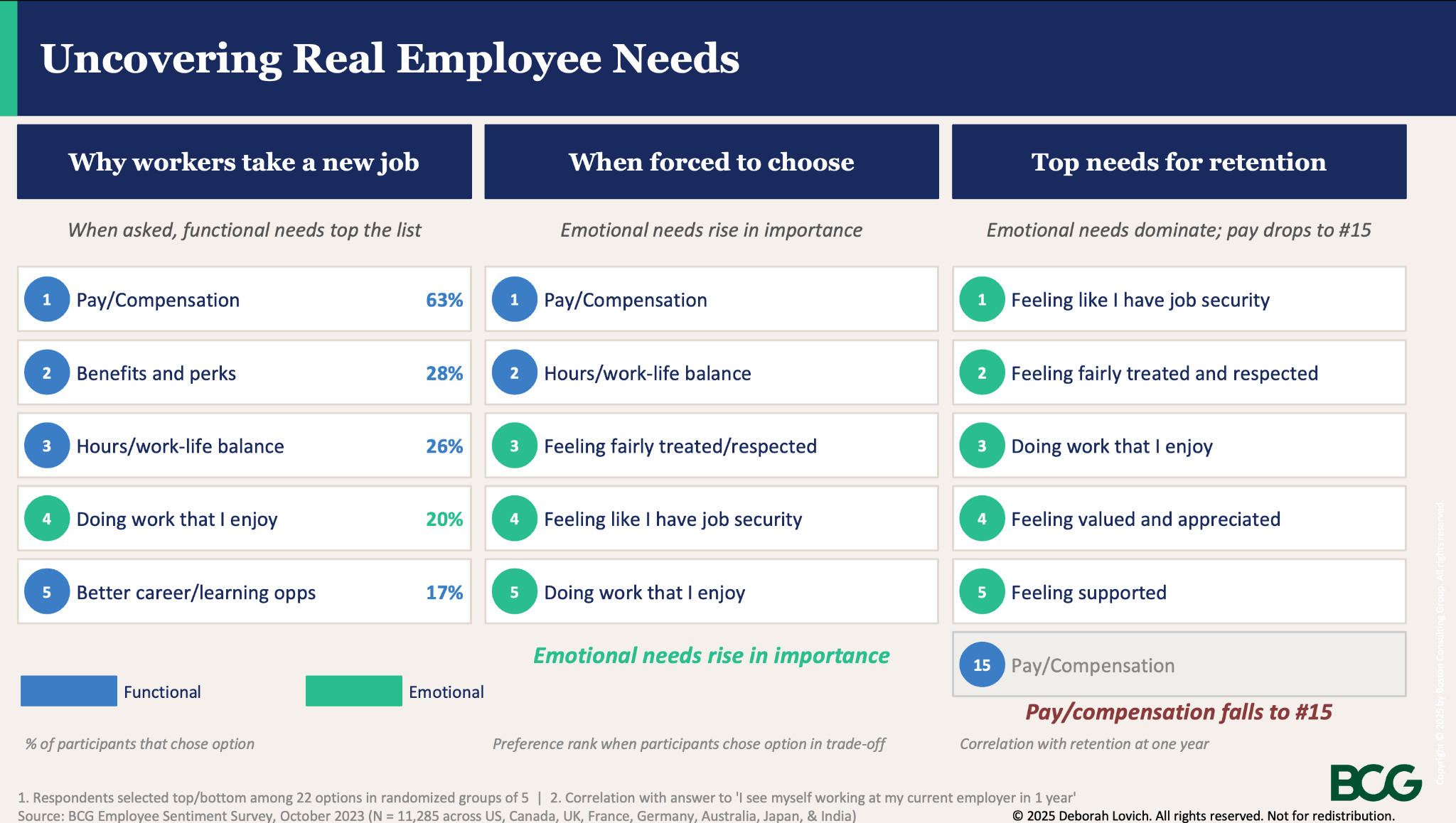
Despite that, the comp lever is the one leaders too often reach for first. It’s also the one that fails fastest. A raise buys a few months before attrition resumes, because money was rarely the problem that got them looking in the first place. I’ve seldom succeeded in talking someone out of quitting who’s already one foot out the door.
I was in a session with senior executives and Board members where similar findings were presented by HBS professor Ethan Bernstein. Senior leaders beliefs overrode his research too: “You don’t know what the real world is like, they’ll leave for a dime.”
The proof points are there, and easy to find in retail, since you can tie revenue gains to happy salespeople and helpful service reps. The harder case is Delta, which Lovich draws on in the book. CEO Ed Bastian‘s logic: every airline flies the same planes, pays the same fuel price, and pays the same airport fees, so the people are the only edge left. From her upcoming book:
“Rewarding our people is fundamental to who we are at Delta, and it’s always my No. 1 priority to take care of the Delta team,” Bastian said. “Those values have been the source of our success for 100 years, and that’s what is going to power us into our next century of flight.”
Swap “fuel” for “AI” and you have this year’s version of the same story: technology is not a long term differentiator.
Lovich’s data says it’s the other way around: happy employees are more likely to lean in to leverage AI, instead of resisting. Working with Professor Stephan Meier of Columbia Business School they have shown that employee-centric companies are seven times more likely to be AI-mature, because they pitch AI as a way to strip out soul-draining work rather than as a way to cut headcount. They involve employees from the start.
Pre-order Make Work Work and get 40% off!
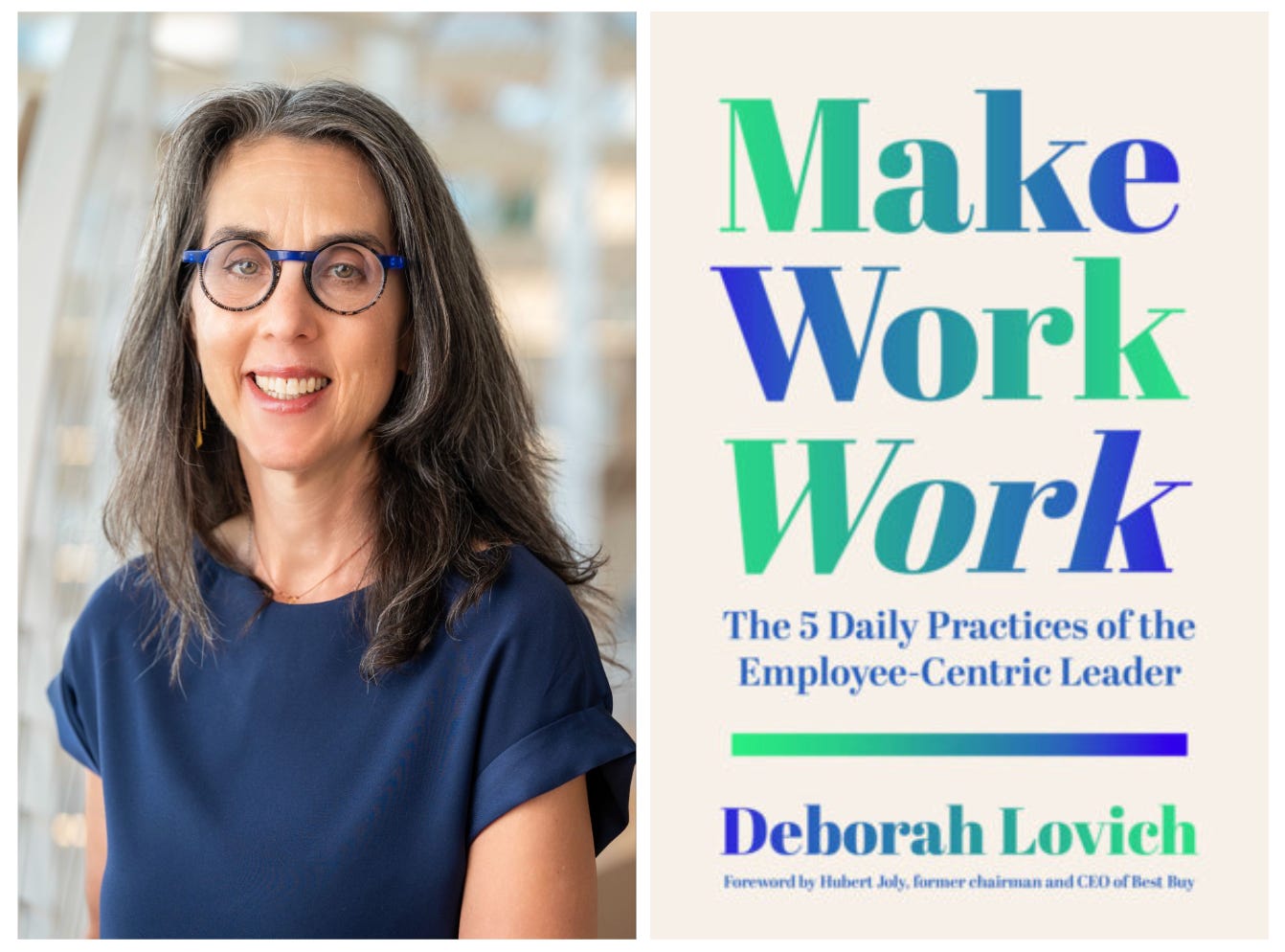
BCG’s Deborah Lovich, Make Work Work
The failure to listen to employees is where most rollouts break. Michael Lopez, who has delivered corporate change programs for decades, surveyed 1,000 workers and found zero overlap between the top five resources companies provide during a change and the top five workers say they need. Companies lead with emails and vision meetings, but what workers want is time to practice, feedback as they go, and to watch their managers do the new thing first.
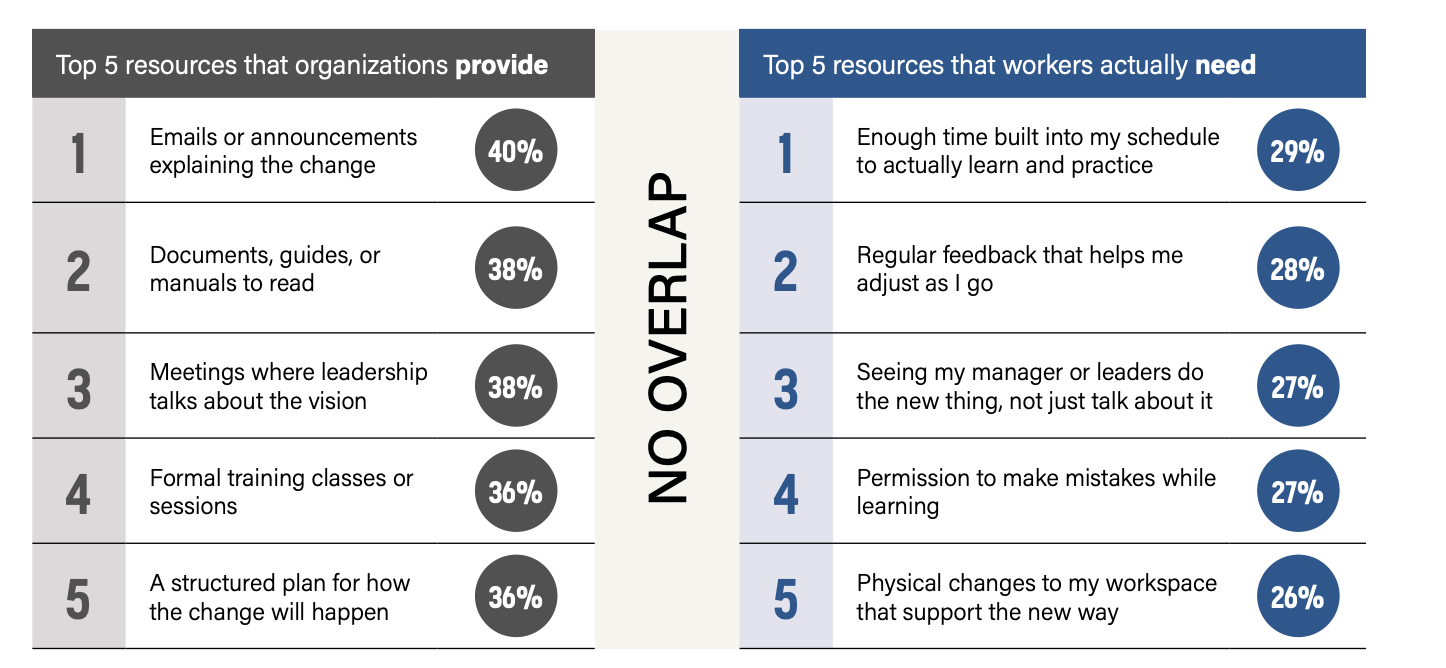
Source: Rethinking Change Management, Michael Lopez 2026
Lopez calls the standard playbook a consumption model: push things into the organization, then measure what you pushed. Conduct a bunch of meetings and count people who’ve taken training modules and you make progress on a checklist. But the person at the desk may still have no idea what to do differently. The top driver of successful change is people experimenting and practicing until the new way feels normal. Better yet, seeing their manager do it too.
“Change is not a spectator sport. You have to do something different in order to be different.”
The reason the bad version persists, in his experience, is that honesty does not sell. Leaders, under pressure, pitch a change as fast and cheap. It launches under-resourced and stalls, trust erodes, and the cycle starts over. Three in four workers in his survey say they want leaders to be more realistic about how long change actually takes.
Lovich and Lopez land in the same place: co-create. Put the people most affected in the room from day one and let them reshape the work. By the time it ships, it feels like theirs, and there is nothing left to “manage.”
That takes time, and that’s the hardest part. Joy shows up in sales numbers and engaged teams show up in retention, but rarely inside the first or second quarter. The leaders who win this are the ones willing to tell the board the payoff is real and protect the work while it proves itself. That patience is rare, which is why the advantage is still there for those with the fortitude.
Work Forward is always free. Like what you’re reading? Please share!
None of this requires a task force or a budget.
Go see and help. Delete half your recurring meetings and spend the time on the frontline. Best Buy’s Hubert Joly ran his first weeks as CEO inside a store wearing a badge that read “CEO in training.”
Run the real survey. Use forced-choice modeling on your own population, not the annual engagement form; AI can build it for you. Then find one line leader willing to pilot the results and be the proof point.
Celebrate someone, specifically. People need roughly a five-to-one ratio of positive to negative feedback to feel good about their work. Most managers are nowhere close.
Do it first. Whatever you are asking people to adopt, whether AI or a return to the office, do it visibly yourself before you ask. As Iain Roberts noted to me recently, “leaders cannot delegate learning” when it comes to AI.
Tell the truth about timelines. Three in four workers want more realism about how long change takes. Naming the eighteen-month reality up front beats losing trust when the quick win fails to arrive.
I‘m the kind of leader who rolls up his sleeves and gets into the work alongside the team. I’ve also spent time in organizations run by leaders who would not, and those were the places where I quietly stuck around until something better came along. When the work is changing this fast, a workforce full of people biding their time is the most expensive problem you have.
The Charter Workplace Summit is going to be amazing! I’m working with the Charter team and our co-chairs, Betty Larson (CHRO at Merck) and Amy Reichanadter (Chief People Officer at Databricks) to build a full day of candid conversations on the questions every leader is wrestling with right now, from AI and the future of entry-level work to leading through constant change.
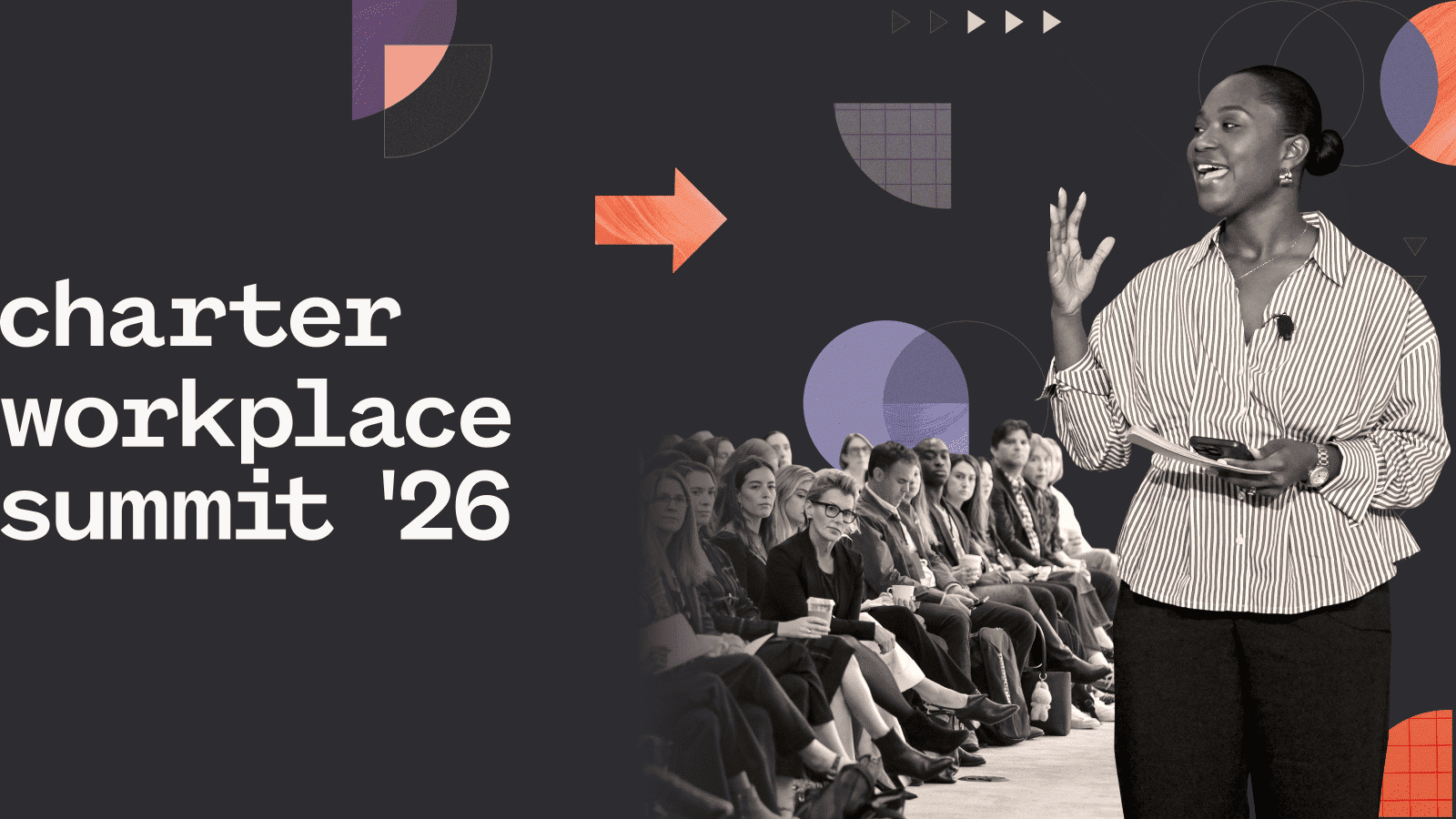
Here’s a sneak peak of just a few of the folks we’ve lined up:
Annie Duke, decision science expert and author of Thinking in Bets
Manoush Zomorodi, host of the TED Radio Hour and bestselling author of Body Electric and DJ DiDonna, senior lecturer at HBS and leader of The Sabbatical Project.
Janet Foutty, President of RAISE US and former CEO of Deloitte and Harvard Professor and Dean David Deming
Last, if you’ve ever wondered if Christina Janzer, former SVP Research & Analytics at Slack and one of my co-founders at Future Forum and I were ever going to do something that cool again, you’ll want to be there!
Register with code JULY by the end of the month, you’ll get $100 off.
AI has the potential to upend traditional positional power in organizations: status, comp, and authority derived from title and headcount.
The question is, who will set the terms that really matter? The terms of structural power: how much work you take on, how fast you’re expected to complete it, how you’re judged, and who sees the results. The answers have profound implications for organizations and gender equity.
Thrilled to co-author this one with Caroline Fairchild.
AI amplifies your culture. Point AI at a surveillance culture, and you get faster surveillance. Point it at a growth culture, and you accelerate growth. The technology doesn't change your operating system, it just makes it run faster. That was the core of my keynote at Culture Amp’s
A people-centric culture doesn’t mean you're "soft." It means leaders are doing the hard work of holding people accountable to performance while supporting them to do their best work.
Please like ❤️, subscribe 📨, and (most of all) share 🔄 — it’s always free!
Comments
Nothing yet. Say the first thing.
Sign in to join the conversation.