
Three news items related to AI’s impact on jobs, careers, and the promises of doom and boom that AI CEOs make. Strip away the technology and what’s left are questions of leadership.

Having sprinkled a little doom, AI CEOs are pivoting to boom. Maybe it’s the Eat the Rich signs going up around San Francisco. As I’ve noted before, AI is having an impact, but most of the AI-related layoffs in tech are driven more by the need to hit earnings targets than gains realized.
The share of CEOs who believe AI will significantly cut headcount fell from about 46% in 2024 to just 20% by May, according to an EY-Parthenon survey.
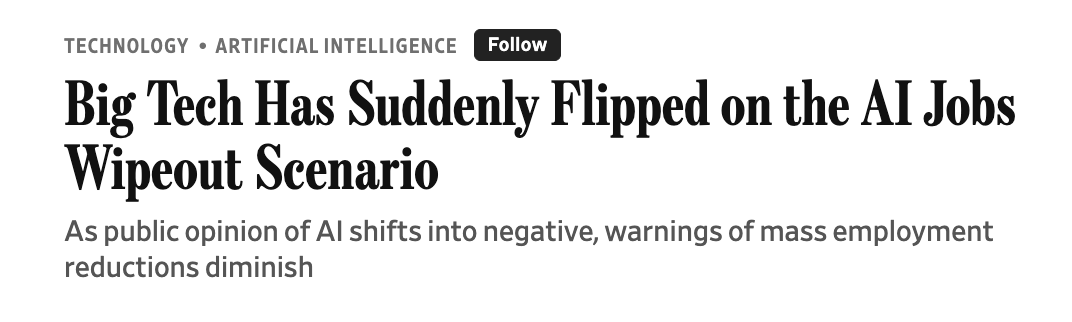
MIT’s David Autor nailed it in Katherine Bindley‘s WSJ piece:
“They may have noticed that the labor market is genuinely not changing (i.e., imploding) as rapidly as they expected. They may have realized it was simply bad business to say that your great new product will destroy the economy.”
Casey Newton argues it may be too late to matter either way: resistance in the U.S. is visible and bipartisan when it comes to data centers. When it comes to work, it shouldn’t surprise us: we’ve got a lousy track record of supporting labor in transition and the social safety net is getting thinner.
Dropping the replacement narrative is good for adoption. Human-led, AI-enabled programs drive deeper usage and more upside, because they focus on outcomes and give people time to build skills instead of chasing usage dashboards and tokenmaxxing.
But there’s a catch, and it’s expensive. AI is a massive capital bet by tech companies, and their customers are already flinching as token-based bills land at more than 10x what seat-based pricing used to cost and AI agents cost as much as developers.
If AI doesn’t replace humans, what you’re left with is good old-fashioned productivity gains, the same ones enterprise software has chased for decades. Real, worth having, and nowhere near the size of the promise.
So here’s the question: doesn’t that make a lot of these valuations a bubble?
Let’s try boom instead! Jensen Huang, Bill Gates, Eric Yuan, and Elon Musk have all promised some version of the same gift: AI will shrink the work week to four days, maybe three. Why not two?
It isn’t happening. In fact, what people are seeing is the exact opposite. Joanne Lipman laid out the broken promise in the NYT this week: AI, like every tool before it, is “increasing our output rather than decreasing our workload.” Ask tech workers what scares them most about AI and few say unemployment. Far more say they’re drowning in the work it creates.
Two surveys out this week back her up. Atlassian’s Teamwork Lab surveyed 1,000 office workers and 92% said their responsibilities have grown. It’s striking that the bar is going up for everyone: 72% of non-AI users have seen their role expanded.
But when 96% of heavy AI users say their role has expanded, the promise of AI giving you time back appears dead on arrival.
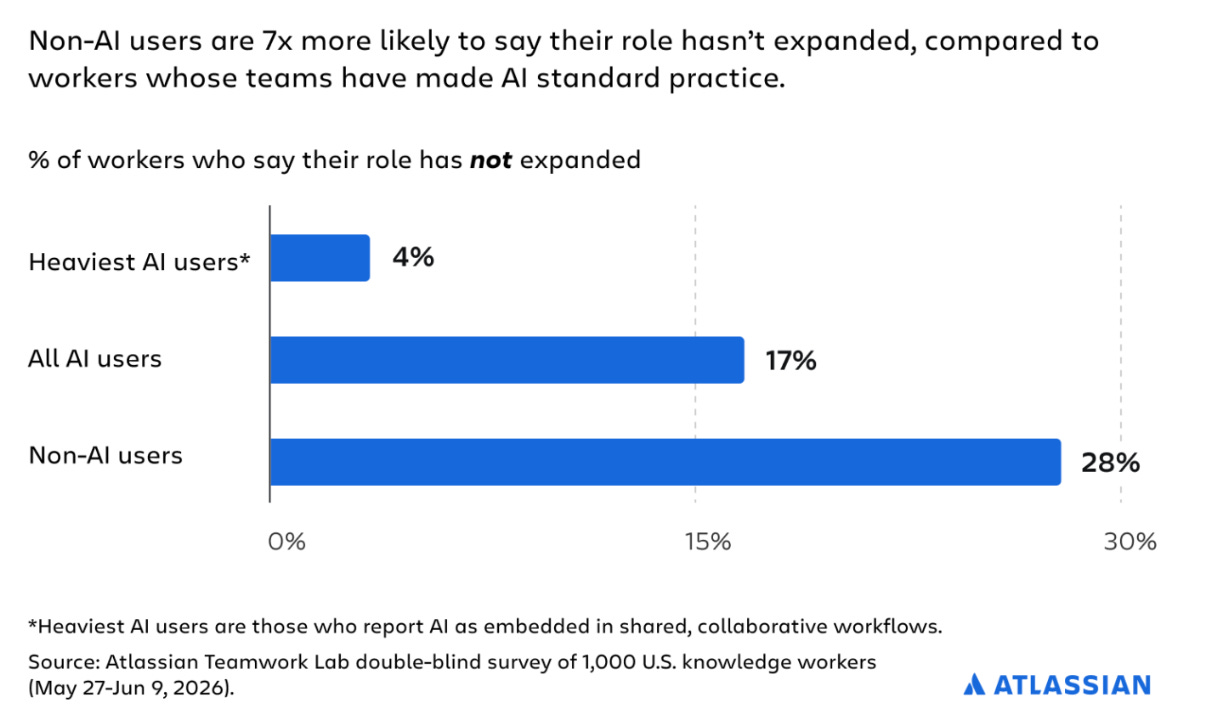
Source: Atlassian 2026
And Lenny Rachitsky‘s survey of nearly 6,000 tech workers found 51% worry AI means more work for the same pay, and 46% think the pace is unsustainable. Only 22% worry about losing their job to it.
More capability has been a real boon for a lot of us. The problem is that individually we’re bad at knowing when to stop, and organizationally we’ve got a foot on the gas. BCG’s AI “brain fry” research found workers in cognitive overload were 39% more likely to make a serious, customer-impacting error.
Atlassian’s report sees the same load piling up, with the heaviest AI users spending the most time in oversight and direction rather than execution. Heavy AI users are 72% more likely to report an increase in cross-functional work. That doesn’t mean they spend more time with other teams: they rank connecting with others dead last.
This lack of connection is going to bite organizations. Research from Anthropic, Cisco, Upwork, and Workday all found the same set of issues with heavy AI users pulling back from their human teammates and, in many cases, losing trust.
So what protects people and teams? Good leaders. Workers with a highly effective manager reported roughly 65% higher job enjoyment and dramatically lower burnout in Lenny’s survey.
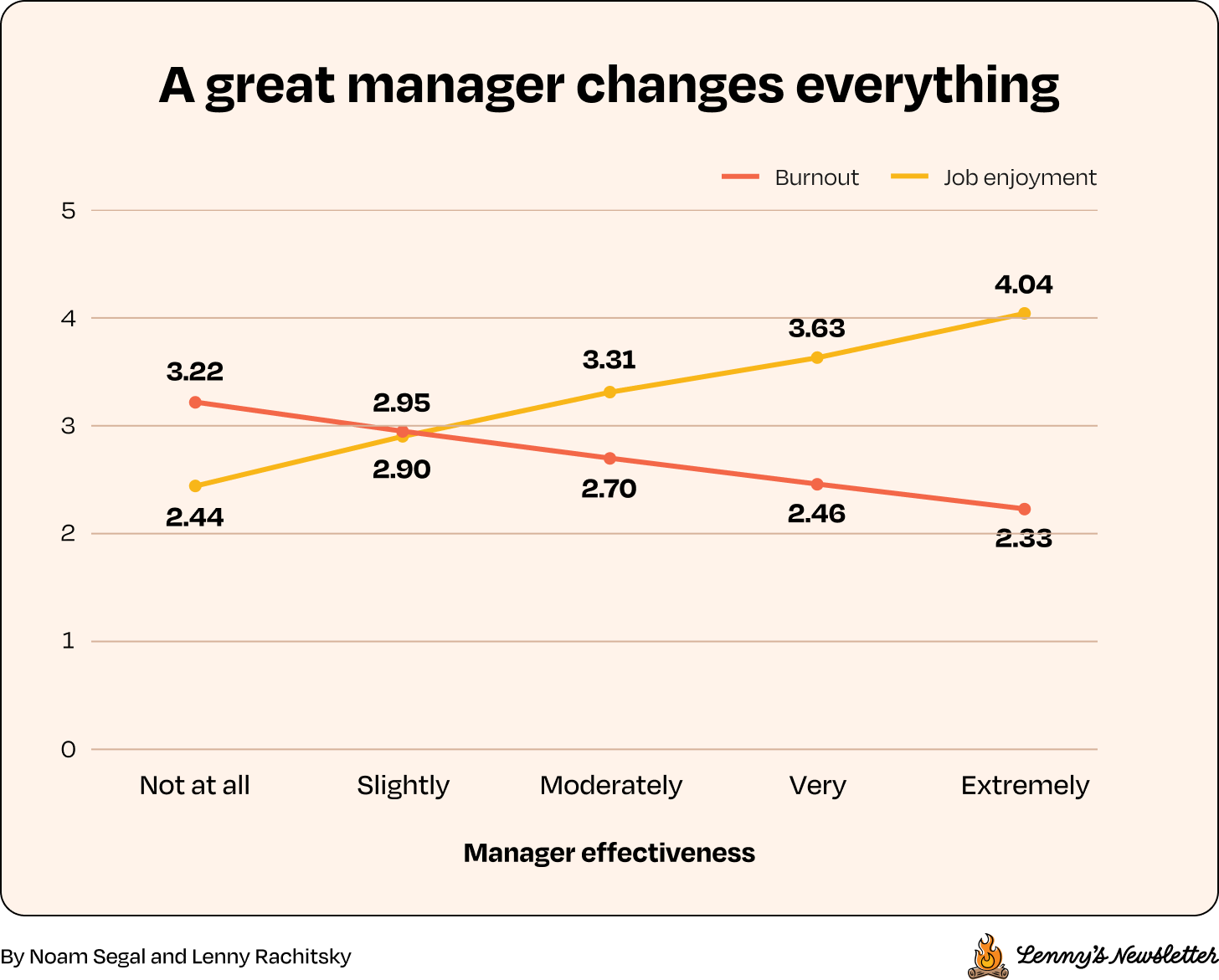
Source: Lenny’s Newsletter
Molly Sands of Atlassian put it plainly:
“Simply handing people more responsibility isn’t a strategy. Expanded roles only hold up when organizations invest in what sits underneath them — the norms, the relationships, the support structures that turn a bigger job into a sustainable one.”
As Lenny Rachitsky put it, “Invest in managers—it’s still the best money you’ll spend.” He notes it was the top recommendation they made last year, and it is again. Maybe this time, listen?
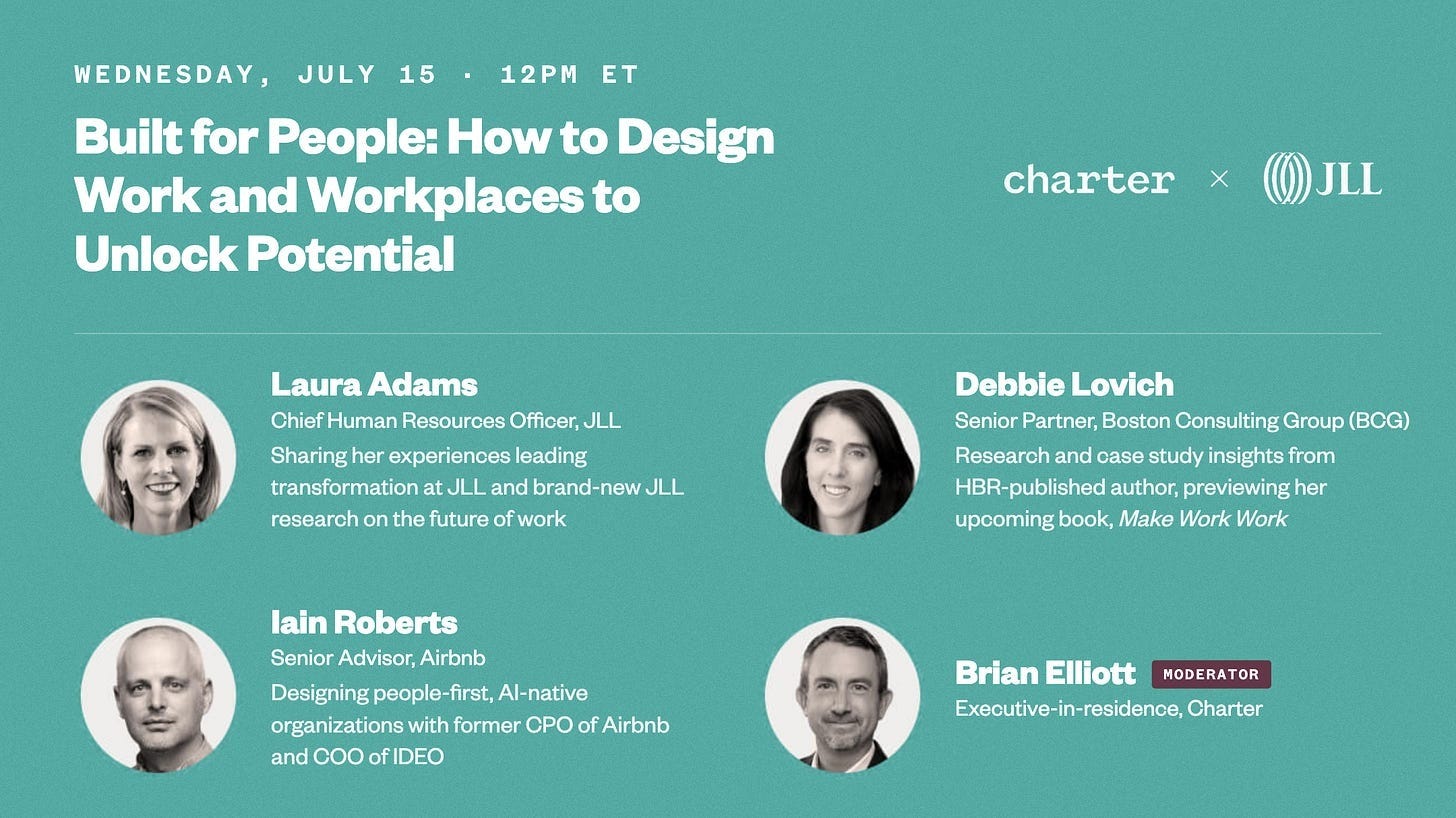
I’ll be moderating a conversation with JLL CHRO Laura Adams, BCG’s Debbie Lovich, and former Airbnb CPO and IDEO COO Iain Roberts this Wednesday, July 15th at 9am PT / noon ET!
Three very different leaders, all talking about how AI, leadership and workplace come together. We’ll also get into brand-new research from JLL on how AI is reshaping how teams use workplaces, and workplaces themselves. All that and live Q&A!
BCG reports that 70% of CEOs are concerned that AI will erode critical worker skills in the next 2-3 years. David Leonhardt brings it back to yet another challenge we’ve put in front of Gen Z: the most consequential thing AI takes from young workers may not be their jobs, but their reps.
Talking with Kevin Delaney in Charter, Leonhardt described how most of us actually learned judgment, by doing the rote work first. “Shooting thousands of layups and free throws to eventually learn how to shoot three-pointers.” Automate the entry-level work out from under the next generation and you’re asking them to shoot threes having never practiced the basics. That’s “not going to be fair to them,” he said, “and it’s not going to be good for our companies.”
History doesn’t offer much comfort.
“If you go back and look at the Industrial Revolution, today we think of it as a great success. It also ruined the job prospects and lives of huge numbers of people at the time.”
His fix cuts against the efficiency reflex: keep handing entry-level people the building-block reps, even on work AI could do, while moving them onto reviewing AI’s output at the same time. A steeper learning curve, built on purpose. And the bigger principle underneath it is the one worth taping to the wall.
“One of the historical lessons is that we should be comfortable sometimes prioritizing human beings over absolutely maximizing economic growth.”
In a financial system wired to the quarter and politics wired to the next election, that’s a hard thing to ask for. It’s also the whole game. Every story above is a version of the same choice: optimize for the machine, or invest in the people running it.
The leaders who get the next few years right will be the ones who keep choosing the second one, even when the spreadsheet is begging them not to.
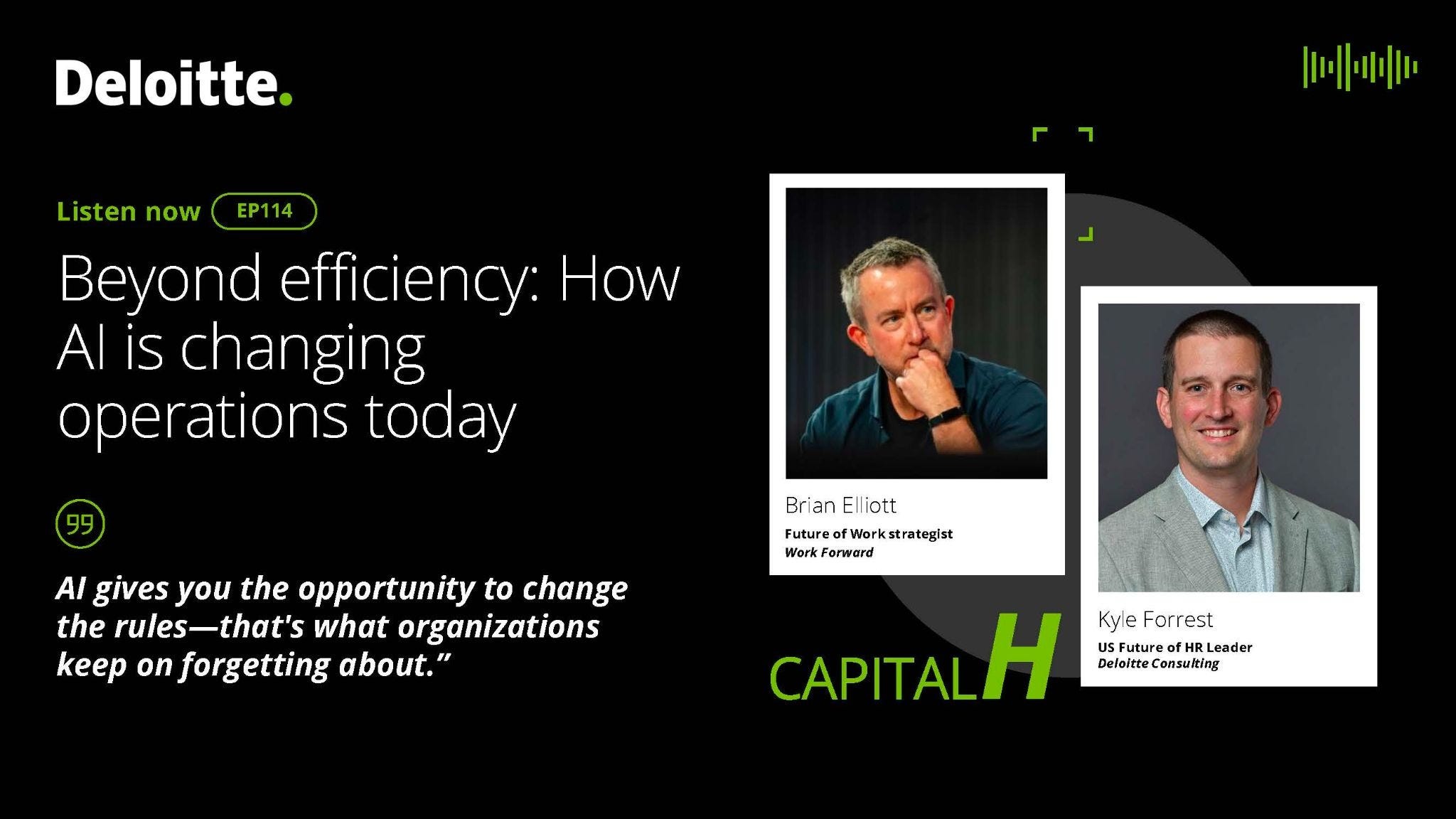
I joined Kyle Forrest on Deloitte’s Capital H podcast to dig into what’s separating organizations that are making progress with AI from those that are spinning their wheels. I usually don’t like listening to myself, but Kyle got me rolling and this one was pretty good (I think!). We talked about:
Moving from adoption to fluency, impact and performance.
Thinking bigger instead of smaller: can we 10X instead of cutting 10%?
Why teams that dedicate time and space to learning together get a lot further, a lot faster
Give us a listen and let me know what you think: Apple, Spotify or Youtube
Please like ❤️, subscribe 📨, and (most of all) share 🔄 — it’s always free!
Comments
Nothing yet. Say the first thing.
Sign in to join the conversation.