
We are producing exactly the leaders we deserve — because we promote for the wrong reasons, ignore the moment that actually shapes them, and then spend a fortune pretending the problem is something else
Leadership quality is not improving despite decades of investment in development. The reason sits upstream of any training programme — in who gets promoted and why, and in what happens at the first leadership tier where character and habits are actually formed. The failure is structural, and the decisions required to fix it sit well above the training budget line.
This piece grew out of a question I received from readers — one that stayed with me because it pointed to a pattern that is widely recognised, but rarely examined at its source.
Why the most capable person on your team may be the worst person to promote into leadership — and why you’ll keep doing it until the structure changes
What actually forms a leader’s character, and why by the time your organisation starts investing in someone’s development, it’s usually too late
Why leadership training keeps failing even when it’s well-designed — and what the real problem is
How organisations end up with the leaders they say they don’t want — and why the system is working exactly as it was built
What would actually need to change — and why it’s not a training decision
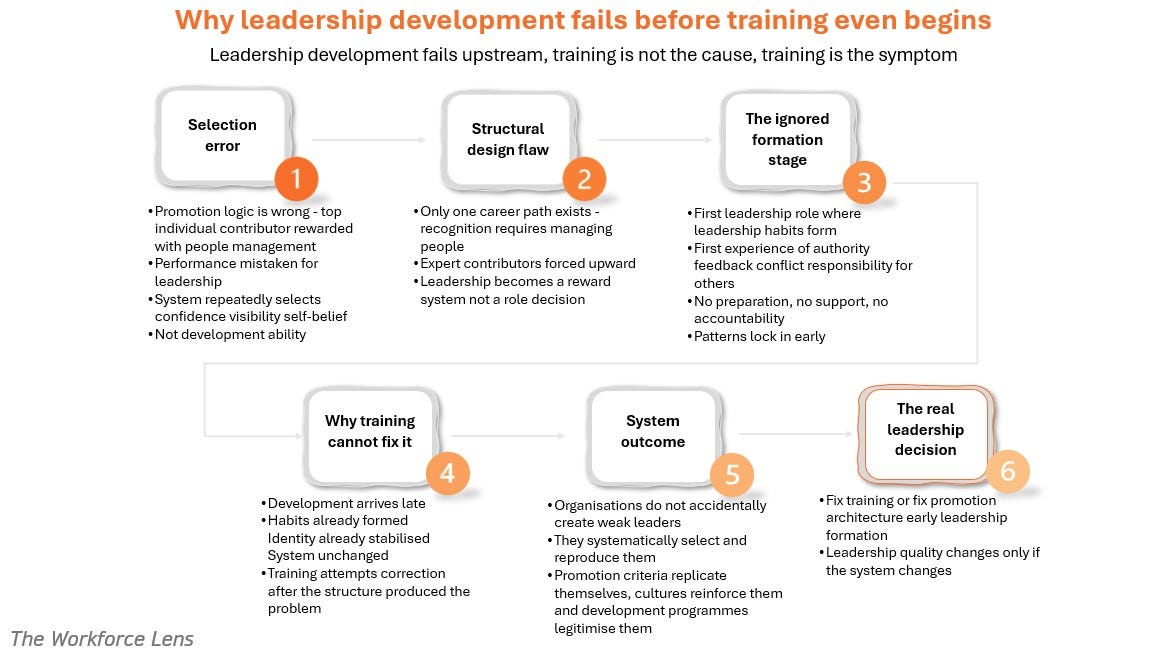
Two promotions decisions are shaping every leader in your organisation. Most are made without thinking
Why Leadership Development Programmes Keep Failing — And Why We Already Know It
Why We Promote the Wrong People Into Leadership Roles
The First Leadership Role: Where Leadership Is Made or Broken
Bad Leadership Is Not a Bug. It Is What the System Produces
Final Thoughts: The Leadership Problem Starts Before the Training Room
Key Takeaways
Next on The Workforce Lens
Further Reading
Global employee engagement fell to 21% in 2024. That is the finding from Gallup’s 2025 State of the Global Workplace report, which surveyed nearly a quarter of a billion workers across 160 countries. The estimated cost of that disengagement: $438 billion in lost productivity. Manager engagement — the people who, by Gallup’s own data, account for 70% of the variance in team engagement — dropped from 30% to 27% in a single year.
This is not a new crisis. Gallup has been publishing the same essential finding, with modest variation, for over a decade. The numbers move slightly up or slightly down, the conclusion does not change. Most people at work are managed by someone who is not doing the job well from many various perspectives.
Meanwhilst, Harvard Business School’s Michael Beer, Magnus Finnström, and Derek Schrader found that US corporations were spending $164.2 billion annually on employee training — with most unable to demonstrate that any of it changed behaviour in any sustained way. They called it The Great Training Robbery. The money moves but the leadership does not improve.
The standard response is to argue for better training. Make it more contextual, more personalised, closer to real work. That argument is not wrong. It is just aimed at the wrong part of the problem. Because the training fails downstream of two earlier failures — and until those get named, every improvement to programme design is a refinement of something that was never going to work.
Most people become leaders because they were very good at something else.
The best salesperson gets the sales team. The engineer who ships the cleanest code becomes the engineering lead. The consultant who bills the most becomes the partner. The logic is not irrational — they have earned recognition, and the organisation wants to reward them. But promotion into people management is not a reward. It is a role change that requires an almost entirely different set of capabilities. Treating it as a reward is a category error, and organisations make it constantly.
Tomas Chamorro-Premuzic, Professor of Business Psychology at UCL and Columbia, has spent years documenting what actually drives leadership selection. His research published in Harvard Business Review shows that organisations do not just promote high performers — they systematically misread overconfidence, narcissism, and surface-level charisma as leadership potential. These traits perform well in exactly the contexts where selection happens: interviews, presentations, high-visibility moments. They deteriorate once the job requires developing other people, receiving honest feedback, or making careful decisions under pressure.
The promoted narcissist is not a bad hire. They are a predictable output of a selection process that was never measuring the right things. And once in post, they tend to build cultures and succession processes that replicate the criteria that produced them. The organisation that promotes confidence over competence once will, quietly, do it forever.
There is a structural absence underneath all of this. Most organisations have one recognised path for rewarding exceptional individual performance: upward, into managing others. There is no credible parallel track — equal pay, equal status, equal visibility — for people who are excellent at their craft and should stay there. So promotion into leadership is sometimes not a leadership decision at all. It is the only available way to say: this person’s contribution matters.
The person who walks through that door is not wrong for walking through it. The organisation built only one door.
💡 Related read:
Qualities of future leaders human skills for uncertain worlds
Explore the five non-negotiable human skills—like emotional intelligence for trust-building and ethical leadership for resilience—that define effective leaders in volatile environments, revealing why structural promotion flaws produce leaders lacking these essentials
In 2014, McKinsey Quarterly published an analysis by Pierre Gurdjian, Thomas Halbeisen, and Kevin Lane identifying four structural reasons leadership programmes fail: they ignore context, they decouple learning from real work, they underestimate the role of mindset, and they do not measure behaviour change. Adults retain roughly 10% of what they hear in a classroom lecture, versus nearly two-thirds when learning by doing. Only 7% of senior managers believed their companies developed global leaders effectively.
Beer and colleagues, in The Great Training Robbery, went further. The problem is not that individuals lack knowledge. It is that the organisations around them have not changed the structures and incentives that determine whether new behaviour can survive. When senior teams have not committed to changing how they operate, training becomes performance. The trained leader goes back to the same system. The system wins.
Both of these analyses are correct. Both are also over ten years old. And if you look at what most large organisations are actually running as leadership development today, you will find something that would be completely recognisable to the people who wrote those critiques. Off-site programmes. Competency frameworks. 360-degree feedback sent to people who were not asked if they wanted it and will not be held to account for what it says.
So the question is not whether the training critique is valid. It is why knowing all of this has produced so little change. The answer is that the training is a symptom. The disease is earlier.
The team leader. Not the manager — the level below. The person who for the first time is responsible for the output and development of other people. Squad lead, team lead, senior, informal anchor — the titles vary. The function is the same. And this is where leadership character is actually formed, and where most organisations are paying the least attention.
This is the moment a person first has to stop optimising for their own delivery and start enabling someone else’s. First has to give feedback that might damage a relationship. First has to represent their team upward, absorb pressure downward, and hold both simultaneously. The instincts formed here — the defaults, the avoidances, the relationship to authority — do not get overwritten later. They compound.
Robert Kegan’s decades of adult developmental research at Harvard Graduate School of Education makes the mechanism precise. Lasting behavioural change requires a transformation of how a person makes meaning — not just new skills, but a different way of processing experience. That kind of development is slow. It is built from accumulated real experience, not extracted from programmes. And the early experiences of leading others are amongst its most formative inputs. What gets established at the team leader tier is not a draft. It is the foundation.
McKinsey’s 2010 survey on frontline management found that only 10% of respondents believed frontline manager training was effective. Nearly 70% of senior executives were dissatisfied with frontline manager performance. And 81% of frontline managers themselves were not satisfied with their own performance. That last number is important. It is not a picture of people who do not care. It is a picture of people who were placed in roles without preparation, support, or development — and who know it.
The same research found that frontline employees receive more formal training than frontline managers. The people with the most direct leverage over team performance and culture are the least invested in. The entry point into leadership gets treated as a throughput problem, not a development problem.
So what happens? The person who should not have been promoted under Section II logic arrives at the team leader tier under Section III conditions. No serious investment. No real modelling. No accountability structure for how they are developing. The patterns that form there — the conflict avoidance, the performance theatre, the learned helplessness about giving honest feedback — do not get interrupted. They get confirmed. And then they advance.
By the time the organisation decides to invest in this person — the coaching engagement, the leadership programme, the 360 — they are managing thirty people and have been doing it for six years. The training is trying to renovate a building whose foundations were poured wrong. It is not going to work. Not because training cannot work, but because this is not a training problem anymore.
If the selection failure is this well-documented, and the neglect of the first-line tier this consistent, the question worth asking is not how to fix it. It is why it has not been fixed.
Promoting high performers into leadership is politically clean. It validates the performance culture. It sends a legible signal that excellence gets rewarded. Building a parallel individual contributor track — same pay, same status, same career ceiling — is architecturally complex and requires senior leaders to accept that not all advancement runs through managing people. That is a harder conversation than commissioning a programme.
Investing seriously in first-line leaders requires measuring what happens there — which means accepting accountability for what the measurement reveals. It requires senior leaders to model the behaviours they are asking first-line leaders to develop. Beer and colleagues are explicit that the most consistent barrier to any sustained development is senior teams that have not committed to changing their own behaviour first. Asking someone to develop leaders whilst refusing that scrutiny yourself is not a development strategy. It is delegation of accountability.
The leadership development industry — L&D functions included — is not outside this system. Commissioning a programme is an action. Redesigning a promotion framework is a decision. The first is easier to take, easier to report upward, and easier to defend when the results are weak. It can always be attributed to design flaws or participant motivation or organisational readiness — never to the fact that the problem was upstream of anything training can reach.
Organisations are not conspiring to produce bad leaders. They are producing the leaders their structures are designed to produce. Performance cultures that have one promotion track will keep selecting confident individuals over capable ones. Organisations that treat first-line leadership as a rehearsal will keep graduating unformed leaders into management. And leadership development functions that measure inputs — programmes delivered, hours completed, satisfaction scores — will keep mistaking activity for change.
None of this is inevitable. It is a set of choices. The question is whether the people making them are willing to look at what they are actually choosing.
We have had the research for a decade. Gurdjian and Lane in 2014. Beer and colleagues in 2016. Gallup, every year, saying the same thing. The knowledge about what produces bad leaders — and what would need to change to produce fewer of them — is not missing. What is missing is willingness to act on the part of the problem that sits upstream of any programme: who gets promoted, and what happens to them at the level no one takes seriously.
If you work in HR or L&D, this matters because the investment you are managing is landing at the wrong point in the chain. More development spend will not fix a promotion architecture that selects for confidence over competence, or a first-line tier that is still being treated as a waiting room rather than the place where everything gets decided. The programmes are not the problem. They are just the most visible thing to point at.
What would actually change things is building a promotion track that does not require excellent individual contributors to manage people in order to be recognised. And treating the first leadership role someone takes — really treating it, with investment, with accountability, with honest feedback — as the moment that counts. Both of those are harder than a programme. Both require decisions that sit above the L&D budget line. Which is probably why, after a decade of clear evidence, most organisations still have not made them.
You are probably promoting the wrong people for the right reasons — and the architecture that forces that choice is yours to fix
The first leadership role someone takes is where their habits, defaults and character as a leader get set. If you’re not investing there, you’re not investing in leadership development. You’re investing in damage control.
Training doesn’t fail because it’s badly designed. It fails because it arrives too late, with the wrong people, inside a system that hasn’t changed around them
Most organisations already know this. The gap isn’t knowledge. It’s the willingness to act on the part of the problem that sits above the L&D budget line
The question worth asking is not how to improve your leadership programmes. It’s whether the people being put into them should have been promoted in the first place
The conversation about AI and work has been dominated by one question for the past three years: will it take our jobs? That question generated enormous heat and very little light. It also turned out to be the wrong one.
What is becoming clearer — in labour market data, in hiring patterns, in the restructuring happening inside large organisations — is that AI is not arriving as a single event that affects everyone equally. It is arriving as a dividing line. On one side, people whose skills, roles and access to technology are putting distance between themselves and everyone else. On the other, people watching the rung they built a career on get removed without ceremony, without transition support, and without anyone in a position of authority willing to describe what is happening plainly.
The debate about job displacement, whilst unresolved, has given way to something more urgent. Not whether AI transforms work — that is settled — but for whom that transformation opens doors, and for whom it closes them. Those doors are not opening and closing at random. They are following patterns that anyone paying attention can already see.
The next piece examines who benefits, who loses ground, and what the workforce transformation driven by AI looks like for the people in the middle — the ones neither celebrated as future-ready nor obviously displaced, but repositioned in ways that will take years to fully understand.
For mastering organizational readiness that underpins effective leadership promotion, Strategic workforce planning: how to know if your organisation is truly ready to succeed reveals why cultural accountability and cross-functional alignment fail without structural change, mirroring the upstream decisions sabotaging leader selection.
For building the human skills leaders lack from day one, The hidden skills that make you future-proof in the age of AI uncovers critical thinking, resilience, and ethical judgment as irreplaceable traits—exposing why training alone can’t retrofit what promotion systems overlook.
For understanding first-line leadership neglect in real workplaces, Retention strategies for real workplaces coping with unmet employee demands shows how operational constraints erode trust and habits at the team lead level, compounding the exact patterns your article diagnoses.
Remote Work Laws You Cannot Ignore: A Global Guide to Compliance
Remote Work in Transition: Benefits, Challenges, and Employee Preferences
How AI is reshaping entry-level careers: risks, skills, and strategies

Thanks for reading The Workforce Lens’s Substack! This post is public so feel free to share it.
Gurdjian, Halbeisen & Lane — Why Leadership Development Programs Fail, McKinsey Quarterly (2014)
Beer, Finnström & Schrader — The Great Training Robbery, HBS Working Paper 16-121 (2016)
Beer, Finnström & Schrader — HBS Working Knowledge: Whose to Blame for the Great Training Robbery?
Chamorro-Premuzic — Why Do So Many Incompetent Men Become Leaders?, Harvard Business Review (2013)
McKinsey & Company — How Companies Manage the Front Line Today: McKinsey Survey Results (2010)
Kegan, R. — Harvard Graduate School of Education: Changing for the Better
Comments
Nothing yet. Say the first thing.
Sign in to join the conversation.