
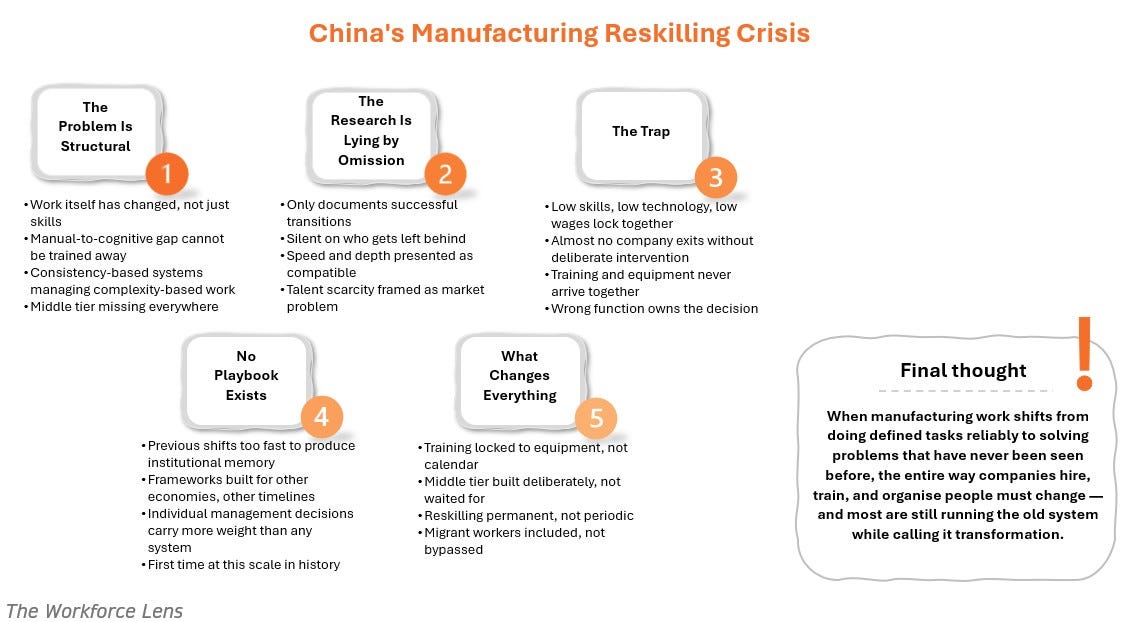
When manufacturing work shifts from doing defined tasks reliably to solving problems that have never been seen before, the entire way companies hire, train, and organise people has to change — and most are still running the old system while calling it transformation.
Why parallel transformation beats sequential — and how to actually execute it without stopping production
The three forces reshaping China’s manufacturing workforce that no single framework accounts for
Where reskilling programmes break down in practice — and what the optimistic literature is not telling you
Why timing kills more workforce transitions than poor training does — and the one structural fix that prevents it
The four things worth doing, ranked by evidence — not by what sounds comprehensive
Why China’s Transition Is Unlike Any Before It
What Is Actually Changing in Manufacturing Work
What the Optimistic Consensus Leaves Out
Why Most Programmes Fail Before They Start
What the Best Thinking Gets Right and Stops Short Of
Where to Put Your Attention First
Final Thoughts: Managing a Transition the Research Was Not Built For
Key Takeaways
Next on The Workforce Lens
Further Reading
China’s manufacturing workforce transition is not different in kind from transitions happening in Germany, the United States, or South Korea. It differs in magnitude and compression. McKinsey estimates that roughly one-third of all global occupational transitions needed for the future of work may occur in China alone — approximately 220 million workers, representing 30% of the entire workforce, needing to change occupations or substantially upgrade their skills by 2030.
When transitions affect 30% of your workforce over seven years, you are not managing change. You are managing organisational reconstruction while the organisation continues operating.
Three structural shifts are happening simultaneously. Occupational restructuring is accelerating as automation and digitisation displace routine cognitive and manual work while creating demand for workers at both ends of the skill spectrum — highly skilled engineers and technicians alongside roles that have not yet been automated. China’s working-age population is simultaneously contracting and ageing, reducing the pool available for physically demanding traditional manufacturing precisely when demand increases for workers skilled in digital systems. And the mobility barrier between these two worlds is steeper than most managers assume: skills taxonomy research published in Nature shows that workers face substantial difficulty transitioning between jobs requiring sensory-physical skills and those demanding social-cognitive capabilities. Traditional manufacturing workers cannot easily pivot to advanced manufacturing roles without intensive retraining. Multiply that constraint across millions of workers and the difficulty becomes structural, not individual.
The sectoral picture adds further complexity. Industrial policy through Made in China 2025 and its successor frameworks has concentrated support in electric vehicles, electrical equipment, biopharmaceuticals, high-performance medical devices, ships, and space equipment. These sectors now demand entirely different workforce capabilities than the heavy industry they are replacing. Sectors where progress has lagged — high-end CNC machine tools, aerospace equipment, advanced materials — reveal where the skills gaps are deepest. In materials science, enrolment in related programmes grew only 14% from 2016 to 2023, versus 62% for computer science. Talent is going where perceived opportunity is, not necessarily where industrial need is greatest.
💡 Related read:
Workforce transformation made real: Singapore’s lifelong learning model and HR insights
Discover how Singapore scaled workforce reskilling across manufacturing and beyond, and uncover the practical HR lessons for managing parallel tech-skills shifts without halting production
The World Economic Forum’s 2025 Future of Jobs Report quantifies what most manufacturing managers already sense: 39% of workers’ core skills will need to change by 2030. Demand for physical and manual skills is falling by 14%, basic cognitive skills by 15%, while social and emotional skills grow by 24% and technological skills fastest of all at 55%. By 2030, technological skills will account for 17% of hours worked, up from 11% in 2016.
These are not projections of incremental adjustment. They describe how manufacturing work is being recomposed.
Field research across advanced manufacturing sectors — from integrated photonics to flexible electronics and additive manufacturing — identifies a consistent secondary finding: collaboration, communication, and critical thinking have become as important as technical skills across technical occupations. This is not a soft-skills argument. When a line goes down and three people need to diagnose it together using a shared interface, the social and cognitive load is as real as the technical one. Networks that have trained over 100,000 workers through competency-based programmes have restructured their curricula accordingly — not because it sounds good, but because manufacturers told them technical skills alone were insufficient.
Workforce road mapping across multiple sectors also reveals a consistent shortage in the middle: roles bridging the gap between traditional technicians and engineers, requiring more than a high school qualification but less than a four-year degree. MIT’s TechAMP programme addresses this by creating pathways for workers who understand manufacturing principles — process controls, statistical analysis, manufacturing systems, workflow, operations management — alongside specific technical specialisations in mechatronics, robotics, automation programming, or digital manufacturing. The design is intentional: foundational principles transfer across technology generations, while specialisations address immediate employer needs. For Chinese manufacturers, this middle tier is where the most acute shortages sit and where internal development programmes have the clearest return.
The literature on manufacturing workforce transitions is systematically optimistic. It documents successful transitions and largely ignores failures. This matters because the gaps in the research are exactly where managers get surprised.
What percentage of workers successfully transition when companies run serious reskilling programmes? The research does not say clearly. Middle-skill workers — those with moderate technical training but not advanced degrees — face the sharpest displacement, yet most frameworks treat them as a category to be managed rather than a specific problem to be solved. The workers who cannot be reskilled appear as a footnote in success stories. In China, where informal and migrant workers constitute a substantial portion of manufacturing employment and have limited social protection, this is not a footnote. It is a central operational and social risk that managers carry largely without framework support. Some workers will not make the transition. Current guidance offers almost nothing on how to manage that reality at scale.
With 39% of skills changing by 2030 — five years away — can organisations execute systematic, coordinated transformation at that pace? The evidence suggests a genuine trade-off that the literature rarely acknowledges: rapid upskilling produces shallow capabilities, while deep capability development takes years. These are in direct tension when transition timelines are compressed. Chinese manufacturers face this more acutely than most, because the combination of industrial policy pressure, export competition, and technology adoption rates creates a pace that serious workforce development programmes struggle to match. Managers who believe they can move fast and develop deep capability simultaneously should examine that assumption carefully. The research does not support it.
When governments concentrate resources on strategic sectors — as China has done explicitly — does this improve aggregate outcomes or simply move talent and capital from other productive uses? The Rhodium Group’s assessment for the U.S. Chamber of Commerce documents extraordinary financial support for targeted industries, with the China Integrated Circuit Industry Investment Fund’s third phase alone totalling $47.5 billion in 2024. State-owned banks increasingly channel lending toward policy-priority sectors. For individual manufacturing managers, this creates clear direction. For the economy as a whole, whether industrial targeting creates new productive capacity or largely redistributes it from other sectors remains genuinely unresolved. Managers in non-priority sectors should understand that the talent competition they face is not purely a market outcome — it is partly a policy outcome.
These three tensions share a common structure: the research identifies them, gestures at their importance, and moves on to frameworks that assume them away. Treating them as solved problems rather than ongoing management challenges is where workforce strategies most often break down.
Three analytical frameworks from the research offer complementary entry points.
McKinsey’s analysis of China’s reskilling challenge identifies system-level levers: enhanced vocational tracks with flexibility, direct pathways from secondary education to application-oriented universities, industry-specific partnerships, and integrated delivery mechanisms that recognise no single actor — government, employer, or educator — can achieve necessary scale alone. The framework is comprehensive and largely correct. Its limitation is that it describes what a well-coordinated national system should do, which is not immediately actionable for an individual manufacturing manager who cannot wait for the system to reach that level of coordination.
MIT’s technologist bridge model operates at the firm and programme level, creating a middle tier between traditional technicians and engineers. It works because it does not require perfect system coordination — individual firms can sponsor workers through programmes to meet specific capability gaps, independently of whether the broader ecosystem is functioning well. For Chinese manufacturers facing acute middle-skill shortages, this is probably the most immediately usable framework.
The World Bank’s analysis of technology-driven manufacturing transitions across East Asia emphasises competitiveness, capabilities, and supply chain connectedness as interdependent conditions for successful transition. Vietnam provides a useful data point: locations with greater robot adoption saw employment gains of 10% and labour income increases of 5%, demonstrating that automation and employment are not straightforwardly opposed when transitions are managed well.
Where these frameworks align: all three argue that technology and skills must develop in parallel, that no single actor can drive transformation alone, and that transitions require sustained effort across years, not quarters. Where they diverge: the first focuses on system coordination, the second on specific educational interventions, the third on macroeconomic preconditions. Success in one dimension does not guarantee the overall transformation. That is the honest caveat the frameworks tend to omit.
The most common failure mode in workforce transitions has nothing to do with curriculum quality or trainer competence. It is timing. Firms run training programmes before equipment arrives, or acquire equipment before training is anywhere near complete. Both fail for the same reason: skills are not retained without practice on the actual system, and new systems are not productively used without trained operators.
Research across small and medium enterprises identifies a structural trap that explains why this keeps happening. Firms remain reluctant to train workers for equipment they do not yet have. Yet without trained workers, they cannot justify or fully use new technology. Factory studies across 20 years found that companies caught in this equilibrium rarely upgrade their equipment at all. Low technology adoption combines with low skills, low wages, and low productivity to form a self-reinforcing system that is very difficult to exit.
The intervention required is specific: training calendars must be locked to technology acquisition timelines. This sounds obvious. In practice it requires workforce and operations leadership to coordinate in ways that most manufacturing organisations are not structured for. The training function typically reports separately from capital expenditure decisions, which means the coupling has to be enforced through management attention rather than organisational design. That is where it usually breaks down.
Four priorities stand out as most supported by evidence and most within a manufacturing manager’s direct control.
Do not assess skills independently of technology acquisition plans. Map your equipment delivery schedule against required workforce capabilities and identify the points where you will need trained workers before those workers currently exist. That gap is your primary implementation risk. Executives consistently underinvest management time in training decisions relative to capital decisions. That imbalance is where transitions fail.
General cooperation agreements produce little. Co-designing curricula around your specific technology environment and creating clear pathways from education to employment at your firm produces results. Given that only 32% of secondary vocational teachers and 40% of higher vocational teachers have meaningful industry experience, manufacturers who second experienced workers to teaching roles or host structured apprenticeships are not being generous — they are protecting the quality of their own future talent pipeline.
In China’s manufacturing workforce, informal and migrant workers carry significant institutional knowledge about how operations actually run. They are also the population most vulnerable to displacement and least likely to be targeted by reskilling programmes. Managers who invest in this group retain operational knowledge and reduce the social cost of transition on their own workforce.
China reached 12 robots per 1,000 manufacturing workers in 2022 against 17 in high-income countries, and the gap is closing quickly. The technology change driving workforce requirements does not have a completion date. Managers who build continuous learning into normal operations will handle each wave of change better than those who treat reskilling as a discrete programme with a beginning and end.
Manufacturing has always absorbed disruption by moving faster than the disruption itself. What is changing now is more fundamental than technology adoption or skills upgrading. It is the nature of manufacturing work itself. For most of the last century, a factory manager’s core workforce challenge was consistency. Getting large numbers of people to perform defined tasks reliably and at scale. The entire architecture of vocational training, job grading, supervision, and performance management was built around that challenge. Advanced manufacturing requires workers who can operate in conditions that are not fully defined, diagnose problems they have not seen before, and collaborate across specialisations that did not exist when they were trained.
Most programmes measure what workers completed, not what they can actually do when the situation is unfamiliar.
China’s particular difficulty is that this shift is happening across an economy still building the industrial base it is simultaneously being asked to move beyond. Workers entering advanced manufacturing are often one generation removed from agricultural labour. Managers overseeing these transitions frequently work without institutional memory of how previous industrial shifts were navigated, because China’s previous shifts happened too fast and too recently to have produced that memory. There is no historical precedent at this scale to learn from.
Every principle in this research was derived from contexts where surrounding institutions were more developed, labour markets more transparent, and timelines less compressed than what Chinese manufacturers face today. The research tells you what the destination looks like. Getting there is a different problem entirely.
The middle tier between technician and engineer is where China’s shortages are deepest and where investing in internal development returns the most
China is managing three simultaneous workforce crises — demographic, occupational, and a mobility barrier between manual and digital work — and no framework addresses all three at once
Low technology, low skills, and low wages lock each other in place — and 20 years of factory data shows that companies caught in this cycle almost never exit it without deliberate intervention
Moving fast on reskilling and building deep capability are mutually exclusive. Every strategy that promises both has already made a hidden trade-off you may not have agreed to
The workers carrying the most operational knowledge are the last to be reached by reskilling programmes — and the first to be displaced
The next article moves further upstream in the leadership pipeline. It examines two structural points that quietly shape the leadership cohort organisations later try to develop.
The first is how organisations decide who moves into leadership roles. In many companies, promotion still follows a familiar pattern: strong individual performance becomes the primary signal of leadership readiness.
The second sits one level lower in the hierarchy and receives far less attention. The team leader tier is where leadership behaviour, identity, and habits often form for the first time. It is also one of the least supported levels in many organisations.
Together, these two dynamics shape the leadership pipeline long before formal development programmes begin.
Leadership training then enters the picture much later, often attempting to develop leaders whose trajectory was largely set years earlier.
Further reading: For mastering parallel workforce transitions at scale, “Future-proof your workforce: how strategic upskilling and reskilling drive business success“ reveals how to prioritize evidence-based reskilling, recompose skills across tech/social/cognitive demands, and align interventions with production realities without overpromising outcomes
For designing reskilling programmes that actually stick, “How to design upskilling and reskilling programmes that deliver real, measurable impact“ uncovers fixes for common failures like timing misalignment and curriculum gaps, focusing on high-pressure environments where results must be tracked and scaled
For assessing organisational readiness amid reconstruction, “Strategic workforce planning: how to know if your organisation is truly ready to succeed“ shows how to audit middle-skill shortages, mitigate parallel transformation risks, and build the structural fixes that prevent transitions from stalling
Remote Work Laws You Cannot Ignore: A Global Guide to Compliance
Remote Work in Transition: Benefits, Challenges, and Employee Preferences
How AI is reshaping entry-level careers: risks, skills, and strategies

Thanks for reading The Workforce Lens’s Substack! This post is public so feel free to share it.
Comments
Nothing yet. Say the first thing.
Sign in to join the conversation.