

“Fáilte* to this week’s TWSD. Charisma. It’s great if you have it, and pretty miserable if you don’t. And if you don’t have it, the more you try to get it, the less charismatic you become. It’s all very frustrating. However, there’s hope for us dull types, as there might be a way of becoming an inspirational leader if you follow a few rules. Also this week: stat nerds reveal who will win the World Cup, some amazing photos taken from orbit, climate change will ruin milk, and a really big scorpion. As ever, please like/subscribe/share to your heart’s content!”
Daniel
* Welcome in Irish
Steve Jobs and Bill Gates - watch this for a minute and you’ll see what I mean🌟 In politics as in life, charisma can be all that stands between success and failure. UK Prime Minister Sir Keir Starmer found this out to his cost this week, announcing he was stepping down, it appears, for the heinous crime of not having ‘it’. Being competent obviously just doesn’t cut it anymore.
Charisma is tricky to define, but we all know it when we see it. When I think about this, I always go back to Steve Jobs vs Bill Gates. Jobs was cool, Gates is not. No matter how successful and rich Gates became, he could never hold a candle to his arch-rival when it came to pure pizzazz. It must have driven him crazy.
Still, psychologists have been busy trying to pin down this frustratingly nebulous quality. They’ve settled on a combination of traits to define charisma: authenticity, emotional competence, persuasiveness, passion, and enthusiasm. Charismatic leadership is thought to be an evolutionary trait, as following an inspiring, confident boss in times of threat may have helped groups survive by motivating them to act together.
So what can be done if you don’t have any, err, rizz (as the kids say)? Well, there’s a chance this social skill can be taught. A deep dive into political speeches reveals there are a handful of tricks you can use in the words you say and how you say them. Read more on The Conversation
▲ I’m not one for superstition, but when an ancient Mexican pyramid suddenly collapses after 1,100 years, I’m with the locals when they think this is probably a sign of bad juju on the way.
The stone pyramid was built by the Purépecha people to watch over a settlement called Ihuatzio. This proud civilisation is notable for being one of the few Mesoamerican powers to successfully see off the advancing Aztecs.
It wasn’t war that did for the pyramid, but the weather. A combination of prolonged drought followed by heavy rainfall weakened the foundations, causing the monument to crumble.
Repair is not out of the question, but for the time being, the pyramid, once an important ceremonial and political centre of the Purépecha world, lies in ruins. Read more on The Times of India
💀 Elsewhere, a rather spooky find has been made in Germany - the foundation of a medieval church and the graves of dozens of young children. The structure is thought to be the Church of St Godehard, which was demolished in the late 1500s. As for the graves, experts think they are ‘eaves children’. In the Middle Ages, parents would bury their children where the rain dripped from the church roof onto their graves as ‘baptismal water’, providing spiritual protection after death
⚽ The World Cup is in full swing - but with many of the bigger teams looking to be in decent nick, who is going to win it? A group of European statisticians has thrown player and team data, expert insights, and advanced statistical models into a big pot, given it a good stir, and come up with an answer.
They used the mathematical stew to run 100,000 simulations and determine the most likely winner: Spain. Well, I could have told them that. However, the research from the University of Innsbruck also shows that England, France and Germany are well in with a shout.
While the Spanish are favourites with a winning probability of 14.5%, they’re not far ahead of their main rivals, with the Three Lions tied with the French in second at 12.4%. Worth noting that the likes of holders Argentina and Brazil trail substantially behind.
My personal pick of Japan come in 14th, so I think I’ll keep my money in my wallet rather than blowing it on a bet. There are a few interesting nuggets you can pick out, including that Spain have a better chance of beating England than France, while England will beat everyone (apart from Ghana!) until they get to the Spanish. I think I’ve seen that before. Read the full blog post - complete with nifty charts - right here
👽 It feels like the release of Steven Spielberg’s alien sci-fi conspiracy thriller Disclosure Day has brought out some proper crazies. This is probably not helped by the great man himself, who tells everyone who will listen that aliens are real and have been happily visiting Earth for decades. For what reason? We don’t know.
You’d feel that religion would want to give UFOs a wide berth, but at the top of the mad list is the idea that Jesus was an alien hybrid - or maybe an alien astronaut taking a long break on Earth. They say this could explain some of the Bible’s bigger mysteries, such as the Star of Bethlehem, the Virgin Mary's pregnancy, and Jesus’s resurrection.
A little more scientific, but no less hat-stand, is the idea that UFOs are actually living creatures that live in the upper atmosphere or even in the near-vacuum of low orbit. This idea originated in the 19th Century, when, to be fair, we hadn’t started flying yet. But it has lived on. In the 1950s, when UFOs were all the rage, some believed that the sightings could be explained by amorphous biological entities - or ‘critters’ - living high up.
An idea that turns up the credibility knob is that pulverised technology from collapsed alien civilisations may lie scattered across the solar system, including the Moon. A new study suggests we could stumble across the ruins of an extinct extraterrestrial civilisation, and the evidence could be closer than we think, carried by the solar winds.
👋 Hello, fellow science geek. If you’re enjoying this newsletter, it would really help me if you could spread the word. Simply forward this email to a friend, and they can sign up here or click the share button below.
What’s Up, Doc?
🧊 A new treatment for stroke victims could be putting them on ice to protect their brains from the most serious related injuries. Docs have tested out curing hypothermia in mice, monkeys, and now people, using chemicals that slow cellular metabolism and limit brain damage
🏃 Scientists have found the strength training sweet spot for a longer life. After tracking 147,000 people over 30 years, they say just 90-120 minutes of lifting weights a week cuts the risk of death from heart disease by 20% and from neurological disease by almost a third
😠 A fascinating link has been discovered between taking drugs such as Ozempic and Wegovy and violent behaviour. It turns out they have the potential to curb people’s tendencies to physically lash out, as well as reduce those inches
🍔 Consuming ultra-processed foods is well known to up your risk of dementia - and it’s not always obvious when you are eating the wrong thing, as the bad stuff can masquerade as a ‘healthy’ option. Luckily, an expert has a decent rule of thumb to go by: If the product is made with ingredients not typically found in a home kitchen, it’s probably ultra-processed
🦴A breakthrough in the fight against osteoporosis has been made after researchers ID’d a key bone-strengthening mechanism at work in the body, which could be targeted to treat the disease. The condition affects millions worldwide, and while treatments can slow the condition's progress, there's no way to reverse or cure
💉 A vaccine developed to fight shingles could slash your chances of developing dementia by a quarter. In the new study, researchers analysed data from more than half a million patients admitted to nursing homes

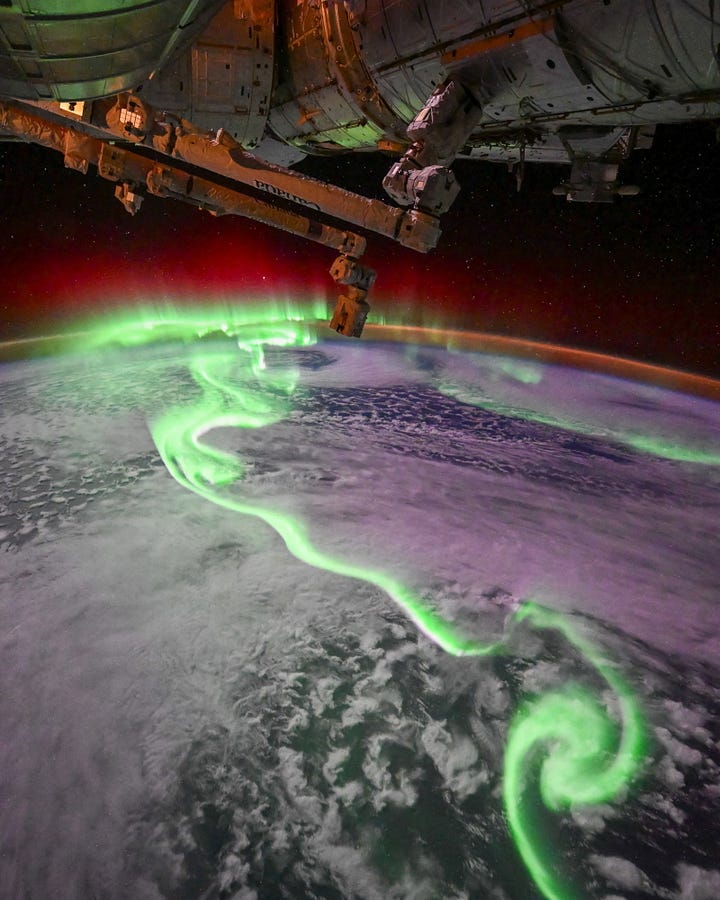


In a display that puts many Hollywood CGI blockbusters to shame, the crew of the International Space Station were amazed by a spectacular aurora from 250 miles up. The glowing effect is caused by charged solar particles interacting with Earth’s magnetic field and atmosphere. ESA astronaut Sophie Adenot said:
“This aurora was absolutely spectacular. It rippled and danced beneath our feet, as far as the eye could see, and its light was so intense that it bathed the entire Station in green reflections. We’ve had the joy of observing several since the start of the mission, but this one – far too bright for my usual aurora photo settings – left us all in awe! Moments like this never lose their magic, even up here, and the whole crew finds itself scrambling for the best spot by a window.”
"The answer has already been figured out by Nature. It's the question that scientists have to discover and define."
Claude Bernard
Weird Science Factoid
When a tree is chopped down in a dense forest, the stump can be kept alive for hundreds of years without a single leaf, thanks to a little help from its friends. Neighbouring living trees will actively pump water, nutrients, and sugar into the ‘dead’ stump to keep it going, treating it as part of the collective organism
☀️ It might not feel it this week, especially if you’re in the UK, but the Earth’s ultimate fate might not be being gobbled up by an expanding, dying Sun. The latest calculations indicate this won’t happen, although we can’t say the same thing for poor old Mercury and Venus
🍄 A new species of ‘hyperparasite’ has been found in Borneo's jungles that preys on the ‘zombie fungi’ known to infect insects before subjecting them to a gruesome death. The organism targets ants already infected by Ophiocordyceps, which manipulates the infected insect’s nervous system and makes it behave erratically before killing it and bursting from its carcass
🐸 A spectacular treasure trove of ancient fossils dating back one million years has been discovered in a cave in New Zealand - and might have cleared humans of the crime of wiping out animals willy nilly. Revealing a world long before mankind turned up with rumbling tummies, the find shows many ancient forest species, such as birds and frogs, vanished way ahead of our arrival
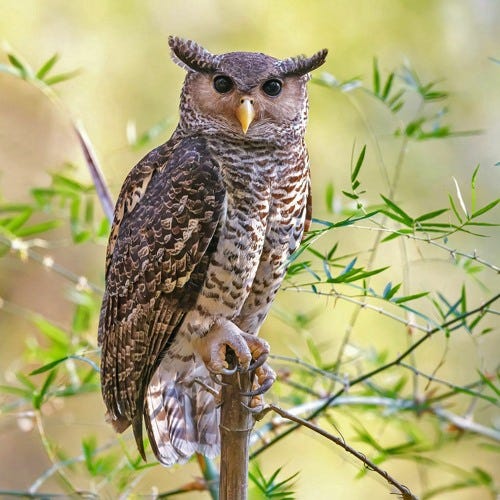
🦉 People living in Sri Lanka have long feared the sound of the ‘Devil Bird’, a human-like shriek coming from the jungle that, according to legend, means something bad is about to go down. However, scientists think they have finally tracked down the culprit of the blood-curdling scream - a spot-bellied eagle-owl, which, to be fair to the locals, actually looks a tad devilish if you ask me
😷 Evidence of the earliest known plague outbreak has been discovered by looking at the teeth of hunter-gatherers who died in Siberia some 5,500 years ago. They found evidence of the ‘Black Death’ - which returned to kill 50 million people in the 14th Century
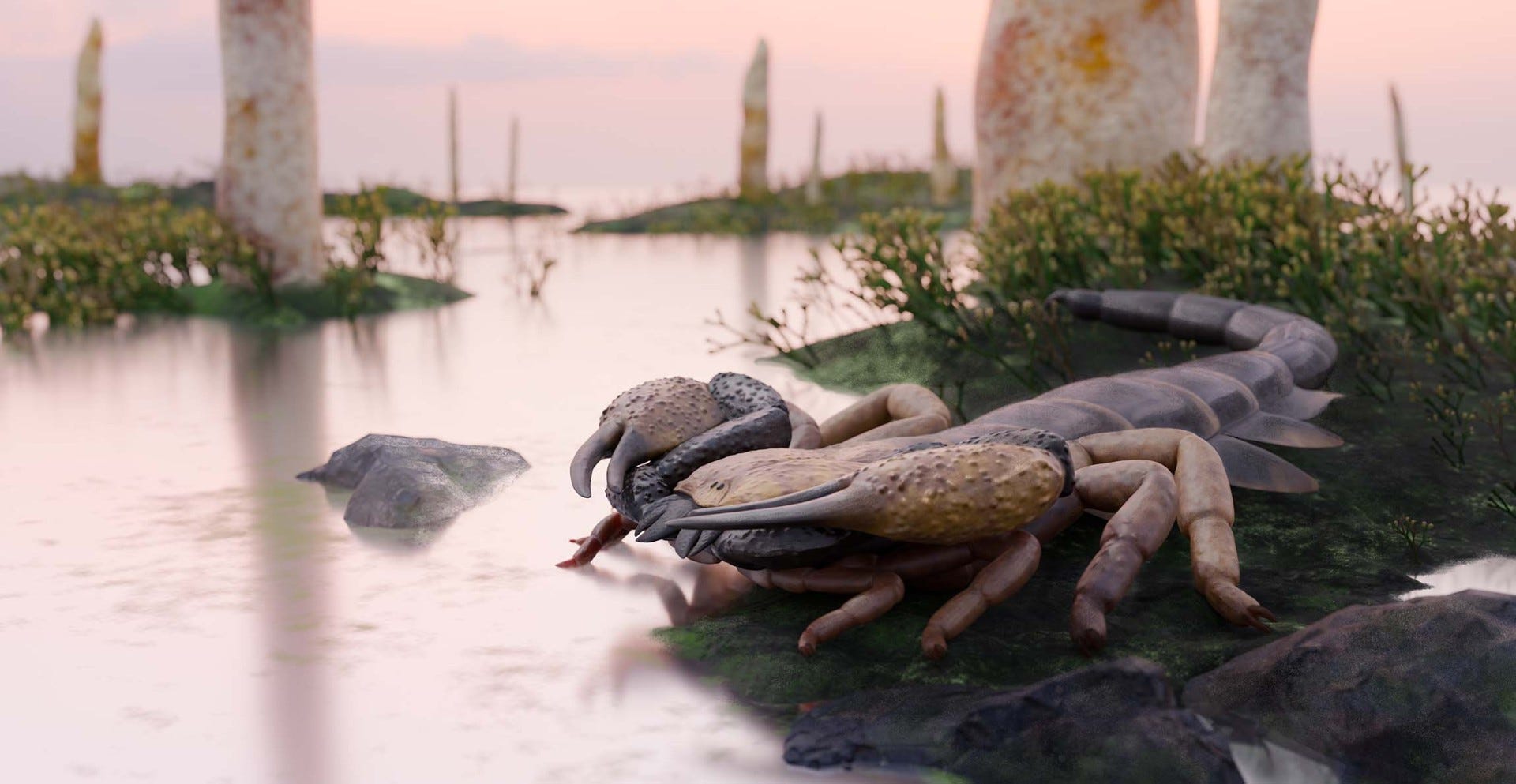
🦂 Add this one to the list of animals you are grateful you’ll never run into on a dark night - a giant scorpion more than a meter long that once ruled Earth’s flood plains 400 million years ago. The fearsome arthropod is the biggest known scorpion, roughly the size of a large dog, and boasted pincers almost 20cm in length
🐄 Climate change will be far-reaching, impacting living things all over the world - including cows. Heat stress on dairy cows will not only reduce the quantity of milk produced, but also the fat and protein content as well
Magic mushrooms
We were warned
Anne Boleyn found by AI
Scientists stunned: Unexpected baldness cure delivers results no one saw coming
‘Aztec Death Whistle’ sounds like human screams and may have been used as psychological warfare
About TWSD
Science is weird, and here’s the proof. The Weird Science Drop goes where other, more-sensible newsletters fear to tread. Every week, we grab our trusty white lab coat, bunch of bubbling test tubes and world-ending robot prototype to go in search of the overlooked, under-the-radar and, above all else, most madcap science news, views and research.
Daniel Smith is an ancient experienced journalist who has worked for a host of news publishers on both sides of the Atlantic. A long, long time ago, he fancied himself an astrophysicist but turned out to be the worst scientist since the man who mapped all those canals on Mars, which turned out to be scratches on his telescope’s lens. Luckily, he is not working on the Large Hadron Collider, inadvertently creating a black hole that would swallow the world by pressing the big red button, but is safely behind a desk writing this newsletter, bringing you the fantastical underbelly of nature... The Weird Science Drop.
No posts
Comments
Nothing yet. Say the first thing.
Sign in to join the conversation.