

“Irasshaimase* to the latest sample of strange science. The end of the universe will one day happen, but it’s usually not something we need to pay much attention to, as we’re not going to see it. But, after thinking about it really hard, an alarming possibility has come up that the beginning of the end could kick off while you read this. Also this week: archaeology dig unearths Ark clue, Antarctic sea creatures could cure cancer, and how long it took to grow a T Rex. As ever, please like/subscribe. Thanks!”
Daniel
* Welcome in Japanese
🌌 There are a few ways the universe will one day come to an end; there’s (probably) no escaping it, and the chances humans will still be around to worry about it are slim at best. However, dig deep into the seemingly magical world of quantum physics, and you can make the case that all this could collapse this afternoon or tomorrow morning, or Tuesday next week.
You may have heard of the Big Crunch, or the Big Freeze, or even the Big Rip, all ways that the universe will meet its ultimate fate. But these scenarios are billions of years into the future. So nothing for us to worry about.
However, there is another scenario. One that could happen at any time. Theoretical types have floated the idea that the universe could fall apart without warning, rewriting the laws of nature in a sweeping bubble racing at the speed of light.
The concept relies on the Higgs boson - the so-called ‘God particle’ that gives matter its mass. Strap yourselves in for this one: The boson is a measurable ‘ripple’ in the invisible Higgs field, and this field exists in a ‘false vacuum’ state that could decay.
If that happened, the familiar building blocks of matter would no longer hold together, and all hell would break loose. As Peter Venkman once put it: “Human sacrifice, dogs and cats living together - mass hysteria!” You get the picture.
The only way to find out how precarious - or stable - our cosmic situation really is, is to make sharper measurements of the Higgs boson itself. Its properties could literally hold the fate of the universe. Read more on End Time Headlines
🧬 Ancient human DNA that could be 17,000 years old has been found in a cave that has been sealed off from the outside world for several millennia. In a world first, researchers have extracted evidence of humans and animals directly from rock art found in Portugal’s Escoural Cave.
The team couldn’t date the DNA precisely due to its scant quantity, but say it’s at least 2,000 years old and likely much older; Escoural has been sealed off to the outside world for around 5,000 years.
Early genetic hints suggest the samples likely came from women and one from a man, and some align with western hunter-gatherer groups that lived between roughly 5,200 and 16,700 years ago.
Scientists argue the method could finally let them probe who made the art, how caves were used, and whether different figures on the same panel were created by one hand or many. Read more on The Smithsonian

An archaeology dig in the Palestinian West Bank has turned up ruins researchers say could be tied to the Ark of the Covenant - the gold‑covered chest said to have held the Ten Commandments. You know, Indiana Jones and all that…
The Associates for Biblical Research reports fresh finds at the biblical site of Shiloh - where the precious Tabernacle, a portable sanctuary that contained the Ark, stood for more than 300 years - strengthen the case that a large structure there matches the size and layout recorded for the ancient refuge.
The latest breakthrough is a newly uncovered southern wall, a key piece that lets the team chart the building’s full footprint. Running east to west, the layout aligns with biblical descriptions of the movable centre of worship said to have been built after the Israelites’ Exodus from Egypt.
Ritual‑related finds have also been unearthed near the structure: ceramic pomegranates, altar horns and murex shells - the latter used to produce the blue dye associated with priestly garments mentioned in the Bible.
The Ark of the Covenant vanishes from the biblical record before the Babylonian destruction of Jerusalem in 586 BC, and its fate remains one of antiquity’s great mysteries. Although we all know it’s in the great big warehouse. Read more on Sky News
🖥️ China has reclaimed the supercomputing crown from the US thanks to the new LineShine machine - a system that can carry out two quintillion calculations a second. The country is back on top after a wait of almost 10 years, after LineShine overtook the United States’ El Capitan to take the number one spot.
Two other US machines at national labs in Tennessee and Illinois come next, with Germany’s Jupiter system now in fifth place. Those five are the only publicly verified computers worldwide capable of handling ‘exaflops’ of data.
LineShine runs entirely on conventional CPUs (with more than 300 cores) rather than the GPU-heavy designs common in AI systems, and draws about 42.2 megawatts of power.
You might ask what China is using its super creation for? It’s used to perform high-speed calculations, modelling, and, errr, artificial intelligence research. Not sure if that's carrying out our research using AI or researching even smarter AIs that will one day rule us all. Read more on AP News
🌡️ This will come as no surprise to anyone living this side of The Pond after a searing heatwave and with another on the way, but Europe is officially the world’s fastest-warming continent. While the planet is around 1.4°C hotter than in pre-industrial times (1850–1900), Europe is roughly 2.4°C warmer, says the EU’s Copernicus Climate Change Service.
Scientists point to several drivers: land warms faster than oceans; shifts in atmospheric circulation are fuelling more frequent, more intense summer heatwaves; and persistent high-pressure systems are becoming more common over Europe.
Geography also plays a role. Europe is linked to an Arctic that’s about 3.2°C warmer than pre-industrial levels. As bright snow and ice retreat, darker land and sea absorb more heat - a relentless feedback loop that accelerates warming.
Ironically, another factor is cleaner air: tighter pollution rules since the 1980s have cut aerosol particles that once helped cool the region slightly by reflecting sunlight, inadvertently removing a short-term brake on rising temperatures. Read more on Slashdot
🌊 In more concerning environmental news, the planet’s oceans are at unprecedented temperatures for this time of year, breaking the all-time June record, with scientists admitting we’re entering ‘uncharted territory’. Hotter oceans keep the air warmer, fuel heat waves; make storms fiercer, and boost the chances of extreme rainfall and flooding
👋 Hello, fellow science geek. If you’re enjoying this newsletter, it would really help me if you could spread the word. Simply forward this email to a friend, and they can sign up here or click the share button below.
What’s Up, Doc?
⏲️ Scientists have discovered a rare genetic condition which causes people to age at a much faster rate - and could help develop age reversal medicines. Researchers believe the ‘biological clock’, which ticks in every cell of the body, could lead to potential breakthroughs on how to slow ageing and prevent diseases that occur in old age
👶 We’ve uncovered a master gene that switches on human development and results in cells forming a human body. Its role has been identified by making little changes to the DNA of fertilised eggs, and could lead to boosting the success rate of IVF
👁️ A parasite found in one in three unwitting people has been found to be a serious risk to human health. Most people infected by the Toxoplasma gondii parasite will know nothing about it, but for some it could lead to eye problems and even blindness
🫑 The Mediterranean has long been heralded as the one to follow if you want to live to a ripe old age. And now a 20-year study of thousands of Greeks has backed this up. Chomping down on a Med-style, plant-based diet cuts heart disease risk by a quarter
👴 Kids are growing up fast these days - maybe too fast. A new study suggests that more recent generations are biologically older than earlier generations were at the same age. This might explain why some cancers are on the rise among younger people
👀 Blind people have been offered fresh hope of seeing again after lab-grown cells restored retinal function in mice. The breakthrough shows promise for new eye therapies after stem cells were used to grow specialised blood vessel cells critical to retinal health for the first time
☀️ Bacterial toxins produced by tiny Antarctic sea creatures could be key to treating melanoma, the deadliest form of skin cancer. A six-week expedition to one of the world’s remotest regions came back with what could be valuable samples of ascidians, invertebrates known as sea squirts that thrive in the icy waters
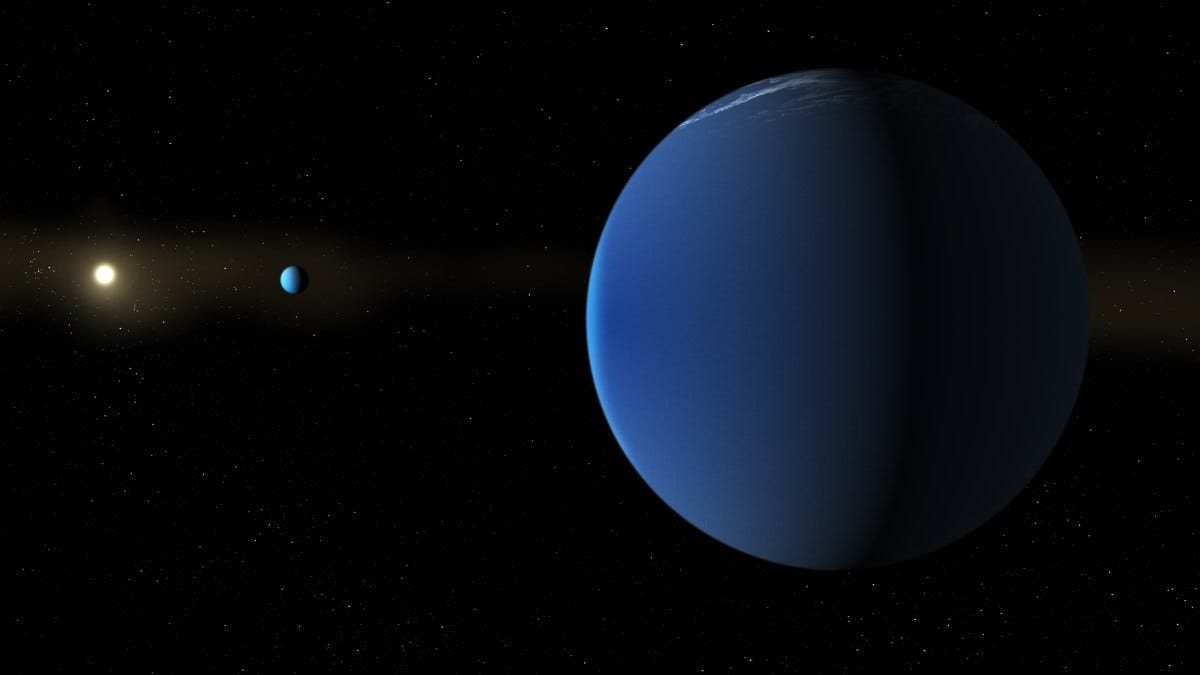
Astronomers have uncovered two of the puffiest ‘candyfloss’ worlds ever seen, each about the size of Jupiter but with densities so low they’d drift off on a breezy day. The planets, named TOI-791 b and TOI-791 c, circle a Sun-like star roughly 1,110 light-years away in the southern constellation Volans.
Despite their large girth, the planets are astonishingly light: estimates put their densities at around 0.038 and 0.047 grams per cubic centimetre, well below candyfloss.
Their extreme puffiness hints at vast, hydrogen-helium atmospheres and poses a headache for current theories of how giant planets form and evolve. Scientists say the James Webb Space Telescope could soon sniff out the chemistry of their bloated skies, offering fresh clues to how such airy giants are born and migrate.
🔵 Closer to home, our local ice giants Uranus and Neptune might be hiding secret magma oceans deep within. According to new computer modelling, rather than a thick layer of water, ammonia and methane ices beneath a hydrogen–helium sky, you’d find vast. searing hot seas of molten silicates, iron and hydrogen

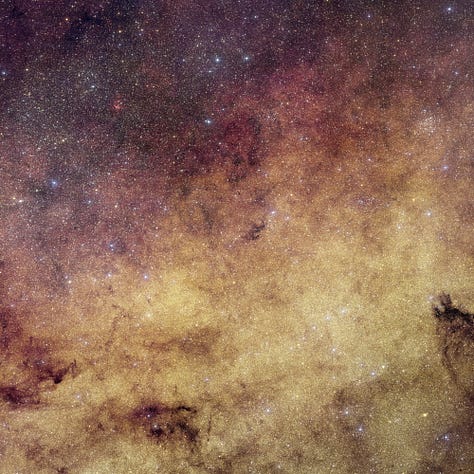
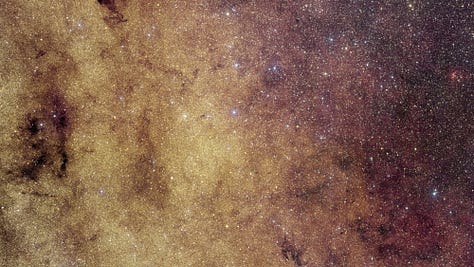
Space scientists have taken the largest and most detailed photo ever made of the Milky Way’s centre - packed with more than 60 million stars. The European Space Agency’s (ESA) Euclid mission captured the enormous photo in about 26 hours: a mosaic of nine ‘pointings’ from its visible-light camera, each covering a patch of sky larger than the full Moon.
ESA says this crowded region of our galaxy is the perfect place for astronomers to search for exoplanets with a technique called microlensing. This is when a massive object passes in front of a more distant star, and its gravity briefly bends and magnifies the star’s light as seen from Earth.
"We are an impossibility in an impossible universe."
Ray Bradbury
Weird Science Factoid
Deep beneath Earth's surface lies a massive, hidden ecosystem known as the Deep Biosphere. Scientists estimate that the total mass of microbes, bacteria, and archaea living miles underground is up to 245 times that of all human beings combined. They survive in extreme heat and pressure, essentially eating rocks and breathing radioactivity.
🪐 The Moon? Mars? Scientists have bigger plans than that and have started mapping out a crewed mission to the huge Saturn moon of Titan. The mini world boasts a dense atmosphere as well as rivers, lakes, weather, dunes and complex chemistry
☄️ The ancient alien comet that zoomed through our solar system last year boasted chemistry unlike anything seen in our neck of the woods. By analysing the tail of interstellar intruder 3I/ATLAS, we now think it could have been formed 12 billion years ago, not long after the Big Bang
💤 Scientists have uncovered the physical signs of lucid dreaming in people with trauma symptoms. The findings offer evidence that the characteristics of a person’s sleep cycle are closely connected to their conscious awareness during dreaming - allowing them to control their dreams Freddy Kruger style
🦖 The terrifying Tyrannosaurus rex took its time when growing up - 40 years to be precise, until it became a fully mature adult, and eight tons of mighty eating machine. As they spent so much time in adolescence, it is now thought that the young T rex occupied a different ecological niche before it became the apex predator we all know and love
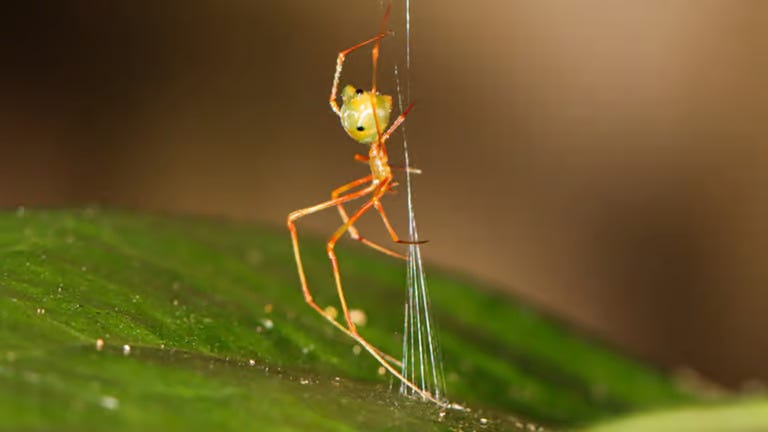
🕷️ A ‘ballista spider’ has been found that uses a spring-loaded web trap to launch prey at 140x the force of gravity. Found in Australia (surprise, surprise), the arachnid was observed targeting green tree ants with the biological catapult
🪨 Our planet’s oldest known asteroid impact on Earth can be found in Western Australia - only a stone’s throw away from where we've seen the oldest traces of life on our planet. The chunk of rock smashed into the Earth’s newly-formed crust around three billion years ago, leaving behind crystals that we can still see today
Can you learn charisma?
Charisma is tricky to define, but we all know it when we see it. When I think about this, I always go back to Steve Jobs vs Bill Gates. Jobs was cool, Gates is not. No matter how successful and rich Gates became, he could never hold a candle to his arch-rival when it came to pure pizzazz. It must have driven him crazy.
Magic mushrooms
We were warned
Steve Jobs and Bill Gates sit down for a chat - but it’s clear which one has charisma
Scientists stunned: Unexpected baldness cure delivers results no one saw coming
About TWSD
Science is weird, and here’s the proof. The Weird Science Drop goes where other, more-sensible newsletters fear to tread. Every week, we grab our trusty white lab coat, bunch of bubbling test tubes and world-ending robot prototype to go in search of the overlooked, under-the-radar and, above all else, most madcap science news, views and research.
Daniel Smith is an ancient experienced journalist who has worked for a host of news publishers on both sides of the Atlantic. A long, long time ago, he fancied himself an astrophysicist but turned out to be the worst scientist since the man who mapped all those canals on Mars, which turned out to be scratches on his telescope’s lens. Luckily, he is not working on the Large Hadron Collider, inadvertently creating a black hole that would swallow the world by pressing the big red button, but is safely behind a desk writing this newsletter, bringing you the fantastical underbelly of nature... The Weird Science Drop.
No posts
Comments
Nothing yet. Say the first thing.
Sign in to join the conversation.