
Every day, thousands of drivers en route to New Haven, or heading in the opposite direction, pass the Mount Carmel Burying Ground in Hamden, Connecticut. There is no indicator on the shoulder of Whitney Avenue that on the opposite side of a little fence, behind neat rows of Revolution-era headstones interspersed with more recent graves, a literary legend lies at the foot of a mountain aptly called “Sleeping Giant.” Grass has begun to creep over the edges of his stone, which is nestled among siblings and parents and now says “Thornton Wilde,” an accidental nod to another giant. There are no mentions on this marker, or the larger slab that lists all family members interred there, of his three Pulitzer Prizes, seven novels, and dozens of plays, including the one many consider to be the best an American has ever produced.
“You know as well as I do that the dead don’t stay interested in us living people for very long,” Thornton Wilder wrote in Our Town.1 “Gradually, gradually, they lose hold of the earth…and the ambitions they had…and the pleasures they had…and the things they suffered…and the people they loved.”
And what’s left when memory’s gone, and your identity, Mr. Wilder?
When Washington’s Shakespeare Theatre Company mounted Our Town in the spring of 2022, the American theater and I were reeling from a lengthy shutdown induced by the COVID-19 pandemic. I was unprepared for what I saw that night, my memory of the play, like so many others, tinted with a rosy sentimentality. But after two years of being shut in, kept apart, on alert, and changed by fear, Wilder’s clarion reminder of the preciousness of time and connections between people walloped me. In the following days, I read the play over and over, hoping to make sense of what we had been through with the wisdom found between its pages.
What struck me most was how familiar those singular characters sounded. I heard my parents, my teachers, my neighbors, and friends in them. In Grover’s Corners, I saw the farms and streets of Central Pennsylvania, where I was raised. In the cemetery above the town, where “a whole mess of Gibbses and Herseys,” are laid to rest, I envisioned the mossy headstones of my people, whose surnames are now middle names for cousins who don’t know where the names came from; people whose stories are lost to time.2 How did he know us? I wanted to know him, too.
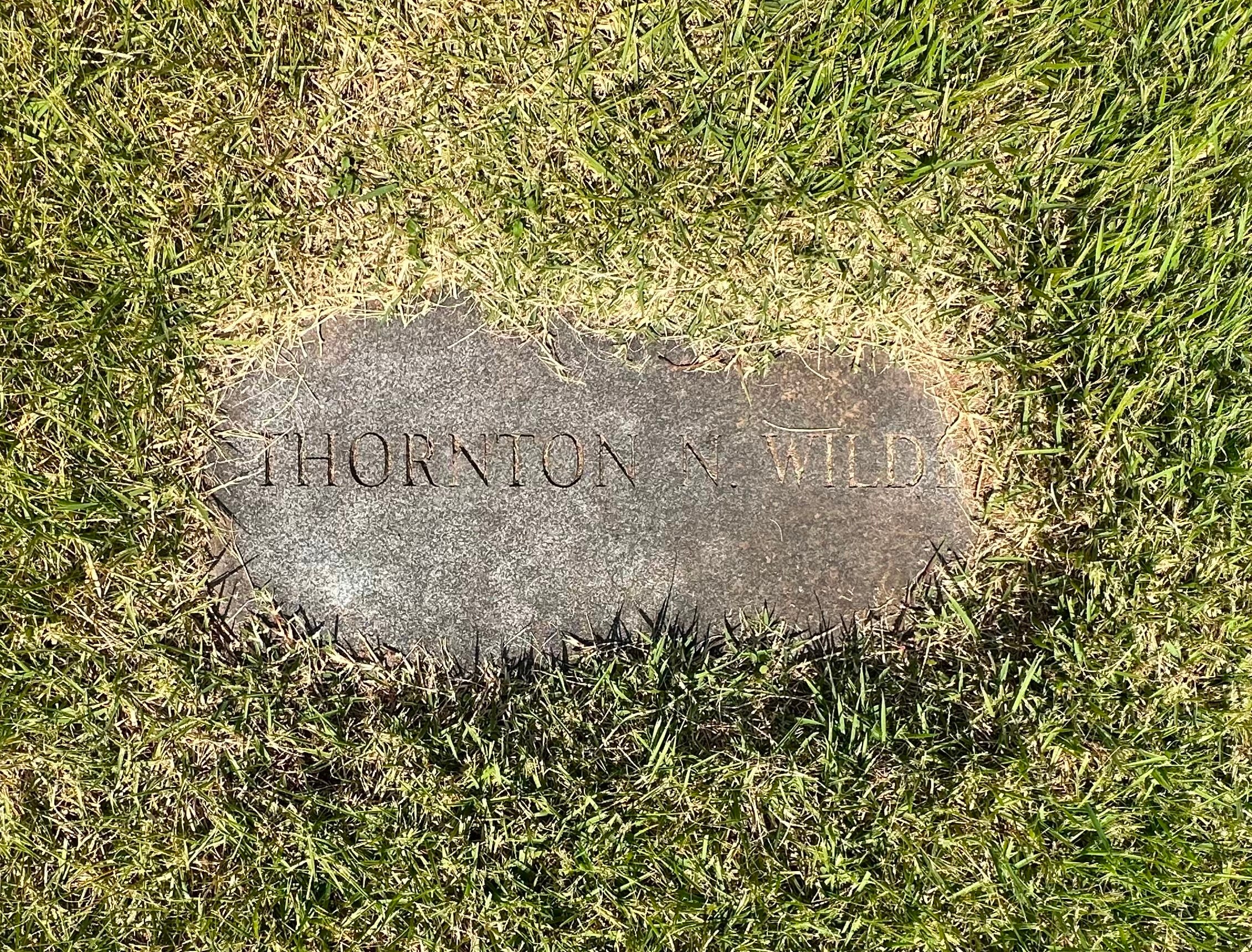
There are rumors in my family of a cousin named John: that he had a male lover; that he knew Wilder. Their lives tracked closely, but separately, both traveling to Europe as young men, meeting and idolizing Gertrude Stein, writing stories, and living with their mother and sister. And when they died, they both ended up back at home, the dirt of the world on their shoes, beneath stones that betray the wandering lives they led.
John was born in 1906 and died in 1962, a life lived entirely in the time of Thornton Wilder. The only physical evidence I have of him, apart from his headstone, is an old photograph, an envelope addressed to him from a publisher at Doubleday, and a 1950 census record that shows him cohabitating with the man my great-grandmother thought to be his lover. The rest of his story hangs on hearsay and rumor. I don’t know of anyone still alive who knew him. As a younger man, I sought confirmation of those rumors, hopeful that I was not the first or only gay man in my family. My research yielded few results and no confirmation. But just because I can’t hold the answer in my hand, it doesn’t mean he didn’t live, or feel, as I do.
Among the many differences between John and Wilder is that the tangible pieces of Wilder’s life—manuscripts, drafts, journals, and correspondence—are largely organized and accessible to the public at Yale’s Beinecke Rare Book and Manuscript Library. His papers have been compiled into books and biographies, and he has been quoted and examined extensively in essays and academic papers. But his story is also marked by rumors, like so many men of his generation, that stretch back longer than he has been gone.
“Opinions diverge as to whether a writer’s sex life is a legitimate field for public examination unless it serves as subject matter and/or thematic matter for the artistic work, or unless it has, with the writer’s complicity, emerged into public view as a defining force in the life and work,” says Thornton Wilder: A Life author Penelope Niven, encapsulating a prevailing attitude of ambivalence.3 “A very private man who often saw his fame as an intrusion into his personal life, Thornton Wilder seems to have studiously kept to himself the details of his sexual experiences, whether homosexual or heterosexual or both.”
At worst, such an attitude maintains that sexual orientation—and especially gay identity—hinges definitively on consummated sexual intercourse between two individuals of the same gender. At best, it innocently overlooks romantic yearning, unconsummated attractions and infatuations, and relationships that transcend friendship or mentorship. In either case, it fails to recognize same-sex attraction, or gayness, as an inherent, sustained, dually physical and emotional experience; it fails to dignify intimacy.
“That’s why I write fiction and plays instead of essays and poems,” he wrote in a letter to a friend in 1926. “The things I have to say are so intimate that I would be ashamed to publish them under I and so pour them into men, women and children.”4
Wilder’s work and letters reflect an intimacy that, in its richness, must have been a defining force in his life and work. In ignoring it, or limiting the bounds of how we consider it, have we impeded our own understanding of the man and his work? In our deference to a man who’s been dead fifty years, or outdated cultural norms and niceties, have we inadvertently perpetuated the forces that would have made same-sex relationships and literary success incompatible during his life? If Our Town truly is the greatest American play, as Edward Albee said, what does it mean to our national identity that its writer was probably a gay man?
The prevailing question on this matter has been, Was he? The purpose of this short collection of essays is to ask, What if he was?
In the first essay, I examine how Wilder’s biographers have approached and addressed the rumors of, and hints at, same-sex attractions in his youth and adulthood. The second considers two pivotal characters in Our Town—the Stage Manager and Simon Stimson—and Cousin Brandon from the one-act The Long Christmas Dinner as proxies for their writer. And the final essay contemplates Thornton Wilder’s relationship to gender, his father, and The Matchmaker’s Dolly Levi, who in her rejoining of the human race has captured the imaginations of gay men and their icons.
History is full of Thorntons and Johns. The ground is peppered with their modest headstones that obscure the lives they lived, as themselves and through fictional others; people who have “[lost] hold of the earth,” but nonetheless once had ambitions, pleasures, sufferings, and people they loved; people who left behind questions to be asked, and answers to be sought.5
This post is part of a larger collection, A Walk on The Wilder Side: A Queer Reading of Thornton Wilder, available on Substack and to view here:
Download the full PDF version of the report by D.R. Lewis here.
Read the next section, Part One: The Intimate Wilder, on Substack here.
Wilder, Thornton. 2020. Three Plays: Our Town, the Skin of Our Teeth, and the Matchmaker. N.p.: HarperCollins Publishers. 90.
Niven, Penelope. 2012. Thornton Wilder: A Life. First ed. New York: HarperCollins, 433.
Wilder, Three Plays, 90.
Quotations and excerpts from The Angel That Troubled the Waters and Other Plays © 1928, The Merchant of Yonkers © 1939, The Journals of Thornton Wilder, 1939-1961 © 1985, Wilder’s Classic One Acts © 2011, Three Plays: Our Town, The Skin of Our Teeth, and The Matchmaker by Thornton Wilder Reprinted by arrangement with The Wilder Family LLC and The Barbara Hogenson Agency, Inc. All rights reserved.
Thornton Wilder: A Life by Penelope Niven © 2012. Reprinted by arrangement with Jennifer Niven and The Barbara Hogenson Agency, Inc. All rights reserved.
To learn more about Thornton Wilder, visit www.ThorntonWilder.com
No posts
Comments
Nothing yet. Say the first thing.
Sign in to join the conversation.