
Pardon the quiet, but I’m just waking up from a long winter’s nap. We’re still digging out of last week’s snow (this being DC, and all), but hot takes are ahead in hopes of accelerating the thaw. As always, thanks for reading. <3
There are a few actors who, as a rule, I will not miss the opportunity to see. If they’re on stage, my booty is seated, and Tracy Lynn Olivera is one of those actors. I remember first seeing her in Ford’s Theatre’s 2013 production of Hello, Dolly! (with Nancy Opel in the title role) and melting for her Irene Molloy (“Ribbons Down My Back” often hits like a dirge, but Olivera’s was all delight). There’s been Ragtime, A Funny Thing Happened on the Way to the Forum, Next to Normal, A Little Night Music, and many others since then, though her Lizzie in 110 in the Shade a decade (!!!) ago remains a highlight among my theatre memories.
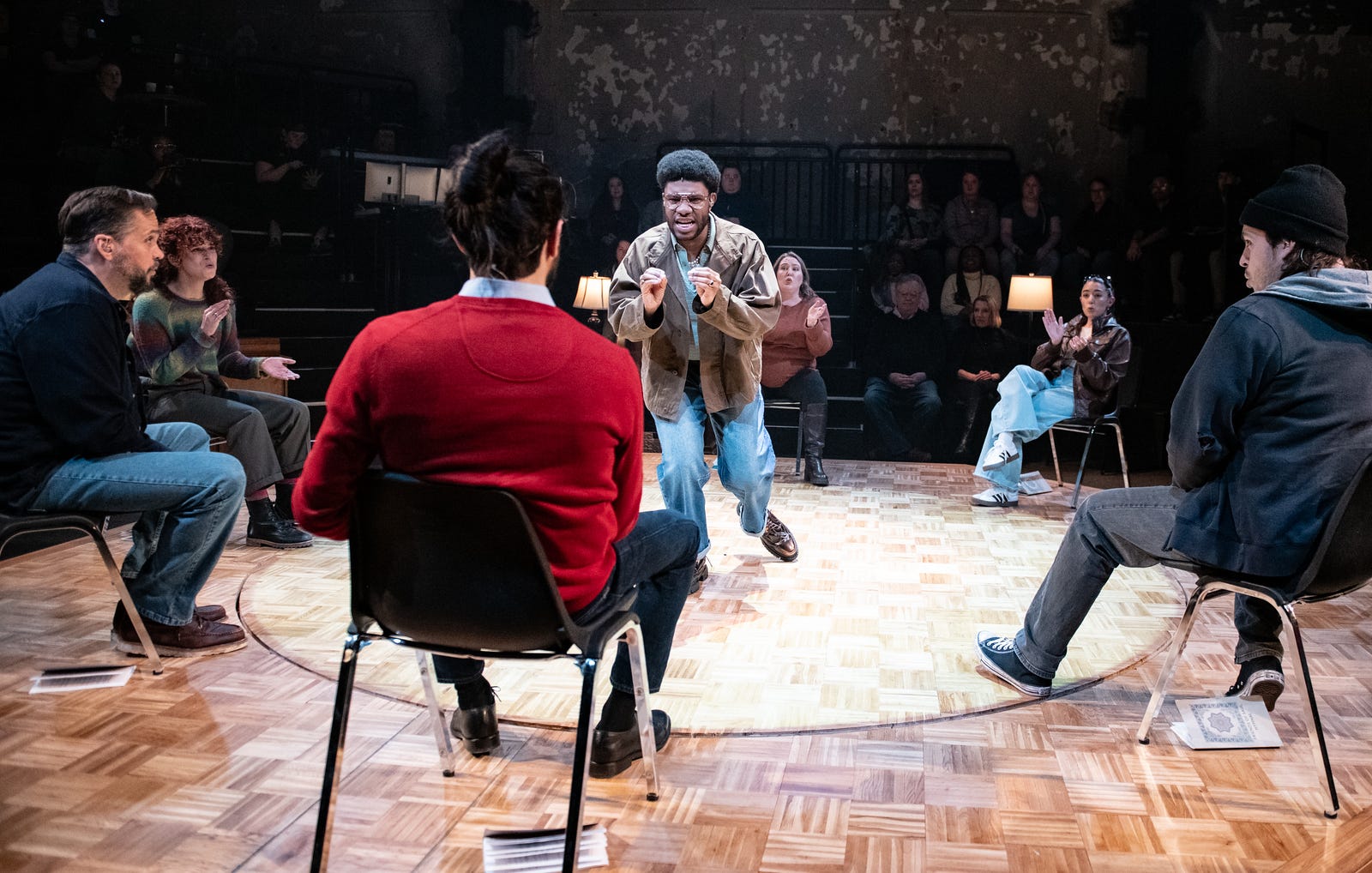
She’s delivering again in Dave Malloy’s a cappella musical about “digital dependency,” Octet, playing at Studio Theatre through March 8. Here, she’s Paula, the facilitator of a support group for phone addicts eager to free themselves of “the monster” and all that’s within it. Paula’s big number is “Glow,” a lament of her husband’s distraction in bed, as he strokes the screen rather than her. It’s a beautiful song and a stellar rendition, and Olivera is joined by an extraordinary cast of singers who each recount how the devices have stolen their attention or pieces of their humanity.
That’s a potent concept for a musical and Malloy’s score is chock full of witty lyrics and tight harmonies (with a structure that reminded me of A Chorus Line). But Octet largely adds up to the sum of its parts. We cannot rely on a single composer to tell us how to solve such an existential crisis of attention, but Octet hardly even tries. It’s essentially a 100-minute screed that is more charming and better constructed than the kind of message board bloviation many of the characters rail against. But when it comes time for blame, Malloy points all eighty onstage fingers at the tech creators and those of us who cradle the devices in our hands. The irreverent lyrics and pretty music only partly cover up what Octet essentially is: a scold. And though I’m not here to judge anyone else’s masochism, I could have done with a little less of that. But maybe I’m in denial; as soon as I left the theatre, I purged a few of the time-sucking apps from my phone (not Substack, of course).
Last month, I published A Walk on the Wilder Side: A Queer Reading of Thornton Wilder right here on The Sunday Critic. The project consists of a few essays that consider the Our Town playwright’s life and work through a queer lens. It was produced with support from the American Theatre Critics/Journalists Association and Foundation ATCA’s Terry Helbing Fellowship. If you missed those pieces, here they are:
Eugene O’Neill’s Anna Christie is more than a hundred years old, but in relation to Sophocles’s Oedipus, it’s practically as new as Oh, Mary. Unfortunately, Thomas Kail’s production at Brooklyn’s St. Ann’s Warehouse seems to have misguidedly adopted the same directorial imperative as Cole Escola’s play to affect the whole thing to maximum tilt. I like O’Neill’s work, but I am not protective of it, and especially not of Anna Christie, which ranks low on my favorites list. But what drew Kail to Anna Christie—which has a Minnesota prostitute (Michelle Williams) seeking out her seafaring father (Brian D’Arcy James) and finding love-ish with rowdy sailor (Tom Sturridge) who is repulsed by her past—is beyond me. It is over-directed within an inch of its life and to the degree that I’ve been grappling with my own notions of O’Neill’s body of work ever since. Until this, I’d have said the plays are a little stiff, but with just a touch of honesty, attention, and endurance, anyone can make them sing, even at their most dialectal, like Anna Christie. But Kail’s production is so puffed up with bluster, so bogged down by meaningless scenic rearrangements, and so concerned with being taken seriously (to the degree that it’s almost goading), he has made a caricature of the American theatre’s original realist.
I can hear the coming accusation that I’m too hard on Anna Christie, and maybe I would be less so if I hadn’t also seen Robert Icke’s superb adaptation of Oedipus the following afternoon. Icke gets the benefit of complete adaptation, whereas Kail has remained faithful to the play’s original time and text. But let’s not forget the wackiness at the heart of Oedipus’s dilemma: an upstart king fulfills a prophecy that has him kill his father and marry his mother, Jocasta, and when all comes to light, she ends her life while Oedipus gouges out his eyes. Not exactly modern realism! But Icke does real work by recasting Oedipus as a British politician (Mark Strong) on the night of an election he is widely expected to win. His promise to release his birth certificate and reopen an investigation into the death of a former leader, whose widow (Lesley Manville) he’s married, sets his downfall in motion. As secrets come to light, he barrels toward ruin in real time. Icke’s adaptation evokes enough real-life political figures to ground the piece in spite of its quirkiness, and knowing that most of us know how it will end, he peppers the text with ironic quips that ramp up the cringe factor of the soon-to-be-revealed mother-son relationship. Oedipus grows more childlike and Jocasta more maternal (Manville shines and plays up these moments without mugging), and by the end, he goes so far as to blackout the theatre and distort the sound to simulate a womb. The technical tricks (including a clock that counts down in front of the audience) are great fun, but it’s Icke’s attention to tension and steady hand that ultimately carry the play to a landslide victory.
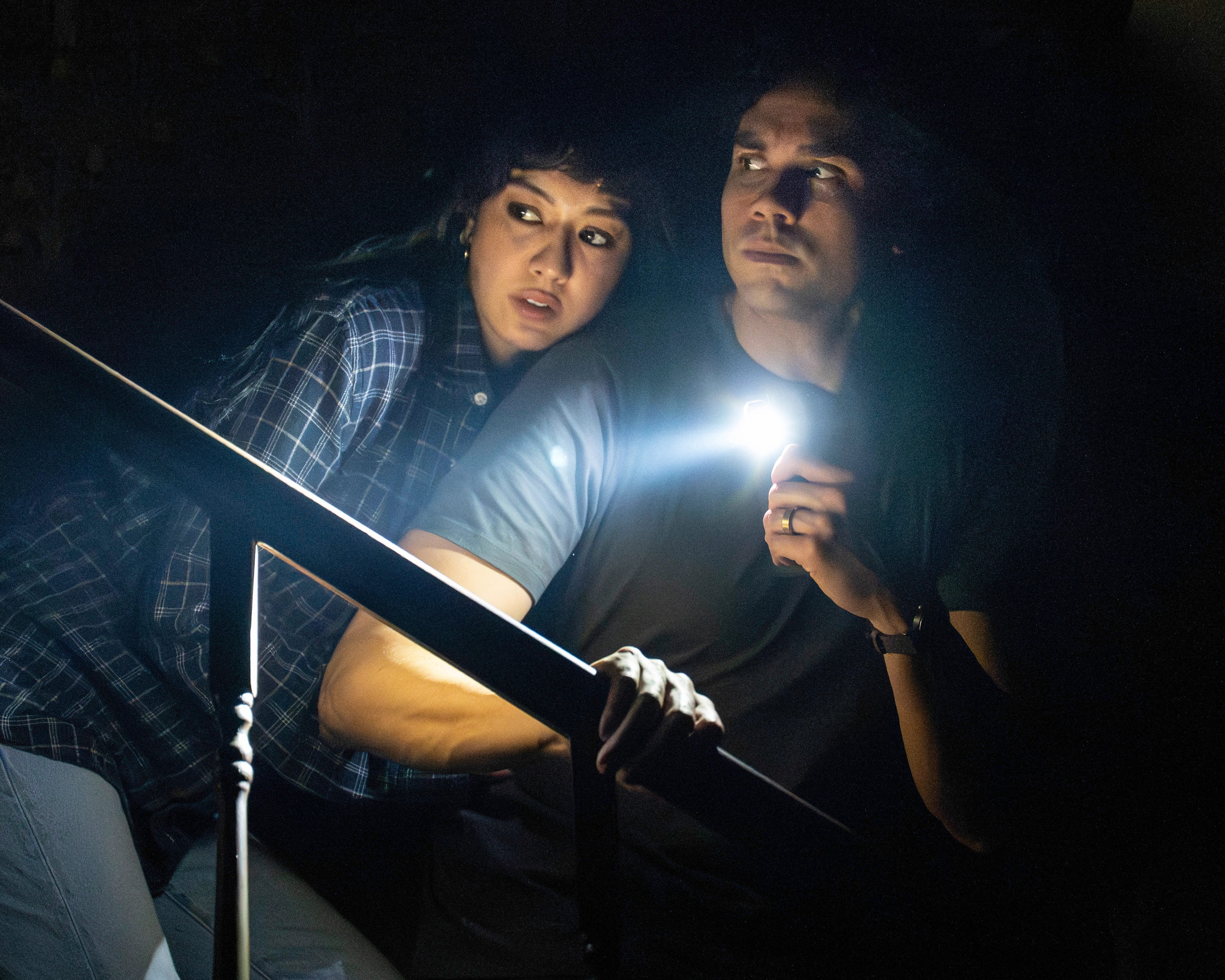
You should know that I am not the target audience for Paranormal Activity, a stage adaptation of the Paramount Pictures movie franchise running at Shakespeare Theatre Company through February 7. I am a wimp, a wuss, a weenie, with a time-tested talent for weaseling out of movie nights with even a whiff of public fright. But more so, I am a sucker for spectacle, and this Paranormal Activity — which leans heavily on illusion and ambient creepiness instead of the “found-footage” format of its film iterations — is a horror hoot. Read my full review for DC Theater Arts here.
I don’t subscribe to Louis Black’s notion that February is the most miserable month of the year (DC residents know that’s August, when the humidity peaks), and certainly not to his aversion to Valentine’s Day. I love love! We should all love love! So in the lead-up to that special day, here are two favorite songs for the single, starry-eyed gals like me:
The Music Man’s “My White Knight” is, by my measure, the single most romantic song in the American musical theatre (sorry, Julie Jordan; get lost, Nellie Forbush). Meredith Willson’s shatteringly simple lyric outs the outcast Marian—a purported gold-digging prude—as a person who just wants a decent, real guy who appreciates a few of the same things she does. A girl can dream! Every line is a miracle, but when I sing along to the original cast album, my voice always catches on this one: “And I would like him to be more interested in me/Than he is in himself/And more interested in us than in me.” *3x crying emoji* There will never be another like Barbara Cook, whose performance of the song (as with so many of her recordings) is, was, and always will be the definitive.
Marc Shaiman is in the midst of a media blitz for his autobiography, Never Mind the Happy, which raked an old Theatre Talk interview to the top of my YouTube feed. In it, he mentions Peter Allen’s “Six-Thirty Sunday Morning,” and I paused to listen…then again…and again…and again. A medley with “New York I Don’t Know About You” from his Taught By Experts album has emerged as my preferred recording and, in pairing them together, Allen paints a picture of a man wandering Central Park feeling sorry for himself on a rainy Sunday morning following a long Saturday night out. The lugubriousness of the original sad-ass standalone song melts into a jaunty, jazzy tempo, where sadness searches for responsibility: “Cheap wine, cheaper love/Don’t make waking up easy/And this is the day you chosе to be gray/New York, I don’t know about you.” Allen’s voice is tinged with defiance before he finally reaches revelation: “There’s too many dancin’ partners/Just try and get one alone, lone, lone, lone/But when you make out on the one-way subway/It’s better if you’re on your own.” The man is tired of the ride. He’s ready to get off. But for five minutes and five seconds, we get to take it with him, and what a pleasure it is.
No posts
Comments
Nothing yet. Say the first thing.
Sign in to join the conversation.